
DRIFT AUDIO
Listen to this story
Choose a voice, then press play.
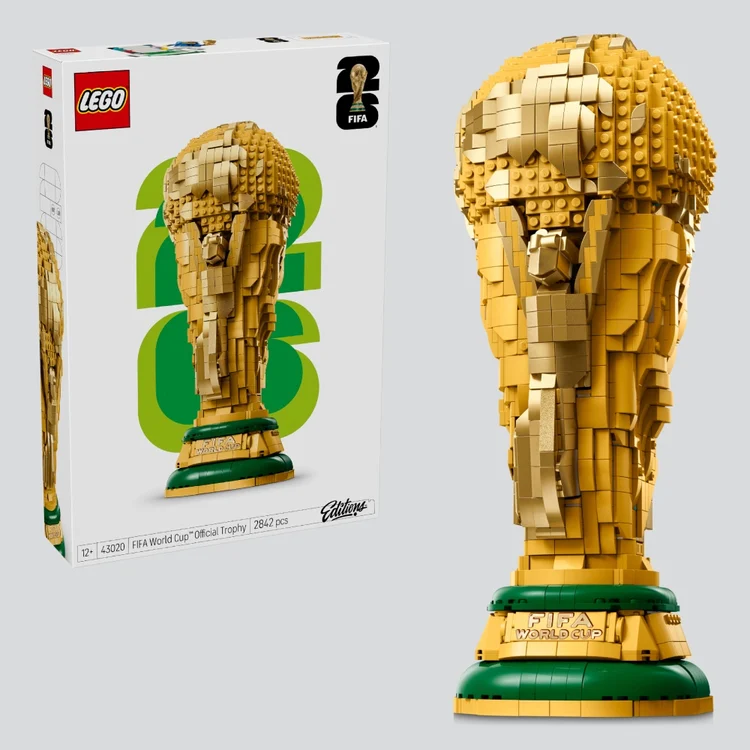
In a move that blends nostalgia, global sports culture, and the irresistible tactility of brick-built craftsmanship, LEGO has revealed a buildable replica of the iconic FIFA World Cup trophy—just months before the world’s biggest sporting event lands across the United States, Mexico, and Canada in 2026. The release positions LEGO not only as a maker of childhood wonder but as a storyteller of cultural landmarks, distilling the emotional weight of the World Cup into a collectible form that resonates with fans of all ages.
a trophy
Few silhouettes in modern culture are as instantly recognizable as the FIFA World Cup trophy: the sweeping upward motion of two human figures, the globe rising above them, the promise of unity, competition, and global drama embodied in a single form. LEGO’s buildable version respects that symbolism rather than merely imitating it. Standing proudly on a brick-built pedestal, the model uses carefully selected gold-toned elements and subtle shaping techniques to capture the fluid movement of the original design, which has been awarded to every World Cup winner since 1974.
In true LEGO fashion, the set isn’t just a display piece—it’s a celebration of construction. Layer by layer, fans re-enact the ritual of creation, echoing the way nations prepare, advance, and ultimately chase glory. For collectors, the set opens the door to a new kind of sports memorabilia, where physical engagement becomes part of the storytelling.
anticip
The timing of this release is no coincidence. As preparation for the 2026 FIFA World Cup accelerates, every partner brand is vying for a cultural moment. LEGO, however, approaches the tournament from a narrative angle—leaning into the global sentiment of anticipation and the multi-city energy that the expanded tournament promises. With 48 teams, 16 host cities, and a continental footprint, 2026 is expected to become not just a tournament but a cultural convergence.
LEGO’s trophy ties directly into that sense of build-up. It is an artifact of the pre-kickoff momentum, giving fans a tangible way to step into the excitement early. Whether displayed on a shelf, office desk, or living room console, the model becomes a visual countdown to next summer, a conversation starter in the months leading up to the opening whistle.
collector
LEGO has established itself as a powerhouse in adult collectibles, but this release lands in a rare sweet spot where football devotion meets design craft. For seasoned adult fans—those who grew up collecting World Cup stickers, memorizing squads, or reliving heart-breaking penalty shootouts—the set functions like an emotional anchor. It transforms the ephemeral moments of past tournaments into something permanent.
The model also aligns with LEGO’s ongoing push into premium display pieces, similar to their architecturally driven sets and cultural icons series. By translating the World Cup trophy into this aesthetic, LEGO elevates it beyond a simple licensed product and into a legitimate design object. The intentionality of the build—the contours, the ornamental base, the subtle shine—signals that this is an item meant for curators, not just casual fans.
View this post on Instagram
build
The World Cup has always been bigger than a sport. It operates as a universal cultural language, capable of transforming cities, transcending borders, and igniting emotion on every continent. LEGO taps into that universality, understanding that its bricks are, in their own way, another global language. This parallel is deliberate: both LEGO and football are shared experiences, built around imagination, teamwork, and possibility.
The set becomes a symbolic bridge between the two worlds. Children who build it may be doing so before watching the first World Cup of their lives; adults who construct it may do so with decades of memories attached. In either case, the act of building creates an entry point into the global narrative that begins unfolding next summer.
flow
LEGO’s engineering team crafted the set with a focus on smooth curvature, structural stability, and a sense of elevation, ensuring that the model matches the iconic height-to-proportion silhouette of the real trophy. The choice of gold elements was crucial: the set uses a combination of metallic-effect pieces and matte bricks to mimic depth, shadow, and shine.
But the interactive dimension may be its strongest feature. As fans piece together the trophy, they experience a reverse-deconstruction of its iconography. The globe, which rises triumphantly in the finished model, appears gradually, mirroring the slow aggregation of national storylines during the tournament’s buildup. The base—a key symbolic anchor—emerges last, grounding the model the same way the World Cup grounds global cultural conversation.
fwd
The 2026 tournament is shaping up to be a merchandising leviathan. As official partners roll out limited editions, apparel, collectibles, digital activations, and experiential installations, LEGO’s model is an early signal of a larger wave. Yet it has a unique advantage: authenticity. It isn’t a one-off novelty; it’s a ritual object. Fans don’t merely receive it—they build it.
That feature sets the LEGO trophy apart from more conventional memorabilia. In an age where sports collectibles are increasingly flat (NFTs, digital signatures, virtual card packs), LEGO brings fans back to the joy of physical engagement, craft, and ownership through creativity.
show
Once complete, the LEGO FIFA World Cup trophy becomes an ideal game-day centerpiece. For watch parties across the U.S., Mexico, and Canada—each hosting stadiums across sprawling geographic zones—the model acts as a connective emblem. Whether you’re tuning in from a soccer bar in Boston, a backyard gathering in Guadalajara, or a rooftop event in Vancouver, the trophy is a unifying icon that mirrors the tournament’s geographic reach.
The set’s design also allows for spotlighting on shelves, media consoles, or gallery walls, making it equally suitable for long-term display after the final match is played in July 2026.
a symbol
The 2026 World Cup is expected to usher in a new era for football in North America—expanding fandom, strengthening local cultures, and creating new rituals around the sport. LEGO’s trophy replica is a symbolic invitation into that era. It distills a global event into a personal moment, offering fans a tactile connection before a single ball is kicked.
Just as importantly, it speaks to the growing relationship between design culture and sports culture: brick-built sculpture meeting global athletic mythology. It shows that fandom is no longer confined to jerseys, scarves, or matchday posters—it now includes art objects, collector builds, and design-forward interpretations of sporting heritage.
impression
By unveiling a buildable replica of the FIFA World Cup trophy ahead of the 2026 kickoff, LEGO demonstrates how a global event can be translated into a creative, emotional, and display-ready form. It becomes more than a set; it becomes a time capsule—marking the excitement of the lead-up, the communal rituals of the tournament, and the enduring power of football to bring the world together, one small brick at a time.
Related Articles

Garage Italia’s Electric Spiaggina Puts the Fiat 500’s Riviera Years on Battery Power
Ten kilowatts, rattan seats and a €85,000 starting price: Garage Italia's 500 Spiaggina rebuilds Ghia's 1958 beach car for the yacht crowd.