DRIFT AUDIO
Listen to this story
Choose a voice, then press play.
The Tokyo collective’s Spring/Summer 2027 menswear show chases the same heat two gens of rock listeners have felt, chains, damage, and all.
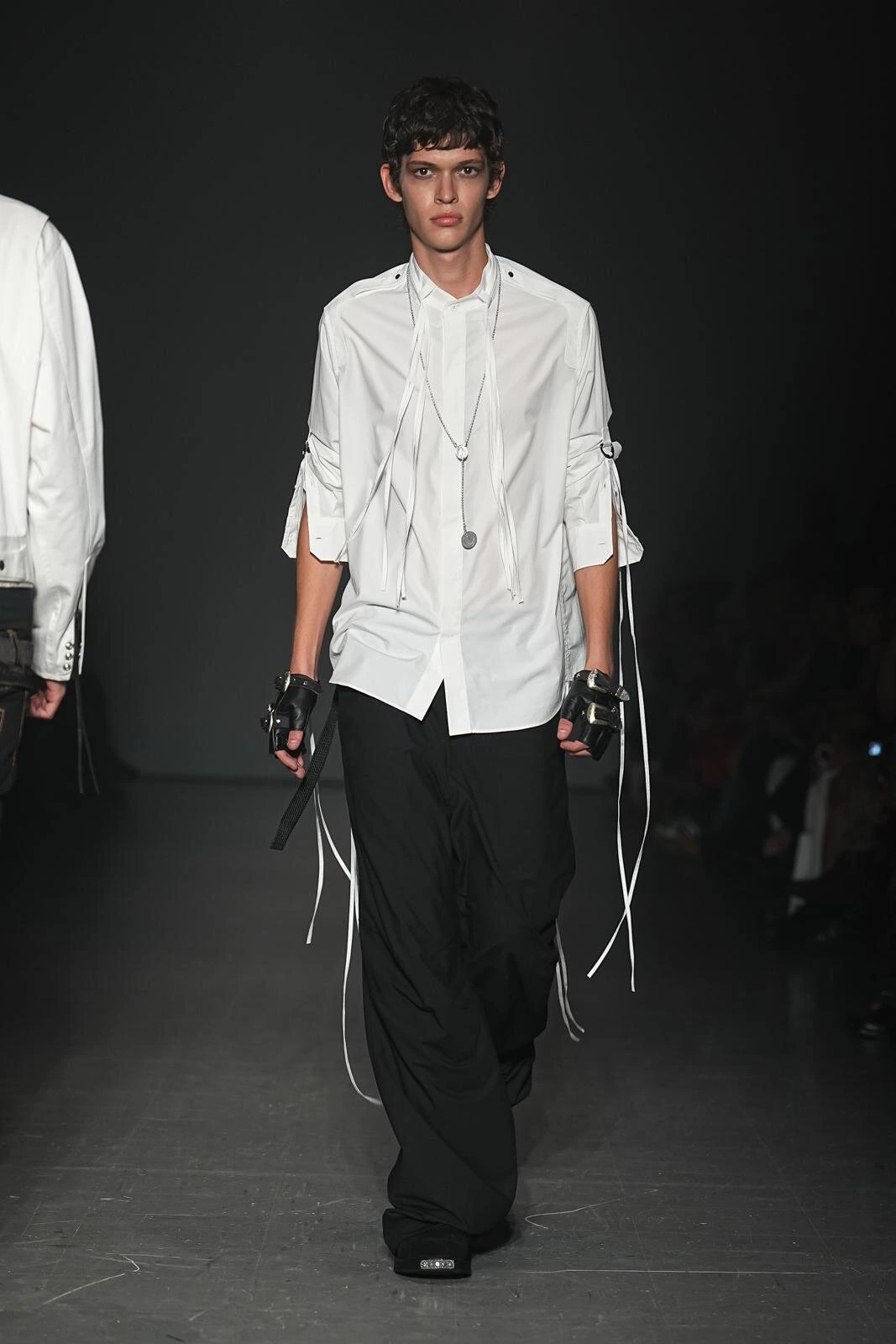
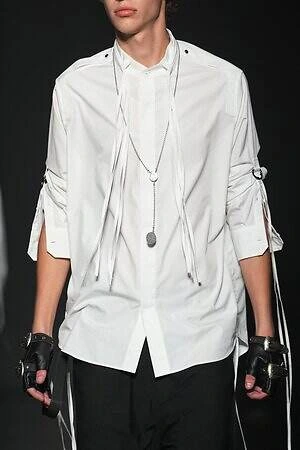
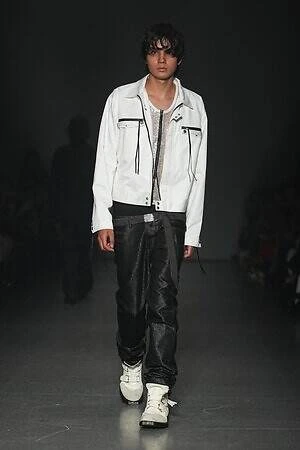
LES SIX, the Japanese design collective known in Japan as Resis, presented its Spring/Summer 2027 menswear collection on Friday, July 31, 2026. The show carried the title “BIRTH OF A CULT,” and it arrived built around slim tailored sets, deliberately unraveled bouclé knits, denim slashed open in wide gashes, and bondage inspired trousers, a wardrobe that leans hard into the visual language of rock music without ever slipping into costume.
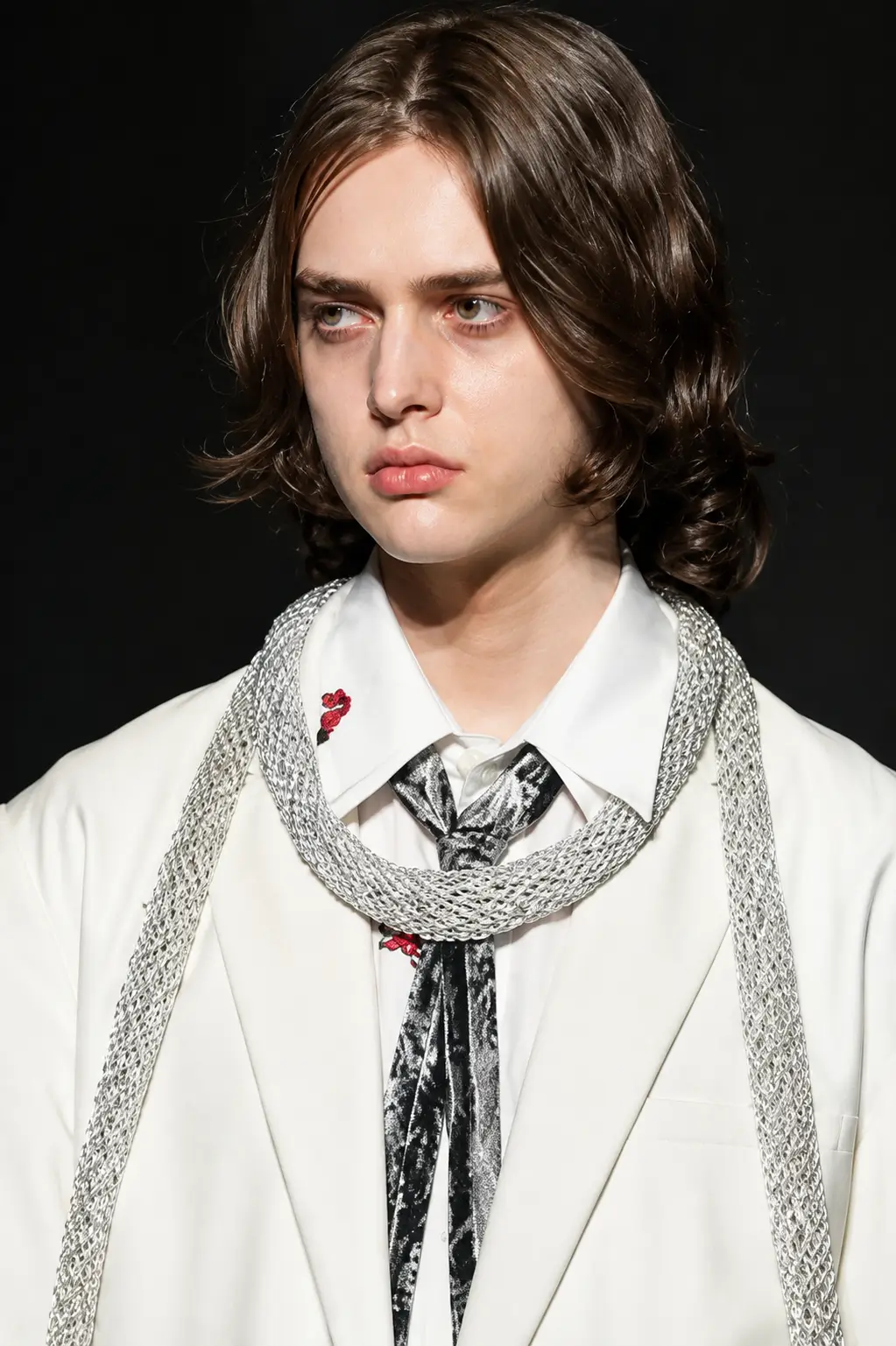
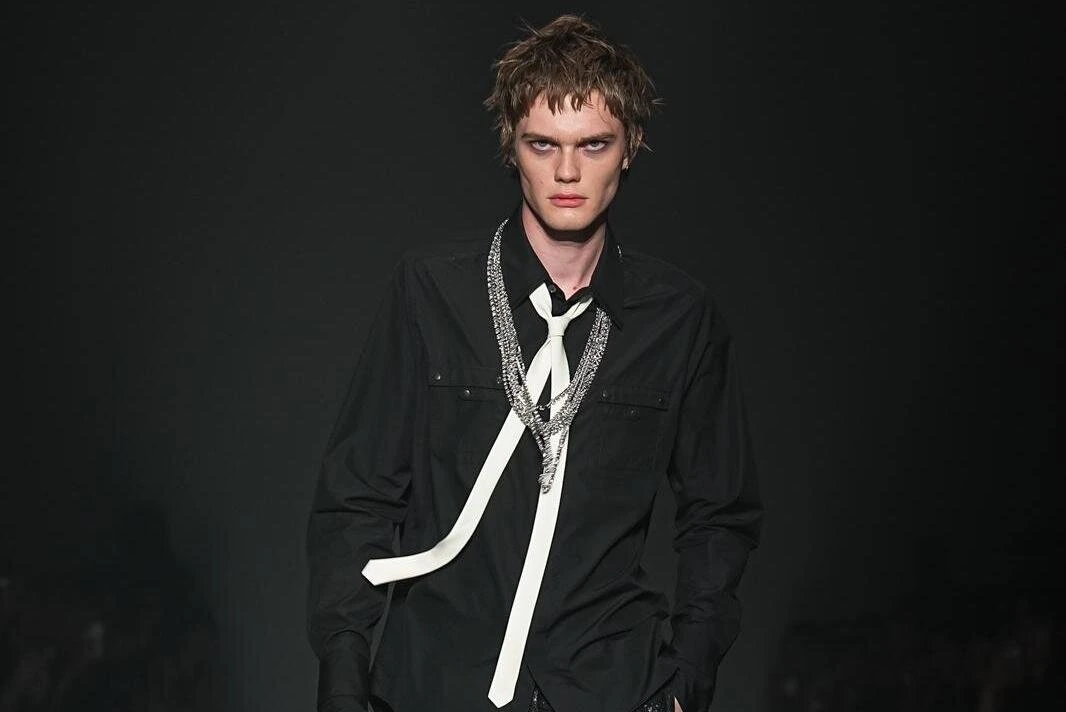
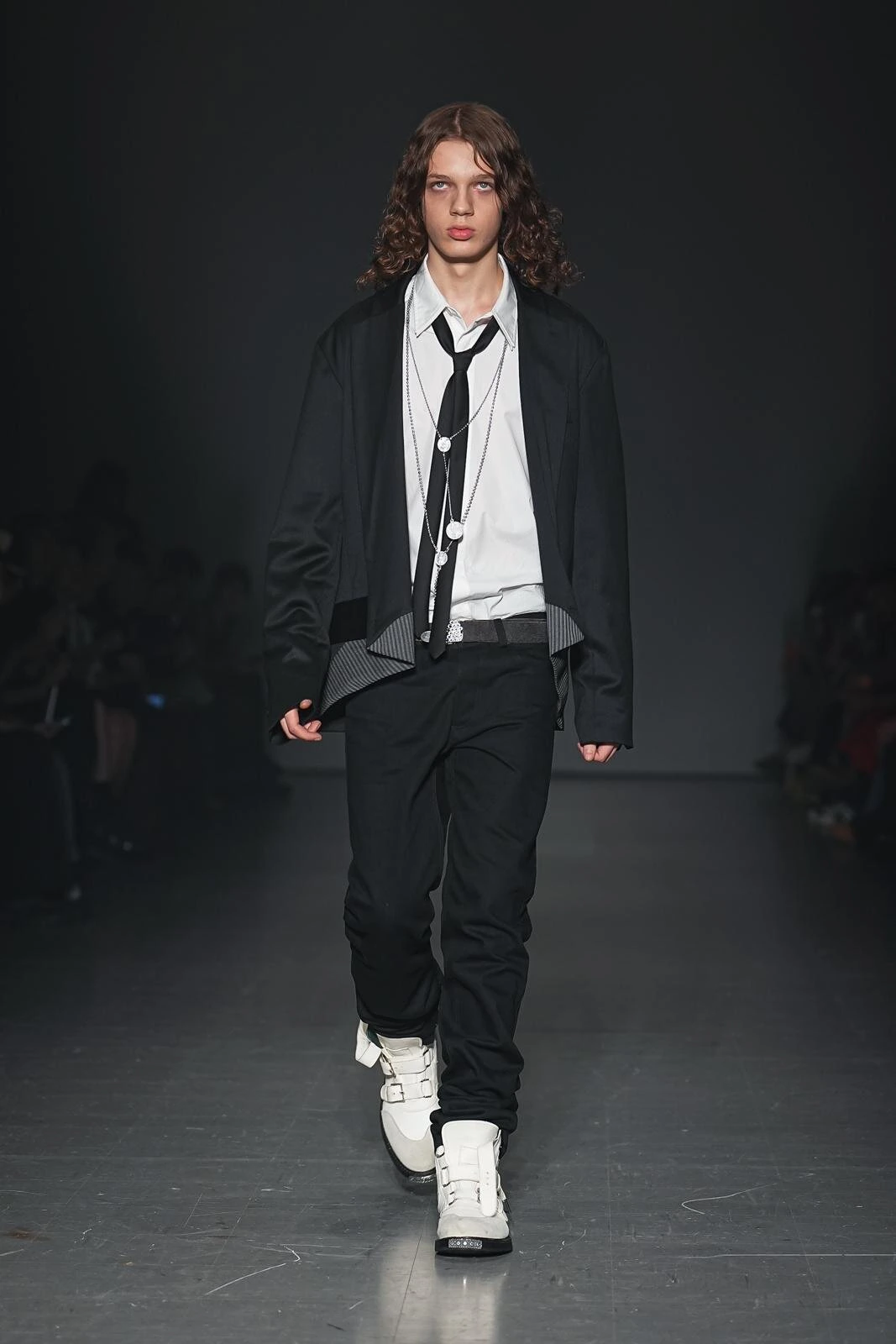
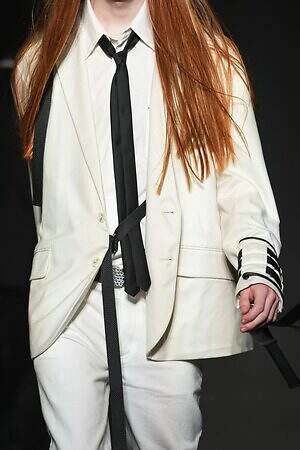
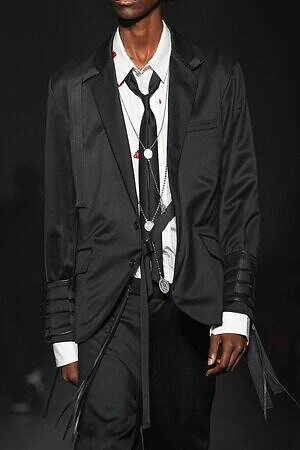
The oversized white tailoring pairs a softly structured blazer with a crisp shirt, abstract monochrome tie, and a sculpture silver rope necklace, blending formal menswear with distressed detail and contemporary runway styling.
stir
The starting point for the season came from designer Ryohei Kawanishi, who founded LES SIX in 2017 with a group of Japanese tailors, jewelers, metalworkers, leatherworkers, and graphic designers after his own years working in London and New York, including a stint building the streetwear label LANDLORD. For this collection, Kawanishi returned to the rock music of the 2000s that shaped him personally, the artists he describes as having been genuinely charismatic to him at the time, and then asked a harder question: who fills that same role for the gen coming up behind him now. Rather than pick a side, the collection sits between both answers, pulling from the sound he grew up on and the sound younger listeners are currently obsessing over, treating the gap between them as raw material rather than a problem to resolve.
Kawanishi’s own path to that question is unusual even by fashion industry standards. He trained at Central Saint Martins in London before moving to New York on a scholarship to complete a master’s degree at Parsons, later teaching at the same school while running LANDLORD, a streetwear label that broke through in the mid 2010s largely because rappers kept wearing it. He showed work in a group exhibition at MoMA while still in his twenties, one of the youngest designers to do so, and built costumes for the musician Arca before returning to Japan and starting LES SIX in 2017 with a small circle of convincers pulled from tailor, jewelry making, metalwork, and graphic design rather than from a single design school lineage. The brand’s own atelier and flagship, opened later in his hometown in Tottori Prefecture, sits inside a renovated Meiji era storehouse built with local blacksmiths and woodworkers, a detail that says as much about how LES SIX operates as any runway note does: the collective treats craft networks, not seasons, as its real infrastructure.
That structure has made LES SIX something of an outlier on the Tokyo calendar, a brand willing to spend a season satirizing capital and religion, as it did with its 2025 to 2026 autumn/winter collection built around America, religion, and the Civil War, and then pivot the following spring toward something as physical and unguarded as fandom itself. In an interview given ahead of that earlier collection, Kawanishi described LES SIX’s role as posing questions through clothing rather than producing garments meant simply to be consumed and discarded, a know that keeps recurring across seasons even as the view references shift dramatically from one show to the next.
View this post on Instagram
That premise gives the clothes their emotional temperature more than their surface details do. A slim, near severe sil runs through much of the lineup, an intentional contrast with how loose and communal a mosh pit actually feels, and it reads less like a literal band uniform and more like an attempt to bottle the physical sensation of being at a show, the tightness in the chest before the first chord hits.
scope
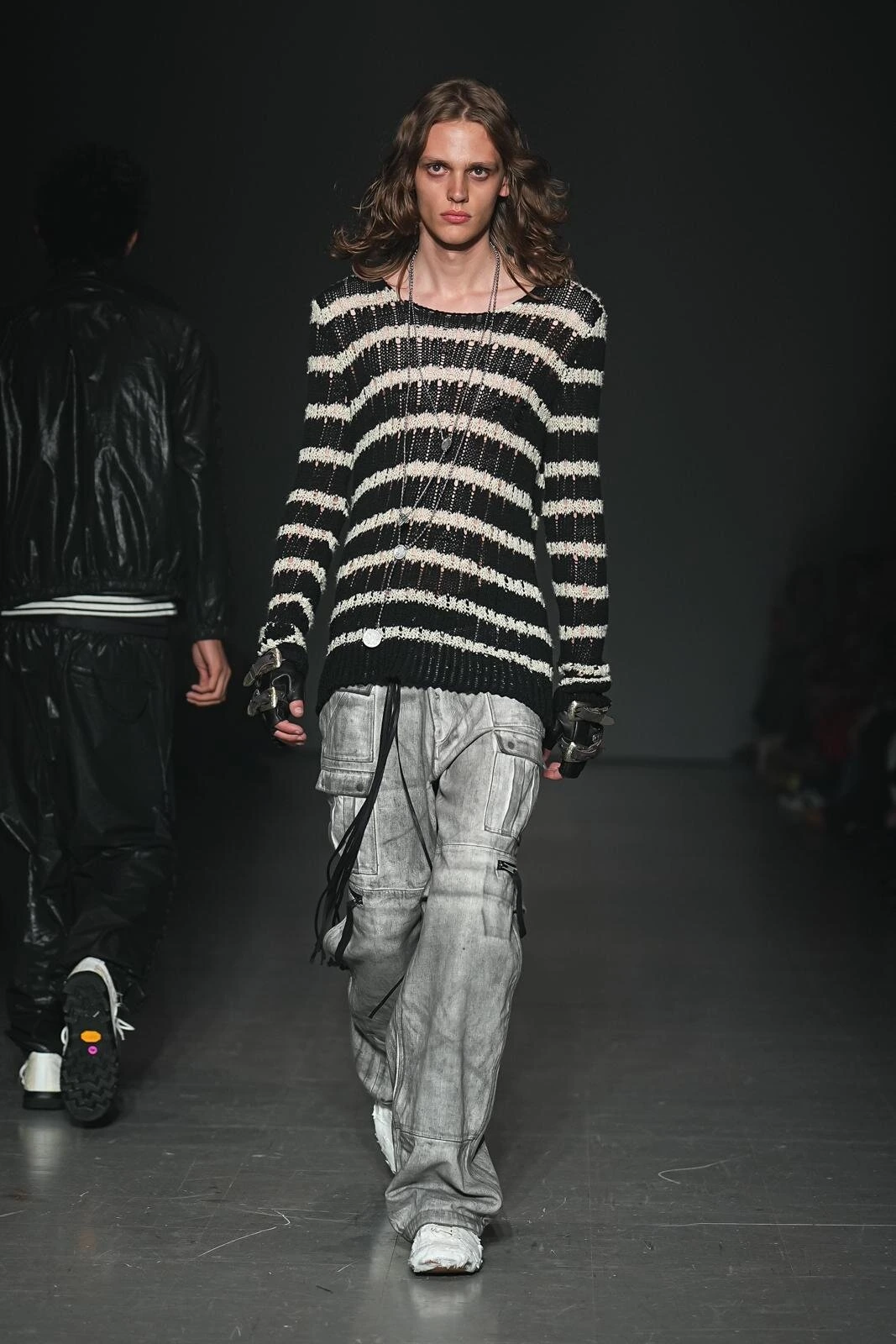
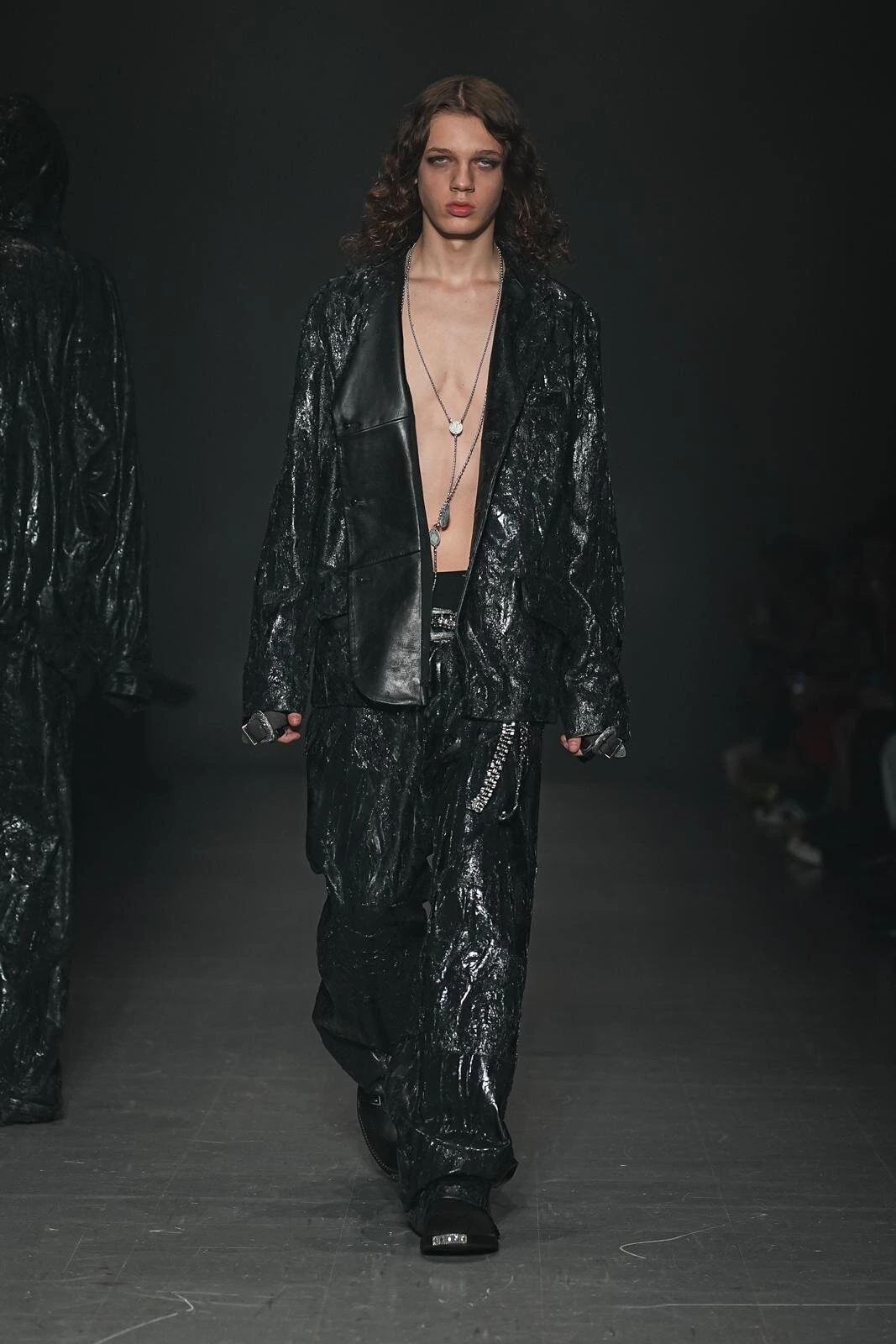
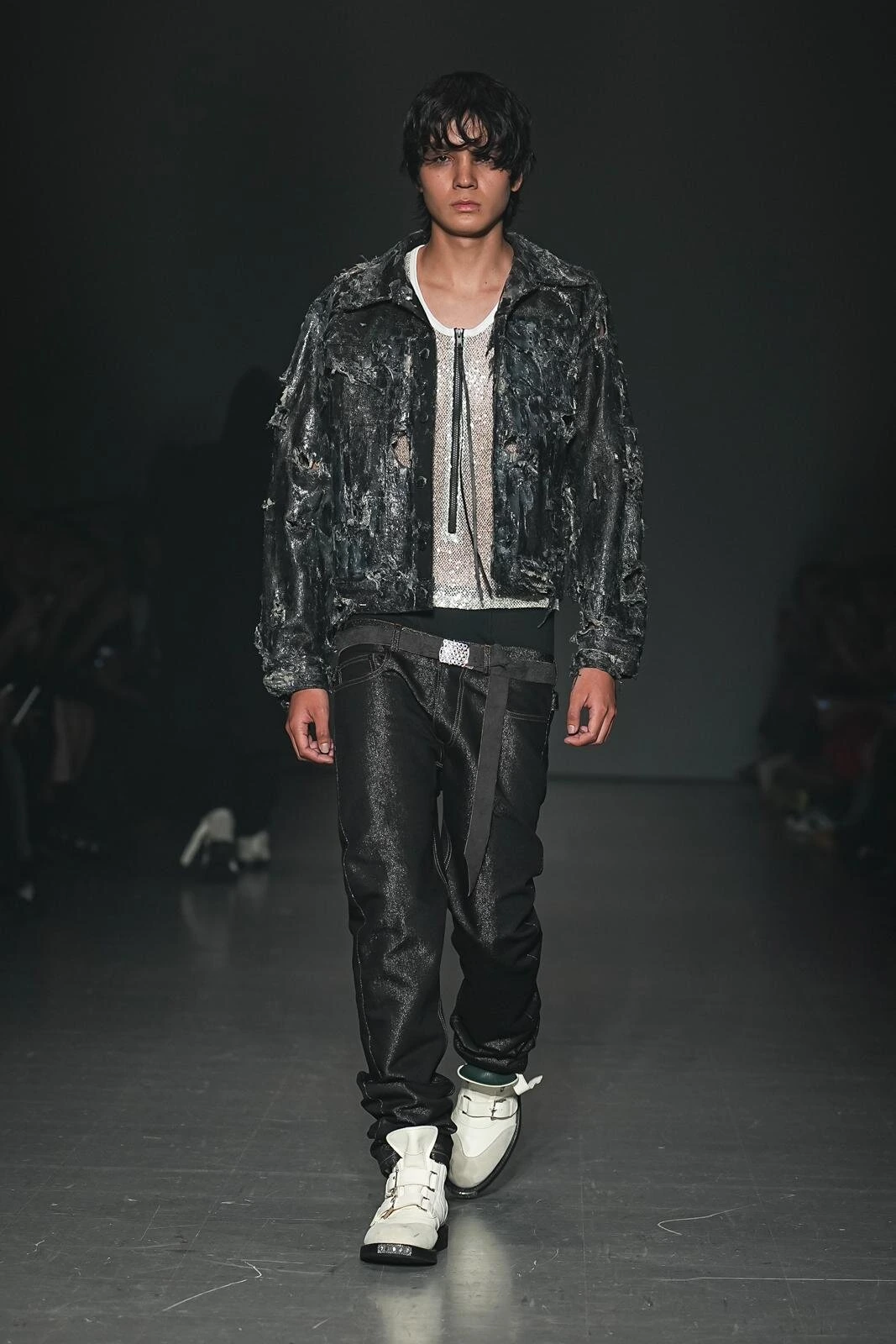
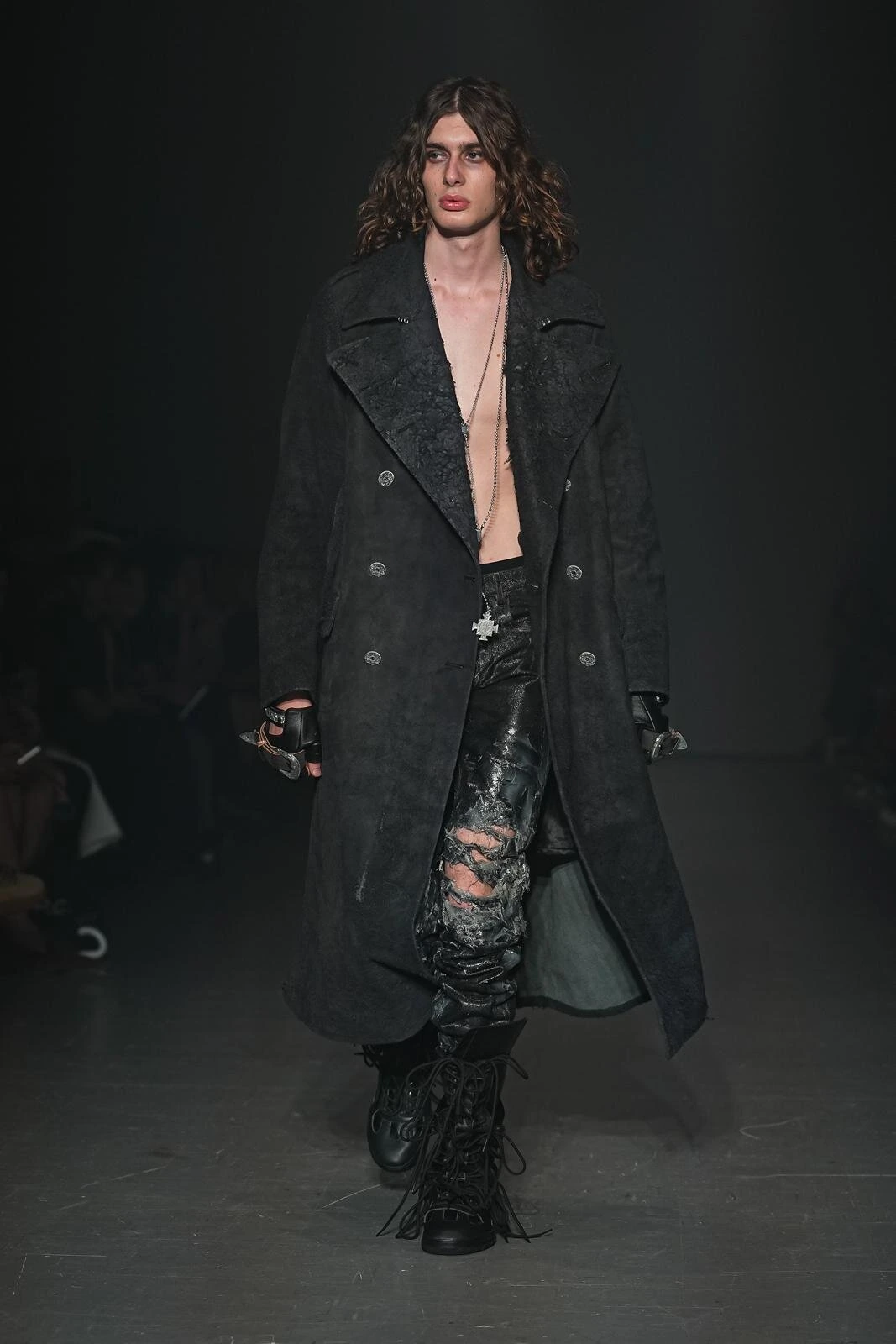
Texture does a lot of the narrative. Chemical distressing treatments give several pieces a warped, noisy quality, as though the fabric itself had been run through a distortion pedal. Coated setups and leather jackets pick up an artificial sheen, while mods coats arrive faded and unevenly worn in, and riders jackets have hems that fray into crooked, asymmetric curls rather than clean edges. The effect throughout is control damage, imperfections that were clearly engineer rather than found.
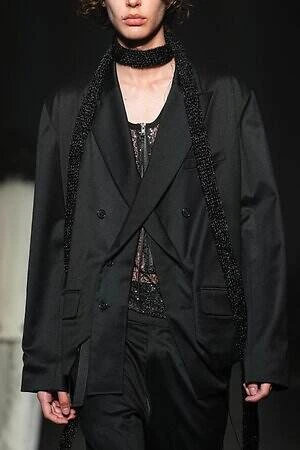
Metal enters the collection as both sound and material. Layered chain necklaces, buckled belts sitting low on the hip, beaded shawls, and heavy buckled gloves all add a percussive glint to the lineup, something that catches light the way a cymbal does. Damaged knitwear is shot through with lamé thread, and denim jackets carry a glossy painted finish, both choices aimed at giving the roughness an unexpected brightness, glitter inside the wreckage rather than gloss layered on top of it.
None of that shine reads as clean, though. Every reflective surface in the collection sits next to something intentionally worn down, so the eye keeps bouncing between decay and glare rather than settling on either one. It is a balancing act that mirrors how a lot of the rock music Kawanishi referenced actually sounds on record, distortion and melody fighting for the same three minutes, neither one winning outright. That tension between polish and rot ends up being the collection’s most consistent throughline, showing up in nearly every look regardless of sil or hue.
decor
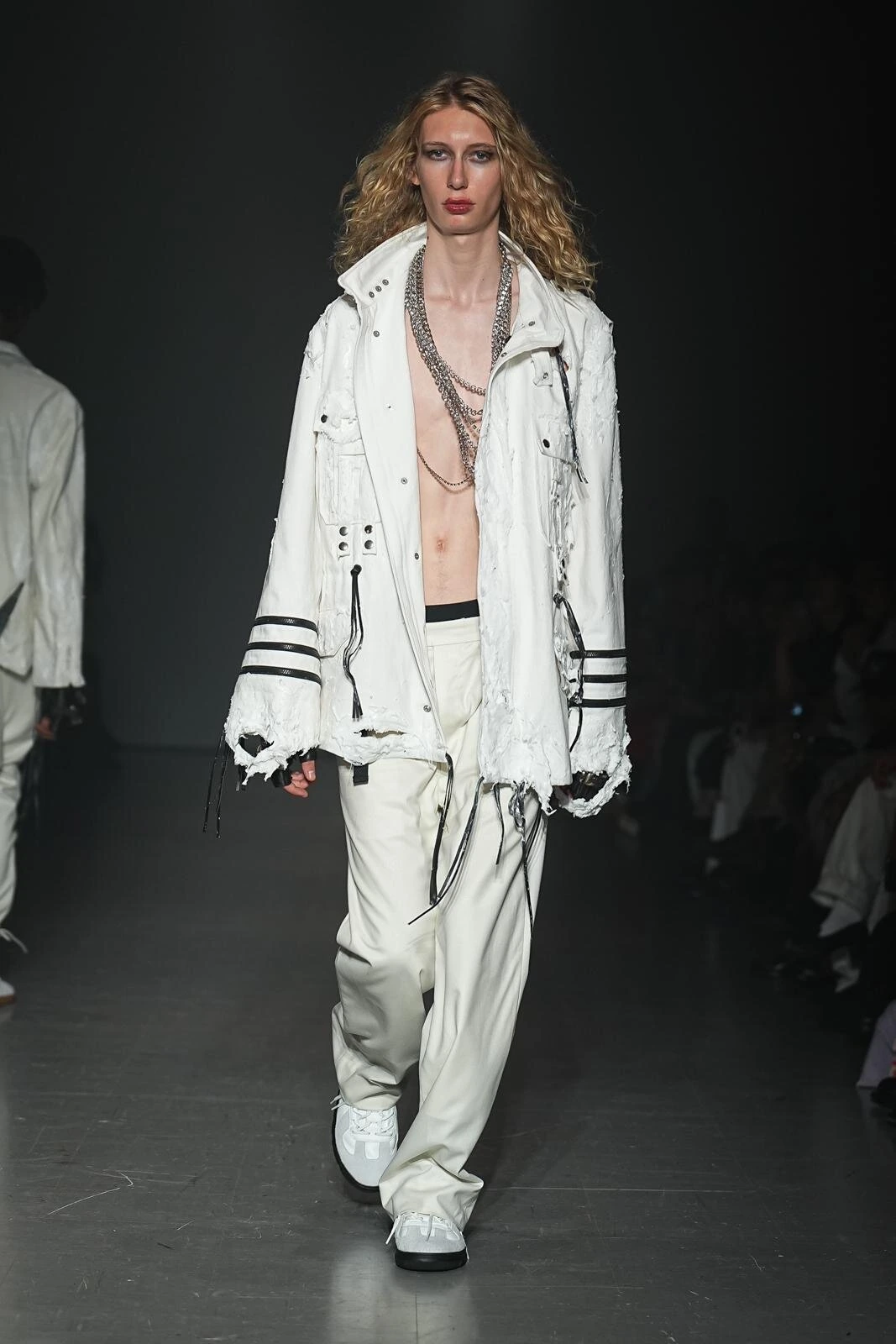
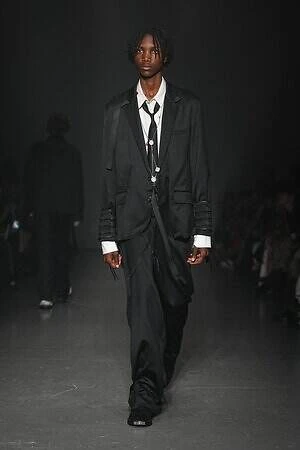
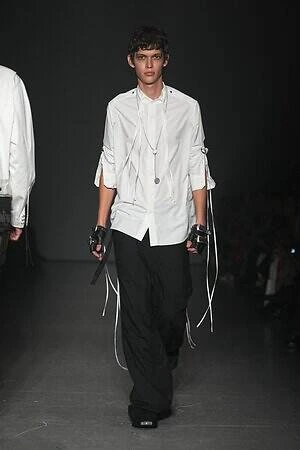
Tint is stripped down to a strict monotone palette this season, white and black run against each other with no middle ground allowed. White cargo pants and jackets carry black zip trims as a graphic accent, and black and white striped knitwear and Tee push the contrast even further. The restriction reads as a deliberate counterweight to everything else happening texturally, a way of keeping the eye anchored while the damage and the metal do their work elsewhere on the body.
It is worth noting how rare that kind of restraint is within a collection this loud in every other respect. Plenty of rock referencing collections lean on saturated color to signal rebellion, band merch reds, patch covered denim in a dozen clashing hues. LES SIX goes the opposite direction, betting that a hard black and white split reads as more confrontational than color ever could, closer to a printed flyer or a cassette insert photocopied one too many times than to a poster designed to grab attention from across a room.
edge
Fit stays close to the body across most of the collection, with tailored jackets that intentionally leave their hems folded and stitched in place rather than pressed flat, and collars and front closures that cross over each other instead of sitting square. Long, narrow straps show up repeatedly, on shirt cuffs and collars and on the zip pulls of compact blousons, small details that keep pulling the eye toward sharp, elongated lines even where the tailoring itself stays fairly restrained.
Those small acts of sabotage matter more than they might appear to on a look sheet. A jacket hem stitched down mid fold is a garment that has been deliberately kept from looking finished, a choice that takes more construction effort than simply pressing the hem flat would, and it signals a kind of control that only shows itself through imperfection. The same logic runs through the crossed collars and front closures, tailoring vocabulary borrowed from formalwear and then twisted just enough to read as slightly wrong. It is a version of sharpness that refuses to sit still, the kind of detail that photographs cleanly from a distance and only reveals its rebellion up close.
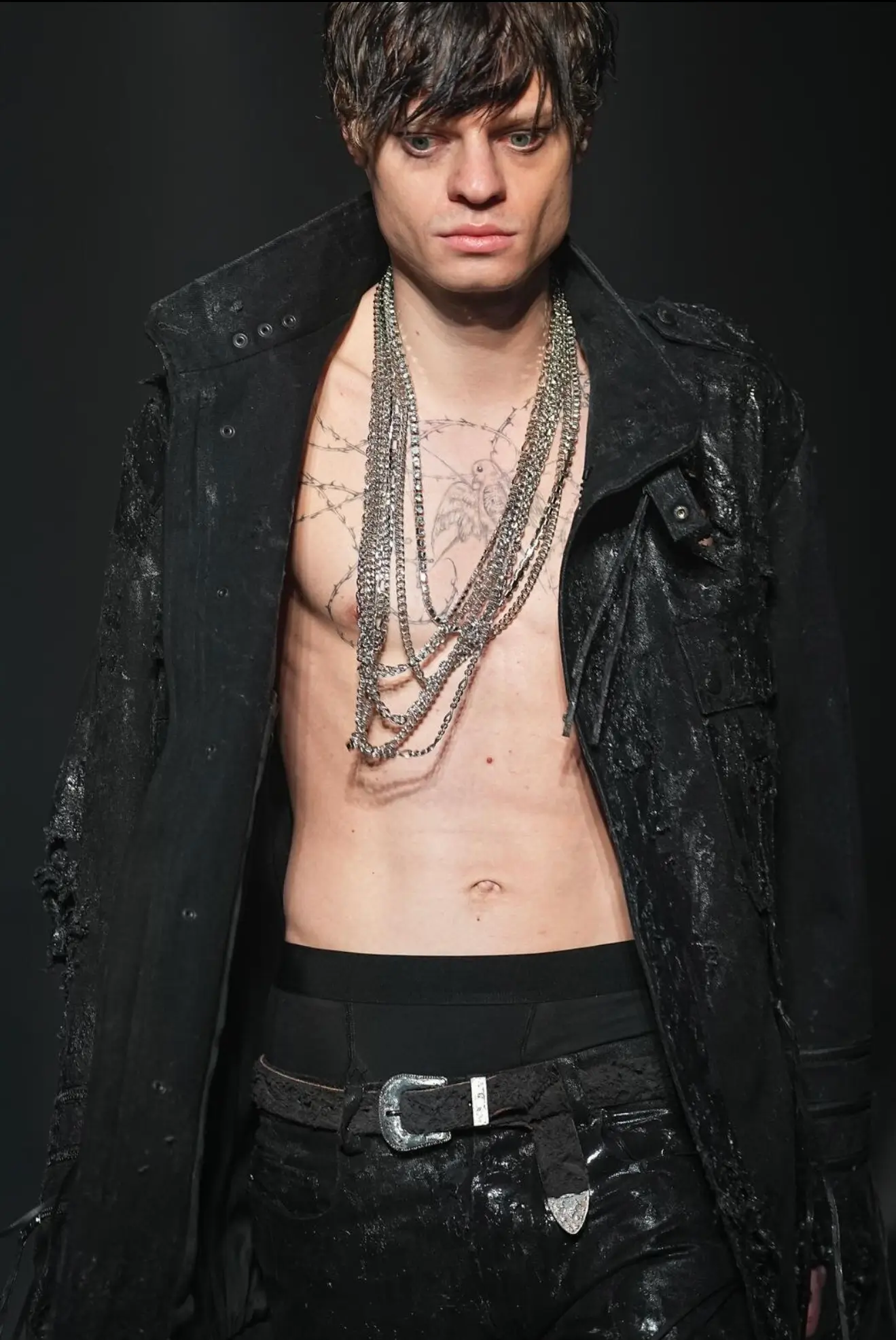
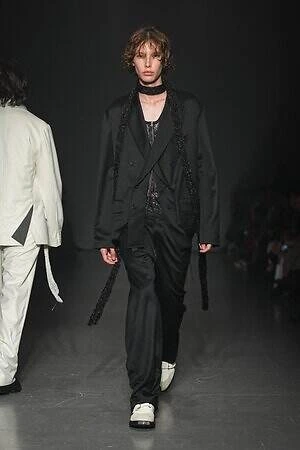
The distressed black look combines a weathered oversized coat with layered oxidized chain necklaces, low-slung leather trousers, and subtle tattoo detail, creating a dark, rock-inspired runway aesthetic that balances raw texture with tailored structure.
That precision gives way by the show’s closing stretch. Oversized pieces take over, worn as standalone statements rather than layered into a fitted sil, including a hoodie with generous volume through the body and a suede coat cut loose enough to swing view with each step. The shift from tight to loose across the runway mirrors the arc of a set, the buildup and then the release, and it closes the collection on a note of physical ease after an hour spent in tension.
culture
LES SIX has built a reputation over its near decade of existence for treating fashion as a place to ask questions rather than sell a lifestyle, and past collections have taken on subjects including capitalism, religion, and America’s political fractures. This season keeps that same interrogative instinct but points it inward, at the mechanics of fandom itself, at what makes a person or a sound worth that kind of devotion in the first place, and at either that devotion looks any different now than it did twenty years ago.
The word “cult” in the season’s title does a lot of work once that context is in place. It is not being used as shorthand for aesthetics, the black clothing and the chains, so much as it is naming the actual social structure the collection is interested in: a small group of people organizing their identity around devotion to something that feels larger than themselves. Every gen finds its own version of that structure, whether it forms around a band, a scene, or a sound that has not been named yet, and LES SIX is betting that the underlying hunger for it has not actually changed even as the specific objects of worship keep turning over. The clothes are less a tribute to any particular era of rock music than an attempt to describe what it physically feels like to be inside that hunger, tight in the chest, loud in the ears, and a little bit undone at the seams.
fin
The brand, whose name pays tribute to the early twentieth century French composer collective Les Six, has never operated at mass scale, and its own Instagram account has stayed set to private for most of its run, a choice its team has described as a way of prioritizing relationships with people who actually handle the clothes over broad visibility. That posture makes runway reports like this one, along with retailer previews at stockists such as STUDIOUS and Mukta, the main way most people outside Japan encounter each new season before it reaches stores.
The Spring/Summer 2027 menswear calendar in Tokyo has skewed toward restraint this year, with several houses leaning on quiet tailoring and muted palettes rather than anything overtly theatrical. LES SIX arrives as one of the few entries pushing in the opposite direction, loud on purpose, textured on purpose, built to look like it has already survived a few too many shows of its own. Where a number of its peers this season have organized collections around ideas of longevity, craft, or timelessness, values that tend to photograph as quiet and neutral, LES SIX has instead built a season around something inherently loud and generational, a choice that sets it apart on a crowded release calendar almost by default.
That contrast is likely intentional. LES SIX has never really competed on the same terms as the brands around it, favoring a small, tightly controlled distribution footprint over wide retail presence, and treating each collection more like a standalone thesis than a commercial deliverable. Pricing and specific release dates for the Spring/Summer 2027 collection had not been published at the time of this report, and stockists are expected to confirm delivery timing closer to the season.
n
From the DRIFT archive: Y-3 Sets the Tone for Its Spring/Summer 2026 Collection · Saint Laurent Unveils New Visuals For Its Spring 2026 Collection