DRIFT AUDIO
Listen to this story
Choose a voice, then press play.
For more than a decade, the LVMH Prize has functioned as fashion’s most view mechanism for identifying and accelerating emerging design talent. Yet the 2026 edition arrives with a subtle but meaningful shift in emphasis. While previous years often revolved around the discovery of a singular breakout star or the consolidation of a dominant aesthetic movement, this year’s shortlist instead communicates something broader about the current state of global fashion itself: fragmentation, decentralization and the growing refusal of creativity to remain anchored to traditional capitals alone.
stir
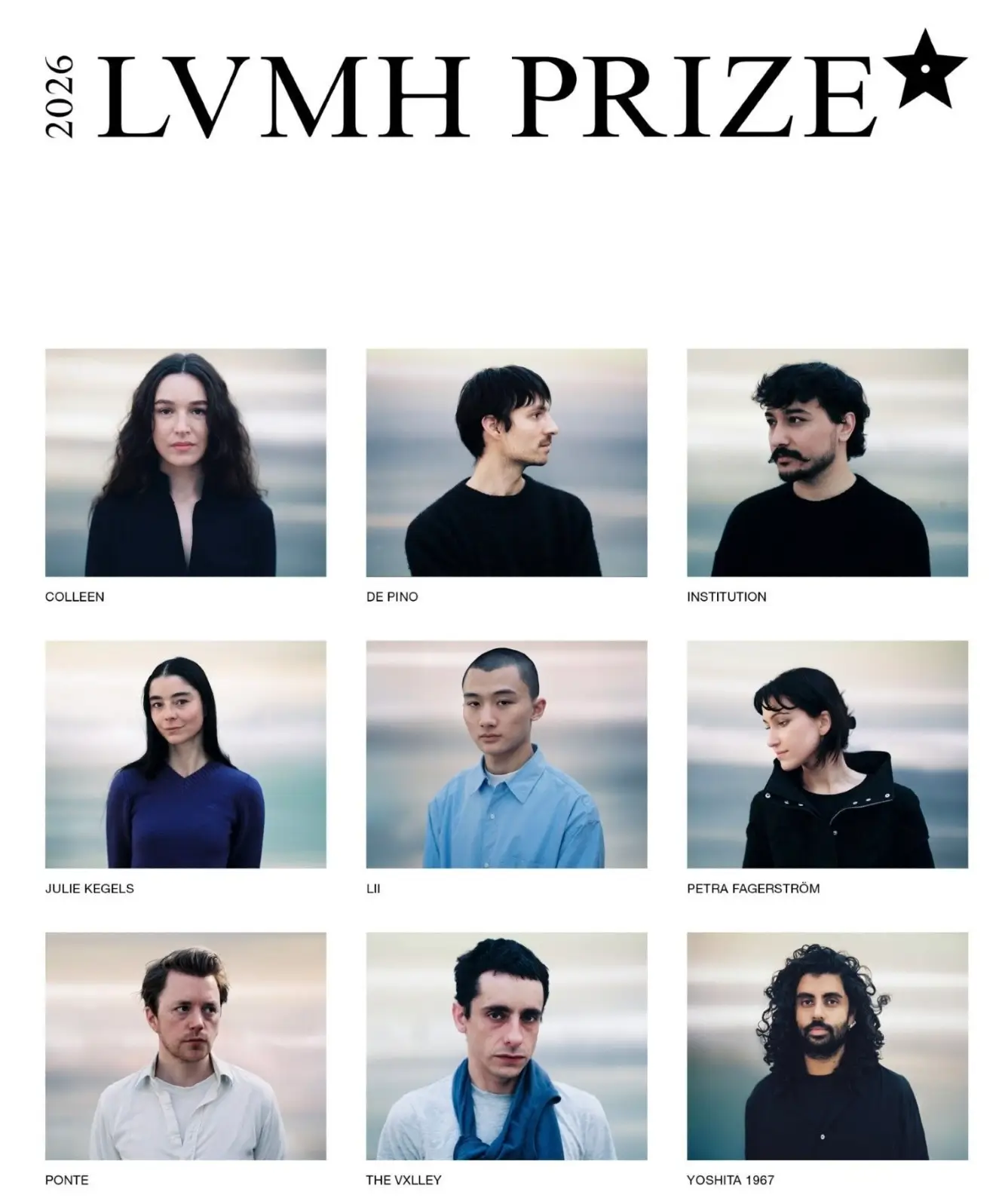
What stands out most immediately about this year’s finalists is their geographical spread. The nine selected designers represent an unusually expansive constellation of backgrounds, stretching across the United States, France, Georgia, Belgium, China, Sweden, the United Kingdom, Spain and, for the first time in the history of the Prize, Kenya. That final inclusion carries symbolic weight far beyond simple representation. The arrival of Anil Padia, founder of YOSHITA 1967, marks Africa’s first official entry into the LVMH Prize finals, a milestone that Delphine Arnault herself underscored publicly when discussing the shortlist.
That acknowledgment matters because the LVMH Prize has increasingly become less about rewarding isolated design brilliance and more about mapping where fashion’s future centers of influence are beginning to emerge. The inclusion of a Kenyan-based finalist suggests a recalibration of how luxury fashion understands innovation geographically. For decades, the industry’s institutional power structures remained concentrated between Paris, Milan, London and New York, with occasional satellite disruptions arriving from Antwerp, Tokyo or Seoul. But contemporary fashion culture no longer moves in such linear circuits. Digital view, decentralized manufacturing, online communities and global fashion week ecosystems have altered how influence forms and travels.
View this post on Instagram
flow
In that sense, the 2026 finalist lineup feels less like a traditional competition and more like a portrait of a rapidly reorganizing fashion industry.
The presence of Colleen Allen, whose American womenswear label has quietly cultivated a reputation for psychologically charged tailoring and intimate femininity, speaks to the continuing appetite for emotionally intelligent clothing rather than overt spectacle. France’s Gabriel Figueiredo enters the competition through DE PINO, a label that has steadily generated interest for its sophisticated negotiation between romanticism and structural severity. Equally significant is Galib Gassanoff’s INSTITUTION from Georgia, one of the few names in the running with a proposal spanning womenswear, menswear and genderless collections, reflecting how younger designers increasingly reject rigid market segmentation.
Belgium’s Julie Kegels continues Antwerp’s long-standing legacy of producing designers whose work balances intellectual experimentation with instinctive wearability, while Zane Li’s LII reinforces China’s growing importance not simply as a luxury consumer market but as a source of increasingly influential design language and cultural direction. Sweden’s Petra Fagerström brings a precision-driven minimalism that still carries emotional atmosphere, complicating long-standing assumptions surrounding Scandinavian restraint. From the United Kingdom, Harry Pontefract’s PONTE fuses British tailoring traditions with a cinematic interpretation of contemporary masculinity, while Spain’s Daniel del Valle Fernandez enters with THE VXLLEY, another label exploring genderless fashion through emotional specificity rather than oversized neutrality.
Collectively, the finalists do not point toward one unified aesthetic movement. Instead, they communicate plurality. Emotional tailoring exists beside conceptual minimalism. Regional specificity coexists beside globally legible branding. Genderless proposals appear not as marketing gestures but as deeper structural reconsiderations of identity and silhouette construction. That absence of consensus may itself define contemporary fashion more accurately than any single trend forecast could.
why
Beyond the designers themselves, the structure of the LVMH Prize reveals how seriously the conglomerate approaches talent cultivation as a long-term strategic investment.
During the 4 September final, three separate prizes will once again be awarded. The main LVMH Prize remains the most prestigious, offering a €400,000 financial endowment alongside a year-long mentorship programme involving direct access to the group’s teams. In practical terms, that mentorship often proves even more valuable than the financial component itself. Emerging designers today navigate a fashion landscape shaped by unstable wholesale systems, sustainability pressures, increasingly fragmented consumer attention and relentless digital acceleration. Access to executive guidance from one of the world’s most powerful luxury groups can fundamentally alter the trajectory of an independent label.
The Karl Lagerfeld Prize and the Savoir-Faire Prize each provide €200,000 alongside their own mentorship structures, allowing the jury to recognize different forms of excellence rather than forcing every finalist into the same definition of success. One designer may excel through craftsmanship, another through conceptual innovation, another through business viability or cultural resonance.
scope
The inclusion of annual recognition for fashion school graduates further reinforces the Prize’s institutional ambitions. Each year, three young graduates receive €10,000, support for their school and professional experience within one of the group’s maisons. While these initiatives naturally function within luxury fashion’s broader talent acquisition ecosystem, they also provide emerging creatives access to infrastructures and professional networks that would otherwise remain inaccessible.
Perhaps most revealing this year, however, is the composition of the jury itself. Returning figures such as Nicolas Ghesquière, Marc Jacobs, Stella McCartney, Nigo, Phoebe Philo and Pharrell Williams are joined by newly installed creative leadership from within the group, including Jack McCollough and Lazaro Hernandez from Loewe, Camille Miceli from Emilio Pucci and Michael Rider from Celine.
The presence of Pietro Beccari, CEO of Louis Vuitton and the LVMH Fashion Group, further confirms that the Prize is treated internally not as ceremonial patronage but as a mechanism for identifying where fashion’s next cultural and commercial directions may emerge.
fin
Luxury fashion currently exists within a deeply contradictory environment. On one hand, conglomerates continue to hold immense cultural and financial power. On the other, younger audiences increasingly question traditional haute values, exclusivity models, sustainability rhetoric and pricing structures. Simultaneously, social media has accelerated aesthetic cycles to unprecedented speeds, making it more difficult for emerging designers to build slow, stable businesses without immediate view.
Against that backdrop, the LVMH Prize functions both as opportunity and filtration system. It identifies which forms of creativity major luxury institutions believe remain culturally relevant and commercially sustainable moving forward.
What makes the 2026 edition especially compelling is precisely its refusal to consolidate around one dominant visual language. There is no singular obsession with maximalism, archival revivalism or technological futurism. Instead, the finalists collectively reflect a fashion culture shaped by fragmentation and coexistence. Contemporary audiences no longer consume style through linear seasonal narratives alone. A single consumer may move fluidly between Japanese avant-garde references, Scandinavian minimalism, Atlanta streetwear, Paris couture codes and underground Berlin aesthetics within the same digital ecosystem.
From the DRIFT archive: Fashionably Late, Perfectly On Time: XO’s Arrival Shakes Up UK Pop
Related Articles
WACKO MARIA Brings Its Leopard Lining to the Big Leagues
Black nylon outside, leopard fur inside: WACKO MARIA’s first Major League Baseball collection reached Japan […]