DRIFT AUDIO
Listen to this story
Choose a voice, then press play.
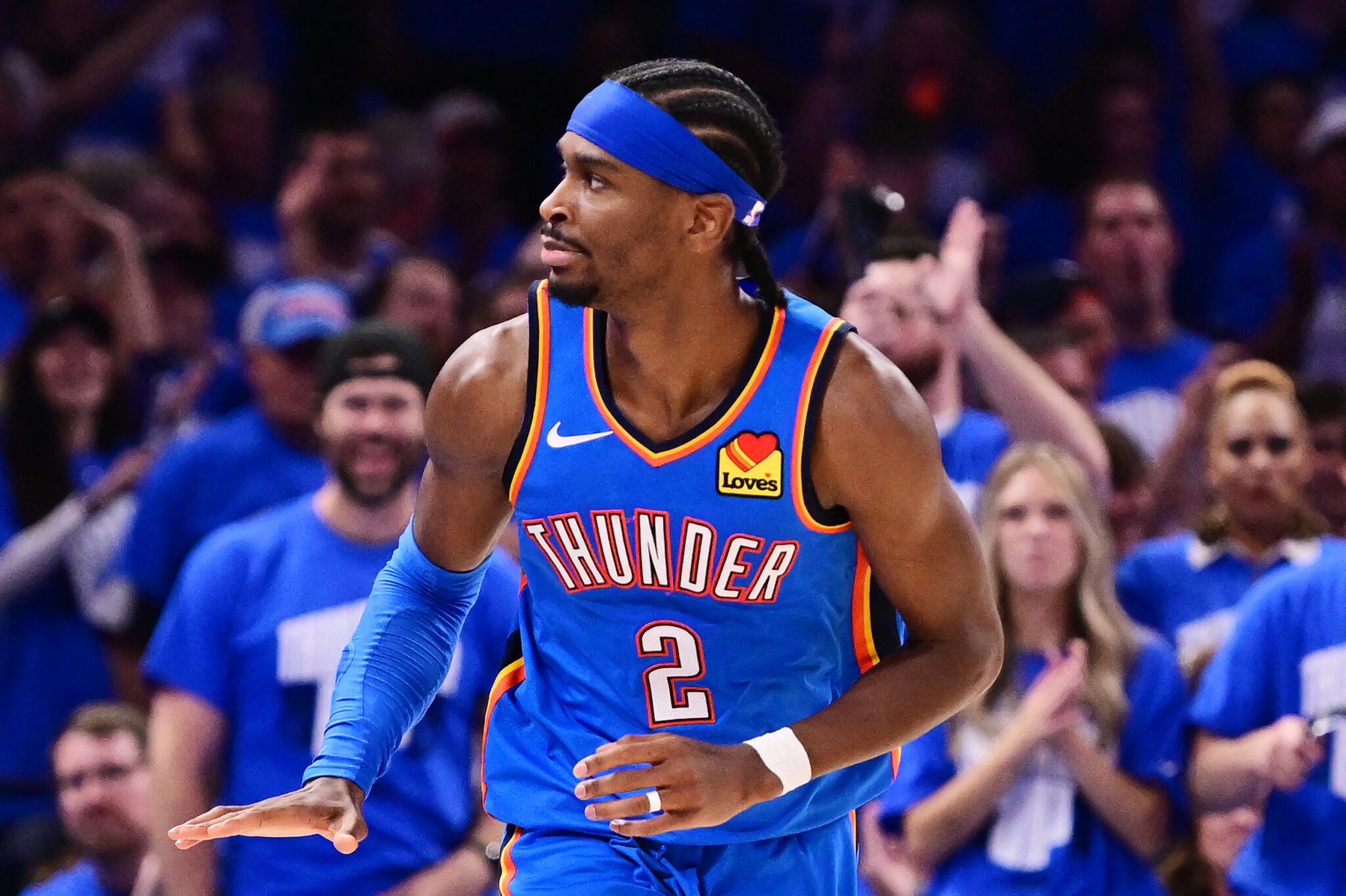
By the middle of the 2025-26 NBA season, the conversation surrounding Shai Gilgeous-Alexander had already moved beyond the traditional MVP framework. The award itself increasingly felt inevitable. What became more difficult to process was the kind of historical territory he was entering while still appearing to operate entirely within his own emotional rhythm.
On Sunday, the Oklahoma City Thunder guard officially secured his second consecutive Kia NBA MVP award, becoming the 14th player in league history to win the honor in back-to-back seasons. In doing so, Gilgeous-Alexander joined a lineage occupied by players who ultimately came to define eras rather than merely dominate seasons: LeBron James, Stephen Curry, Nikola Jokić, Giannis Antetokounmpo, Tim Duncan, Steve Nash, and others whose primes eventually reshaped the league’s understanding of greatness.

stir
The achievement alone would have positioned the season among the most important individual campaigns of the modern era. What elevated it further was the manner in which Gilgeous-Alexander arrived there. This was not a year driven by spectacle, statistical inflation, or narrative fatigue. It was a season built on precision, consistency, and an increasingly rare form of control.
Modern basketball often rewards visible force. The league’s defining superstars frequently impose themselves through overwhelming athleticism, relentless pace, or stylistic excess. Gilgeous-Alexander operates almost entirely against that current. His game rarely feels rushed, emotionally volatile, or performative. Even at its most devastating, it remains composed.
That composure became historically productive throughout the 2025-26 campaign.
scope
Gilgeous-Alexander broke Wilt Chamberlain’s long-standing record for consecutive 20-point games and became the first player since Chamberlain during the 1963-64 season to score at least 20 points in every regular-season appearance while playing a minimum of 50 games. He also joined Michael Jordan as the only guards in NBA history to average more than 30 points per game while shooting above 50 percent from the field across four consecutive seasons. Then he pushed beyond even that distinction, becoming the first guard the league has seen average 30-plus points while shooting over 55 percent from the floor.
In another era, several of those benchmarks individually would have defined a career season. Collected together, they begin to describe something more unusual: a perimeter scorer operating with the efficiency profile of a dominant interior player while still carrying the offensive burden traditionally reserved for high-usage guards.
That contradiction is central to understanding why this version of Gilgeous-Alexander has become so difficult to defend.
discip
Most elite scoring guards eventually accept some degree of inefficiency as the natural cost of offensive responsibility. High-volume creators are expected to live with difficult percentages because modern defenses are specifically designed to force perimeter stars into compromise. The combination of aggressive switching, advanced scouting, weak-side rotations, and increasingly sophisticated defensive spacing usually ensures that even great scorers stray into volatility over the course of a season.
Gilgeous-Alexander has largely resisted that volatility altogether.
His offensive game now functions through timing and manipulation more than speed or force. Defenders rarely appear dramatically overpowered against him. Instead, possessions unfold gradually until their positioning begins to deteriorate. His footwork consistently shifts angles by inches rather than feet. His handle creates hesitation without requiring excessive movement. His change of pace remains one of the most effective weapons in the league because it is used selectively rather than constantly.
The result is a scoring profile that feels unusually sustainable.
At times, his possessions resemble less a series of reactions than a sequence already solved several movements in advance. He rarely appears hurried into uncomfortable decisions. Even his difficult shots often emerge from situations he has deliberately slowed into his preferred tempo.
flow
The midrange area has become the clearest expression of that control. While much of the league continues prioritizing either three-point volume or direct rim pressure, Gilgeous-Alexander has turned the intermediate floor into the center of his offensive identity. There is very little wasted movement in those possessions now. The balance, shoulder positioning, and pacing are refined to the point where defenders often commit to counters before he fully reveals his intention.
What separates him from many technically gifted scorers, however, is that the efficiency never collapses under the weight of usage.
His 55 percent shooting season would be exceptional for almost any perimeter player regardless of role. Combined with his scoring volume, it became historically unprecedented.
struct
That individual precision also translated directly into Oklahoma City’s broader dominance.
The Thunder did not simply finish near the top of the Western Conference again. They increasingly resembled the league’s most structurally complete team. Their defense suffocated rhythm. Their transition game punished hesitation immediately. Their depth no longer looked developmental; it looked overwhelming. Most importantly, the roster maintained an uncommon sense of continuity despite its youth.
Gilgeous-Alexander sits at the center of that environment in a way that mirrors his playing style. He stabilizes games emotionally as much as tactically. Oklahoma City rarely appears frantic because its best player rarely does. Even in late-game situations, the Thunder increasingly operate with a level of composure more commonly associated with veteran championship groups.
grasp
That stability became especially view in clutch situations. Gilgeous-Alexander led the NBA in total clutch points this season, earning Kia NBA Clutch Player of the Year honors while repeatedly closing games with a level of calm that has become almost routine.
What makes him particularly dangerous late in games is not unpredictability but the opposite. Defenses generally know where he wants to operate. They understand the footwork patterns, the preferred spacing, and the pacing he attempts to establish. Yet very few teams consistently disrupt it because his counters are rooted less in improvisational chaos than in balance and timing.
That distinction matters. Many modern superstars dominate through escalation. Gilgeous-Alexander dominates through reduction. He removes unnecessary movement from possessions until only the most efficient option remains.
fear
The psychological effect of that approach on opponents became increasingly sawn throughout the season. Oklahoma City rarely needed dramatic runs to take control of games. Instead, teams often appeared gradually compressed over four quarters, losing spacing discipline possession by possession until the game tilted fully toward the Thunder.
Advanced metrics reflected that impact clearly. Gilgeous-Alexander finished the season with a league-best plus-minus differential of +788, more than 100 points ahead of the next closest player. Numbers of that scale generally require not only individual excellence but complete organizational alignment. The Thunder increasingly possess both.
That organizational rise also altered the broader perception of Gilgeous-Alexander himself. For several years, he was viewed primarily as one of the league’s most elegant young scorers operating within a promising rebuild. The conversation has now shifted entirely. He is no longer discussed as an ascending star. He is discussed as the defining player on what may become the NBA’s defining team.
stringent
What makes that transition especially compelling is how naturally it aligns with his public persona.
In an era where athlete visibility often depends on constant performance beyond the court, Gilgeous-Alexander remains unusually restrained. His confidence rarely presents itself through confrontation or spectacle. Even his growing influence within fashion operates through a similar philosophy. His tunnel style is experimental without appearing attention-seeking, refined without looking overly calculated. The silhouettes, tailoring, and layering choices reflect the same measured control visible in his basketball.
That restraint has ultimately become part of his cultural appeal.
He represents a version of superstardom less dependent on volume than presence. His interviews are concise. His demeanor remains steady regardless of circumstance. Even after historically significant performances, he often speaks with the tone of someone still studying the game rather than trying to author mythology around himself.
Ironically, that absence of visible self-mythologizing has only intensified the aura surrounding him.
hx
By the second half of the season, the historical comparisons became unavoidable. Michael Jordan surfaced frequently because of the scoring efficiency. Steve Nash naturally entered discussions because of the shared Canadian lineage and back-to-back MVP trajectory. Kobe Bryant appeared in conversations surrounding footwork and pacing. Yet Gilgeous-Alexander increasingly resists clean comparison because the balance of his game feels distinctly modern.
He combines old-school scoring patience with contemporary spacing efficiency. He carries a superstar workload without dominating possession flow to the point of exhaustion. Teammates remain involved offensively because his style organizes possessions rather than consuming them.
That scalability may ultimately become one of the most important aspects of his career.

sustain
Many heliocentric superstars eventually force organizations into difficult structural compromises. Oklahoma City currently faces very few. Gilgeous-Alexander’s game expands the effectiveness of the roster around him rather than narrowing it. That reality gives the Thunder an unusually sustainable championship window moving forward.
Now, as Oklahoma City advances deeper into the postseason against a rising San Antonio Spurs team led by Victor Wembanyama, the league appears to be entering another transition point. Wembanyama represents one possible future of basketball: unprecedented size, defensive range, and physical versatility. Gilgeous-Alexander represents another: technical refinement, composure, efficiency, and control elevated to historic levels.
Together, they may shape the next decade of the league.
fin
For now, though, the 2025-26 season belongs entirely to Gilgeous-Alexander.
Not simply because he won another MVP award, but because of how convincingly he altered the framework through which modern perimeter greatness is usually understood. At a time when basketball increasingly rewards speed, volume, and spectacle, he constructed one of the most dominant seasons in recent memory through patience, balance, and precision.
He did not overwhelm the league with noise.
He controlled it with clarity.
From the DRIFT archive: Fightland: 50 Cent, Sheff G, Sleepy Hallow, and Jeremih Step Into the Ring
Related Articles
Ray Vaughn Splits it up On “Set It Off”
Hitmaka hands Ray Vaughn a soul loop that turns mean halfway through. The Long Beach rapper changes gears right along with it.