DRIFT AUDIO
Listen to this story
Choose a voice, then press play.
A twenty-second main event still gave Max Holloway the last word on Conor McGregor’s comeback.
In This Story
- A Five-Year Wait Ends in Seconds
- The Kick That Undid the Comeback
- Holloway’s Pivot From Fighter to Pitchman
- Thirteen Years Since the First Meeting
- A Card That Delivered Everywhere Else
- What Comes Next for Both Men
T-Mobile Arena had spent all week building toward a moment that lasted less time than the walkout music. Conor McGregor, the sport’s biggest commercial draw for over a decade, returned to the Octagon on Saturday night in Las Vegas for the first time since 2021, and it ended before either man had thrown more than a handful of strikes. Max Holloway was declared the winner by TKO, but the story that traveled fastest out of the building was not the stoppage itself. It was what Holloway did with the microphone immediately after.
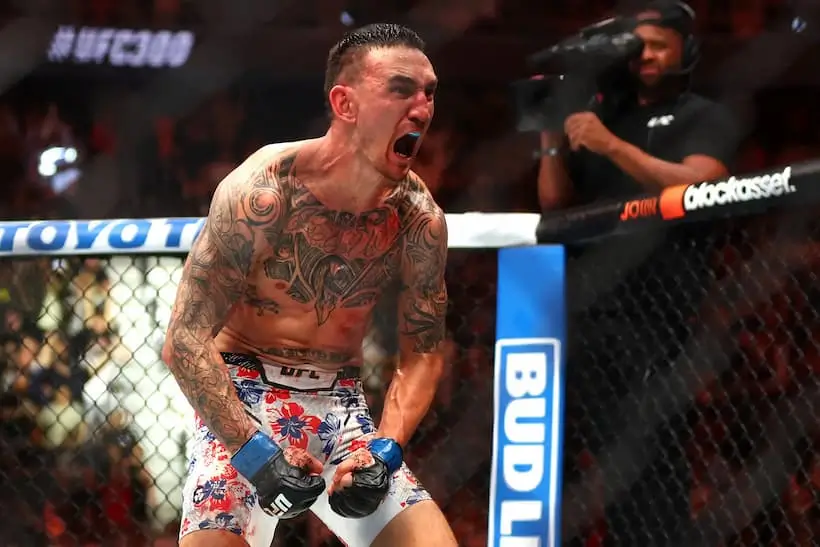
Max Holloway reacts to Connor Mcgregor with the decisive knockout at UFC 318, bringing their long-awaited trilogy to a dramatic finish.
stir
The build to UFC 329 had been unusual even by McGregor standards. He had withdrawn from a previously booked fight against Michael Chandler, spent years managing the aftermath of the broken leg he suffered against Dustin Poirier in 2021, and arrived in Las Vegas carrying more doubt than anticipation about whether he would actually step into the cage. Ticket demand and pay per view projections had been built almost entirely around the idea that this was his true comeback, the first live test of whether five years away and one of the sport’s ugliest injuries had left anything behind. He did show up. The rematch with Holloway, thirteen years after their first meeting, was billed as a genuine crossroads fight, contested at welterweight, a division neither man competes in under normal circumstances and one that required Holloway to add roughly fifteen pounds on comparatively short notice.
Holloway had spent the buildup doing what he generally does, absorbing verbal jabs at the press conference without matching McGregor’s theatrics, letting the Irishman carry the noise while he carried the composure. Things briefly turned physical during the final staredown, when McGregor snatched the glasses off Holloway’s face and pressed his forehead into his opponent’s, prompting Dana White to step in and separate the two men before a handshake attempt ended with McGregor slapping Holloway’s hand away instead. It played, at the time, like standard McGregor theater ahead of a night that was supposed to be about him reclaiming a stage he had not stood on since 2021. By fight night, none of that mattered. What mattered was a single kick, thrown in the opening seconds, that undid five years of anticipation before the crowd had finished its opening roar.
The entrance alone signaled how much weight the promotion had put on this moment. McGregor walked out to his usual pageantry, sporting a new haircut and the kind of showman’s grin that has sold out arenas for a decade, while Holloway, a two time featherweight champion and one of the sport’s most durable stars, waited in the Octagon looking notably calm given the stakes. Neither man’s face gave away what was about to happen. Nothing in the buildup, the staredowns, or the pageantry hinted that the entire encounter would be decided before either fighter had settled into a rhythm.
It’s over! Max Holloway stops Conor McGregor after an early leg injury. #UFC329 pic.twitter.com/WvWw4Qo2ei
— MMA Junkie (@MMAJunkie) July 12, 2026
scope
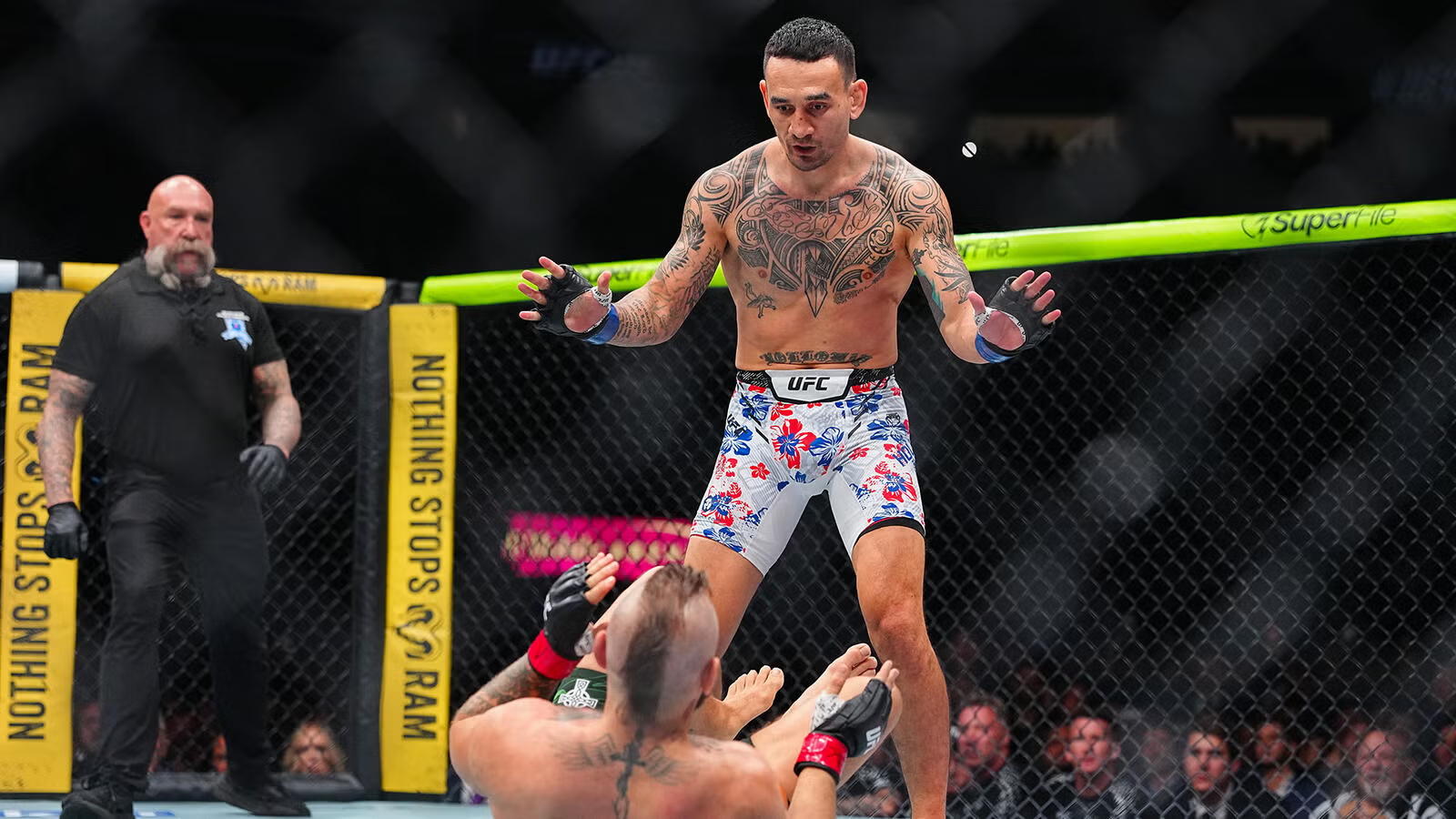
McGregor opened the fight with a jumping kick, and the moment his leg met the canvas, something gave out. He was down within seconds, worked his way back up, tried to continue, and slipped again. Referee Mike Beltran, one of the sport’s more experienced officials, waved the fight off at roughly the one minute mark, handing Holloway a TKO victory that required almost no offense to secure. Reports on the exact finish time varied slightly across outlets, landing anywhere between one minute and just under two, but the essential shape of the ending was consistent everywhere it was described. McGregor never fully recovered his footing after that first attempt, and Holloway, according to multiple accounts, could be seen asking Beltran whether he wanted to step in even before the official stoppage came.
That detail matters as much as the finish itself. This was not a fighter looking to end things quickly for the sake of a highlight. Holloway appeared genuinely reluctant to see the fight end this way, which set up the tone he would carry into his microphone moment minutes later. The injury marked the second time in McGregor’s career that a leg has failed him early in a bout against Holloway specifically, an echo of the shattered tibia he suffered against Dustin Poirier in this same city in 2021, though notably not the same leg. For a fighter whose career has been defined as much by physical setbacks as by knockouts, the symmetry did not go unnoticed by anyone watching.
For a card that had been sold on star power and a five year wait, the anticlimax was immediate and total. Commentary in the aftermath from fighters and analysts alike leaned on words like disappointing and anticlimactic, and few disputed that this was among the shortest, strangest endings a McGregor main event has ever produced. Broadcast commentary struggled in real time to characterize what had just happened, since so little of it resembled an actual contest. There was no exchange to analyze, no read on either man’s game plan, nothing beyond a single kick and its immediate consequences. The arena’s mood shifted within seconds from raucous anticipation to a kind of stunned quiet that lingered well after Beltran’s arms went up.
transition
This is where Holloway did the heaviest lifting of the night, and he did it without landing a meaningful strike. Facing a booing arena that had paid for five rounds and gotten roughly one minute, Holloway grabbed the microphone and refused to let the moment sour. He praised McGregor directly, calling him an animal, and told the crowd he had tried to wave the fight off himself before the finish, only for McGregor to insist on continuing. Then came the pivot. Holloway told the arena there would be a third fight between them, framed the moment as a favor to the fans, and left no ambiguity about wanting the trilogy, asking for it explicitly and repeating that the fans deserved one more meeting between them.
It was, in effect, a promoter’s instinct deployed inside an athlete’s disappointment. Holloway did not get the finish he wanted, a clean, competitive rematch that could settle a thirteen year old unanimous decision loss on his own terms. What he got instead was a chance to reset the narrative in real time, turning a fight fans felt cheated by into the setup for the fight they will now clamor for. That instinct is not new for Holloway. Across a career defined by grinding, high volume performances and a reputation as one of the sport’s most consistently likable figures, he has repeatedly shown an ability to read a room and give it what it wants, even in defeat. What made Saturday different is that he did it in victory, and did it so quickly that the pivot happened before most of the arena had processed what they had actually paid to see.
Reaction across combat sports was split between sympathy for McGregor’s body and amusement, sometimes bordering on disbelief, at how quickly Holloway converted the moment into a sales pitch. Fighters posting in real time ranged from concern over the severity of the injury to blunt commentary suggesting McGregor had effectively beaten himself before Holloway ever got the chance to. Few, however, disputed that Holloway had handled an awkward, deflating situation about as well as it could be handled, walking a line between respecting an injured opponent and still building toward his own next paycheck.
last
The two men first fought in 2013, early in both careers, with McGregor winning a unanimous decision that has since become a footnote to two very different trajectories. At the time, neither man was the fighter he would become. McGregor went on to become the first simultaneous two division champion in UFC history, a distinction still unmatched, while Holloway built his own case as one of the greatest featherweights the sport has produced, defending his title across multiple eras of the division before moving up in weight and delivering one of the most replayed knockouts in recent memory against current lightweight champion Justin Gaethje. That win alone reframed Holloway’s legacy for a new generation of fans who had only known him as a featherweight staple.
Holloway had most recently dropped a decision to Charles Oliveira in March, costing him the promotion’s ceremonial BMF title, and arrived at UFC 329 having added roughly fifteen pounds to fight McGregor at welterweight on short notice. That physical adjustment alone would have been a significant storyline in a normal fight week. Instead it barely registered once the opening kick landed, since Holloway never needed the added size or strength to secure the win.
None of the thirteen year old history got resolved on Saturday. The rematch was supposed to answer whether the 2013 result still meant anything given how far both careers have traveled since, whether Holloway’s evolution into one of the sport’s most complete strikers would look different against the same opponent who beat him when both were still finding their footing. Instead, it raised a new question about whether McGregor’s body will allow him to answer that question at all, at any point, against anyone.
View this post on Instagram
other
The rest of UFC 329 largely overperformed relative to the main event, which made the letdown at the top of the card feel sharper by comparison. Paddy Pimblett needed less than a minute to submit Benoit Saint Denis with a D’Arce choke in the co-main event, immediately calling out a list of names that included Holloway and McGregor themselves in his post-fight interview, making clear he was happy to fight either man next. Mario Bautista ground out a decision win over Cory Sandhagen in what several outlets described as a gritty, back and forth affair, Brandon Royval submitted Lone’er Kavanagh, King Green extended his winning streak with a stoppage of Terrance McKinney, and Robert Whittaker finished Nikita Krylov, giving the undercard a run of finishes that a healthier main event might have complemented rather than overshadowed entirely.
Under different circumstances, a card with that many finishes across its main and preliminary slates would have been remembered as one of the stronger UFC events of the year. Instead, the arena’s energy swung from anticipation to stunned quiet within the first minute of the headliner, and the rest of the night played out under that shadow, with even the strongest performances on the undercard struggling to shift the conversation back away from what had happened in the main event. Fighters watching from home were blunt about it in the immediate aftermath, with reactions ranging from concern for McGregor’s long term health to pointed commentary about the fight ending on a self inflicted injury rather than anything Holloway did. Several posts framed it less as a loss for McGregor and more as a continuation of a physical pattern that has now shaped multiple chapters of his career.
look
UFC president Dana White has generally avoided booking rematches in the direct aftermath of an event, but the appetite for a Holloway trilogy is already part of the public conversation Holloway himself started on the microphone, and White is likely to face immediate questions about it in the coming days regardless of his usual booking approach. There is also the matter of Holloway’s own championship ambitions, since a rematch with Gaethje for the lightweight title remains a natural next step given the knockout win that already links the two men, leaving Holloway with genuine options rather than a single obvious path forward.
Where that leaves McGregor is less clear. He is 37 years old, has now suffered significant leg injuries in multiple appearances inside this same arena across two different fights, and the question of whether he fights again at all is likely to dominate discussion well before any trilogy bout gets scheduled, if it ever does. His comeback had already been delayed once by injury and once by a fight he withdrew from entirely, and Saturday’s result adds another layer to a pattern that has increasingly defined the back half of his career more than any specific opponent has. Whatever commercial appeal remains in a third Holloway fight will have to compete with genuine uncertainty about whether McGregor’s body can support it.
Holloway, for his part, leaves Las Vegas with a win that will not go down as one of his signature performances, but with something arguably more valuable to his leverage, a night where the story became about what he said rather than what either man actually did with his hands. In a main event that gave fans almost nothing to remember from the fight itself, Holloway made sure the walk to the microphone was the part people would replay, and in doing so, turned one of the more disappointing nights in recent UFC history into a moment that still points toward a future rather than closing the book on this rivalry entirely.
n
From the DRIFT archive: Slaine, Statik Selektah & ILL BILL Strike Back with “Cancel Culture”
Related Articles
American Horror Story Opens the Vault for a Thirteen-Episode Reunion of Its Own Ghosts
Three half-hour episodes land September 24 on FX and Hulu, with Jessica Lange, Sarah Paulson […]