DRIFT AUDIO
Listen to this story
Choose a voice, then press play.
A newly created president role hands J.Crew’s next chapter to a Dyson Beauty and Estee Lauder veteran with a track record of scaling brands fast.
In This Story
- The Announcement
- Who Is Kathleen Van Nest Pierce
- Inside Her Run at Dyson Beauty
- Why J.Crew Created This Role
- The Turnaround She Is Joining
- What Happens Next
There is a specific type of retail news that lands reticently and then keeps rippling for weeks, and this is one of them. J.Crew Group confirmed on a Thursday in July that it has named Kathleen Van Nest Pierce as president of the J.Crew brand, a newly created position that puts one executive in charge of merchandising, design, marketing, and retail for the first time in years. Pierce starts on August 4, and she will report directly to Libby Wadle, the chief executive officer who has run J.Crew Group, and effectively the J.Crew brand itself, since taking over in November 2020.
That last detail matters more than it might seem at first glance. For the better part of five years, nobody held this specific job. Wadle absorbed it into her own role while she also oversaw Madewell and J.Crew Factory, which meant the flagship brand’s day to day decisions on what to design, how to market it, and where to sell it all funneled through the same person steering the entire portfolio. Handing that authority to a dedicated president is as much a statement about where J.Crew thinks it is in its recovery as it is a hiring decision.
Pierce arrives from Dyson, where she spent four years as global president for beauty, and before that she logged two decades at The Estee Lauder Companies in a series of senior roles. It is an unusual resume for someone about to run design, merchandising, and retail at a preppy American apparel brand, and that is precisely the point. J.Crew did not go looking for another apparel lifer. It went looking for someone who had already proven she could take a brand into new territory quickly and make the numbers work.
In a statement announcing the hire, Wadle described Pierce as a rare kind of operator, someone capable of building brands that customers actually feel something for while still delivering the results a board wants to see. Kevin Ulrich, chairman of J.Crew Group and the figure who has overseen Anchorage Capital Group‘s majority stake since the 2020 bankruptcy restructuring, echoed that sentiment, framing Pierce’s experience scaling global consumer brands as exactly what the moment calls for.
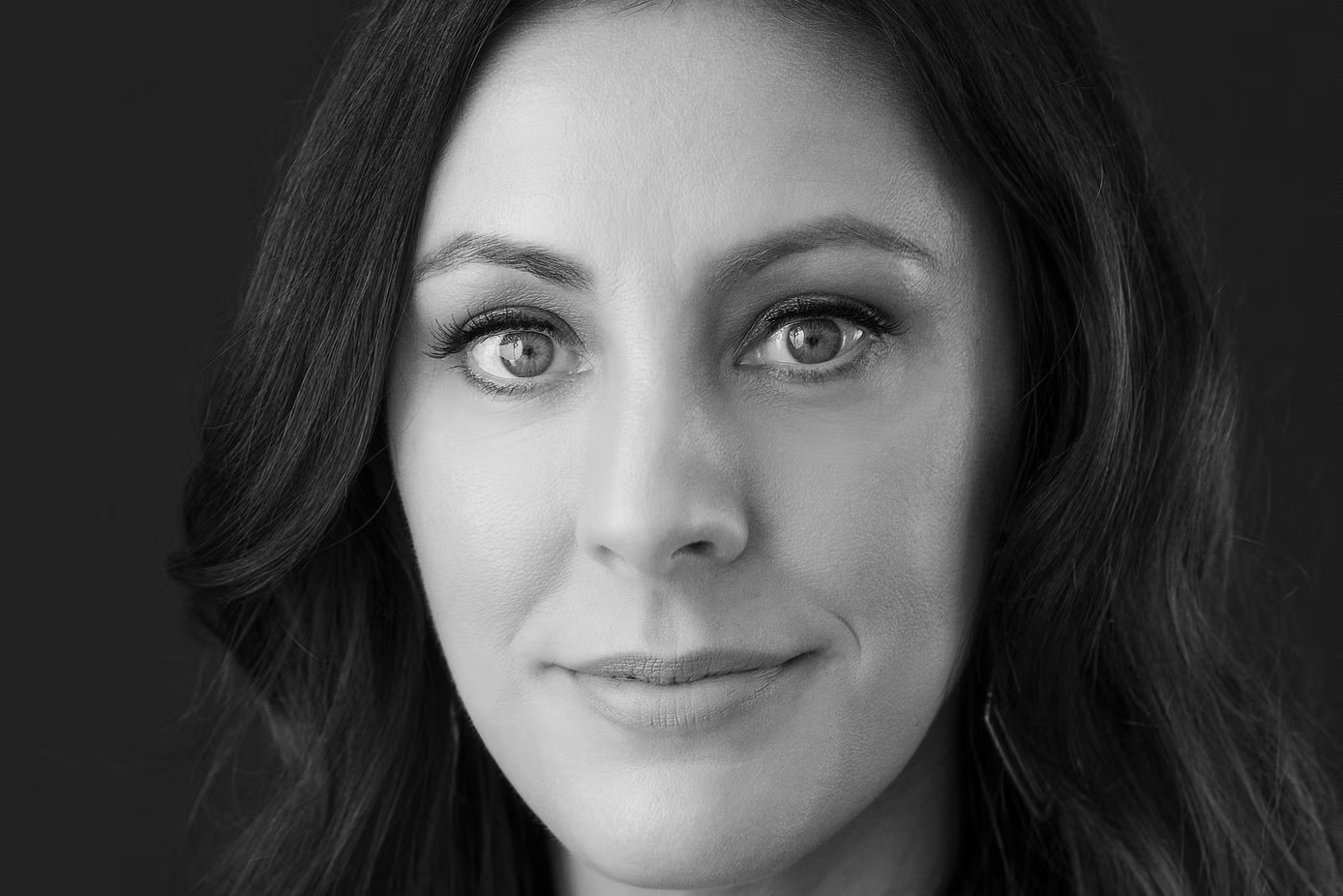
The image accompanying most of the trade coverage is a simple executive portrait credited to J.Crew itself, the kind of understated corporate photo that tends to run alongside leadership news, a notable contrast to the brand’s usual view language of sun bleached catalogs and Soho storefronts.
View this post on Instagram
who
Pierce is not a household name outside the beauty and retail trade press, but within it she carries real weight. She built her career at Estee Lauder over roughly twenty years, working her way up through senior positions that gave her exposure to global transformation work and channel innovation, the kind of behind the curtain operational muscle that rarely gets a headline of its own but ends up mattering enormously when a company is trying to modernize how it reaches customers.
From there she moved to Dyson in November 2022 to head up its beauty division as president, a role that put her in charge of a business unit still in its relatively early years of existence. Dyson had only entered hair care in 2016 with the original Supersonic dryer, following a lengthy and expensive engineering effort, and by the time Pierce joined, the brand was looking for someone who could turn strong engineering into an actual beauty business with the retail presence, marketing muscle, and category range to match.
She is a graduate of Southern Methodist University, and her public professional presence, visible through her LinkedIn profile, reads like a running log of Dyson Beauty product launches over the past several years, from the Supersonic r professional dryer developed with input from stylist Larry King, to the Airstrait styling tool that Time magazine later named one of its best inventions of the year, to the Nural update to the original Supersonic dryer. Pierce herself has described the pace of that period as a whirlwind, and the language tracks with what she is walking into now: another brand at an inflection point, needing someone to move quickly without breaking what already works.
in
The specifics of what Pierce accomplished at Dyson explain why J.Crew was willing to hire so far outside the apparel world for this role. Company statements credit her with tripling Dyson Beauty’s technology portfolio during her four year tenure and cementing the brand’s position in the premium beauty device category, a space that has only gotten more crowded and more competitive as rivals raced to copy the halo effect of the original Supersonic.
More strikingly, she is credited with building a full end to end formulations division from scratch, meaning Dyson Beauty did not simply add more hair tools to its lineup under her watch. It moved into an entirely different kind of product, formulated beauty items, and did so while bringing twenty seven products to market in just two years. That is an aggressive release cadence for any consumer brand, let alone one expanding into a category it had no prior footprint in.
It is worth pausing on why that particular experience translates so directly to what J.Crew needs. Dyson Beauty, like J.Crew, is a brand with enormous inherited equity, in Dyson’s case built on engineering credibility and premium positioning, and the challenge Pierce faced there was proving that equity could stretch into new categories without diluting what made the brand desirable in the first place. J.Crew’s board is clearly betting that the same instinct, expanding reach while protecting what is core to the brand, applies just as well to sweaters and denim as it does to hair dryers.
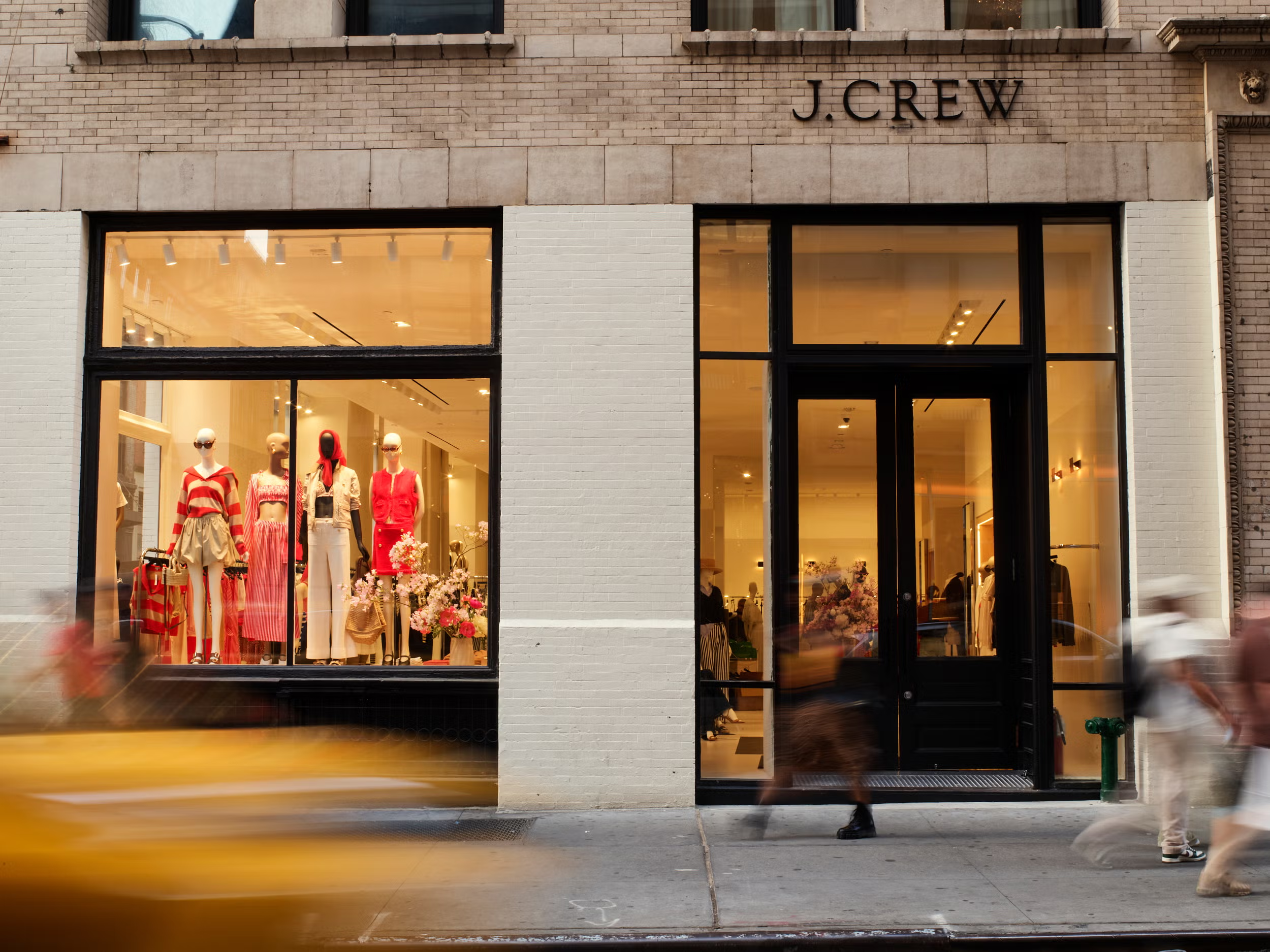
A J.Crew storefront featuring illuminated window displays and a bustling streetscape outside.
role
To understand why this hire carries weight, it helps to rewind to where J.Crew has been. The company, parent to J.Crew, Madewell, and J.Crew Factory, filed for Chapter 11 bankruptcy protection in April 2020 as the pandemic gutted physical retail, carrying roughly $1.7 billion in debt at the time. It emerged four months later through a debt for equity swap that wiped out most of that debt and installed Anchorage Capital Group as majority owner. Wadle, a longtime J.Crew and Madewell executive who had also spent years under Gap Inc. leadership earlier in her career, became CEO that November, inheriting a brand that had lost its cultural footing after a string of fashion missteps and leadership changes throughout the 2010s.
The recovery since then has been real. J.Crew reclaimed some of its cultural relevance, Madewell carved out its own distinct identity under the same parent company, and the retailer reopened a flagship womenswear store on Spring Street in Soho, marking its return to a neighborhood it had exited in 2018 during the worst of its contraction. Revenue has grown, and the group’s overall portfolio, which as of this month operates around 117 J.Crew stores, 158 Madewell locations, and roughly 375 J.Crew Factory stores across the country, looks nothing like the shrinking footprint of five years ago.
But retail analysts who follow the group closely have pointed out that the recovery so far has been an enterprise level story more than a brand specific one, with Wadle stretched across three distinct businesses that each need focused attention. Creating a president role dedicated solely to J.Crew, separate from Madewell and separate from the group level strategy Wadle now oversees, is a structural acknowledgment that the flagship brand needs someone whose entire job is thinking about J.Crew’s product, its customer, and its position in the market, full stop.
amb
Retail strategists who track the apparel sector see this less as a simple executive hire and more as a sharpening of accountability. The reasoning goes that J.Crew Group has spent several years stabilizing its finances and rebuilding brand credibility across its portfolio, and that Madewell in particular has developed a clear identity of its own during that stretch. What the group has lacked, in this reading, is a single person whose full attention sits with the J.Crew brand itself, rather than splitting focus across the enterprise.
There is an interesting parallel drawn between consumer electronics and apparel here too. Dyson built its beauty business on the same principles that any strong brand relies on: a distinctive identity, disciplined pricing that protects a premium position, and an emotional bond with the people who buy in. Those principles do not care what category they are applied to, and the argument from retail watchers is that J.Crew’s next phase depends less on simply selling more clothing and more on sharpening exactly what the brand stands for in a market where shoppers have nearly infinite choices and increasingly reward brands that make them feel like they belong to something, not just brands running a sale.
Pierce, for her part, framed her decision to join in personal terms rather than strategic ones. She described J.Crew as one of those rare brands that holds a genuine place in people’s lives, calling it beloved and relevant with what she sees as extraordinary room still to grow, and said she is honored to be joining Wadle and the wider team at what she called an exciting moment for the company. She also spoke about wanting to honor J.Crew’s storied history while building lasting connections with its customers going forward, language that suggests she is aware of exactly what she is inheriting: a brand with deep nostalgic equity from its 1983 founding through its Michelle Obama era cultural peak in the early 2010s, now trying to figure out what it means to a new generation of shoppers who never lived through either moment.
look
For now, the practical picture is straightforward. Pierce starts August 4, she will oversee merchandising, design, marketing, and retail for the J.Crew brand specifically, and she reports to Wadle, who continues to run the group’s overall strategy along with Madewell and J.Crew Factory. A company spokesperson has been clear that there are no current plans to create a similar dedicated president role at Madewell, where day to day leadership has been handled by the existing team since its previous president departed in September 2025, with Wadle continuing to drive that brand’s broader strategy herself.
What remains to be seen is how quickly Pierce’s beauty industry instincts show up in the actual product. J.Crew under women’s creative director Olympia Gayot and menswear counterpart Brendon Babenzien has spent the past few years leaning into archival references and a more elevated take on the brand’s original coastal, collegiate aesthetic, and the Soho flagship built around that vision has become something of a physical manifesto for where the brand wants to sit culturally. Whether Pierce pushes that direction further, pulls it toward faster category expansion in the way she did at Dyson, or lands somewhere in between will likely become clear over the next several retail seasons, starting with whatever the brand puts forward for its next holiday cycle under her watch.
There is also the matter of what her hire signals to the wider retail industry about where executive talent is coming from these days. Beauty and consumer electronics have both become proving grounds for the kind of operational speed that legacy apparel brands are now chasing, and Pierce’s move from Estee Lauder to Dyson to J.Crew traces a path that other struggling or recovering apparel names may well look to replicate if this appointment pays off the way J.Crew’s leadership is clearly hoping it will.
It is also a hire that fits a broader pattern playing out across American retail right now, where boards recovering from a rough decade are increasingly reaching outside their own category for leadership, betting that someone who has already proven they can scale a brand quickly will bring more value than another executive steeped only in apparel. Dyson itself borrowed heavily from consumer electronics thinking when it built its beauty division from nothing, hiring engineers and beauty operators side by side rather than defaulting to a traditional cosmetics company org chart. J.Crew appears to be making a similar wager, that the instincts Pierce sharpened building a hair care and skincare business from the ground up will translate just as well to denim, knitwear, and the kind of considered basics that built the brand’s reputation in the first place.
n
From the DRIFT archive: No Me Quiero Ir De Aquí — The Story of Bad Bunny and FRSH Company’s Puerto Rican Streetwear Moment · Jodie Foster Narrates Morgan Neville’s Breakdown: 1975: A Cultural Autopsy of the Most Radical Year in American Cinema
Related Articles

American Horror Story Opens the Vault for a Thirteen-Episode Reunion of Its Own Ghosts
Three half-hour episodes land September 24 on FX and Hulu, with Jessica Lange, Sarah Paulson […]