DRIFT AUDIO
Listen to this story
Choose a voice, then press play.
collision
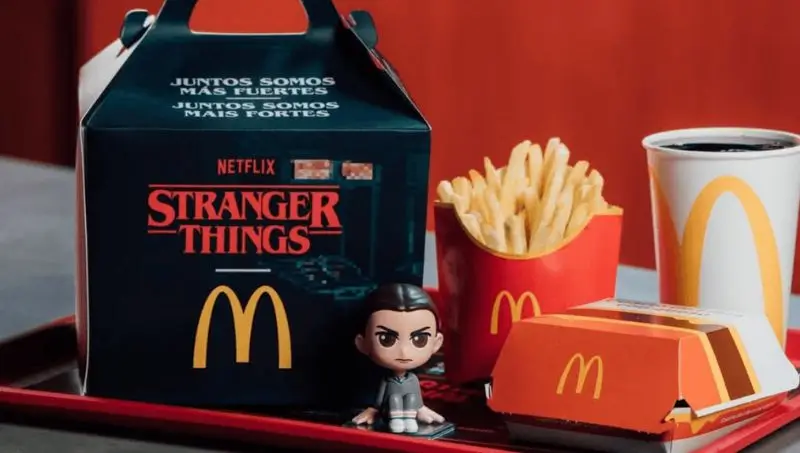
McDonald’s has mastered the cultural crossover, but the arrival of its Stranger Things menu marks an entirely different level of immersion—an edible expansion of the show’s universe that feels both cinematic and collectible. This collaboration doesn’t simply slap logos on wrappers; it translates the retro, spine-tingling atmosphere of Hawkins directly onto the tray, merging fast-food Americana with sci-fi nostalgia in a way that feels perfectly timed. As Stranger Thingsnears its final chapter, the appetite for anything tied to the franchise has intensified, and McDonald’s taps that emotional frequency with precision.
This isn’t just a seasonal promo—it’s a world-building exercise. From the vintage-style packaging to the diner-era typography echoing the 1980s Midwest aesthetic, everything hits that sweet spot between memory and myth. Fans don’t just buy a meal; they’re stepping into a set piece, participating in a storyline, and capturing a moment that feels like a shared cultural checkpoint. Retro food culture has been trending hard, and McDonald’s leans into it with confidence, reinforcing its place as the fast-food chain most fluent in nostalgia.
flow
At the pithy of this partnership is the Hellfire Sauce—a fiery, smoky, almost rebellious condiment positioned as an homage to the Hellfire Club of the series. It arrives with an energy that feels mischievous and dangerous, the edible equivalent of rolling a natural 20 in a high-stakes D&D session. What makes the Hellfire Sauce stand out isn’t just the spice level but the intentionality behind its flavor profile. It’s bold without being punishing, layered with heat that blooms rather than overwhelms, and crafted to pair effortlessly with McDonald’s staples.
The name alone carries weight. “Hellfire” evokes the supernatural threat of the Upside Down while also nodding to teenage rebellion, secret clubs, and the thrill of pushing boundaries—exactly what Stranger Things has always embodied. It feels like something you’d dare your friends to try in high school, not because it’s unbearable but because it builds hype, invites reactions, and becomes an inside joke. And in today’s food culture, where virality can hinge on a single dip, McDonald’s understood the assignment.
Fans instantly gravitated toward the sauce as a centerpiece, using it creatively with fries, nuggets, burgers, and even—unofficially—breakfast menu items. Social media quickly flooded with taste-tests, spice-alerts, mock D&D rolls, and Hawkins-themed unboxings. Hellfire Sauce became more than a condiment; it became content.
idea
One of the strongest elements of this crossover is the packaging. McDonald’s didn’t settle for thematic stickers or minimal branding—they developed full retro kits that place each customer inside the world of the show. The wrappers mimic ’80s fast-food graphics, the bags feel like they belong on a Hawkins counter, and the drink cups look like props designed for a scene with Eleven, Mike, or Dustin.
There’s a tactile pleasure in this kind of branding. It’s crinkly paper as time-travel. And for a generation raised on digital ephemera, holding a physical crossover item carries weight. Many customers began saving the packaging as memorabilia, flattening bags, preserving boxes, and even listing unused sets on resale platforms as “Stranger Things x McDonald’s collectibles.” This isn’t surprising—nostalgia items tied to major franchises repeatedly find their way into fandom circulation, gaining value as the shows reach new milestones or finales.
For McDonald’s, this level of attention to design is strategic. A thematic meal with cinematic packaging creates an emotional loop: fans buy for the food, stay for the immersion, and return for the ritual. It’s the kind of branding that turns a limited-time promo into a cultural memory.
show
The fast-food industry has been shifting toward full sensory experiences, and McDonald’s is leading the movement. The Stranger Things menu isn’t simply about feeding customers; it’s about making them feel part of a world that extends beyond the restaurant. Fans walk in expecting dinner, but they walk out with an experience they can share—photos, reactions, collectibles, and a sense of participation that goes beyond the meal.
The timing is key. As Stranger Things approaches its final season, the emotional momentum is at an all-time high. Audiences are craving closure, nostalgia, and opportunities to reconnect with the world they’ve grown up with since 2016. This collaboration offers that, framed through a brand nearly everyone has childhood memories of. It’s a dual nostalgia hit: McDonald’s as the after-school hangout and Stranger Things as the coming-of-age phenomenon.
What elevates this partnership even further is the interplay between the supernatural and the everyday. The food remains familiar—the fries, the McNuggets, the classic burgers—yet the environment feels altered, charged with atmosphere, suspense, and fan-driven meaning. It’s fast food reimagined with lore, a bite-sized blockbuster delivered in takeout form.
collect
The success of the Stranger Things menu signals something bigger happening in global food culture. Fast-food drops are becoming more like sneaker releases: limited, aestheticized, and content-driven. People aren’t just hungry for the meal; they’re hungry for the moment, the exclusivity, the bragging rights. They want to participate in something that sparks conversation, trends, and community.
McDonald’s understands that the modern diner is also a digital storyteller. Everything from the Hellfire Sauce to the vintage wrappers to the Hawkins-coded typography invites social sharing. The connection builds an ecosystem where food becomes fashion, fandom becomes ritual, and branding becomes collectibility. It’s a playbook that has worked with anime collabs, streetwear tie-ins, and character-driven campaigns across the globe.
With the Stranger Things crossover, McDonald’s has delivered something deeper than a themed meal. It’s a cultural checkpoint marking the ascent toward the show’s final season. It’s a shared experience for fans who grew up watching Hawkins unfold. And it’s a reminder that food—especially fast food—can still create moments that feel magical, communal, and unforgettable.
The Hawkins heat is real, and the Hellfire Sauce is only the beginning.
Read Drift’s related feature, From Hawkins With Style: Nike’s Stranger Things Dunk Bids Farewell to the Upside Down.
Related Articles

Garage Italia’s Electric Spiaggina Puts the Fiat 500’s Riviera Years on Battery Power
Ten kilowatts, rattan seats and a €85,000 starting price: Garage Italia's 500 Spiaggina rebuilds Ghia's 1958 beach car for the yacht crowd.