Meryll Rogge S/S 2026: A View of Lightness and Rebellion

April 19, 2026
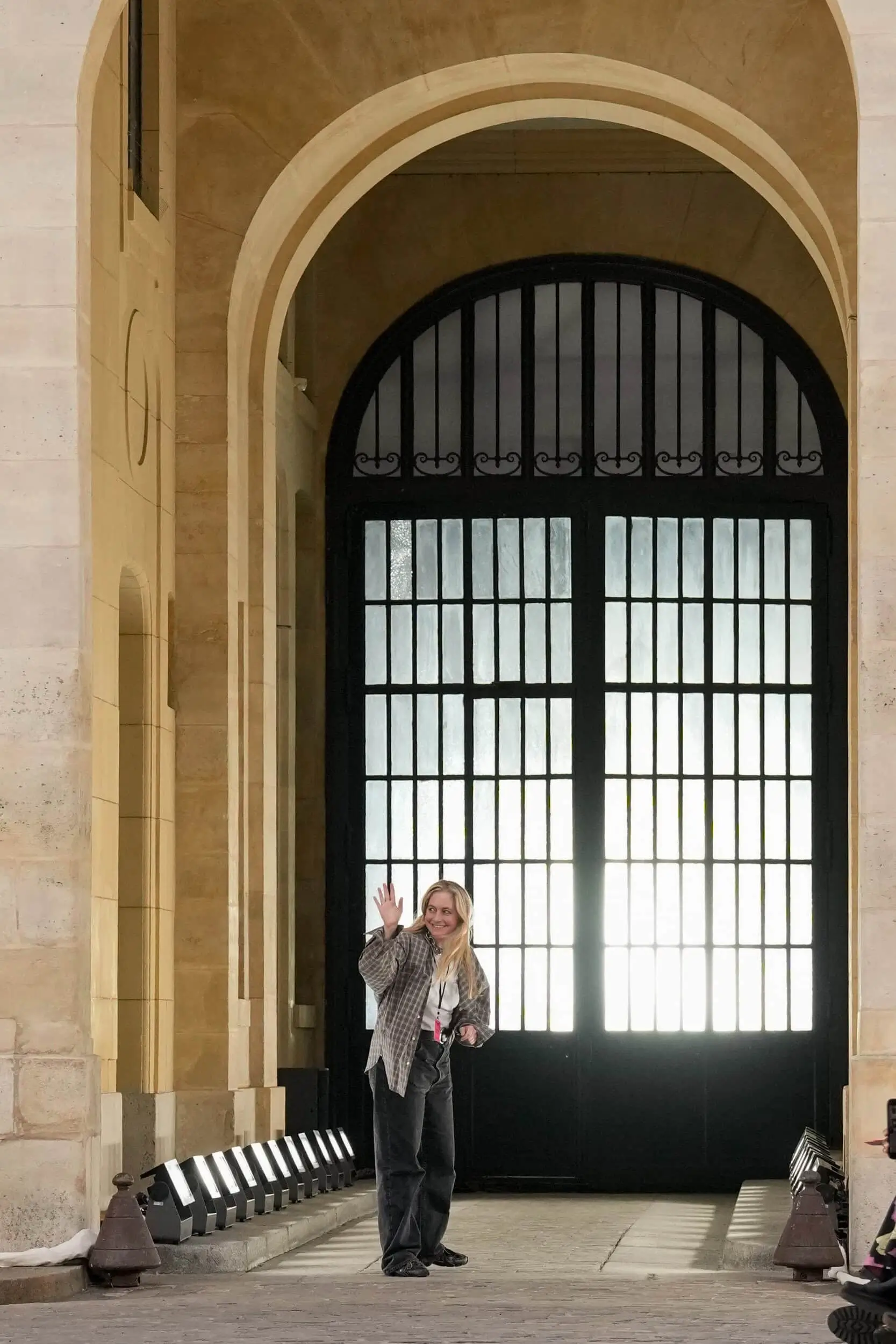
The Paris Fashion Week calendar often rewards spectacle—scale, celebrity, and speed. Yet on March 3, 2026, inside the storied halls of the Palais Brongniart, Meryll Rogge offered something quieter, more deliberate, and ultimately more enduring. Her Spring/Summer 2026 collection did not attempt to overwhelm. It unfolded with intention.
Positioned as the closing punctuation of a dense week, the show carried a clarity that felt almost corrective. Where the broader industry continues to tilt toward consolidation and acceleration, Rogge’s work insists on something else: authorship. Not as branding, but as method. Celebrated by Vogue for its “strong and strongly witty” vision, the collection stood as a precise articulation of independent, woman-led design thinking—one that resists simplification and instead builds meaning through contrast, tension, and emotional intelligence.
At its core, this was not simply a seasonal proposition. It was a study of lightness—not as fragility or absence, but as a cultivated state of clarity. A way of moving through structure without being confined by it. Rogge’s work suggests that lightness is not about reduction, but about precision: knowing what to keep, what to strip away, and how to allow garments to carry both emotional and physical weight without collapsing under either.
stir
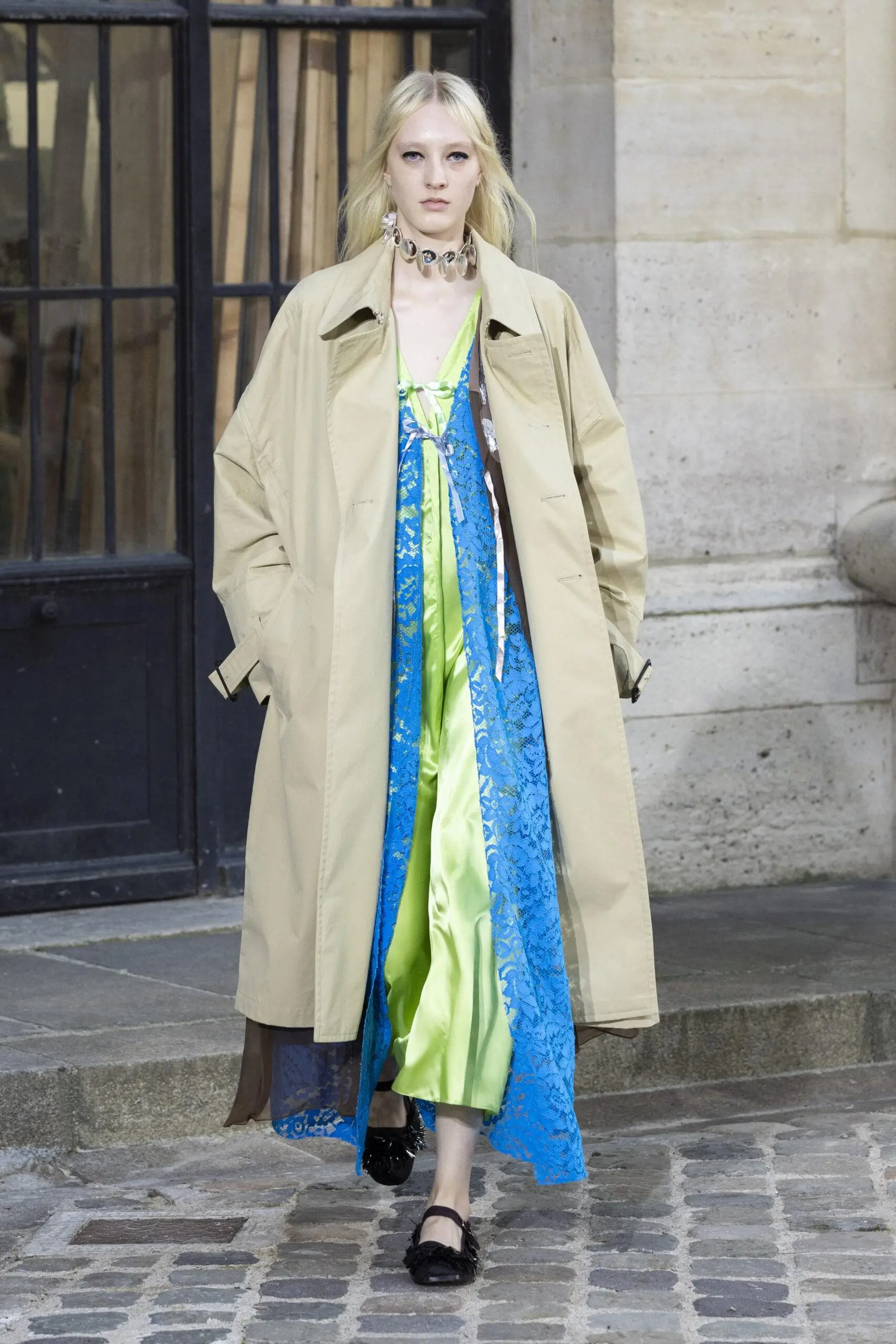
From the first look, Rogge established a visual and conceptual grammar rooted in duality. An acid-lime boudoir slip—delicate, almost translucent—was layered beneath a kingfisher-blue lace peignoir. The pairing was immediate, disarming, and exact.
The slip, intimate and exposed, suggested vulnerability—not weakness, but openness. The peignoir, intricate and structured, functioned as a counterweight, offering a sense of protection without obscuring what lay beneath. This tension between exposure and concealment became the collection’s organizing principle. It was not resolved. It was sustained.
In this way, Rogge sidestepped the binary narratives that often define contemporary womenswear. Rather than choosing between softness and strength, she proposed their coexistence. A femininity that does not reconcile contradiction, but lives within it. The garments did not attempt to stabilize the wearer into a fixed identity; instead, they allowed for fluctuation, for contradiction, for movement between states.
flow
The collection’s backbone lay in its series of short, swingy dresses—a silhouette widely present across the season, yet here recalibrated through Rogge’s specific lens. These were not trend pieces. They were interventions.
Rendered in vivid sky-blue satin, several dresses featured collaged floral-check compositions, their asymmetry suggesting both spontaneity and construction. The seams did not disappear—they spoke. Leather bows punctuated certain pieces, introducing moments of weight and interruption, while others were layered over sport-inflected garments, collapsing distinctions between lingerie, daywear, and evening.
What emerged was not hybridity for its own sake, but a reflection of contemporary dressing as lived experience. Clothing that adapts to context rather than dictating it. A wardrobe built not on rules, but on response. Rogge’s dresses moved not just physically, but conceptually—shifting between categories, refusing to settle into a single definition.
intel
Perhaps the most intellectually rigorous dimension of the collection lay in its material contrasts. Rogge approached fabric not as surface, but as language—each pairing constructing meaning through opposition.
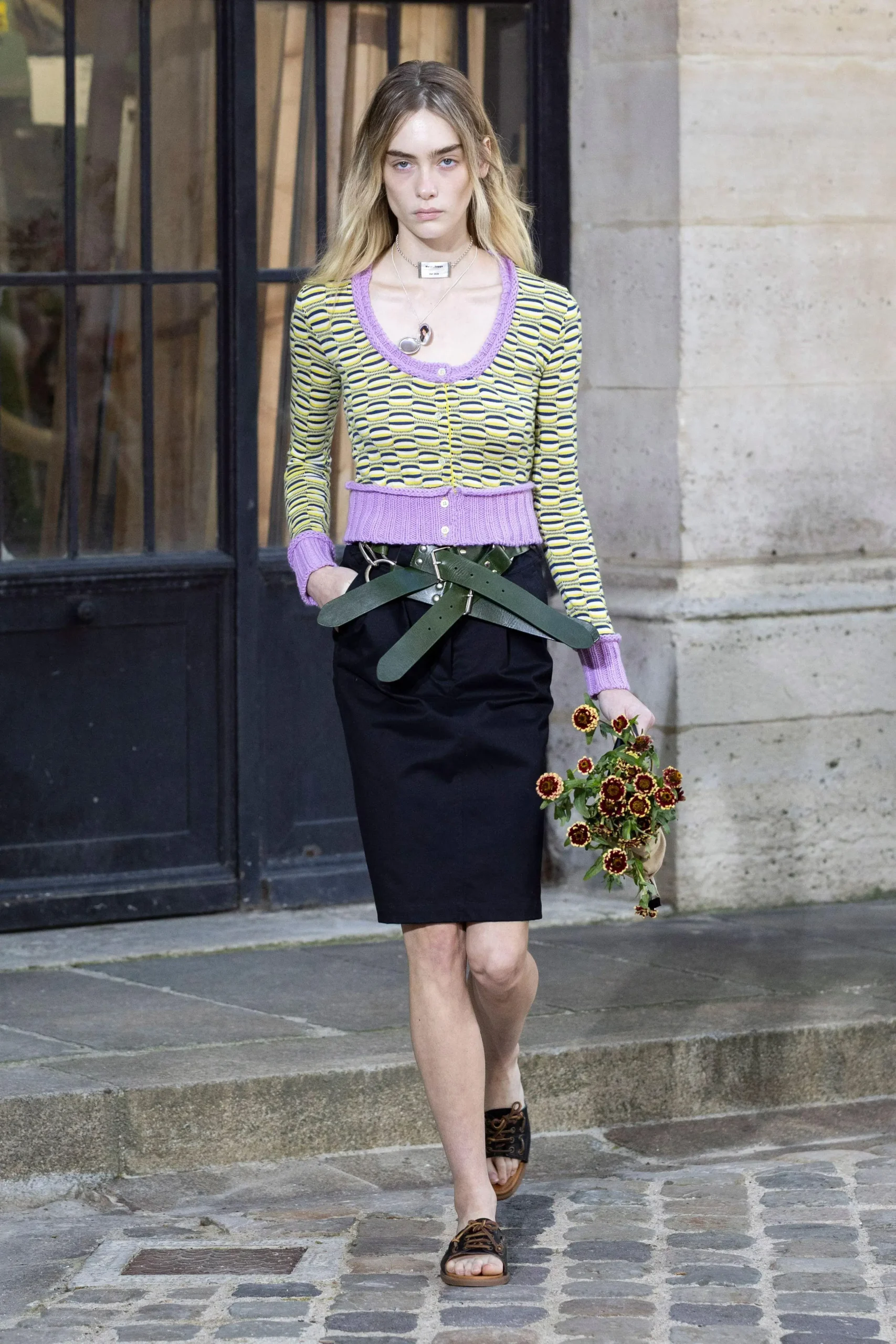
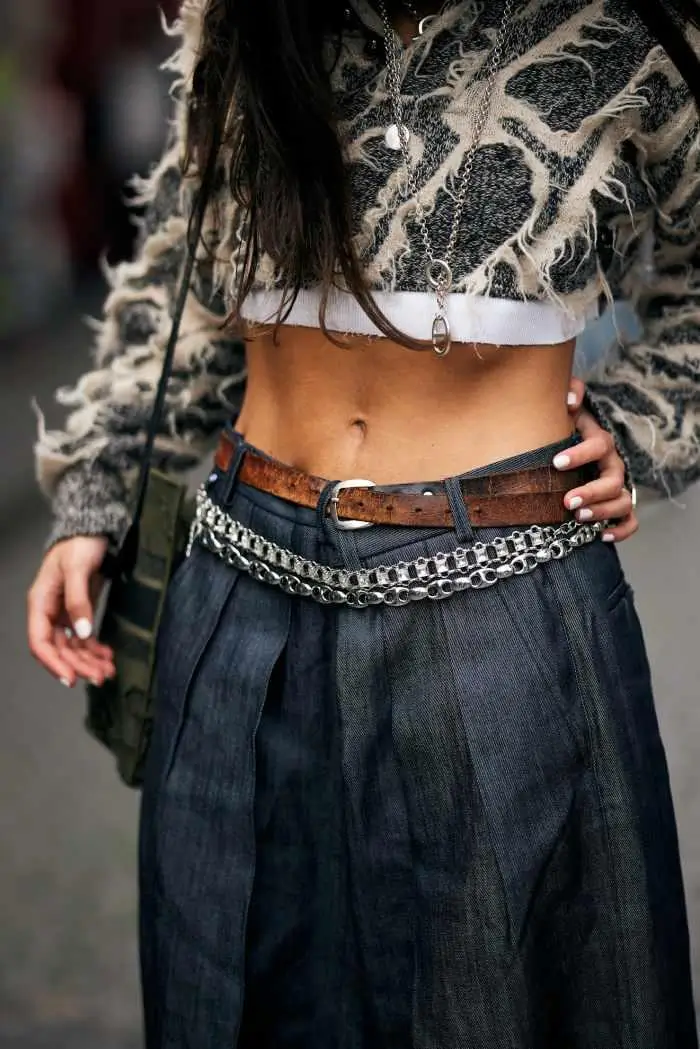
Hand-knit sweaters, with their homespun irregularity, were set against low-slung leather skirts structured by multiple belts. The belts—layered, overlapping, almost architectural—did more than secure. They redefined proportion, pulling the eye downward, destabilizing traditional waistlines, and introducing a new rhythm to the silhouette.
Elsewhere, shrunken jacquard knits sat beneath oversized leather jackets, exaggerating volume through compression. The body was not simply dressed; it was reframed. These combinations resisted hierarchy. Soft did not subordinate to hard. Craft did not yield to industry. Instead, each material maintained its integrity while contributing to a broader, more complex whole.
Rogge’s material logic rejects the idea that luxury must be smooth, polished, and resolved. Instead, she proposes that richness can come from tension—from the friction between textures, from the visible negotiation between elements that do not naturally align.
tailor
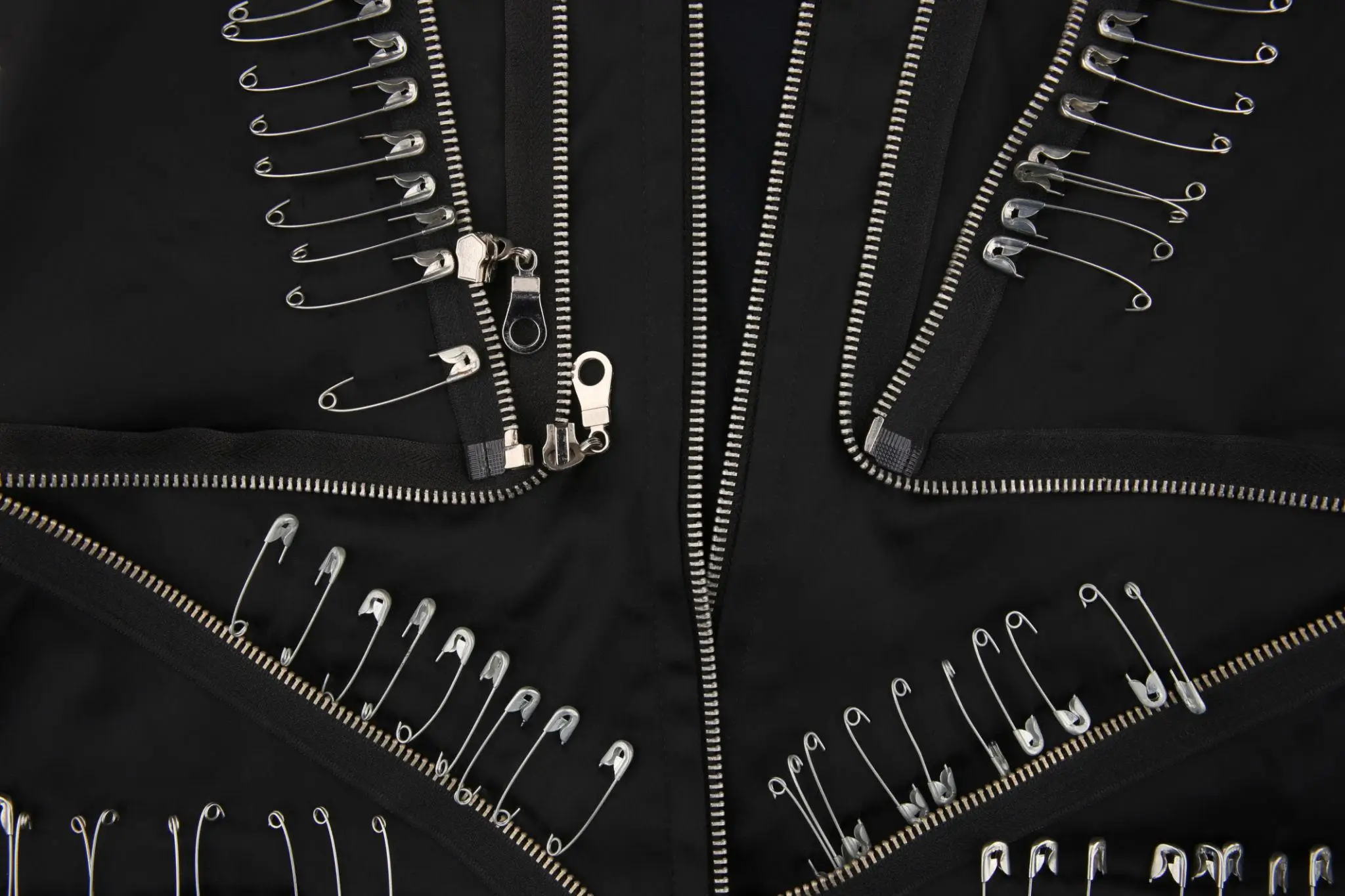
Rogge’s approach to tailoring was equally subversive. Classic English tweed coats—symbols of continuity, heritage, and control—were punctured with jeweled safety pins. The gesture was simple, but its implications were layered.
The pins disrupted the surface, catching light, introducing irregularity. They did not destroy the garment; they recontextualized it. Tradition, here, was not rejected—it was edited. The act of puncturing became a form of authorship, a way of marking the garment as lived-in, reconsidered, reworked.
This philosophy extended into collaged shirts, where floral-check fabrics were spliced and reassembled. Seams remained visible, almost emphasized, marking the act of construction as part of the final form. Imperfection was not hidden. It was authored.
In these moments, Rogge articulated a quiet but firm position: refinement and rebellion are not mutually exclusive. They are most compelling when intertwined. The garments do not shout their subversion; they embed it within their construction.
tincture
Color in this collection operated with intention rather than decoration. Rogge deployed it as a system—one that translated emotional states into visual cues.
Acid-green accents cut sharply through neutral beiges and trench-inspired tones, functioning almost as signals—interruptions of calm, flashes of energy. Blues and whites, by contrast, grounded the collection, offering a sense of openness and breath.
This balance produced a specific kind of lightness. Not emptiness, but clarity. A removal of excess without a loss of intensity. The palette suggested that emotional expression in clothing does not require saturation or spectacle; it can emerge through precision, through restraint, through carefully calibrated contrast.
In this sense, color became a form of narrative shorthand—an immediate way of communicating mood without relying on overt symbolism.
lang
Spring/Summer 2026 also marked a structural expansion for Rogge’s label, with the introduction of footwear. Boat shoes—traditionally coded as casual, even conservative—were reimagined across multiple forms, including a striking knee-high variation.
These designs were elevated through collaboration with Wouters & Hendrix, whose signature hardware—spikes, chains, silver studs—introduced a sharper edge. Accessories followed suit: graphic chokers, layered necklaces, pieces that did not decorate so much as define.
Together, they extended the collection’s central dialogue. Refinement, again, met disruption. Utility met ornament. The boundary between accessory and garment dissolved, reinforcing Rogge’s broader commitment to fluidity—not just in silhouette, but in function.
self
Beyond the garments themselves, the collection carried a broader significance. At a time when independent designers are increasingly absorbed into larger systems, Rogge maintained a distinctly personal voice.
Her simultaneous preparation for her role at Marni added another layer of complexity. Rather than diluting her perspective, this duality appeared to sharpen it. It demonstrated an ability to navigate multiple creative identities without collapse, to maintain coherence across contexts that often demand compromise.
“I have different creative outlets for different things I want to express,” she noted. The statement resonates not as division, but as expansion. A recognition that authorship can exist across platforms without becoming diluted or generic.
View this post on Instagram
stud
From an educational standpoint, the Spring/Summer 2026 collection offers a rich framework for analysis. It engages directly with questions of narrative construction, material hierarchy, and gender expression, positioning clothing as both artifact and argument.
It demonstrates how garments can operate as carriers of meaning—how structure can suggest freedom, how imperfection can signify control, how lightness can be constructed rather than assumed. It also provides a model for how designers can build coherence without rigidity, allowing collections to evolve organically rather than conforming to predetermined narratives.
For students and observers alike, Rogge’s work underscores the importance of intention. Every detail—material, color, proportion—functions as part of a larger system. Nothing is incidental. Nothing is purely decorative.
endure
The lasting power of the collection lies in its refusal to simplify. It does not reduce femininity to a single narrative, nor does it resolve the tensions it introduces. Instead, it allows them to exist, to circulate, to inform the way the garments are worn and understood over time.
In this sense, the collection extends beyond the runway. It becomes a framework—a way of thinking about clothing not as fixed identity, but as evolving language.
And that may be its most significant contribution. In an industry constantly searching for the next new thing, Rogge offers something rarer: a reminder that innovation is not always about invention. Sometimes, it is about precision. About knowing exactly how much to say—and how much to leave open.
Related Articles

France Just Banned Social Media for Kids Under 15, and the Fight Over Anonymity Is Only Getting Started
France becomes the first EU nation to bar under 15s from social platforms, and critics […]