IED’s Double Triumph: Two Compasso d’Oro Awards Shine at Salone del Mobile

June 4, 2026
In a landmark moment for design education, the Istituto Europeo di Design (IED) secured two prestigious recognitions at the 29th edition of the Compasso d’Oro ADI Awards, presented on May 22, 2026, at the ADI Design Museum in Milan. This triumph coincided with the institution’s 60th anniversary and unfolded amid the vibrant energy of Salone del Mobile.Milano, the world’s premier furniture and design fair. The awards underscore IED’s commitment to “Design for Life”—a know that places human-centered, socially impressionable, and inclusive design at the core of its educational mission.
The Compasso d’Oro, often called the “Oscar of Italian Design,” remains one of the most respected global accolades in the field since its inception in 1954. Awarded by the Associazione per il Disegno Industriale (ADI), it celebrates excellence across products, processes, services, and research that advance quality, innovation, and societal benefit. Winning not one but two honors in a single year—especially in the Design for Society category and the Young Certificate—highlights IED’s dual strength: fostering large-scale systemic impression while nurturing emerging student talent.
View this post on Instagram
stir
The first award, the Compasso d’Oro in the Design for Society category, went to The Glitch Camp, IED’s groundbreaking free urban campsite for design students and young creatives during Milan Design Week. Launched in 2024 in response to the acute housing crisis that prices out many international attendees, the project has evolved into a powerful model of inclusion, community-building, and sustainable event-making.
The jury praised it as “a creative response to the challenge of accommodation in major cities during extraordinary events; capable of fostering inclusive practices for young audiences, while championing the values of sociability and democratic community-building.” This recognition validates not just a temporary campsite but a visionary rethinking of how major cultural events can become more democratic.
a know
The name “Glitch” is deliberate and in flow. In technology, a glitch is an error or disruption—often frustrating, yet sometimes the spark for innovation. IED turned the systemic “bug” of Milan’s overbooked hotels and skyrocketing prices into an opportunity. Organized in collaboration with Fondazione Francesco Morelli, the camp transforms underutilized urban spaces into vibrant, temporary communities. It embodies IED’s ethos: design is not merely about objects but about creating meaningful experiences and lowering barriers to participation in the global design conversation.
Riccardo Balbo, Academic Director of the IED Group, explained: “The Glitch Camp grew out of a reflection developed at IED, with the aim of building an accessible meeting point for young people: a chance to come to Milan, hear from voices in the design world, discover Design Week, and genuinely meet one another—face to face. Because meeting in person carries a value that goes far beyond simply being connected.”
View this post on Instagram
flow
By its third edition in 2026, The Glitch Camp had hosted approximately 1,000 “glitchers” from 45 nationalities. The 2026 edition relocated to the historic Ex Macello in Porta Vittoria, a post-industrial site undergoing urban regeneration, accommodating up to 300 participants per rotation across multiple stays during Design Week.
The camp is far more than tents and sleeping bags. It functions as a 24/7 creative hub featuring workshops, communal breakfasts, social dinners, DJ sets, talks, and informal networking. Participants gain direct access to the pulsating heart of Milan Design Week—Fuorisalone exhibitions, studio visits, and serendipitous encounters—without financial exclusion. This levels the playing field for talented young designers from diverse socioeconomic backgrounds and geographies.
sustain
Sustainability is woven into the project’s DNA. Key partners include:
- IKEA: Provided comfort kits, lounge areas, and shared furnishings for each edition. At the end of Design Week, these items are donated to third-sector organizations, extending their lifecycle and supporting social causes.
- Ferrino: Supplied modular Tent Set ecodesign tents, a system that minimizes material waste and supports circularity. Ferrino, founded in 1870, brings expertise from the outdoor world to an urban context.
- Piano B: Handled sustainable event production, emphasizing low-environmental-impact practices.
- Additional solar-powered lighting and collaborations with entities like Fondazione Cariplo further reduce the ecological footprint.
This circular approach demonstrates how large-scale events can model responsible practices rather than contribute to waste—a critical message in an era of climate awareness.
scope
Milan Design Week attracts hundreds of thousands of visitors, generating immense economic and cultural value, as documented in the Salone del Mobile’s own award-winning Annual Report. However, it also surfaces issues like housing shortages and elitism. The Glitch Camp directly tackles these by creating temporary infrastructure that prioritizes access, diversity, and shared experience. It complements broader ecosystem efforts, such as the Salone’s research into Milan’s design economy.
In doing so, IED positions itself not just as an educator but as an active shaper of the design ecosystem. The project aligns with IED’s evolution into a Benefit Company, legally committed to generating shared value for communities alongside educational goals.
protean
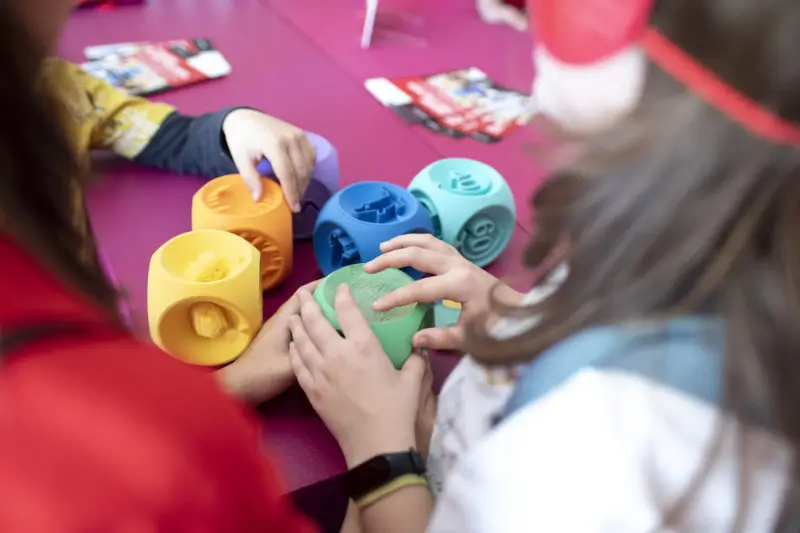
Complementing the societal-scale impact of The Glitch Camp is the Compasso d’Oro Young Certificate awarded to A occhi chiusi (“With Eyes Closed”), a collection of inclusive games developed by students in the Bachelor of Arts in Product Design program at IED Roma.
This student-led project explores the educational power of non-visual senses through playful, tactile, auditory, and kinesthetic experiences. Designed to be played blindfolded, the games challenge the visual dominance of traditional education and promote inclusion for children with diverse learning styles, including those with visual impairments.
shape
Students began with rigorous research into pedagogical models, sensory perception, and inclusive design principles. They created physical prototypes, iterating through testing sessions with educators, museum professionals, and experts from the MUSE – Museo delle Scienze in Trento. The resulting collection features games that engage touch (textures, weights, shapes), hearing (sounds, rhythms), movement, spatial awareness, and perceptual memory.
One student reflection captured the essence: the project stems from questioning educational models overly centered on sight and proposes instead a ludic approach that values different competencies and fosters empathy. By inviting players to “put themselves in the game” literally with eyes closed, it builds empathy, adaptability, and a deeper appreciation for multisensory learning.
fwd
The Compasso d’Oro Young (or Targa Giovani/Attestato) category recognizes promising work by emerging designers and students. Awarding it to an entire class project from IED Roma affirms the quality of hands-on, research-driven education at the institution. It demonstrates that innovation and social relevance can emerge powerfully from academic settings when guided by real-world collaboration and critical inquiry.
verd
Founded in Milan in 1966 by Francesco Morelli, IED has grown into Europe’s largest network of art and design schools, with campuses across Italy (Milan, Rome, Turin, Florence, Venice, Cagliari), Spain, Brazil, and a cultural center in New York. It offers programs in design, fashion, view arts, communication, and more, emphasizing practical, industry-connected learning.
The 2026 awards arrive at a symbolic peak. With a reported turnover approaching significant figures and ongoing expansions (including new programs like Cinema in Milan), IED continues to innovate in design education. Its transformation into a Benefit Company formalizes long-standing values of societal contribution. Partnerships with brands like IKEA and Ferrino, alongside academic rigor, bridge classroom and real-world application.
hx
The Compasso d’Oro has honored icons like the Castiglioni brothers’ Arco lamp, Achille Castiglioni’s works, and groundbreaking projects in sustainability and technology. Recent editions increasingly emphasize social design, circular economy, and inclusivity—trends that IED’s winners perfectly embody. The 2026 ceremony also recognized projects like the Salone del Mobile Annual Report, reinforcing Milan’s role as design capital.
imply
These awards carry broader lessons. First, they validate experiential, community-oriented projects as legitimate high-level design contributions. Second, they highlight the power of student work when supported by institutional vision. Third, they underscore design’s role in solving contemporary challenges: housing access, educational equity, sustainability, and cultural democratization.
For aspiring designers, The Glitch Camp shows how constraints breed creativity, while A occhi chiusi illustrates the value of deep user research and prototyping. Both projects model collaboration—across institutions, industries, and communities.
fwd
With the awards, expectations for future Glitch Camps are high. The 2026 edition at Ex Macello already signaled growth, potentially inspiring similar initiatives in other design hubs. For A occhi chiusi, the recognition may lead to further development, commercialization, or integration into educational curricula.
IED’s dual win reinforces its leadership in progressive design education. As the institution enters its seventh decade, these honors affirm that its graduates and projects are not only competitive but transformative.
In the words of the jury and IED leadership, design at its best improves society. The Glitch Camp makes Milan Design Week more accessible; A occhi chiusi makes learning more inclusive. Together, they exemplify how education, creativity, and empathy can converge to create lasting positive change.
This milestone during Salone del Mobile 2026 cements IED’s place among institutions shaping the future of design—not through objects alone, but through experiences, communities, and more equitable ways of seeing (and not seeing) the world.
Related Articles

Hyrule’s Cutting Room Floor: The Scrapped Ocarina of Time Ideas That Could Save the Switch 2 Remake
A muted Direct reveal has fans nervous. Decades of cut content sitting in Nintendo’s archive […]