Sabrina Carpenter and Madonna at Coachella 2026: A Defining Pop Anointing Under the Desert Sky

April 18, 2026
As the sun dipped below the San Bernardino Mountains on Friday, April 17, 2026, the Coachella Valley Music and Arts Festival pulsed with anticipation. Sabrina Carpenter, stepping into her first headlining slot, opened her set with the precision of a seasoned performer—each note, each costume change, each choreographed moment a testament to the meticulous craft of modern pop. Dressed in a custom red peacoat by Jonathan Anderson for Dior that flared open to reveal a shimmering mini dress, she embodied a new kind of star: polished, self-aware, and deeply connected to the view language of fame.
But no one could have predicted the moment that followed.
stir
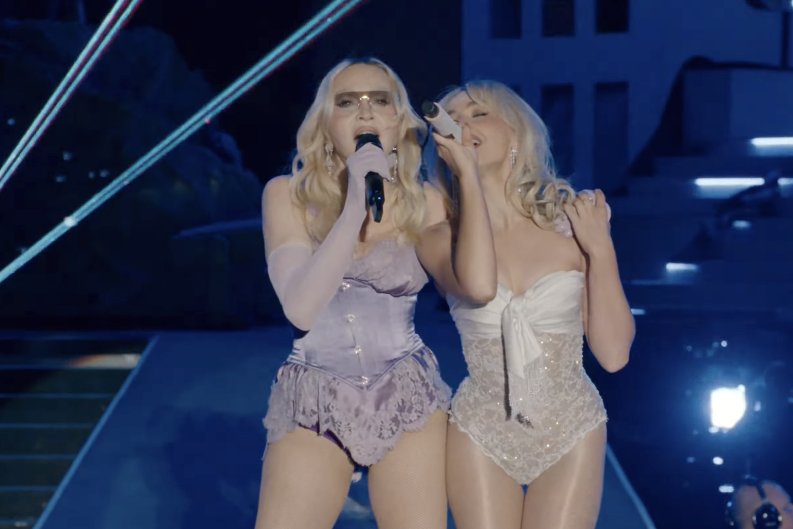
Midway through her set, as the beat dropped into a medley of her biggest hits, the stage lights dimmed. A hush fell. Then, from the silhouette, a figure emerged—tall, poised, unmistakable. Madonna, clad in a reimagined version of the corset, jacket, and boots she wore during her legendary 2005 Coachella performance, walked forward like a ghost from pop’s golden age—except this time, she was very much alive, very much present, and utterly commanding.
The crowd erupted. Phones rose. Time seemed to stop.
What followed was not just a performance—it was a ritual. The two artists, separated by nearly four decades in age but united by an unspoken lineage, launched into “Vogue,” the 1990 anthem that once redefined visibility for LGBTQ+ culture. The choreography was tight, the energy electric. Then came “Like a Prayer,” Madonna’s 1989 gospel-infused masterpiece, now backed by a full choir that swelled beneath the desert sky. The song, once controversial, now felt like a hymn—a prayer not just for redemption, but for unity.
And then, the revelation.
View this post on Instagram
flow
As the final notes faded, Madonna stepped forward. “I wrote this for anyone who’s ever felt trapped,” she said, her voice steady, resonant. “By expectation. By time. By fear. This is for the ones who still believe in freedom.” The first chords of “I Feel So Free” pulsed through the speakers—a soaring, synth-laden anthem layered with spiritual urgency, blending elements of house, gospel, and art pop. It was the lead single from Confessions II, her upcoming album set for release on July 3, 2026. The track felt both personal and universal, a declaration of liberation that echoed across generations.
Carpenter’s role in this moment was not incidental. Her entire set had been a narrative arc—four custom Dior ensembles, each marking a transformation. From the red coat to the gold fringe, the beaded bra, and finally the black lace bodysuit crowned with an avant-garde cape for “Espresso,” she moved through archetypes: ingenue, starlet, temptress, queen. When Madonna appeared, it was as if the final act had arrived—not to overshadow, but to affirm.
This was not just a guest appearance. It was a symbolic anointing.
show
In pop culture, few moments carry the weight of intergenerational recognition. Madonna, who once redefined what it meant to be a female pop star—defying censorship, owning her sexuality, and weaponizing controversy—now stood beside an artist who had grown up watching her videos on loop. Carpenter, in turn, represented a new era: one where pop is both hyper-curated and deeply personal, where image and authenticity coexist.
This exchange was not staged in the traditional sense. It wasn’t an awards-show duet or a pre-announced collaboration engineered for streaming numbers. It unfolded organically, almost mythologically, as if summoned by the very structure of pop history itself. The baton did not simply pass—it was recognized, acknowledged, and reframed in real time.
Madonna’s presence was not about nostalgia. It was about authorship. She has long been the architect of reinvention, a figure who bends time by refusing to be fixed within it. Standing beside Carpenter, she did not appear as a relic, but as a living framework—proof that pop’s past is not static, but generative.
idea
The fashion, too, told a story. Anderson’s designs for Carpenter paid homage to vintage Hollywood while asserting a bold, contemporary identity. Each look functioned as a chapter, advancing the narrative rather than decorating it. The red peacoat signaled arrival. The gold fringe introduced motion, spectacle, and risk. The beaded bra hinted at vulnerability and exposure. And the final black lace bodysuit—paired with an almost theatrical cape—cemented her transformation into something mythic, something sovereign.
Madonna’s return to her 2005 silhouette was not nostalgia—it was continuity. She wasn’t reliving the past; she was proving its relevance. The corset, once a symbol of constraint, became a symbol of control. The boots, grounded and unapologetic, echoed her decades-long insistence on presence. Together, the garments formed a dialogue: past and present speaking in the same visual language, across time.
audience
What cannot be overstated is the role of the audience. In an era where live performance is often mediated through screens, algorithms, and post-production edits, this moment unfolded in real time—unfiltered, immediate, irreversible. The crowd did not just watch; it participated. The collective gasp, the synchronized rise of phones, the chorus of voices singing along to decades-old lyrics—these were not passive reactions. They were acts of recognition.
For those present, the experience was visceral. For those watching through livestreams and social media clips, it was archival in the making. Within minutes, the performance had been fragmented, shared, memed, and reassembled across platforms. Yet even in its digital afterlife, the core of the moment remained intact: two artists, one stage, a shared language of sound and image.
living
For educators and archivists, this moment is a treasure trove. It offers a multidimensional lens:
Music History: A direct line from 1989 to 2026, showing how pop evolves while honoring its roots.
Fashion as Narrative: How clothing functions as storytelling, identity, and cultural commentary.
Intergenerational Mentorship: The rare, unscripted passing of the torch between icons.
Live Performance in the Digital Age: In an era of AI-generated vocals and virtual concerts, this was real—raw, human, and irreplaceable.
The visual record, preserved in galleries by Vogue and Rolling Stone, captures not just the spectacle, but the emotional weight—the way Carpenter looked at Madonna with reverence, the way Madonna smiled with quiet pride.
myth
What lingers after the lights fade is not just the memory of a surprise guest or a new single. It is the structure of the moment itself. The way it unfolded. The way it resisted prediction. The way it collapsed time into a single, shared experience.
Pop music has always operated on myth—on larger-than-life personas, on narratives that blur the line between reality and performance. But rarely does that myth feel tangible, immediate, almost touchable. On that night, it did.
Carpenter did not lose herself in Madonna’s shadow. She expanded within it. And Madonna, rather than dominate, chose to reflect—to mirror the future back onto itself. The result was not a hierarchy, but a continuum.
fin
This wasn’t just a set.
It wasn’t just a comeback.
It was a reminder that pop music, at its best, is not entertainment.
It is culture.
It is memory.
It is myth.
And on that night, under the California stars, myth became real.
Related Articles

France Just Banned Social Media for Kids Under 15, and the Fight Over Anonymity Is Only Getting Started
France becomes the first EU nation to bar under 15s from social platforms, and critics […]