DRIFT AUDIO
Listen to this story
Choose a voice, then press play.
Forty-three grams, no camera, $349. Meta’s answer to its smart glasses privacy problem arrived at Connect in a Clubmaster frame.
Mark Zuckerberg took the stage at Meta‘s Menlo Park headquarters on Wednesday evening with a statistic he plainly intends to repeat for years. “There are almost 2 billion people in the world who wear glasses today,” he told the room of developers and executives, before predicting that most of those frames will be swapped for AI glasses in the coming years. The Connect 2026 keynote, which started at 4:00 p.m. Pacific, then ran through the largest hardware slate Meta has shown in one sitting: a third generation of Ray-Ban Meta, the company’s first glasses with no camera at all, a VR headset that weighs about 100 grams, a small AI device meant to live on a keychain, and a new eyewear collection designed with LISA.
Signal. What happened: Meta used its annual Connect conference on September 23, 2026 to launch Ray-Ban Meta Audio, its first camera-free AI glasses, alongside Ray-Ban Meta (Gen 3), new Meta Glasses styles including a LISA collection, Meta VR Glasses and the Muse Charm. Exact object: Ray-Ban Meta Audio, in Clubmaster and Burbank frames, 43 grams, from $349. When and where: pre-orders opened September 23 on Meta’s own store, with shipping from October 13; Ray-Ban Meta (Gen 3) is on sale now from $449, and Meta VR Glasses follow in spring 2027 at $1,299. Source: Meta Newsroom. Why it matters: removing the camera is Meta’s most direct product concession yet to the privacy critique that has trailed its glasses since 2021, and it lands at the same moment Meta is asking people to hand its new AI agent access to their bank, health and shopping accounts. Earlier DRIFT: our coverage of Dario Vitale’s appointment at Emporio Armani traced how EssilorLuxottica, the eyewear giant behind these frames, became one of the buyers lined up for a stake in the Armani Group.
Mark Zuckerberg just unveiled Meta VR Glasses, plus a new lineup of AI glasses, and lots more at Meta Connect 2026. pic.twitter.com/RZ3Zm3j9V6
— Meta Newsroom (@MetaNewsroom) September 24, 2026
The product holding the whole show together, though, was software. Muse, the personal AI agent Meta released earlier this month, was framed by Zuckerberg as the center of the company’s vision, and the hardware kept circling back to it. The glasses are now built to talk to Muse. The keychain device exists purely to talk to Muse. Even the camera-free pair is, in practice, a pair of speakers and microphones for an assistant that can book, buy and call on a user’s behalf.
stir
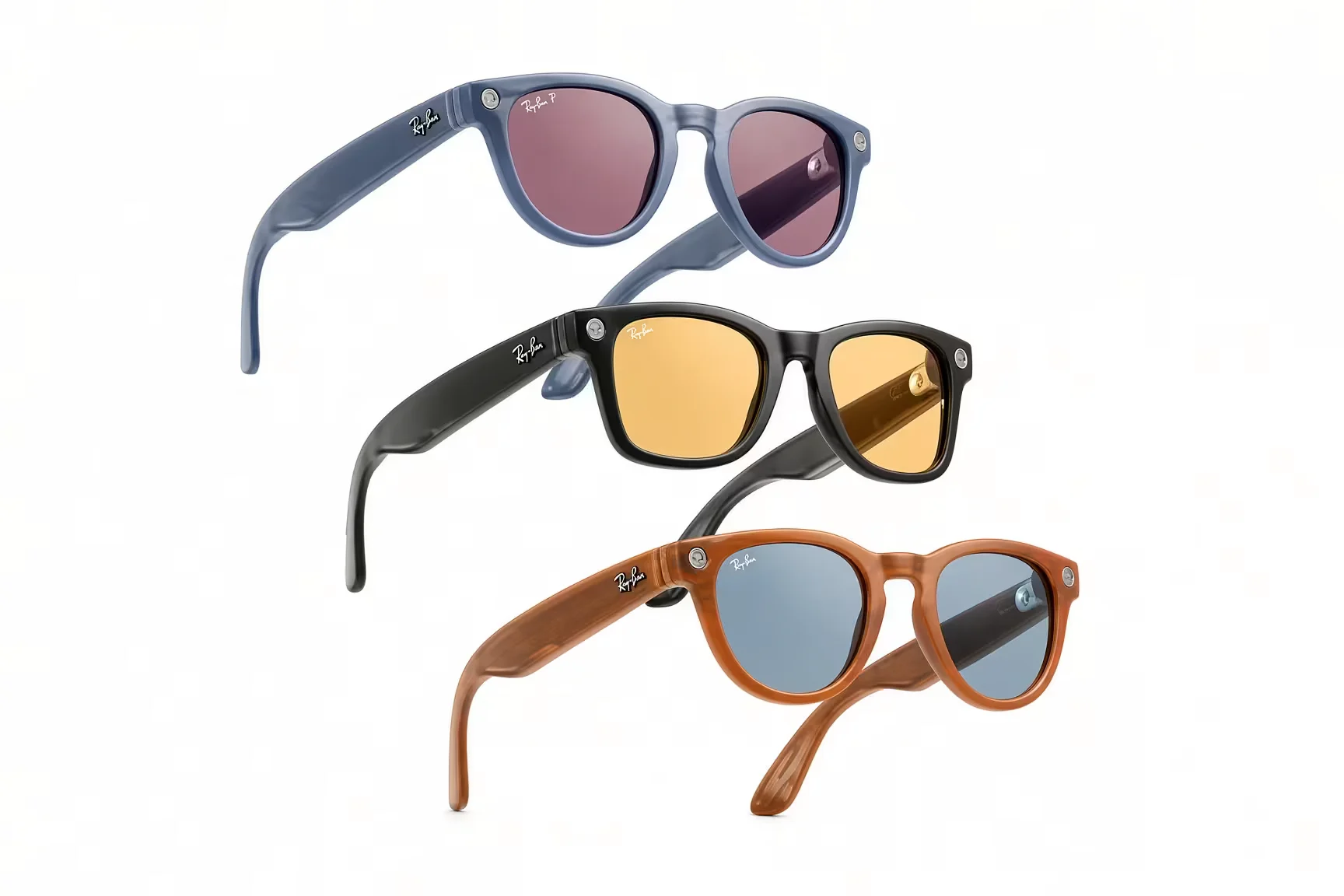
Meta is careful not to describe Ray-Ban Meta Audio as a privacy product. The official announcement leads with comfort and sound instead: audio, the company says, has been the most used feature on its glasses since the first pair shipped, and the new model packs earbud-level listening into the lightest and slimmest frame Meta has made. At 43 grams it is light enough for all-day wear, with up to 12 hours of listening and calls on a charge and roughly 48 more stored in the included case. It comes in two new Ray-Ban shapes, the retro Clubmaster and a rectangular style called Burbank, across 23 tint and lens combinations, and both take a wide range of prescriptions.
That debate is older than the AI boom itself. Meta’s first pair of interactive smart glasses arrived in 2021, roughly a year before ChatGPT turned generative AI into a mass consumer product, and each generation since has added capability: better cameras, livestreaming, an assistant, and last year a display projected onto the lens. Every one of those upgrades made the glasses more useful to the wearer and, for people on the other side of the lens, harder to ignore.
The audio model sidesteps the argument entirely. Its buyer still gets music, podcasts, calls, live translation and Muse, and bystanders get a pair of glasses with nothing pointed at them. TechCrunch notes that EssilorLuxottica designed the frames, which keeps them inside the same partnership that produced every Ray-Ban and Oakley Meta pair to date.
The timing is not subtle. Industry analysts have been warning for a while that cameras are the category’s ceiling. When Omdia forecast last September that AI glasses would pass 10 million units in 2026, its research director Jason Low flagged the privacy worries around built-in cameras and microphones, plus plain social resistance to wearing tech on the face all day, as the things most likely to keep the devices from spreading beyond early adopters. A pair with no camera removes half of that list. The microphones, which Muse depends on, stay.
flow
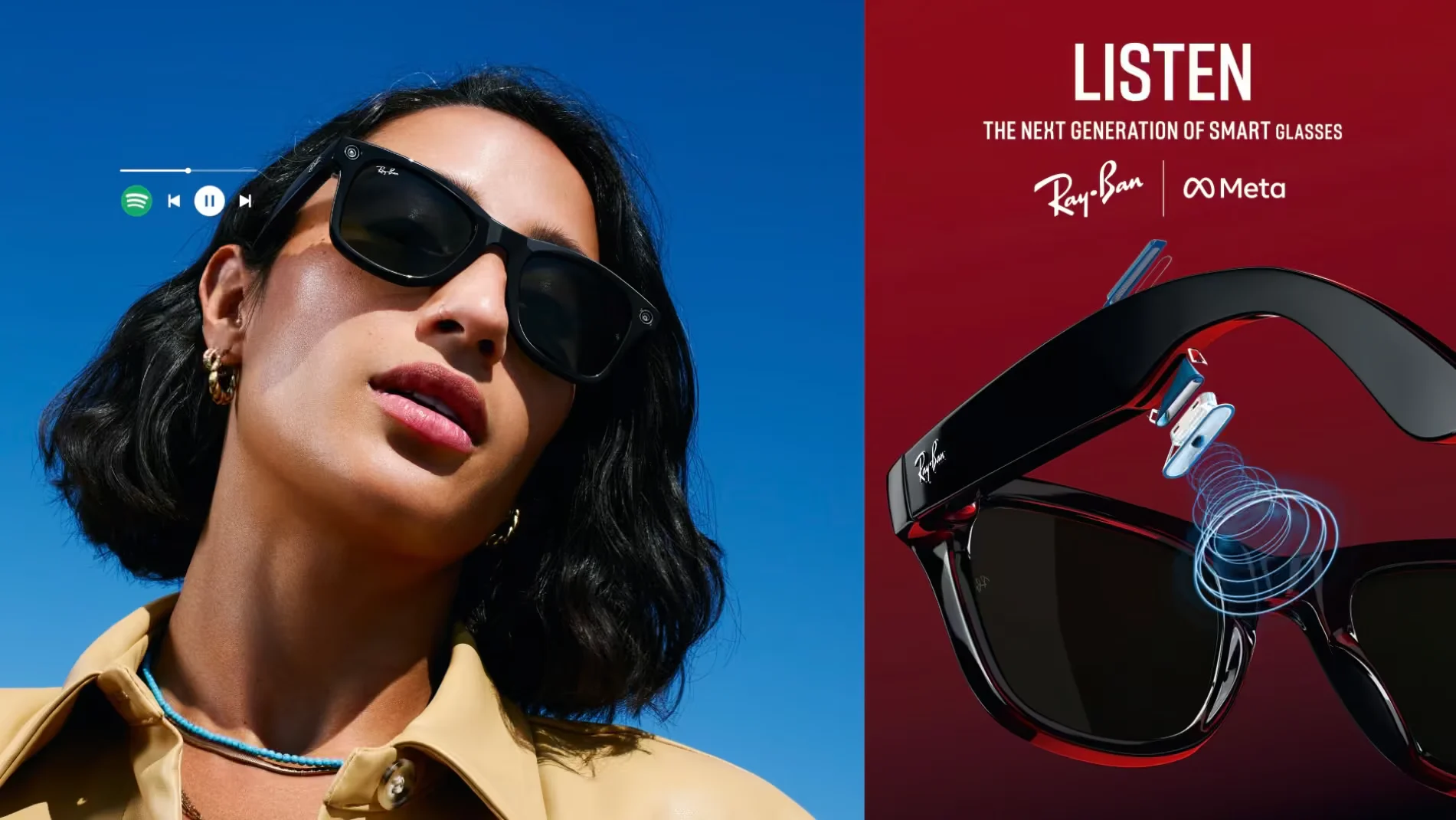
The camera did not disappear from the rest of the lineup. Ray-Ban Meta (Gen 3), which Meta bills as the next gen of the world’s best-selling AI glasses, keeps a 12 MP sensor and adds 3K Ultra HD video, along with the same LED indicator every generation has carried. The upgrades are mostly about wear: a slimmer build, up to nine hours of battery (an hour more than Gen 2), adjustable temple tips, a six-microphone array that Meta says cuts more than 90 percent of background noise, and a customizable action button that calls up Meta AI. Styles run to Aviator, Wayfarer and Zena, a new cat-eye, across 27 tint and lens combinations, with a limited vintage-toned Aviator marking that frame’s 90th anniversary. Gen 3 is on sale now from $449.
The fashion story sits with Meta Glasses, the self-branded line Meta launched with EssilorLuxottica earlier this year. It gains two new shapes, Capri and Nova, plus an Ivory colorway of the Starfire style from Meta Glasses by Kylie Jenner at $399. The headline collision with LISA. Her collection comes in two frames: the Meta Adventurer LISA Edition, a Moonlit Sky frame with Blush lenses, and the Meta Capri LISA Edition, an Eclipse cat-eye with grey lenses. A custom star sits on the frames and the case, special edition case charms are modeled on her pets, and wearing the glasses unlocks a set of digital photocards, a detail aimed squarely at a fan base raised on K-pop album inclusions. Both styles take prescriptions and start at $399.

LISA’s Meta Glasses collection
Further down the price ladder, a black Meta Adventurer with grey lenses and a plug-in case starts at $249, the cheapest Meta Glasses yet, on pre-order now and on sale October 23. A clear-framed, mirror-lensed Meta Fury is limited to Connect and Meta’s own Meta Lab stores at launch, and a Mix and Match program lets buyers choose frame, lens and case color. Meta Glasses reached Singapore, South Korea, Mexico and the United Arab Emirates on Wednesday, with Brazil next. By the end of the year Meta says it will sell more than 100 different glasses across Ray-Ban, Oakley and its own label. The Meta Ray-Ban Display, the in-lens screen model unveiled last year from $799, is heading to Britain, France, Italy, Germany and Canada.
The scale behind that catalog is considerable. According to Omdia’s figures for 2025, AI glasses shipments reached 8.7 million units worldwide last year, and Meta accounted for 7.4 million of them, an 85.2 percent share.
show
Meta VR Glasses is the device that most clearly breaks from the Quest era. At roughly 100 grams it is, by Meta’s count, about five times lighter than the Quest 3, and Zuckerberg compared its weight to a deck of cards. The trick is offloading: battery, storage and compute live in a tethered puck running a Qualcomm Snapdragon chipset, leaving magnesium alloy frames, pancake lenses, full-color passthrough and a 5K display on the face. There are no external controls. Hand gestures and voice do the work. Engadget lists up to three hours of continuous high-resolution playback per charge, Dolby Vision and Dolby Atmos support, and IMAX Enhanced certification. It arrives in spring 2027 at $1,299.
The smallest reveal was the most unusual. The Muse Charm is a compact, puck-shaped device with a display, designed to let people talk to their Muse agent without pulling out a phone. Meta says it ships before the holidays this year and has not given a price. Rounding out the hardware news, Gizmodo reported a new hearing-assist feature on the glasses aimed at people with mild to moderate hearing loss.
extend
Muse is where Meta’s ambitions and its critics meet most directly. The agent runs on Meta’s own models and is built to compete with OpenAI‘s ChatGPT and Anthropic‘s Claude. After a user links personal accounts, including financial, health and shopping ones, Muse can sign up for services, book appointments and place calls for them. The pitch has landed quickly: the app climbed to the top of the free charts on both the App Store and Google Play, passing ChatGPT, Claude and Google‘s Gemini. At Connect, Meta added the ability to fully customize a Muse avatar, from its look and name to the way it speaks.
Retailers have split into camps. Instacart, Shopify and Expedia have announced integrations, and Meta said Walmart, Best Buy, Gap and Sephora are also partnering with the app. Amazon went the other way this week, blocking Meta from using AI bots to shop on its platform automatically for users. That leaves the largest online store in the United States outside the agent Meta now wants in every pair of glasses it sells.
The glasses make that tension physical. An agent that can see a user’s calendar, bank balance and purchase history, paired with a device worn on the face all day, is a far larger bet on trust than a photo-sharing feature ever was. Meta’s camera-free frame addresses the people around the wearer. It does not address what the wearer has chosen to connect.
fin
Meta’s vice president of AI product, Vishal Shah, told AFP on Wednesday that privacy features such as the recording light remain essential, that the company has made the light more obvious over time, and that it probably needs to keep saying so more often than it has lately. The company has plenty of reasons to. In August, Meta settled a lawsuit brought by dozens of U.S. state attorneys general over alleged violations of consumer protection and children’s online privacy laws, agreeing to pay as much as $18 billion and to impose new restrictions on teenage users. It still faces age-based social media limits and bans in several countries, and thousands of potential personal injury cases continue to move through U.S. state courts.
Those pressures sit alongside a user base of nearly four billion people a month across Meta’s apps, which is the audience Meta hopes glasses will convert into daily AI users. Wednesday’s lineup offered that audience something new: for the first time, a way to buy into Meta’s AI glasses without a camera attached. Pre-orders for Ray-Ban Meta Audio opened the same day, and the first pairs ship October 13.