DRIFT AUDIO
Listen to this story
Choose a voice, then press play.
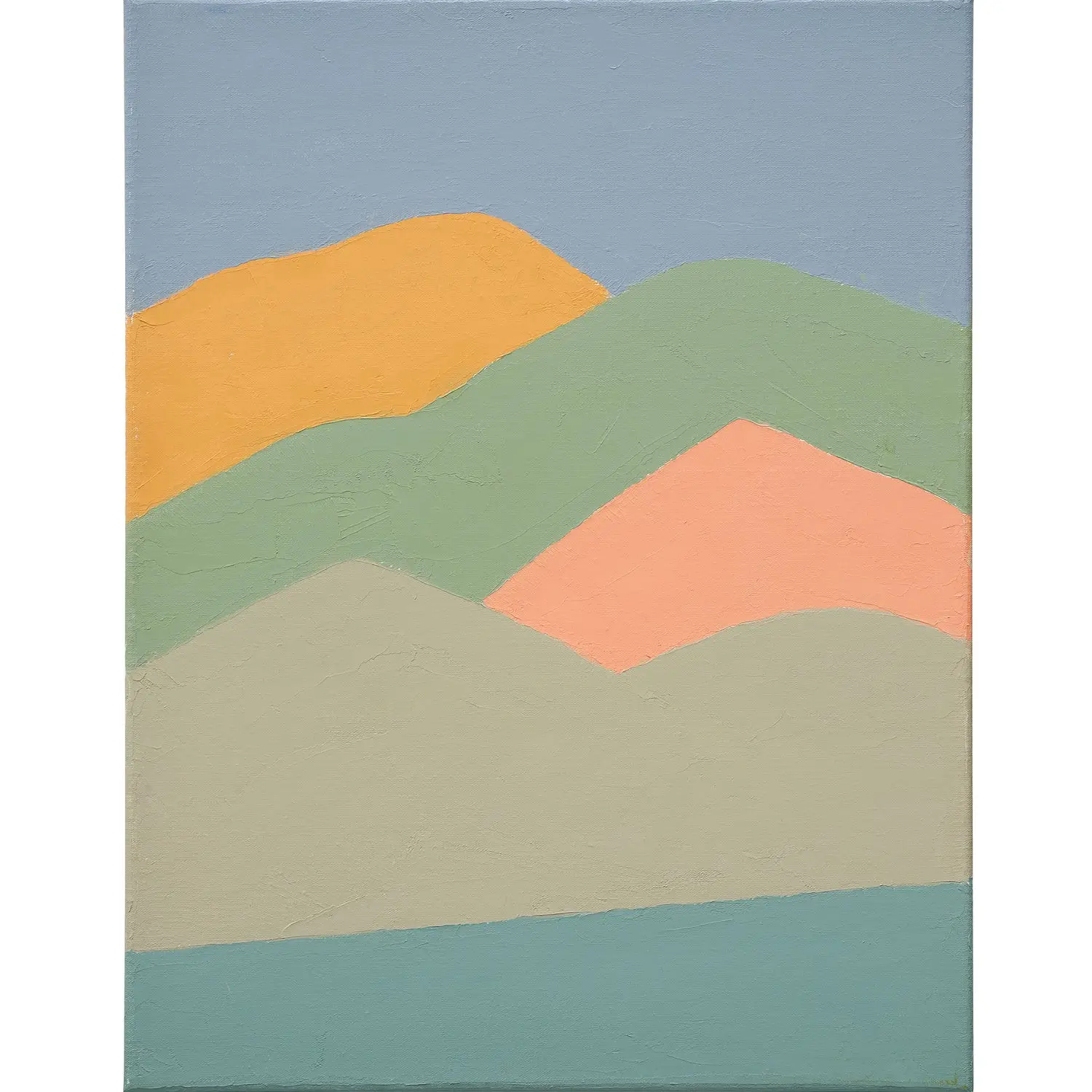
In 2016, the year she opened solo shows in London and Paris, Etel Adnan made an intimate landscape that boils mountains and sky down to warm, glowing fields of color.
Etel Adnan made Untitled (2016) out of very little: broad fields of warm, luminous tincture arrange so that they read as mountains beneath a sky. The composition is spare and the mood is calm, and the picture offers no story beyond the one the hue tells. Like many of her canvases, it carries only the word Untitled and a year, which leaves the light to do the talking.
The year matters. Adnan turned 91 in February 2016, and before it ended she had opened a solo exhibition at the Serpentine Galleries in London and another at the Institut du monde arabe in Paris, published a book-length poem, and seen a series of tapestries move from her designs onto the loom. A landscape made in the middle of that activity is a reminder that her working scale stayed modest even as the audience around her grew.
Signal. What happened: DRIFT is looking at Etel Adnan’s Untitled (2016), an intimate landscape from the year the painter, then 91, opened solo exhibitions at the Serpentine in London and the Institut du monde arabe in Paris. Exact object: Etel Adnan, Untitled, 2016, in which broad, warm, luminous hue fields stand in for mountains and sky. When and where: made in 2016, the year of The Weight of the World at the Serpentine’s Sackler Gallery (June 2 to September 11) and of Etel Adnan at the Institut du monde arabe (October 18 to January 1, 2017). Source: the description supplied with the work for its title, year and viewl character, set against the Serpentine’s exhibition page, the Institut du monde arabe’s exhibition page and the Guggenheim’s 2021 press kit for how she painted. Why it matters: it shows how Adnan, in her nineties and working in Paris, compressed the mountains and skies she had painted for decades into a few planes of color, and how a picture that modest carries the memory of a place. Earlier DRIFT: the story on Alex Katz, whose Quick Light show filled the Serpentine’s other gallery during Adnan’s 2016 run, and the story on Louise Bourgeois‘s handkerchief, another late-career object by an artist who treated text as material.
stir
The Serpentine’s exhibition, The Weight of the World, ran from June 2 to September 11, 2016, and the gallery billed it as Adnan’s first solo show in a UK public institution. It brought together paintings, drawings, poetry, film and tapestry, and took its title from a new series of paintings she completed specifically for the occasion. In the Serpentine’s other gallery, Alex Katz: Quick Light ran over the same dates, and the Serpentine’s text on Katz pointed across to Adnan, whose landscapes it described as similarly defined by bold color and simplified form rooted in close observation of the world. The show was inaugurated on June 1 with a reading by the poet Robert Grenier and a conversation with Adnan.

The Classical Fold: A Study in Stone and Sail
Paris followed in the autumn. From October 18, 2016 to January 1, 2017, the Institut du monde arabe presented what it called the first solo exhibition of her work in France, organized in four sections. One opened with her book-length poem The Arab Apocalypse (1980), played back in French, English and Arabic. Another was devoted to Mount Tamalpais, which the institute called the artist’s true Mont Sainte-Victoire. The remaining two took up bridges and exile, and tapestry. The institute had presented her with the Chevalier des Arts et des Lettres two years earlier, Galerie Lelong & Co. notes.

The Lattice of Light: A Study in Civic Porosity
The printed page kept pace. Nightboat Books published Night, a book-length poem that Publishers Weekly said maps consciousness through the many shapes night can take, and Galerie Lelong & Co. issued Life Is a Weaving, a 69-page book in which Adnan writes about the collaboration behind her tapestries, woven in wool on a basse-lisse loom with the Pinton studio between 2015 and 2017. The tapestries came from her own designs, some dating to the 1960s and 1970s and others sketched anew, and the Serpentine noted that they draw on the feeling and color of the Persian rugs of her childhood.
to
Adnan did not begin as a painter. Born in Beirut on February 24, 1925, to a Greek mother from Smyrna and a father from Damascus who had served as an Ottoman army officer, she studied philosophy at the Sorbonne, moved to the United States in 1955 for graduate study at Berkeley and Harvard, and from 1958 to 1972 taught philosophy and aesthetics at Dominican College in San Rafael, California, according to ARTnews.
The push toward the canvas came in 1959, when she was 34. Ann O’Hanlon, the painter who led the college’s art department, wondered how Adnan could teach a course on the subject without practicing it, handed her crayons and scraps of paper, and told her she needed no training. Her publisher’s biography ties the turn to language as well: during the Algerian War of Independence she began to resist writing in French, and painting offered another way to work, City Lights explains. In a 1984 essay she wrote, “Furiously, I became a painter,” and described abstraction as the equivalent of poetic expression, made of colors and lines instead of words.
The earliest canvases were fully abstract: loosely rendered squares of color stacked or suspended in single-color grounds, many of them anchored by a square of red, as the Guggenheim’s exhibition texts explain. She worked without preliminary studies and finished each canvas in a single sitting, and reviewers, the Brooklyn Rail among them, still describe paintings that seem to explode onto the canvas in one go.
show
The method is physical and quick. Adnan often applied color directly from the tube and pushed it around with a palette knife, which can give her shapes the crispness of cutouts, Artnet observed after her death. Apollo‘s Gabriel Coxhead, who interviewed her at her Paris apartment in 2018, described hue laid on thickly enough to feel like building up terrain, and recent work in which contrasting tones sit against one another like slabs of rock, balanced yet firmly in place.
The vocab is small. In many canvases a sloping, triangular form reads as the mountain, a red disc as the sun, and a band of azure as the sea, while the red square from her first paintings keeps return as a point of energy. The Guggenheim traced the flow of sun and sea to a childhood on the Beirut coast, and noted that Adnan preferred the Arabic word Mashriq, the place where the sun rises, to the term Middle East.
Scale is part of the method. The Guggenheim called her paintings notably modest in size while still evoking the sublimity of nature, and two 2016 canvases from The Weight of the World series that it showed in 2021, Le poids du monde 10 and 11, each measure 30 by 24 centimeters, roughly 12 by 9 1/2 inches.
Critics reach for Paul Klee, whose small, often squarish, geometrically simplified landscapes Coxhead saw echoed in her work, and for Nicolas de Staël, whose bright late landscapes are another frequent comparison. Hyperallergic noted that her references ran wider, to Lebanese modernists such as Saloua Raouda Choucair and Paul Guiragossian. In 2018 she showed at the Zentrum Paul Klee in Bern alongside a few of Klee’s works, and told Coxhead that he had been so present in 1960s California that she felt she had lived with his paintings almost as if she had attended the Bauhaus.
She also made leporellos, accordion-fold books that combine drawing and writing. She first bought blank ones in a California shop specializing in Japanese crafts, and she likened the long unfolding pages to a river, the Guggenheim reports.
extend
By the 2010s the mountain lived mostly in her mind. Adnan lived in Paris, in a sixth-arrondissement apartment that doubled as the studio for a daily painting and writing practice, and the Guggenheim’s 2021 wall texts note that she could no longer travel to Sausalito and kept conjuring the peak as it lived in her imagination. She told Apollo in 2018 that her recent paintings had drifted toward pure abstraction, partly because she could no longer fly, and that she was evoking “a landscape that is in me.” California, she added, was a longing she felt almost physically.
The idea sits at the center of how she thought about painting. Adnan wrote that the actual dimensions of a painting are “the space of memory,” which is one way to understand how a picture of modest size can hold a range of mountains and an entire sky: memory keeps the color and the proportion of a place and lets the detail go.
Writing and painting shared the work. As she put it, “I write what I see, paint what I am.” Her writing carried the war, exile and loss she lived through in and after Beirut, while painting, she told Apollo, was where she was happy. Kaelen Wilson-Goldie, who wrote a monograph on Adnan, sees the paintings as the daily exercises of a writer, and as pictures that hold the beauty of the world and its horrors together. The Guggenheim framed the paintings, tapestries and works on paper as an expression of faith in people and in the natural world.
fin
Attention came late and quickly. A large survey of her abstract paintings at Sfeir-Semler in Beirut around 2010 led to documenta 13 in Kassel in 2012, when she was 87, and the 2014 Whitney Biennial and a retrospective at Mathaf: Arab Museum of Modern Art in Doha followed, according to ArtAsiaPacific. Adnan told Coxhead that newspaper reports on her documenta showing all opened with her age, which she found funny at first and then annoying, as if the age were the story. MoMA’s Making Space included her in 2017.
The Guggenheim’s Etel Adnan: Light’s New Measure opened on October 8, 2021, took its title from a writ in her 2012 collection Sea and Fog, and was called her first major New York museum show by the Brooklyn Rail. Adnan died at home in Paris on November 14, 2021, at 96, and her death was confirmed by Galerie Lelong & Co., ARTnews reported.
Fattal, her partner of nearly fifty years, now has a museum survey of her own. Simone Fattal: Cities at the Bottom of a Lake, at the Musée d’Art Moderne de Paris, runs from September 18, 2026 to January 24, 2027, and the museum describes it as her first exhibition at a Parisian museum, with about one hundred works spanning more than fifty years.
Related Articles
Rome Opened A Wall Of Tesserae Under Trajan And Called It The Great Mosaic
Ten meters high, sixteen meters wide. First century. Museum of the Baths of Trajan on […]