DRIFT

There are wins that read cleanly in a box score, and then there are wins that carry residue—years, eras, expectations that linger long after the final buzzer. What Michigan Wolverines men’s basketball accomplished in their 69–63 victory over UConn Huskies men’s basketball belongs to the latter. It wasn’t just a championship. It was a correction of time.

For Michigan, this wasn’t simply about ending a drought that dates back to 1989. It was about recalibrating a program that has hovered in proximity to greatness—close enough to feel it, distant enough to never fully claim it. For the Big Ten Conference, it was something even more structural: the snapping of a 25-year national title absence that had quietly become a narrative shadow over the league itself.

And for UConn, the loss lands differently—not as failure, but as interruption. A program that has defined the modern championship standard, now reminded that even dynasties fracture.

stir

The final score—69 to 63—suggests a game played in tight margins. That part is true. But what it doesn’t capture is how little either team was allowed to breathe.

Michigan didn’t win this game by overwhelming UConn. They won it by denying them rhythm.

Possession by possession, the Wolverines turned the game into something slower, heavier. Not quite defensive chaos, not quite half-court grind—something in between. A deliberate constriction. Every pass contested. Every drive redirected. Every shot forced into hesitation.

UConn, a team that has built its recent dominance on flow—on turning sequences into surges—never fully found that cadence. There were moments, brief stretches where the Huskies looked like themselves: a quick transition bucket, a corner three that felt like ignition. But each time, Michigan answered not with flash, but with restraint.

The game became less about scoring runs and more about survival inside possessions.

flow

What stood out wasn’t dominance—it was control without spectacle.

Michigan never looked rushed. Even when UConn cut into the lead, even when the arena shifted in tone, the Wolverines resisted the urge to escalate. They didn’t chase momentum; they neutralized it.

Offensively, they worked through contact, extending possessions, forcing UConn deeper into defensive sequences. Defensively, the team conjured with a kind of positional discipline that bordered on stubbornness—closing gaps, rotating without overcommitting, forcing contested attempts late in the shot clock.

It’s the kind of basketball that doesn’t always translate to highlight reels. But it travels in March. It holds under pressure.

And in this game, it held all the way to the end.
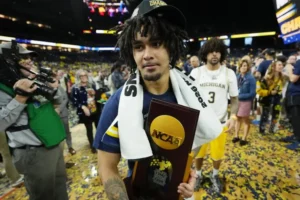
Michigan Wolverines player holds NCAA championship trophy on confetti-covered court after defeating UConn in the 2026 national title game

a first

For UConn Huskies men’s basketball, the loss carries a rare statistical weight: their first defeat in a national championship game.

That detail matters—not because of what it says about this particular team, but because of what it disrupts. UConn has long been defined by its efficiency on the biggest stage. When they reach this point, they typically finish.

This time, they didn’t.

It wasn’t a collapse. It wasn’t even a clear unraveling. It was something subtler: an erosion of certainty. Shots that normally fall came up short. Offensive sets that usually resolve cleanly ended in contested attempts. Defensive rotations, typically sharp, arrived a half-step late.

Michigan didn’t overpower UConn. They outlasted their precision.

And that distinction matters.

retro

As advising sentiment to the significance of this win for Michigan, you have to return to 1989—not as a date, but as a lingering reference point.

That championship has existed less as a memory and more as a constant comparison. Every tournament run measured against it. Every near-miss framed by its absence.

Over the decades, Michigan has produced talent, moments, and even deep tournament runs. But the final step—closing the season with a title—remained just out of reach.

Until now.

This victory doesn’t erase the years in between. It reframes them. It turns a long stretch of “almost” into something that now reads as accumulation rather than failure.

The program doesn’t just have a past anymore. It has continuity.

travel

For the Big Ten Conference, the significance is just as pronounced.

A 25-year championship drought is long enough to become identity. Not official, not stated—but implied. A conference known for depth, for physicality, for producing tournament teams… but not champions.

Michigan’s win disrupts that narrative.

It suggests that the Big Ten’s style—often critiqued as too rigid, too defense-oriented, too slow for modern tournament play—can still translate at the highest level. Not by adapting into something else, but by refining what it already is.

This wasn’t a stylistic departure. It was an affirmation.

pressure

The last stretch of the game didn’t explode. It compressed.

With under four minutes remaining, the margin tightened, possessions grew heavier, and every decision carried consequence. Michigan’s lead hovered within reach, but never fully slipped.

Free throws became critical. Defensive stops became decisive. The pace slowed even further, each possession stretching toward its limit.

UConn had opportunities—brief windows where a single shot could have shifted everything. But Michigan closed those windows quickly, decisively.

Not with dramatic blocks or steals, but with positioning. With discipline. With an understanding of time and space that felt almost procedural.

The final buzzer didn’t arrive with chaos. It arrived with inevitability.

stretch

What defines this Michigan team isn’t a singular star performance or a defining highlight. It’s something less immediate, but more durable: cohesion.

They don’t rely on volatility. They don’t depend on explosive stretches to create separation. Instead, they operate through accumulation—small advantages layered over time until the game tilts.

In a tournament often defined by unpredictability, that kind of structure becomes its own form of resilience.

They don’t need the game to break open.

They just need it to stay within reach.

show

Looking back through the tournament—in view—the path wasn’t accidental.

Michigan moved through each round with a similar profile: controlled pace, defensive pressure, and a refusal to be drawn into chaos. Whether it was the early rounds or the Final Four, the identity held.

Their semifinal performance, particularly against a top-seeded opponent, hinted at what was coming. Not dominance, but consistency.

By the time they reached the championship, the formula was already established.

UConn, for all their talent and experience, ran into a team that didn’t need to adjust. A team that had already decided how it would play—and refused to deviate.

tempo

For years, the story around college basketball’s upper tier has been one of cycles—programs rising, sustaining, then resetting. UConn, in recent seasons, has represented the peak of that cycle: a program capable of stacking championships, redefining expectation.

Michigan’s win doesn’t end that cycle.

But it interrupts it.

It introduces a different rhythm—one where discipline outweighs momentum, where structure can disrupt even the most efficient systems.

And in doing so, it opens the field again.

scope

Championships don’t exist in isolation. They reshape perception.

For Michigan, this win changes how the program is viewed—not just historically, but in the present. They’re no longer a team chasing validation. They have it.

For the Big Ten, it shifts the narrative from absence to possibility.

And for UConn, it introduces a rare moment of recalibration. Not decline, not collapse—but a reminder that even the most consistent programs operate within margins.

Margins that, on a night like this, can close.

sum

When the game ended, the reaction wasn’t explosive. It wasn’t the kind of chaos that often accompanies a championship.

It was something quieter.

Players embracing. Coaches exhaling. A sense of release rather than eruption.

Because this win wasn’t about a single moment.

It was about the accumulation of many—years, expectations, near-misses, and the slow, deliberate work of building something that could hold under pressure.

Michigan didn’t just win a title.

They resolved a timeline.

Related Articles

Modern data center facility with a solar-panel-clad exterior, bright green administrative offices, and secure perimeter fencing, showcasing sustainable digital infrastructure and renewable energy integration

Lombardy’s Data Center Boom: Balancing Digital Ambition with Environmental Responsible

Lombardy has emerged as Italy’s primary hub for new digital infrastructures, particularly data centers—vast complexes […]

In a highly anticipated reunion after 24 years, Adidas Originals and Coca-Cola have joined forces once again to celebrate the FIFA World Cup 2026™. The collaboration revives their iconic 2002 partnership from the Japan-South Korea tournament, now reimagined for the biggest global sporting event of 2026, co-hosted by the United States, Canada, and Mexico. Set to launch on June 6, 2026, this collection masterfully blends Adidas' streetwear heritage with Coca-Cola's timeless branding, creating a vibrant fusion of football culture, nostalgia, and modern style. The drop arrives at a perfect moment. With the World Cup kicking off on June 11, 2026, fans worldwide are gearing up for a summer of football excitement. This collaboration isn't just merch—it's a cultural statement that merges two legendary brands under the banner of "Originals are the Real Thing," a clever twist on Coca-Cola's famous slogan. Historical Context: A Reunion 24 Years in the Making Adidas and Coca-Cola first collaborated during the 2002 FIFA World Cup, producing limited-edition pieces that captured the era's energy. That partnership helped define early 2000s football-streetwear crossover culture. Fast-forward to 2026, and the brands are back with fresh energy, leveraging Adidas' deep FIFA ties (as an official partner) and Coca-Cola's long-standing sponsorship of the tournament. The 2026 edition promises to be historic as the first 48-team World Cup, spanning three countries and generating unprecedented global hype. This collab taps into that momentum, offering fans wearable pieces that celebrate both brands' legacies while looking forward to the future of football fashion. Collection Overview and Design Philosophy The Adidas Originals x Coca-Cola collection fuses 2000s street style with classic sporting aesthetics. Expect bold reds, creams, whites, and silver accents inspired by Coca-Cola's iconic packaging—think classic script logos, droplet detailing, and can-inspired motifs. The lineup spans footwear, apparel, and accessories, divided into two visual directions: one logo-heavy and graphic-forward, the other drawing from vintage advertising aesthetics. Designs pay homage to Coca-Cola's visual language while staying true to Adidas Originals' archival roots. High-quality materials, attention to detail, and versatile silhouettes make these pieces suitable for both match-day wear and everyday street style. The campaign, featuring young football star Lamine Yamal and a diverse cast in everyday scenes building anticipation for the tournament, reinforces themes of originality and shared cultural moments. Footwear Highlights Footwear takes center stage in this collaboration, with reimagined takes on iconic 2000s Adidas silhouettes: Samba and Superstar Models: These classics get Coca-Cola treatment with white/cream/red colorways and prominent script branding. The Samba blends street heritage with football roots, while the Superstar II features weathered bases and bold side panels. Expected pricing around $110–$130. Adistar Control 5: A standout with droplet detailing mimicking condensation on a cold Coke can. This model brings performance-inspired design into lifestyle territory. Predator Sala: Indoor/hybrid style with silver-and-red accents, nodding to predatory precision on the pitch and Coca-Cola's bold energy. Climacool 1: Revived with breathable tech and Coke-inspired graphics, perfect for warm summer days. Megaride F50: A highlight paying tribute to the iconic Coca-Cola glass bottle, with unique contours and refreshing design cues. Each pair incorporates thoughtful details like embroidered logos, custom insoles, and packaging that mimics vintage Coke crates or cans. These shoes are built for durability and comfort, appealing to sneakerheads, football fans, and casual wearers alike. Apparel and Accessories Beyond kicks, the collection offers a full lifestyle range: Track Tops and Jerseys: Standout jerseys fuse retro Coca-Cola advertising from different eras into cohesive football designs. Track jackets feature signature three stripes alongside Coke branding, in vibrant reds and classic whites. Shorts and T-Shirts: Relaxed fits with graphic prints, ideal for casual wear or layering. Expect motivational football motifs blended with refreshing beverage references. Accessories: A bright red airliner bag stands out as a functional statement piece. Additional items may include caps, socks, and tote bags carrying the collaborative spirit. The apparel emphasizes comfort with premium cotton blends, mesh panels for breathability, and oversized silhouettes popular in contemporary streetwear. Unisex sizing and inclusive fits make the collection accessible to a broad audience. Cultural Impact and Fan Appeal This collaboration resonates on multiple levels. For football fans, it represents national pride and global unity ahead of the 2026 tournament. Sneaker enthusiasts will appreciate the nostalgic 2000s revival mixed with modern execution. Streetwear collectors see it as a prime example of how heritage brands can innovate through partnerships. In an era where sports and fashion increasingly intersect, Adidas and Coca-Cola deliver pieces that transcend the pitch. Wear them to watch matches at home, attend watch parties, or hit the streets in any host city—New York, Los Angeles, Toronto, or beyond. The designs are versatile enough for gym sessions, festivals, or daily commutes. The timing aligns perfectly with rising interest in football in North America, boosted by the co-hosting nations. Young talents like Lamine Yamal in the campaign help bridge generational gaps, attracting newer fans while satisfying longtime supporters. Where to Buy and Release Details The collection launches globally on June 6, 2026, via: Adidas CONFIRMED app (for early access and raffles) Adidas.com Select retailers and flagship stores worldwide Some regions may see staggered drops, with Japan and other markets getting early access. Prices are expected to range from $50–$150 depending on the item, making it relatively accessible compared to ultra-limited drops. Pro Tips for Copping: Enable notifications on the CONFIRMED app. Check local stock at Adidas stores in major cities. Monitor resale platforms post-drop for exclusive colorways, but be wary of markups. Size up slightly for oversized apparel fits. Given the World Cup hype, popular items like the Sambas and jerseys are likely to sell out quickly. International shipping is available, but factor in potential customs delays. Styling Suggestions Match Day Look: Pair a collaborative jersey with classic black shorts and Samba sneakers for effortless fan style. Streetwear Rotation: Layer a track top over a graphic tee with wide-leg pants and the Megaride F50 for a bold urban ensemble. Casual Summer: White Superstar with denim shorts and the airliner bag for a refreshing, vacation-ready vibe. These pieces mix seamlessly with existing Adidas or neutral wardrobes, maximizing versatility. Broader Context in 2026 Fashion and Sports The Adidas x Coca-Cola drop is part of a larger wave of high-profile collaborations tied to the World Cup. Adidas continues its dominance in football kit design, while Coca-Cola leverages its sponsorship with collectibles, bottles, and experiential activations like the Trophy Tour. In the sneaker industry, this collab exemplifies the ongoing trend of lifestyle reinterpretations of performance silhouettes. It also highlights how global brands use major events to drive cultural conversations around unity, originality, and joy—core values for both companies. Sustainability notes (based on Adidas' broader initiatives) suggest some pieces may incorporate recycled materials, aligning with modern consumer expectations. Looking Forward: Legacy and Excitement As the countdown to kickoff continues, this collection serves as the perfect prelude to an unforgettable summer of football. Whether you're a die-hard supporter, a fashion-forward collector, or someone seeking motivation through style, the Adidas Originals x Coca-Cola FIFA World Cup 2026 lineup delivers. Expect potential restocks, special event exclusives in host cities, and continued campaign content featuring more athletes. This isn't just clothing—it's a ticket to participate in the global celebration of the beautiful game. Mark your calendars for June 6, 2026. Refresh your wardrobe, lace up those Sambas, and get ready to cheer on your team in style. The "Real Thing" meets the Originals in what promises to be one of the most talked-about releases of the year. This collaboration captures the essence of football's universal appeal: bringing people together through shared passion, iconic brands, and unforgettable moments. As the world prepares for 2026's expanded tournament, Adidas and Coca-Cola remind us that some partnerships are truly timeless.

Adidas Originals x Coca-Cola Collection: FIFA World Cup 2026

In a highly anticipated reunion after 24 years, Adidas Originals and Coca-Cola have joined forces […]

Loewe shoulder bag crafted in brown and black leather with minimalist lion face detailing and a matching fur tail charm

180 Years Unfolded: The Full Story Behind Loewe’s New Campaign

The year was 1846. Queen Victoria was on the British throne and the telephone, the […]