DRIFT AUDIO
Listen to this story
Choose a voice, then press play.
A near total blackout on the Air Max Plus, save for one accent color doing all the talking.
In This Story
- A Sil Built on Gradients Goes Dark
- Where the “Dusty Cactus” Colorway Gets Its Name
- Black Mesh, Teal Waves, and Tuned Air Details
- How It Fits Into the Air Max Plus Lineup
- What the Timing of This Release Suggests
- Available
The Nike Air Max Plus built its reputation on wavy, multi tone TPU cages that shift tincture across the upper, a design lang that has carried the shoe since its 1998 debut under designer Sean McDowell. Nicknamed the TN early on for its Tuned Air branding, the silhouette became a defining shape in skate culture in the United States before finding a second, arguably larger life in European streetwear, particularly in the United Kingdom and France, where the model has held cult status for the better part of two decades. That approach has made the silhouette one of the more reliably distinctive entries in Nike’s Air Max family, and it is part of why a mostly blacked out version reads as a departure rather than a routine seasonal update.
Here, the brand strips the cage down to a single dark base and lets one accent shade carry the entire visual identity of the shoe, rather than splitting attention across a full gradient run. That is a notable shift given how consistently gradients have functioned as the model’s calling card. Even the shoe’s earliest colorways, built around ocean and sunset inspired fades, established a visual grammar that later releases have mostly followed, whether through subtle two tone treatments or the louder, multi color drops the line has leaned into more recently. A pair that deliberately withholds that gradient effect is working against the silhouette’s own habits rather than simply following them.
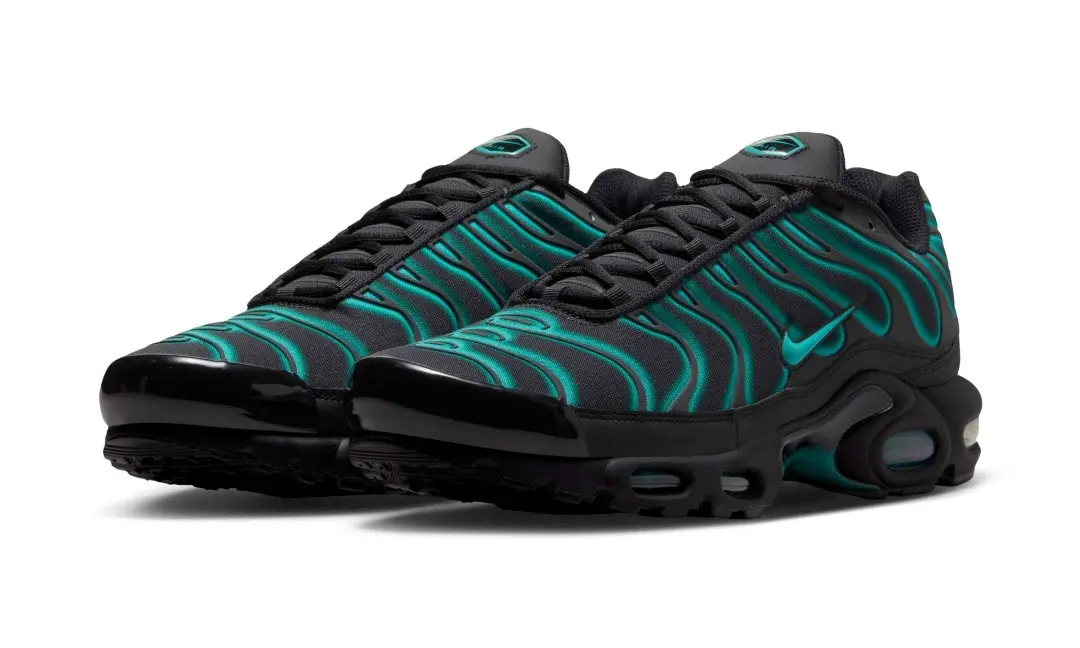
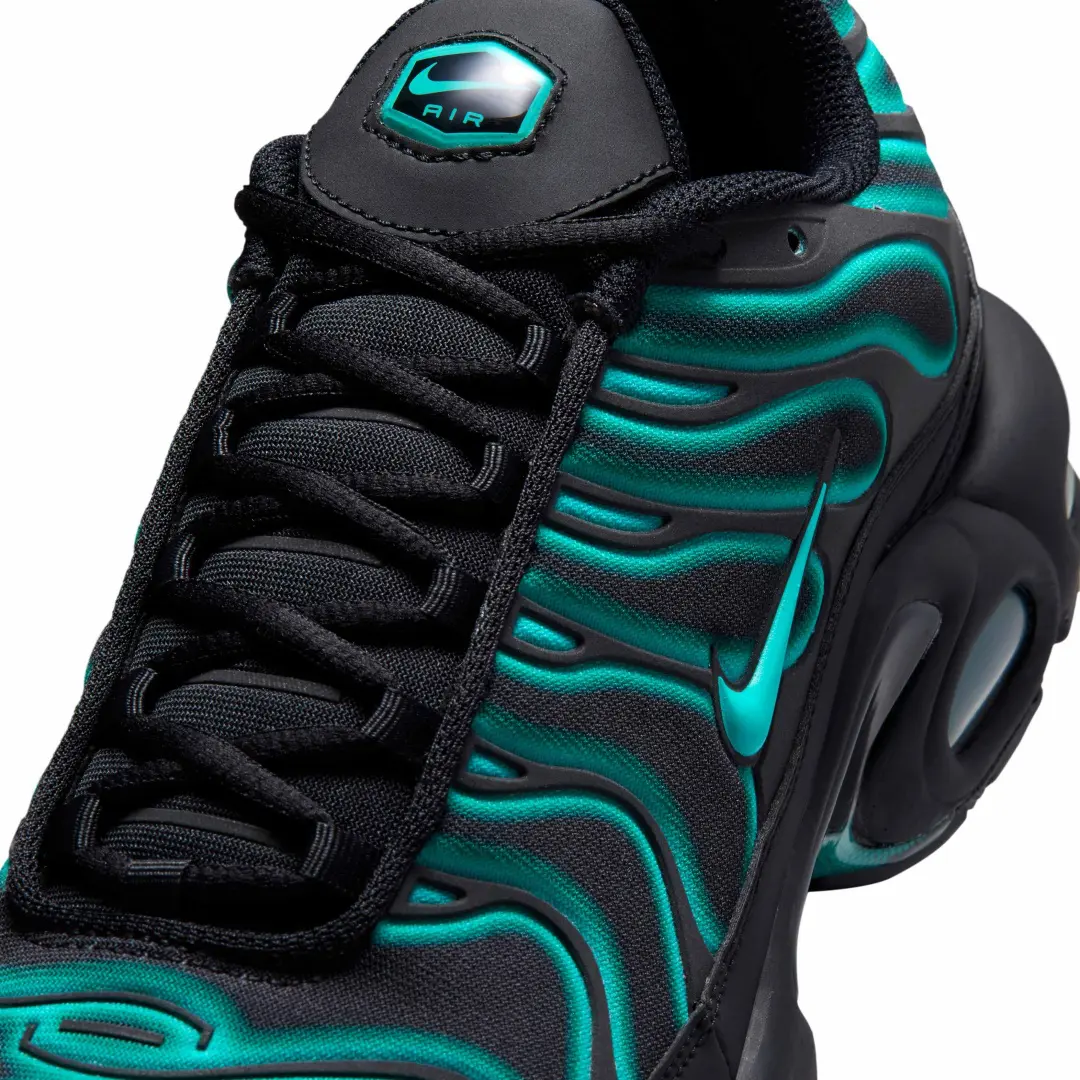
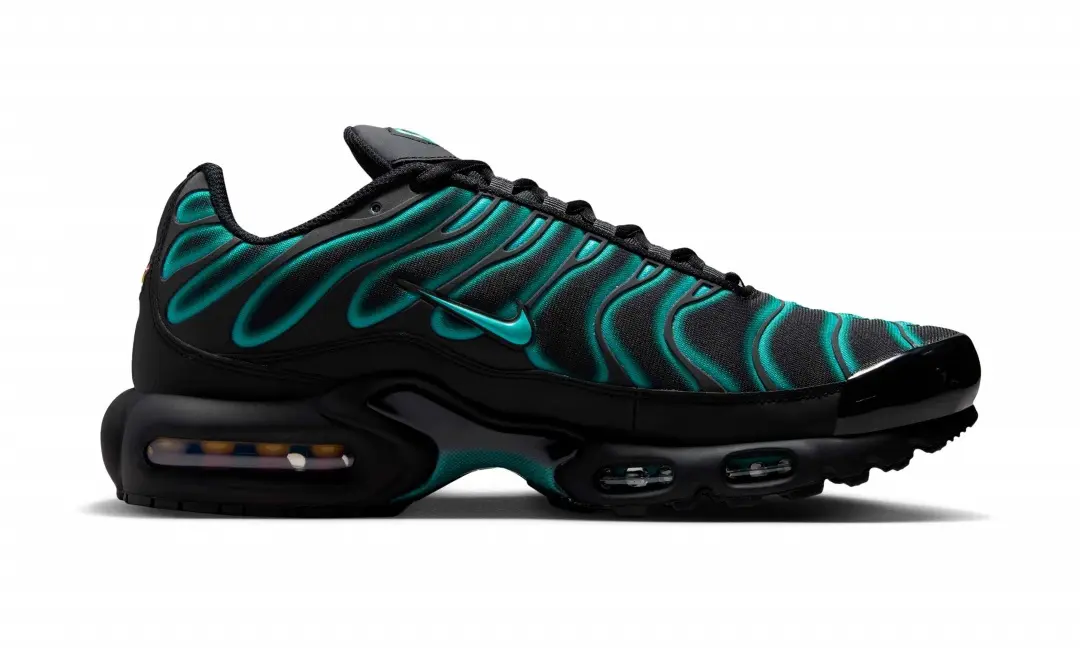
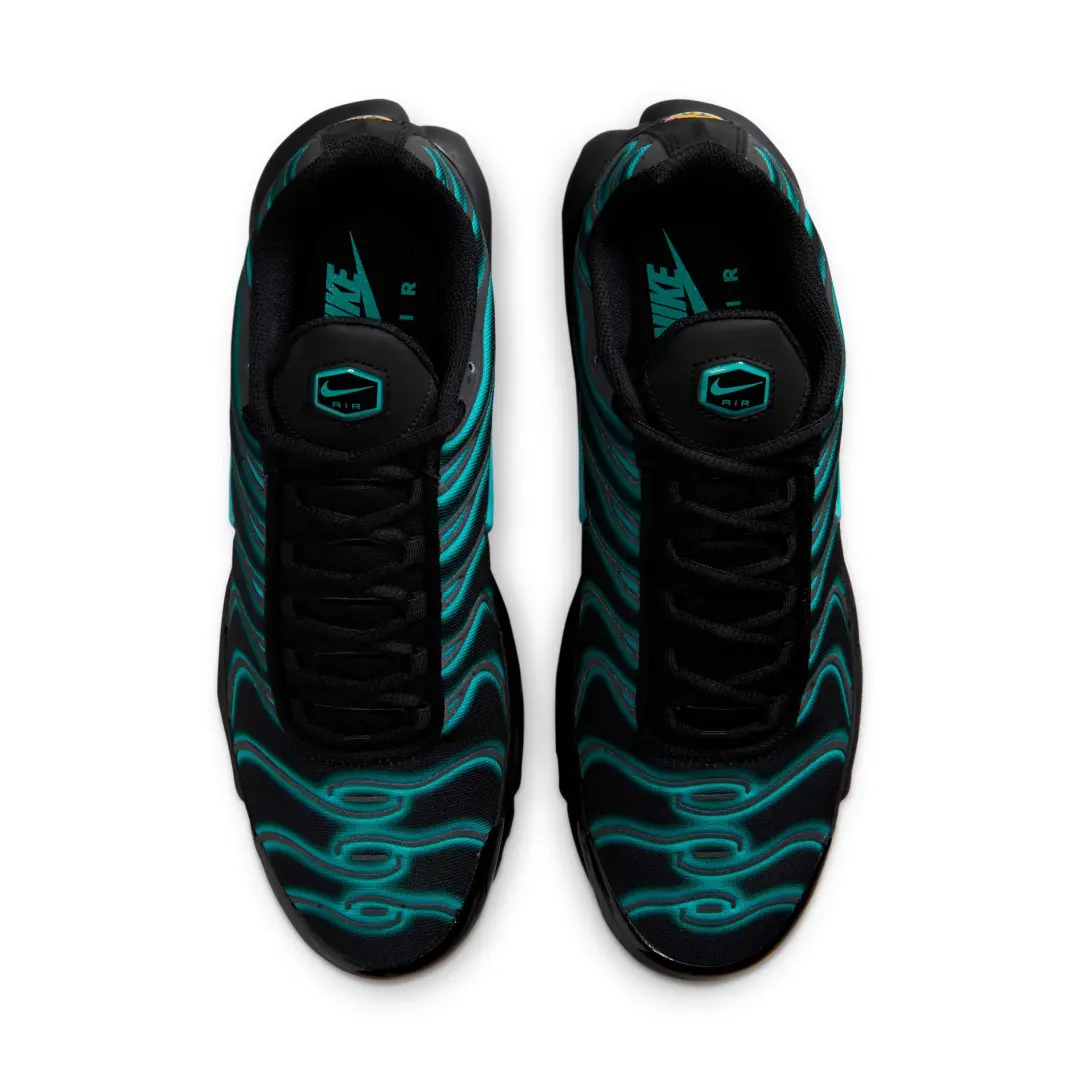
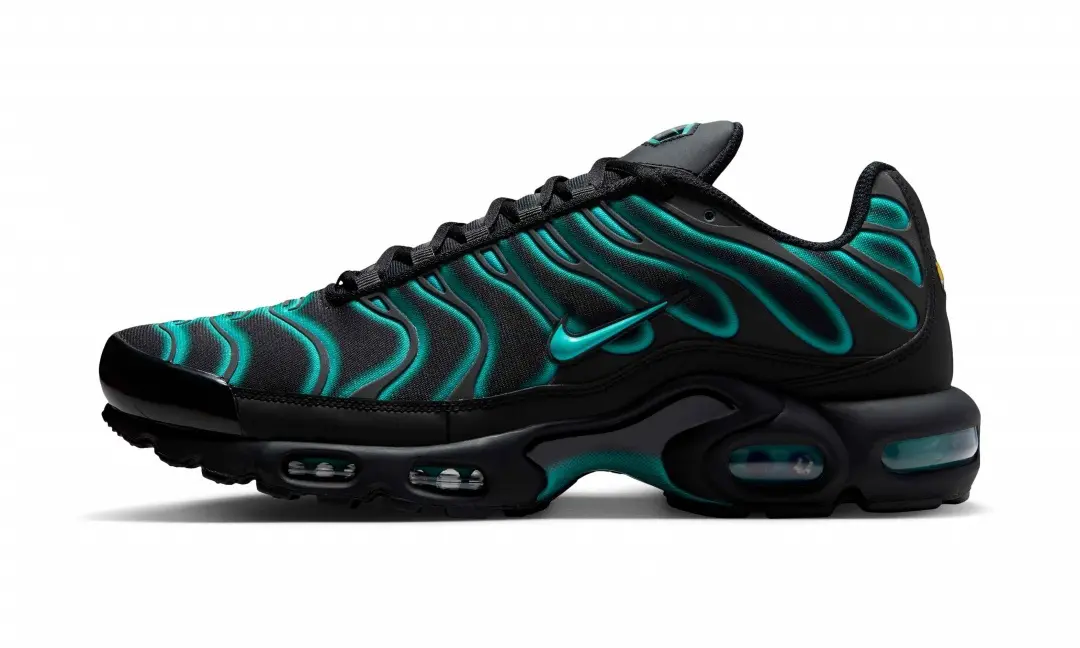
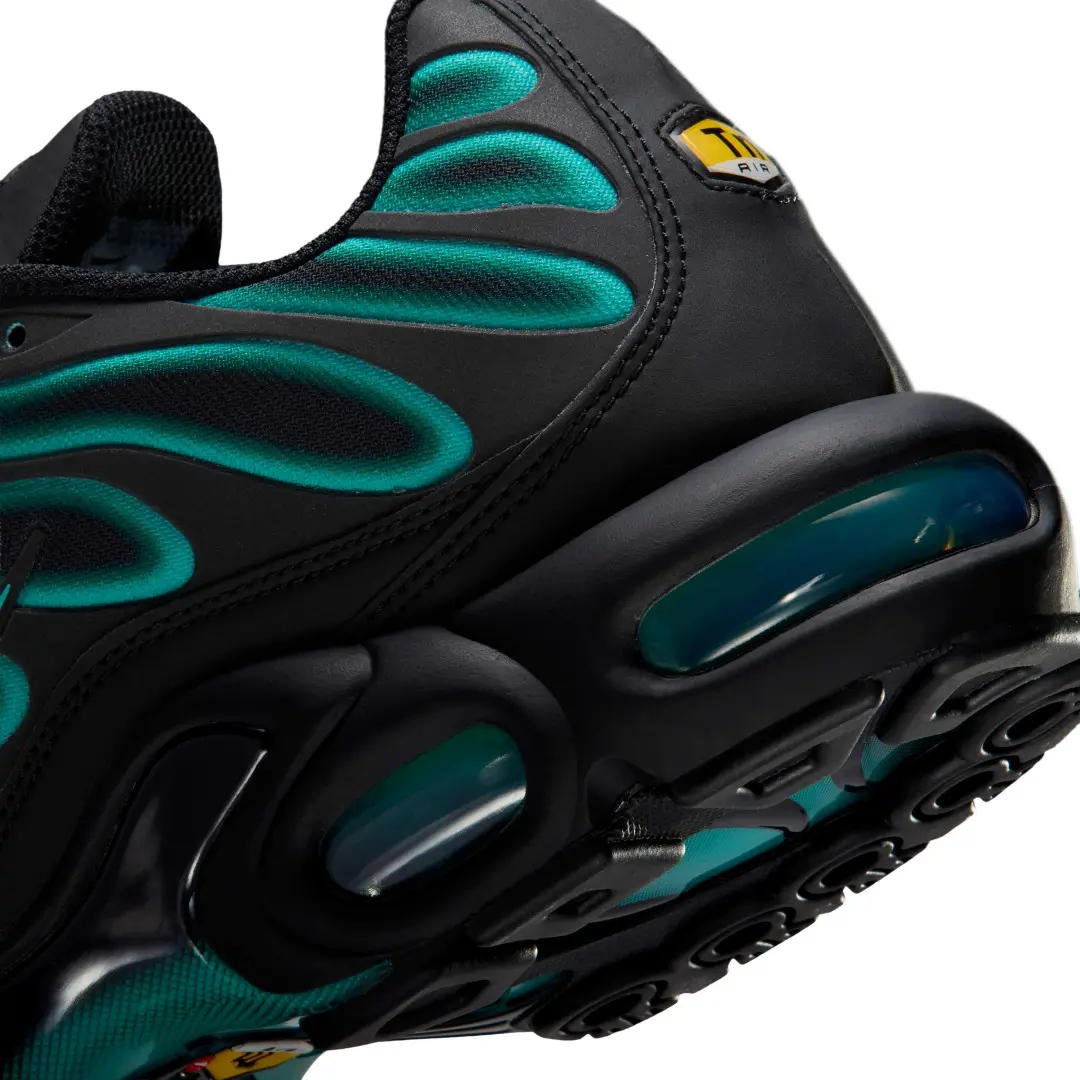
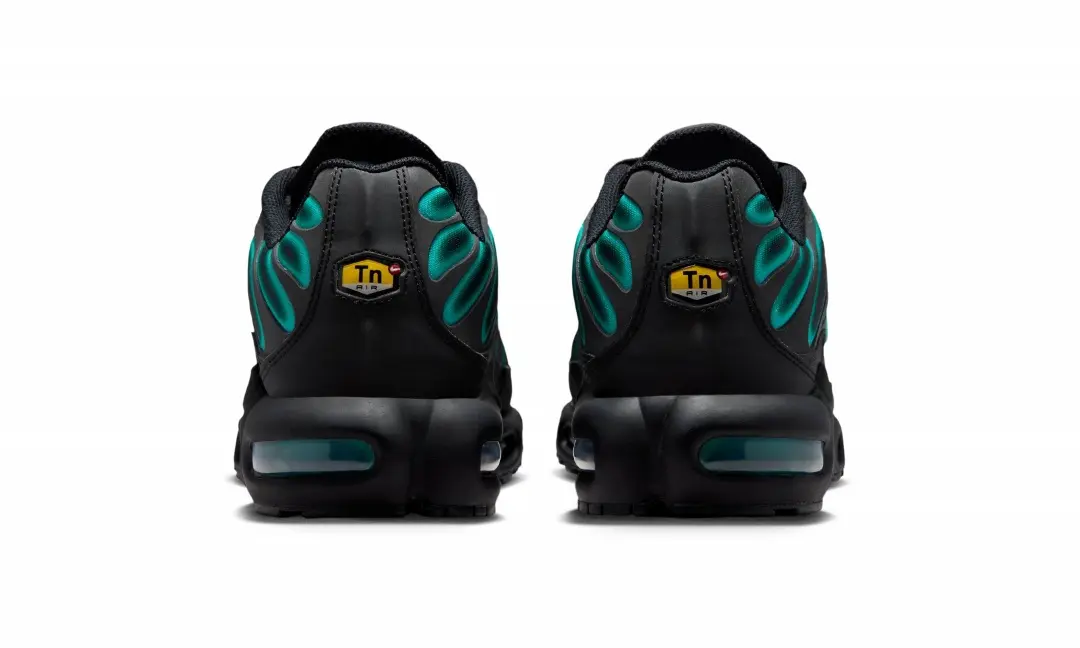
The effect, according to early images circulating ahead of the release, has been described as an eerie, almost glowing look along the edges of the frame, which tracks with how the accent color has been deployed elsewhere on the shoe. Instead of a wash of tones fading into each other, this pair isolates its color story into specific hits: the TPU cage’s outer edges, the midfoot plate, the tongue branding, the Swoosh, and the exposed Air unit. Everything else stays black, giving the pair a stealthier profile than most Air Max Plus releases tend to carry, and putting more emphasis on silhouette and texture than on color blocking.
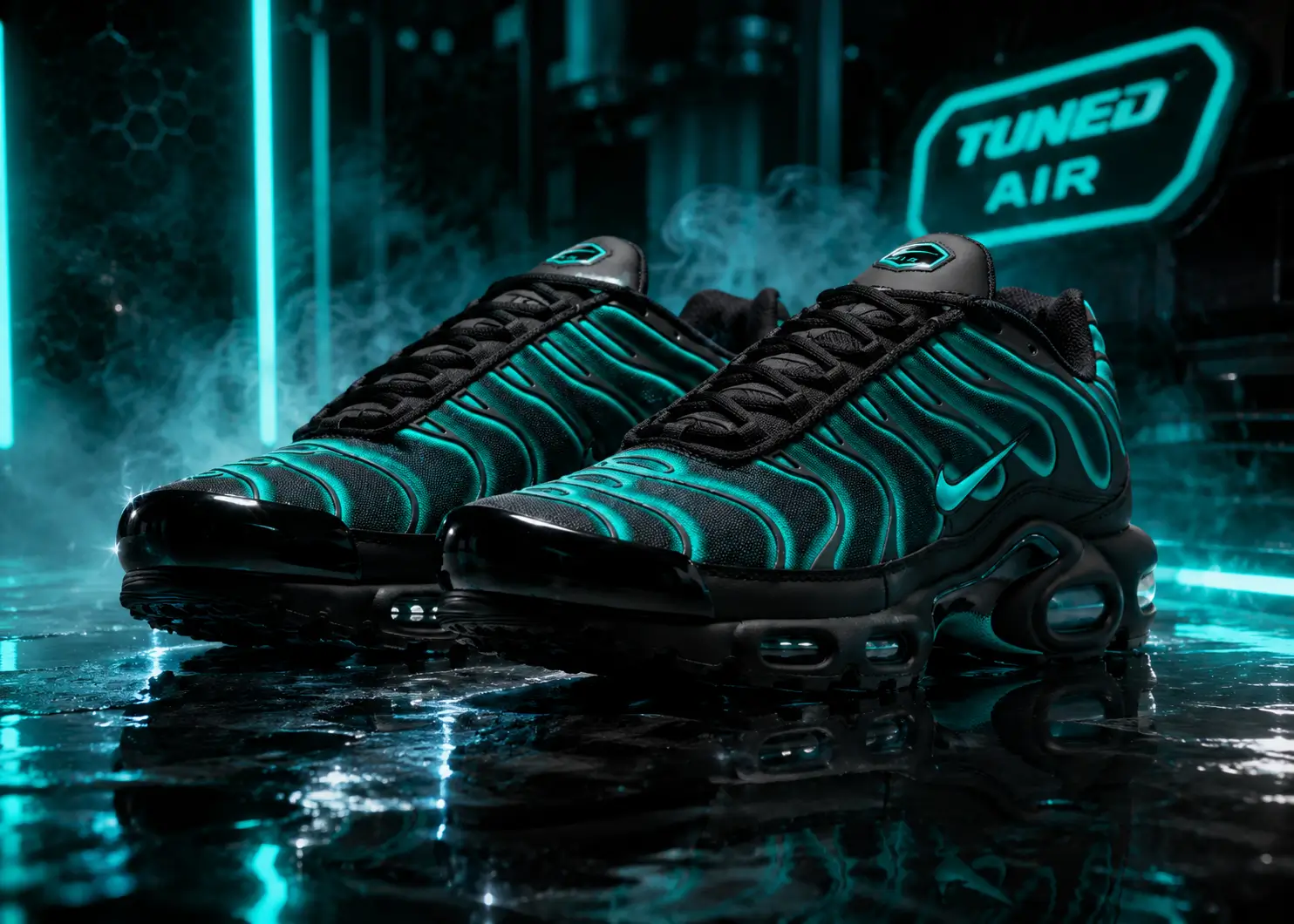
The Nike Air Max Plus “Dusty Cactus” is showcased in a cinematic neon-lit environment, highlighting its flowing teal gradient overlays, Tuned Air cushioning, and signature blacked-out design.
from
The accent shade running through this release is Dusty Cactus, a hue with a longer history inside Nike’s Air Max catalog than most casual buyers might assume. The color first showed up on the Air Max 93, and it has resurfaced periodically since across several models in the Air Max family, typically as a supporting color rather than the shoe’s dominant tone. Its return here fits a pattern Nike has followed on other recent Air Max releases, where a familiar heritage color gets reintroduced on a different silhouette as a way of tying newer product back to the line’s older visual DNA.
That pattern has been especially visible over the past two years. The Air Max Dn picked up its own Black/Dusty Cactus treatment during Holiday 2024, pairing a black upper with teal accents across its silicone detailing and Air bubbles, a release some observers connected to the teal and black palette associated with retired baseball star Ken Griffey Jr’s Seattle Mariners era signature shoes, given how closely the Dn has echoed Air Max Plus and Air Max 97 styling cues in its own design language. The Air Max 180 also received a Black/Dusty Cactus pairing in September 2024, built around the model’s original 1991 architecture from Tinker Hatfield and Bruce Kilgore, which underscores how far back the color’s association with the Air Max name actually runs.
On the Air Max Plus specifically, this is not the color’s first appearance either. A handful of past colorways across the line, including releases built around dot pattern uppers and other muted, cooler accent treatments, have paired black bases with tones adjacent to this one, though rarely with the cage stripped down this far. What sets this version apart is less the color choice itself and more the restraint around it. Rather than spreading Dusty Cactus across a gradient, the design keeps it contained to a handful of specific structural elements, which is part of what gives the shoe its glow like quality in photos rather than a straightforward two tone look.
show
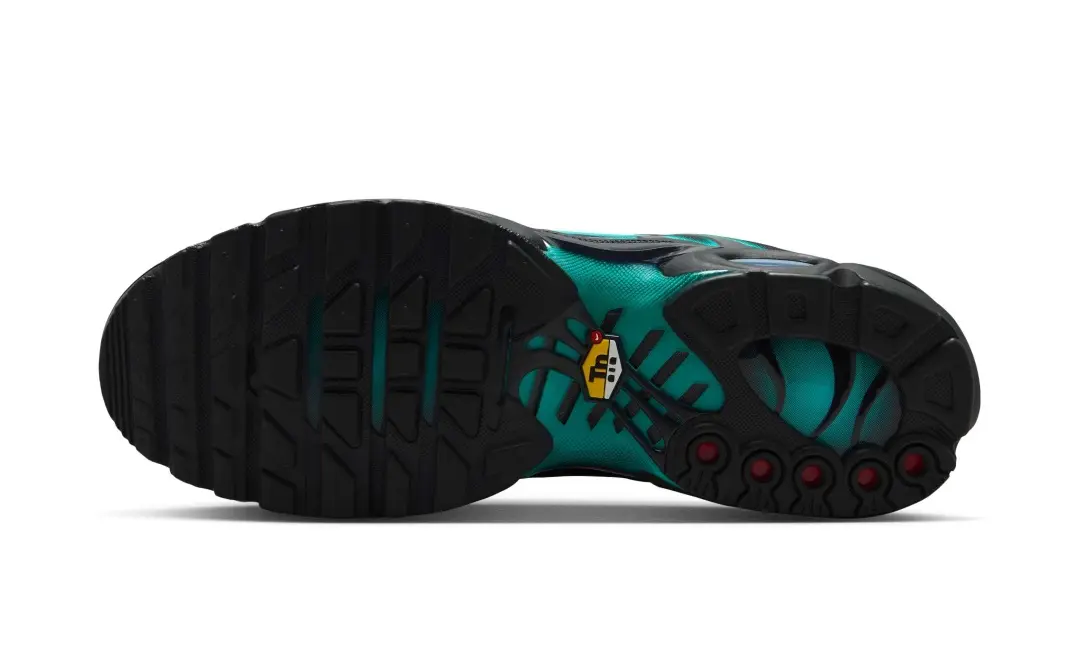
Underneath the colorway, the Air Max Plus keeps its usual construction largely intact. The shoe still runs on Nike’s Tuned Air system, pairing a heel Air unit with a forefoot Air bag and internal Tuned Air pillars that were originally engineered to add lateral support without sacrificing cushioning, a setup that has stayed mechanically consistent across nearly every Air Max Plus release regardless of colorway. That consistency has been part of the shoe’s staying power. Despite two and a half decades of design updates and hundreds of colorway variations, Nike has rarely tampered with the underlying cushioning architecture, treating the Tuned Air system as close to sacred within the line even as the upper treatments around it have shifted dramatically from release to release.
The wavy TPU cage remains the shoe’s signature structural element, running the length of the upper and framing the mesh base beneath it, with the black portions of this release leaving the cage’s shape more visually legible than busier gradient versions tend to. Because so much of the model’s visual identity is carried by that cage rather than by branding elements or stitching patterns, a blackout treatment like this one puts unusual pressure on the shape itself to hold interest, since there is comparatively little color variation elsewhere on the shoe to draw the eye.
Where Dusty Cactus actually shows up matters more than how much of it there is. Its placement along the cage’s outer edges creates a rim of color that frames the shoe’s silhouette without covering the mesh underneath, while its appearance on the midfoot plate ties directly into the shoe’s structural support system rather than being purely decorative, since that plate reinforces the arch area during wear. The tongue branding and Swooshes pick up the same tone, giving the accent a consistent throughline across the upper, and the color reaches the exposed Air unit as well, which is typically one of the more photographed details on any Air Max Plus release given how visible the bag sits at the heel and how much it tends to catch light in retail and lifestyle photography alike.
next
Air Max Plus releases move at a steady enough pace that any single colorway has to work a little harder to stand out, and this one does that mostly by being quieter than what typically comes out of the line. Recent Air Max Plus drops have leaned into busier, multi color treatments, dot patterns, and translucent cage effects, all of which put competing tones in conversation with each other across the upper. A near blackout pair with one accent doing the work is a different kind of statement inside that context, closer in spirit to some of the shoe’s darker colorways from earlier points in its run than to its more maximalist recent output.
That contrast is likely to be part of the appeal for people who already own multiple pairs of the silhouette. A single accent color on a black base reads cleaner in rotation, easier to pair with a narrower range of outfits than some of the model’s louder releases, while still keeping the visual signature, the TPU cage’s wave pattern, front and center rather than buried under competing colors. It is a version of the shoe built for people who want the silhouette’s shape more than its usual color complexity, and it also sits comfortably alongside the darker, more subdued palettes that have become increasingly common across Nike’s broader running and lifestyle output over the past few seasons, as brands generally have leaned toward tonal, easy to wear colorways alongside their louder statement pieces.
It is also worth noting how this release fits into the wider pattern of Dusty Cactus showing up across the Air Max family within a fairly tight window. Between the Air Max Dn, the Air Max 180, and now the Air Max Plus, the color has effectively become a connective thread running across three different silhouettes inside of roughly two years, which suggests it has become something closer to a recurring seasonal accent for the Air Max line as a whole rather than a one off callback. Whether that consistency reads as thoughtful continuity or simple efficiency likely depends on how closely any given buyer tracks the line across its different models.
huh
Fall releases within the Air Max Plus line have historically served as a mix of core, easy to stock colorways and slightly more considered seasonal statements, and the timing here places this pair alongside whatever else Nike lines up for that period across the wider Air Max catalog. A $185 retail price sits at the upper end of the standard Air Max Plus range, in line with where the model has settled for most non collaborative releases over the past few seasons, reflecting incremental price increases across Nike’s Air Max lineup generally rather than anything specific to this colorway. Specific drop dates within the Fall 2026 window and detailed size run information were not yet finalized at the time of reporting, which is typical for a release still several months out.
View this post on Instagram
avail
The Nike Air Max Plus “Black/Dusty Cactus” carries the style code IV5756-001 and is set to release in Fall 2026 at a retail price of $185, through Nike and select retail partners. Sizing and specific drop timing within the season had not been finalized as of this writing.
For anyone already tracking the Air Max Plus closely, this pair reads as a continuation of a design conversation that has been building across the model’s last several seasons: less about chasing a single standout colorway and more about how much visual restraint the sil’s structure can hold before it stops looking like an Air Max Plus at all. On that measure, the cage’s wave pattern alone appears to be doing enough work to keep the shoe legible even with nearly everything else pared back.
From the DRIFT archive: Palace x Nike Air Max DN8 “Safety Orange”: High-Visibility Energy Meets London Street Logic
Related Articles
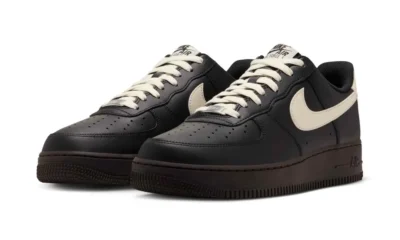
NIKE AIR FORCE 1 07 LOW “Black/Velvet Brown”
Air Force 1 07 Low. FJ4146-006. Black/Velvet Brown/Coconut Milk. 16 October 2026. ¥16,500. Leather that softens with wear.