DRIFT AUDIO
Listen to this story
Choose a voice, then press play.
Tory Burch just created a new executive seat and handed it to a Cypriot born brand architect with credits at Estée Lauder, Sol de Janeiro and The Row.
recall
- A New Kind of Seat at the Table
- Who Klitos Teklos Actually Is
- The Résumé Behind the Résumé
- Why Now, Why This Shape of Job
- The Reporting Lines Tell Their Own Story
- A Trend Bigger Than One Brand
- What Teklos Inherits
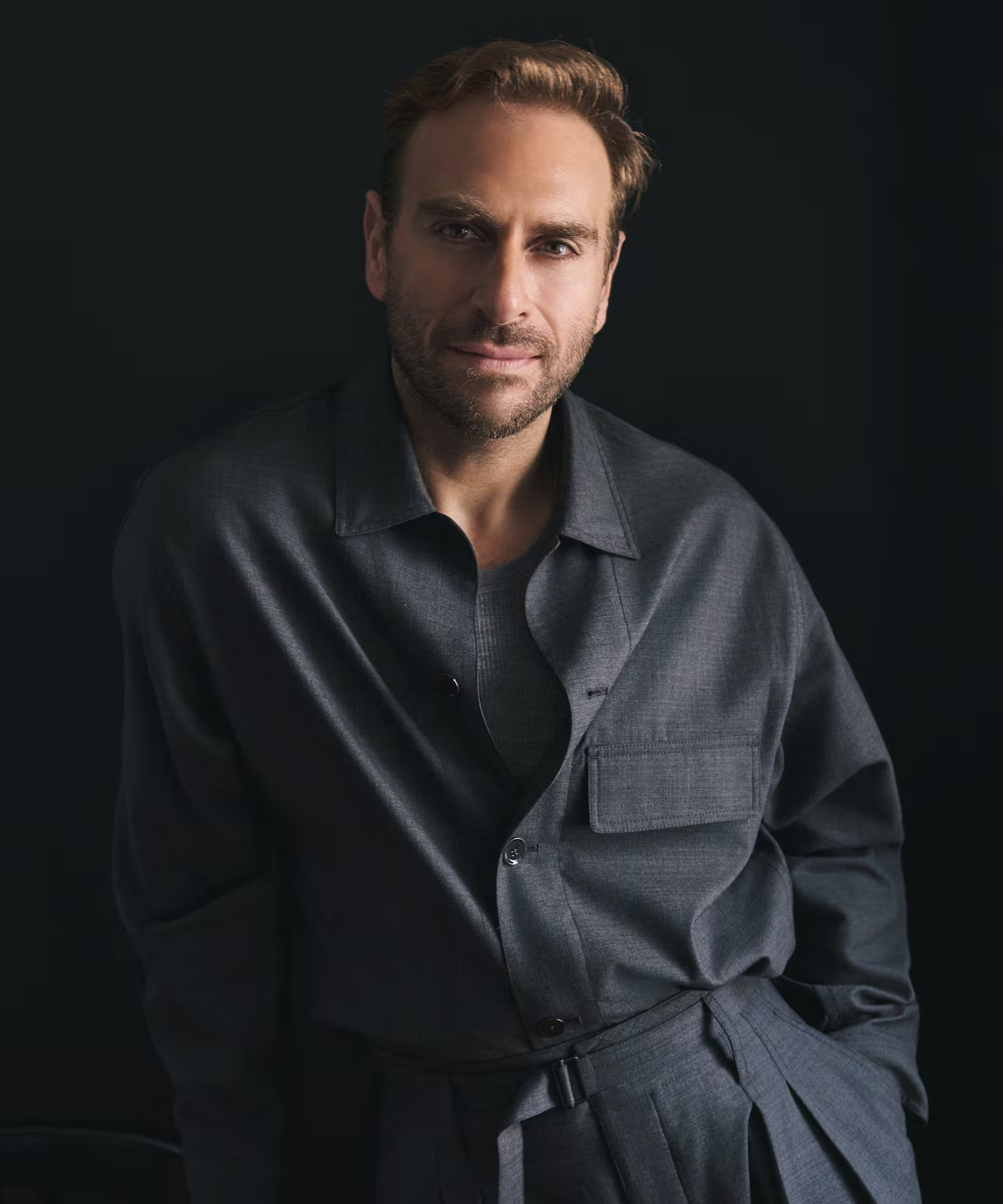
Tory Burch LLC announced this week that it has appointed Klitos Teklos to a role the company has never had before: chief brand officer. It is a title with real teeth. Teklos will now oversee global marketing, social media and visual merchandising in one unified function, and he reports directly to Tory Burch herself, who holds the titles of founder, executive chairman and chief creative officer, alongside chief executive Pierre-Yves Roussel.
“Sublime is the ultimate way you want to feel: confident, sensual and strong. It is a word and an emotion that has no ending… It makes you feel like anything is possible.” xTory
Shop now https://t.co/ZKmgKRRfEL#ToryBurchSublime #ToryBurchBeauty pic.twitter.com/jeWSmEWMqR— TORY BURCH (@toryburch) August 19, 2024
The appointment is effective this week, and it lands at a moment when Tory Burch, the brand, has spent several seasons trying to sharpen its identity across a widening set of channels: runway, retail, e-commerce, social platforms, and international markets that increasingly behave like their own ecosystems. Burch described the hire in blunt, admiring terms, saying Teklos brings a rare mix of creative instinct, commercial sense and operational discipline, and that he understands how to build real connections with customers. Roussel, for his part, framed the hire around a more specific skill: the ability to turn brand strategy into measurable business results.
Neither executive was vague about what they expect. A chief brand officer role sounds, on paper, like a communications job with a fancier title. In practice, at a company the size of Tory Burch, it is closer to a coherence job. Someone has to make sure that a handbag campaign, a Fifth Avenue window, an Instagram Reel and a Tokyo pop up all sound like they came from the same place. That job did not formally exist at Tory Burch until this week.
stir
Teklos is not a name most casual observers of the fashion industry would recognize immediately, and that is somewhat by design. He has spent nearly two decades operating as a hired gun for brand transformation, moving between agency work and what he has described as “brand residencies,” extended in house stints where he embeds with a company’s team rather than consult from a distance.
Born in Cyprus and educated at Pratt Institute in Brooklyn, Teklos built his early career at the New York outpost of Air Paris, an advertising agency, where he eventually rose to chief creative officer and worked across fashion, fragrance and beauty accounts for the better part of a decade. From there he moved to Estée Lauder Companies, where he spent five years as senior vice president and global chief creative lead across eleven brands in the company’s designer fragrance, men’s grooming and skincare portfolios. His portfolio there reportedly touched Aramis, DKNY, Lab Series, Donna Karan, Kiton, Michael Kors, Origins, Tommy Hilfiger and Zegna, along with consulting work on Tom Ford campaigns. Notably, Tory Burch’s own fragrance business was part of that same Estée Lauder creative remit, which means Teklos arrives at his new employer with an unusual head start: he has already worked inside the brand’s universe once before, just from a different chair.

Long-exposure view of the Hotel Empire’s neon sign transformed into abstract streaks of light against the night skyline.
In 2023 he stepped away from full time corporate life to found his own studio, called Tēklos, describing it as a multidisciplinary brand architecture practice built around the residency model rather than traditional retainer consulting. Under that banner, he took on an interim chief creative officer post at Sol de Janeiro, the Brazilian inspired body care brand that has become one of the more closely watched growth stories in mass beauty, running that engagement from 2024 into 2026. His client list during this period also included The Row, and most recently Gap Inc., where he led creative and brand development across the beauty categories of Old Navy, Gap, Banana Republic and Athleta simultaneously, a scope that suggests he is comfortable managing brand voice across very different price points and customer bases at once.
respond
What makes Teklos an interesting hire is less the brand names on his résumé and more the pattern underneath them. He has built a career around walking into companies mid transformation and imposing a kind of visual and strategic discipline without erasing what made the brand distinctive in the first place. At Sol de Janeiro, a brand whose identity is inseparable from its scent and its social virality, that meant working within an already loud aesthetic rather than quieting it down. At Estée Lauder’s fragrance portfolio, it meant doing the opposite: finding throughlines across eleven brands that otherwise had very little in common.
His personal portfolio, hosted on his studio’s own site, lists an eclectic set of collaborators beyond the corporate résumé, including Kate Moss, Sabrina Carpenter, Scent Beauty and Ford Models, suggesting a practice that moves comfortably between institutional brand work and more editorial, talent driven projects. He has also picked up a string of industry recognitions over the years, including a National Design Award nomination from the Cooper Hewitt Smithsonian Design Museum and honors from the Art Directors Club of New York, the American Society of Media Photographers and the International Fragrance Foundation. In 2025, according to his own biography, he was named Man of the Year in Cyprus, a national recognition for his international career.
None of that guarantees success in a role this new and this broad, but it does explain why Tory Burch’s leadership frames the hire as a strategic bet rather than a straightforward staffing move. The company is not simply replacing a marketing chief. It is testing whether one person can hold together a set of functions that, at most luxury houses, still report up through separate chains.
huh
The timing matters. Tory Burch has spent the last several years trying to reposition itself somewhere between accessible luxury and something more elevated, a shift that has shown up in its runway presentations, its store design and its pricing architecture. That kind of repositioning is hard to pull off if marketing, social and visual merchandising are all optimizing for slightly different goals. A campaign built for prestige can get undercut by a store window built for volume, or a social calendar built for engagement metrics rather than brand tone.
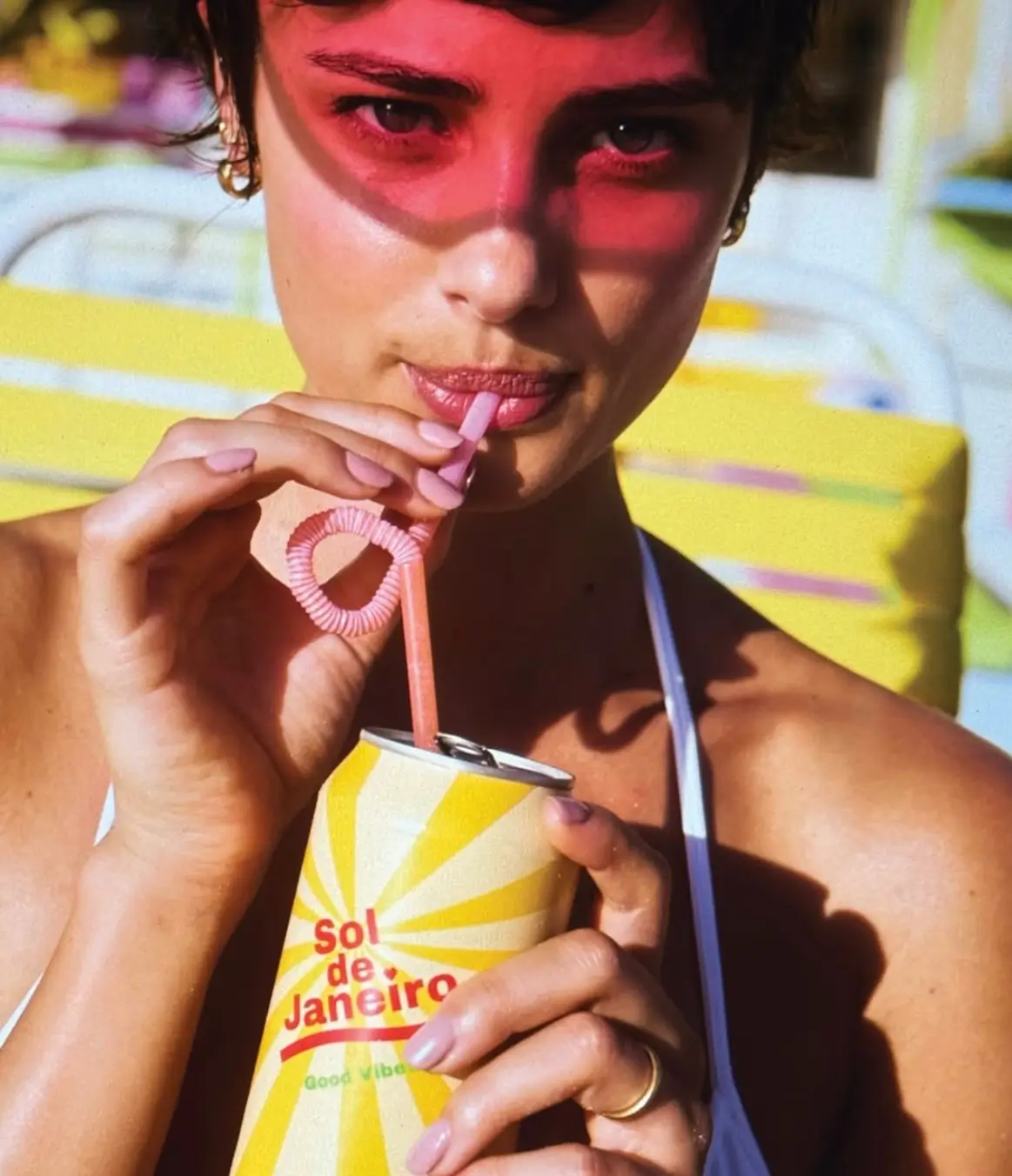
Sunlit campaign image featuring a Sol de Janeiro drink can, play pink straw, and vibrant poolside styling.
Creating a single role to own all three functions is, in effect, an admission that the old structure was producing friction rather than cohesion. It is also a fairly aggressive consolidation of power for one executive, and it places Teklos in regular proximity to two of the most senior people at the company, Burch herself and Roussel, rather than several rungs below them. That structure gives him unusually direct access to shape decisions that, at other houses, might get filtered through multiple layers of committee before reaching the top.
Teklos will also work alongside Honor Brodie, Tory Burch’s longtime creative director, a pairing that will be worth watching closely. Creative direction and brand strategy can pull in different directions even when the people holding those jobs like each other personally, since one role is fundamentally about product and image while the other is about consistency and reach. How Teklos and Brodie divide the territory between “what looks right” and “what keeps the story straight across every channel” will likely say a lot about whether this new structure actually works.
flow
It is worth sitting with the reporting structure for a moment, because it is unusual. Most brand or marketing chiefs at companies this size report to a single executive, typically a chief executive or a chief marketing officer above them. Teklos reports to two people at once, both of whom sit at the very top of the organization. That is either a sign of how much trust the company is placing in the role, or a sign of how much oversight it wants over a function this newly consolidated. Realistically it is probably both.
It also suggests that Tory Burch’s leadership sees brand coherence as a company wide priority rather than a marketing department problem, which tracks with how the broader luxury sector has started talking about the discipline. A decade ago, a brand’s “look” could largely be managed by a creative director and a marketing team working somewhat independently. Now, with social platforms functioning as a storefront, a media outlet and a customer service channel all at once, brands increasingly want one person accountable for whether all of those touchpoints feel like the same company.
extent
Tory Burch is not inventing the chief brand officer title, but the way it has structured the role, folding in visual merchandising alongside marketing and social, is a more aggressive consolidation than most of its peers have attempted. Luxury and premium brands more broadly have been investing heavily in senior brand leadership over the past several years, largely because the number of channels a shopper might encounter a brand through has multiplied so quickly that consistency has become genuinely difficult to engineer without a single point of accountable.
The logic tracks with what has been happening across retail and beauty simultaneously. Companies that once treated store design, digital marketing and social content as three separate disciplines with three separate budgets are increasingly trying to fold them under one strategic umbrella, on the theory that a shopper does not experience a brand in silos even if the org chart says otherwise. Someone browsing a brand’s Instagram feed in the morning and walking past its storefront that same afternoon should, in theory, feel like they encountered the same point of view twice. Getting there requires structural change, not just better creative briefs.
There is also a gen shift underneath all of this. A shopper who discovers a brand through a fifteen second video has a very different relationship to that brand than one who discovers it through a print campaign or a window display, and most heritage houses are still figuring out how to serve both experiences without one undermining the other. Handing all three functions, marketing, social and visual merchandising, to a single executive is one way of forcing an answer to that problem rather than letting different teams quietly optimize for different audiences and hoping the discrepancies do not show. It is a bet that unity of vision matters more right now than specialization within each individual channel.
Other haute and premium brands have experimented with versions of this same consolidation over the past few years, though rarely with quite this much scope folded into one title. Some have created chief brand officer or chief experience officer roles that sit closer to marketing alone, leaving visual merchandising under retail operations. Tory Burch’s version goes further by explicitly placing store presentation in the same hands as digital storytelling, which suggests the company sees its physical retail footprint, still a meaningful part of its business, as inseparable from how it shows up online.
fin
Teklos steps into the role at a company that has real momentum to protect. Tory Burch has built a genuinely global footprint across ready to wear, handbags, footwear and fragrance, and it has done so while maintaining a distinctive view lang rooted in Burch’s own aesthetic instincts, part preppy, part bohemian, filtered through two decades of runway evolution. The challenge for Teklos will not be inventing a new identity from scratch. It will be making sure that identity survives contact with dozens of markets, hundreds of retail doors and a social media environment that rewards speed over polish.
His history suggests he is comfortable with exactly that kind of tension, having spent his career moving between brands with very different temperatures, from the maximalist energy of Sol de Janeiro to the quieter, more controlled world of The Row. Whether that range translates cleanly into a single, sustained role inside one company, rather than a string of shorter engagements, is the open question that will define how this appointment is remembered a year from now.
Tory Burch, the company, has always drawn its identity from a specific tension of its own, the founder’s instinct for mixing prep school polish with something looser and more bohemian, built up over roughly two decades since the brand’s founding in 2004. That tension has served the company well precisely because it resists easy categorization, which is also what makes it hard to franchise out across dozens of markets and channels without losing its edges. Teklos’s entire career has been built around solving exactly that kind of problem for other people’s brands. Now he gets to try it on one that, by his own account, he has quietly admired and already partly helped build, from the fragrance counter outward.
The early read from the industry press has been broadly favorable, framing the hire as a sign that Tory Burch is serious about the next stage of its evolution rather than simply filling a vacancy. Whether that read holds will depend less on Teklos’s résumé, which is already well established, and more on how quickly the newly unified team under him can translate a single point of view into campaigns, stores and social feeds that genuinely feel connected. That is a slower, quieter kind of success to measure than a splashy campaign launch, and it may take several seasons before anyone outside the company can say with confidence whether the bet paid off.
For more on brand, see Rhuigi Villaseñor: Turning Rhude Into a Heritage Luxury Brand.
For more on brand, see The Expanding Universe of A$AP Rocky’s HOMMEMADE Furniture Brand.
n
From the DRIFT archive: No Me Quiero Ir De Aquí — The Story of Bad Bunny and FRSH Company’s Puerto Rican Streetwear Moment
Related Articles

American Horror Story Opens the Vault for a Thirteen-Episode Reunion of Its Own Ghosts
Three half-hour episodes land September 24 on FX and Hulu, with Jessica Lange, Sarah Paulson […]