DRIFT AUDIO
Listen to this story
Choose a voice, then press play.
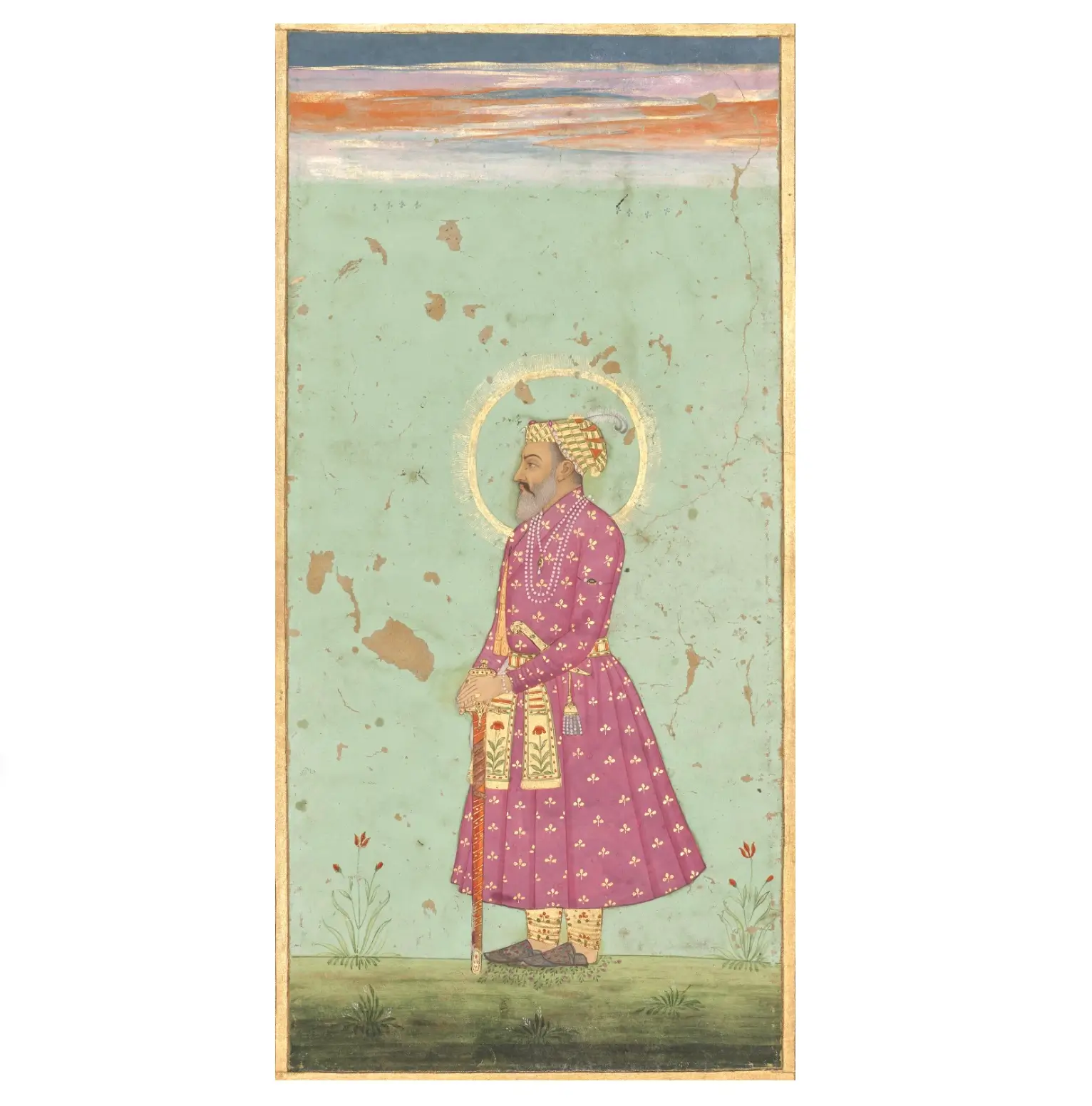
Portrait of Shah Jahan, Mughal India, circa 1650, is a quintessential example of mid-17th-century Mughal miniature painting, capturing the zenith of imperial portraiture under one of India’s most magnificent rulers. This opaque watercolor and gold on paper work, measuring approximately 8 ½ x 4 1/8 inches within a larger folio, depicts Emperor Shah Jahan standing in profile in an open landscape. He rests both hands upon the hilt of a sword, a classic pose symbolizing authority, composure, and martial readiness. The emperor wears a richly ornamented pink jama patterned with small gold floral motifs, fastened with an elegant sash from which a bejeweled dagger hangs. Multiple strands of pearls drape across his chest, underscoring the opulence of his court.
date
Shah Jahan, born Prince Khurram in 1592 in Lahore, ascended the throne in 1628 after a succession struggle following his father Jahangir’s death. His reign, from 1628 to 1658, is often called the Golden Age of Mughal architecture and culture. He is best remembered today as the builder of the Taj Mahal, the eternal marble monument to his beloved wife Mumtaz Mahal, who died in 1631. Yet his patronage extended far beyond architecture to painting, jewelry, textiles, and court ritual.
stir
Under Shah Jahan, Mughal art shifted from the more naturalistic, emotionally expressive style favored by Jahangir toward greater formality, symmetry, and idealized grandeur — qualities vividly evident in this portrait. The circa 1650 date places the work late in Shah Jahan’s reign, when he was in his late fifties or early sixties, though the portrait idealizes him in a timeless, middle-aged vigor. His refined angular features, sharp nose, thoughtful eyes, and neatly trimmed beard are rendered with the meticulous precision typical of Mughal court ateliers.
flow
This composition echoes earlier prototypes, notably a portrait by the artist Nanha around 1620 in the Shah Jahan Album. Shared motifs — the profile stance, pearl jewelry, and sword — demonstrate how imperial workshops circulated and refined standard view types of the emperor. Court artists such as Bichitr, Hashim, Chitarman, and Muhammad Abed produced varies, often for albums assembled for the emperor or gifted to dignitaries.
scope
Mughal portraiture under Shah Jahan balanced realism and idealization. The sword here is not merely a weapon, but an emblem of padshahi, or kingship. The pink jama, translucent muslin, jeweled dagger, pearls, and gems highlight the emperor’s legendary connoisseurship of luxury materials. Jewelry in these portraits was never only decoration. Pearls, rubies, emeralds, spinels, and diamonds carried cosmological, economic, and political meaning, symbolizing divine favor, imperial wealth, and control over global majestic networks.
in lieu
Beyond aesthetics, the painting encodes political messaging. By the 1650s, Shah Jahan faced challenges: Deccan campaigns strained resources, while succession tensions simmered among his sons. The war of succession eventually ended with Aurangzeb’s victory, and Shah Jahan was imprisoned in Agra Fort until his death in 1666. Portraits like this, produced or collected late in his reign, project enduring majesty amid underlying fragility. The emperor’s composed stance reassures viewers of stability even as clouds gathered.
refine
Mughal painting techniques reached technical uniqueness here. Artists ground pigments from minerals, plants, and insects, while fine brushes allowed microscopic detail in embroidery, jewel facets, and fabric folds. Gold heightening creates luminous effects, making pearls and sword hilts gleam. The borders, often framed with gold and red rules, turn the image into a jeweled window onto the imperial world.
end
Today, such miniatures offer intimate glimpses into a vanished world of unparalleled splendor. Viewing this portrait, one senses the emperor’s presence — dignified, opulent, eternal — frozen in pigment and gold. It transcends mere likeness to become a statement of Mughal shaan: power tempered by refinement, worldly wealth infused with aesthetic and spiritual grace.
In an age when empires rose and fell, Shah Jahan’s portraits endure as testaments to a ruler who shaped India’s view and architectural heritage. The Taj Mahal may be his most famous legacy, but these jewel-like miniatures reveal the man behind the monument: a connoisseur, a builder, a lover, and an emperor who bequest that image, like marble, could conquer time.
Related Articles
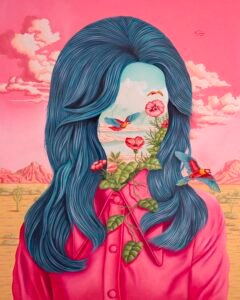
Where the Face Should Be, Rafael Silveira Paints Open Sky
A pink shirt, shoulder-length hair, then no face at all: in “Surprise,” Rafael Silveira lets flowers and a clear blue sky stand in for the person.