Orange Against the Gray: A Close Look at TelveArt Telve’s MANUELA (2026)
DRIFT AUDIO
Listen to this story
Choose a voice, then press play.
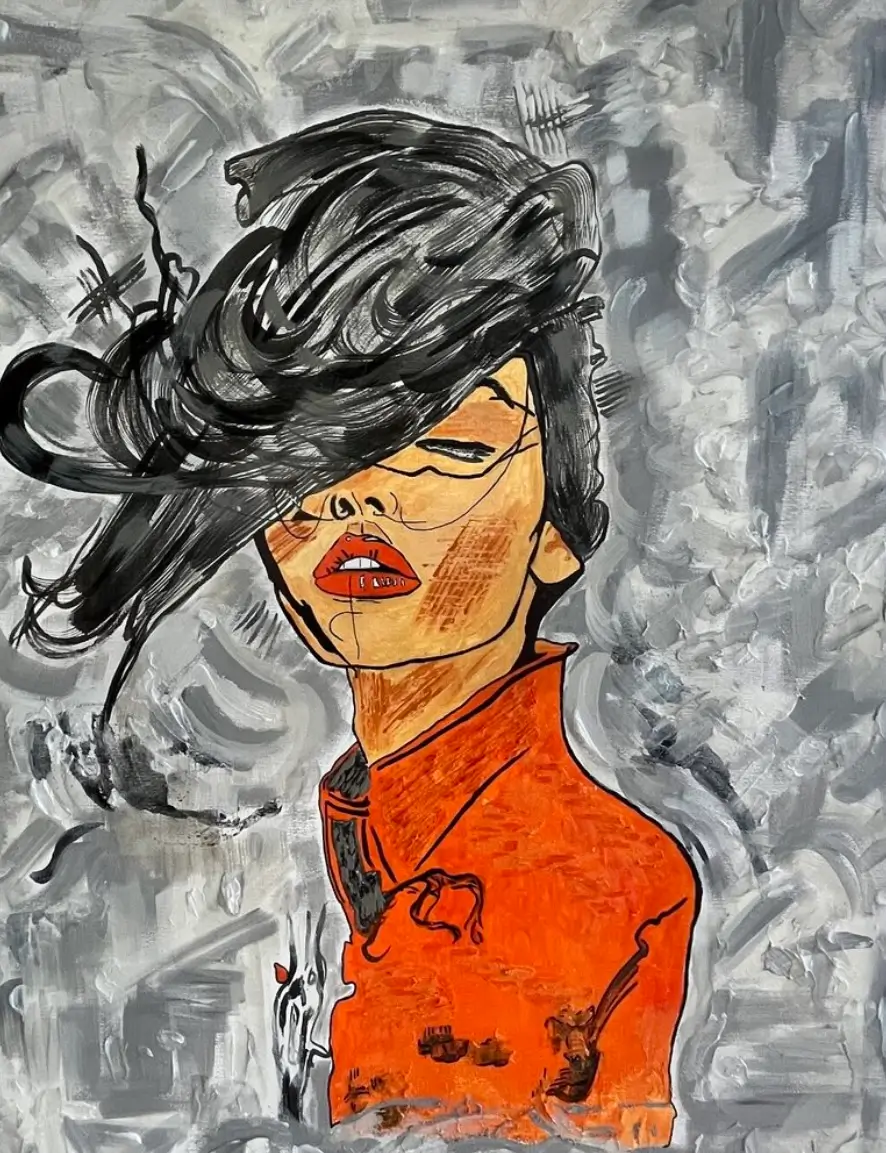
There is something immediate, almost involuntary, in the way Telve arrests the eye. The portrait does not ask for attention—it seizes it. A figure emerges from a field of ash-toned abstraction, her face partially obscured by a sweep of black hair that feels less styled than wind-struck, less composed than disrupted. The background churns in greys, layered like sediment or memory, while the figure—rendered in warm ochres and a striking, almost incendiary orange—pushes forward, refusing to dissolve into that same uncertainty.
What TelveArt achieves here is not simply portraiture. It is an interruption. A figure caught mid-thought, mid-motion, mid-exposure. The image feels like it has been taken from somewhere between stillness and fracture, where identity is not stable but negotiated.
stir
Acrylic and India ink—two mediums with inherently different temperaments—are made to coexist here with deliberate tension. Acrylic, with its density and opacity, grounds the composition. It gives weight to the orange garment, saturating it with a presence that feels almost sculptural. India ink, by contrast, moves differently. It scratches, stains, bleeds. It carries gesture. It resists containment.
In Telve, ink is not used to outline so much as to destabilize. The lines around the face are not clean—they tremble, overlap, break. Hair becomes a site of expressive violence, its strokes cutting across the face like marks of interruption rather than decoration. The eye, partially veiled, becomes less a focal point and more a withheld disclosure.
This interplay between media creates a dual rhythm: one that anchors and one that unsettles. The painting does not resolve this tension; it thrives on it.
flow
The choice of orange is not incidental. It is central. Against the monochromatic turbulence of the background, the garment reads as both armor and exposure. Orange, historically associated with energy, visible, even warning, here becomes something more ambiguous. It radiates, but it also isolates.
The figure is set apart not just spatially but chromatically. The grey background feels almost industrial—textured like concrete, layered like urban residue. Within this environment, the orange becomes a signal. Not quite defiance, not quite vulnerability, but something in between. A declaration that is also a risk.
The skin tones, rendered in warm ochres and layered with visible marks—scratches, cross-hatched textures—echo this tension. The face is not polished. It is worked, almost weathered. Beauty here is not softened; it is constructed through friction.
idea
Perhaps the most compelling aspect of Telve is what it withholds. The face, traditionally the site of recognition and emotional access, is partially obscured. The hair does not frame the face; it interrupts it. One eye is hidden, the other barely suggested. The mouth—painted in a vivid red—becomes the only clear point of articulation, yet even it is slightly misaligned, its lines imperfect, almost trembling.
This fragmentation even potentially disrupts the viewer’s instinct to “read” the subject. We are denied full access. Instead, we are left with fragments—suggestions of identity rather than its confirmation.
This is where the work moves beyond portraiture into something more psychological. The figure is not presenting herself; she is being encountered in a moment where presentation has broken down. There is a sense of interiority that resists translation.
move
The gestural quality of the brushwork is not decorative—it is emotional. The background, with its layered greys, feels almost like accumulated thought, or perhaps accumulated noise. It swirls without forming a clear structure, creating a sense of unease, of instability.
Against this, the figure’s form is more defined but still marked by disruption. Lines are not clean; they are insistent. The ink scratches into the surface, leaving traces that feel almost like revisions, or attempts to correct something that refuses correction.
This creates a temporal dimension within the painting. It feels as though we are seeing not just the final image, but the process of its making—the hesitation, the reworking, the insistence.
subject
The body, particularly the neck and shoulders, is elongated, stylized. The high collar of the orange garment creates a vertical emphasis, drawing the eye upward toward the face, but also constraining it. There is a subtle tension between the rigidity of the garment and the fluidity of the hair.
This contrast reinforces the idea of containment versus movement. The body is held, structured, almost formal. The hair—and by extension, the identity it obscures—is in motion, resisting that structure.
The figure exists between these states: composed and disrupted, visible and concealed.
modernity
Situating Telve within a contemporary Italian context is not about tracing direct lineage, but about recognizing a sensibility. There is a certain confidence in gesture here, a willingness to allow imperfection to remain view. The work does not aim for polish; it aims for presence.
Italy’s long history with figurative art often carries an expectation of refinement, of mastery over form. TelveArt, however, engages with that history by loosening it. The figure is not idealized. Proportions are slightly exaggerated, lines are intentionally unstable, textures are left raw.
This is not a rejection of tradition, but a reworking of it—where the figure becomes less about representation and more about expression.
consider
The subject, read as feminine, carries with it a long history of representation—often shaped by external gaze, by ideals of beauty, by narratives of passivity or allure. Telve disrupts these conventions.
The figure does not invite. She does not pose. Her gaze is not fully accessible, her expression not fully legible. The red lips, often a symbol of seduction, here feel almost defiant—bold, but not performative.
There is a sense that the figure exists for herself, not for the viewer. The obscured eye becomes a refusal. The visible textures of the skin become a rejection of smoothness, of perfection.
This is a portrait that does not resolve into comfort. It remains slightly abrasive, slightly distant.
amb
The background is not passive. It actively shapes the reading of the figure. Its layered greys, its almost chaotic brushwork, create an environment that feels unstable, perhaps even oppressive.
Within this, the figure’s presence becomes more pronounced, but also more precarious. She is not simply placed against the background; she is emerging from it, or perhaps resisting it.
The environment and the subject are in dialogue. One does not exist without the other.
linger
Telve is not a painting that reveals itself in a single glance. Its impression is immediate, but its meaning accumulates. The longer one looks, the more the details begin to shift.
The scratches on the face begin to read differently—not as damage, but as marks of construction. The background’s chaos begins to feel less random, more deliberate. The obscured eye becomes less a concealment, more a focal absence.
This is where the work gains depth. It resists a singular interpretation, instead offering a field of possibilities.
fin
Telve stands as a compelling example of contemporary mixed-media portraiture that prioritizes sensation over resolution. It is not concerned with likeness, nor with narrative in a traditional sense. Instead, it offers a moment—charged, unstable, incomplete.
The figure remains with you not because she is fully known, but because she is not. The obscured eye, the restless hair, the vivid garment against a collapsing background—these elements linger, forming a memory that is less about image and more about feeling.
In a cultural landscape often saturated with clarity, with images designed for immediate consumption, Telve insists on something slower, more uncertain. It asks not to be understood, but to be experienced.
And in that insistence, it finds its power.
Related Articles
Joël Andrianomearisoa Finds More Than One Black in a Square of Buttons
In La Guerre des Boutons I, a field of ordinary fasteners turns a modest textile […]