DRIFT AUDIO
Listen to this story
Choose a voice, then press play.
Miami City Ballet opens its season October 16 with Robbins’ Opus Jazz in all-new GapStudio costumes, billed as the first authorized redesign of the ballet’s stage wardrobe.
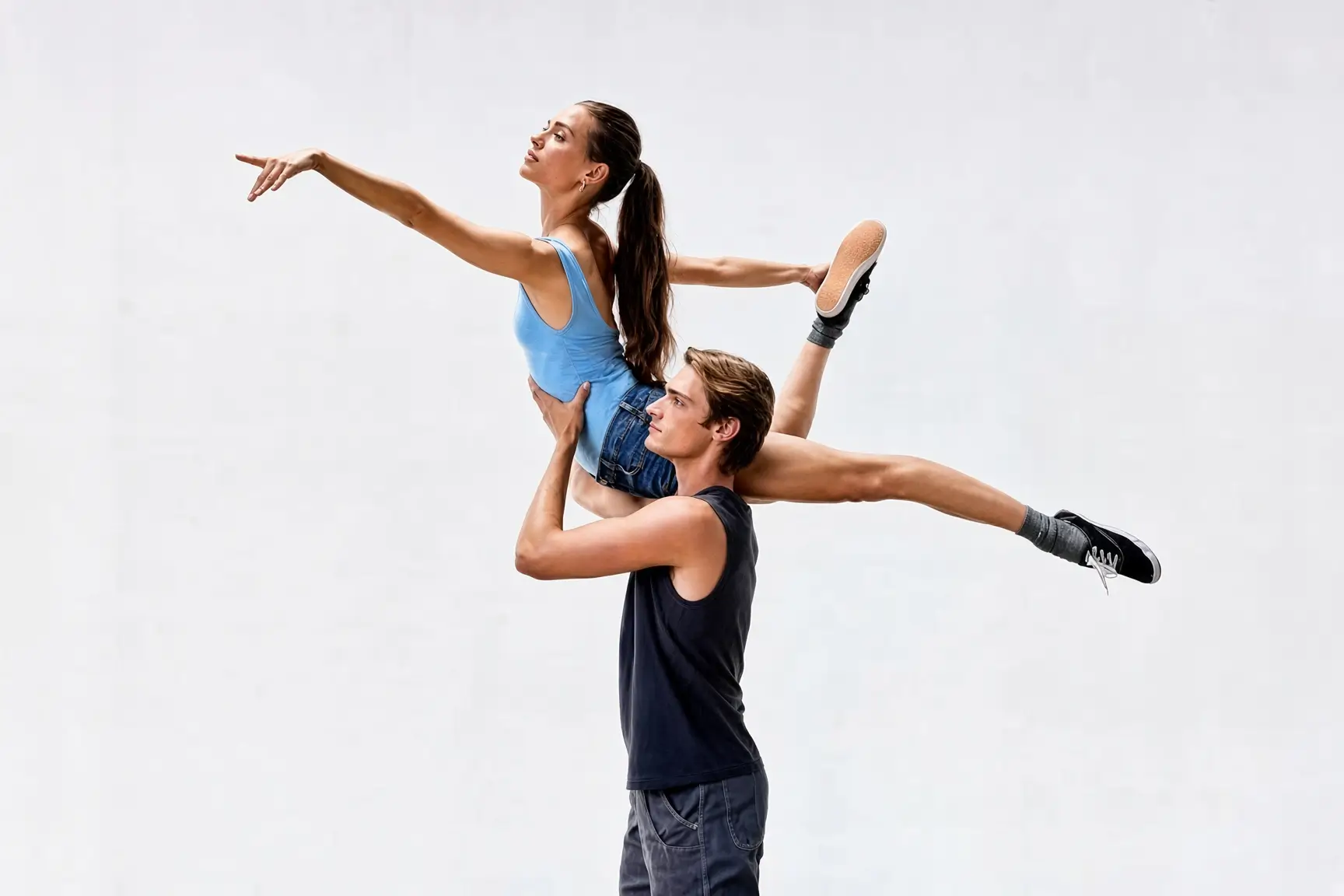
For most of the ballet, nobody in the cast of Miami City Ballet’s new Opus Jazz is dressed like anyone else, and that is the point. When the company opens its 2026/27 season on October 16 at the Adrienne Arsht Center, each of the sixteen dancers in Jerome Robbins‘ 1958 work will step out in a look made for that individual by GapStudio, the line led by Zac Posen inside Gap. Posen was invited by The Robbins Rights Trust and Miami City Ballet to reimagine the wardrobe, and the company bills the result as the first authorized redesign of the ballet’s stage costumes.
On paper it is an easy match. Robbins earned the nickname “ballet in sneakers” for Opus Jazz by trading pointe shoes for sneakers and putting dancers in Tee and pants, and a brand whose catalog runs on denim, tees and button-downs has a fair claim to that wardrobe. Posen’s own pitch for the pairing is a shared vocab, which he boils down to a single line: “Our ads have always danced.”
View this post on Instagram
Signal. What happened: Miami City Ballet unveiled new costumes by GapStudio for its company premiere of Jerome Robbins’ N.Y. Export: Opus Jazz. Exact object: sixteen individually designed looks, one per dancer, drawn from GapStudio’s Fall 2026 collection and built from Gap staples with adapted construction for movement, with no retail version mentioned in any of the announcement materials. When and where: October 16 to 25, 2026, at the Adrienne Arsht Center in Miami and the Broward Center in Fort Lauderdale, as part of the American Rhythms program. Source: Miami City Ballet’s September 16 press release and the project announcement issued around the campaign film. Why it matters: the company bills it as the first authorized redesign of the ballet’s stage costumes, and it carries GapStudio off the red carpet and out of the store onto a theater stage.
The wardrobe is built from Gap’s own vocabulary: denim, Tee, button-down shirts, hoodies and relaxed trousers. What turns those basics into stage clothing is what happens underneath: technical adaptations and modified construction that preserve the freedom of movement Robbins’ choreography demands. The organizing idea is individuality. Every look is meant to read as its own character, and together the sixteen add up to a spontaneous-feeling group of young people who happen to be sharing a stage. Gap describes the collaboration as being about creativity, identity and the power of bringing individual voices together to make something memorable.
Couture arrives from an unexpected direction. The palette takes its cues from Henri Matisse’s Jazz, the 1947 artist’s book of colorful cut-paper prints, and it pairs the usual streetwear anchors of denim, black and neutrals with bold, saturated hues meant to echo the vibrancy of Miami. Then the individuality gives way. The costumes build to a finale that puts the whole cast in white Tee and shoe, a nod to Robbins’ original vision and a last statement about community and unity.
stir
Opus Jazz was never designed to be polite. Robbins premiered it on June 8, 1958, at the Festival of Two Worlds in Spoleto, Italy, with his own company, Ballets: U.S.A., on stage. The score came from Robert Prince, the abstract urban backdrops from the painter Ben Shahn, and the title, N.Y. Export, announced what the ballet was: a piece of New York shipped overseas.
It is not a story ballet. Miami City Ballet describes the piece as a series of distinct sections that unfold like a jazz suite, with dancers emerging from the group and returning to it the way soloists move in and out of an ensemble. The movement blends ballet technique with jazz and ballroom, Robbins drew on popular dance forms rooted in Black and Latin American culture, and the subject is the restless energy of young people in postwar American cities.
Television helped turn it into a hit. After it was broadcast on The Ed Sullivan Show, the ballet toured around the world, and then, for something so well known, it became a rarity. Performances were infrequent over the following decades until New York City Ballet revived it on April 29, 2005, at what is now the David H. Koch Theater.
That revival set up the project that explains why Gap’s wardrobe lands the way it does. Two City Ballet soloists who had danced in the 2005 revival, Ellen Bar and Sean Suozzi, conceived a film version shot on locations around New York with company dancers, and they made a decision that now reads like a precedent: putting the dancers in regular clothes instead of costumes. The 2010 film, co-directed by Jody Lee Lipes and Henry Joost, took Robbins’ street-level premise literally. GapStudio’s version carries that premise back onto a stage.
The film’s cast list reaches into the present. Tiler Peck, one of the City Ballet dancers who took part in the 2010 production, is now creating a world premiere for Miami City Ballet, Tough Luck, which anchors the company’s spring program, Icons & Innovators, running March 26 to April 18, 2027. Seen from Miami, Opus Jazz has become a thread that keeps pulling new people in: a dancer from the 2010 film now supplies choreography to a company that, in 2026, is putting the ballet into its repertory for the first time.
Robbins, who lived from 1918 to 1998, remains one of the most influential choreographers of the twentieth century, a figure who moved between ballet and Broadway with works that ranged from West Side Story and Fiddler on the Roof to ballets for New York City Ballet. That dual life matters here, because Opus Jazz sits on the line between the two: a ballet company’s repertory piece with the swagger of a Broadway number.
to
Posen arrived at Gap Inc. in February 2024 as executive vice president and creative director, with a brief to restore the company’s cultural relevance. GapStudio, the line he leads from a design studio inside Gap’s New York headquarters, debuted with a holiday collection in December 2024 and followed with Collection 01 on April 3, 2025, a mix of tailoring and inventive denim treatments priced from $78 to $248 and shot by Mario Sorrenti with Alex Consani, Anok Yai and Imaan Hammam.
View this post on Instagram
Denim has been the line’s calling card, and so have one-offs worn by famous people. At the 2024 Met Gala, Posen dressed Da’Vine Joy Randolph in a custom denim gown that paid homage to Gap’s classic 1969 denim, and a year later Laura Harrier arrived in a raw-denim look made in the Gap studio, described as his first Met Gala design to feature pants. A GapStudio shirtdress worn by Anne Hathaway in May 2024 was recreated for retail at $158 and sold out within hours. Timothée Chalamet’s head-to-toe GapStudio look at the 2025 Academy Awards nominee dinner led to a limited drop of the set that also sold out quickly, and the line has dressed Cynthia Erivo for the CFDA Awards and Cara Delevingne for the Vanity Fair Oscars party.
extend
Costume work was on the résumé before Miami. In February 2025, Posen designed new costumes for the San Francisco Ballet staging of Christopher Wheeldon’s Within the Golden Hour, using ombre dyeing to echo the shifting palette of golden hour, with tailoring designed to emphasize movement. Wheeldon’s ballet dates to 2008, and Posen’s job was to give a returning work a fresh visual identity while honoring the choreographer. The costumes needed to be simplified, modern and unpretentious, built to highlight the poetry of the choreography and the form of the dancers. San Francisco Ballet artistic director Tamara Rojo called the designs a fitting way to welcome a new resident of the city, since Posen had recently moved there for his Gap Inc. role.
The two commissions pose different problems. Within the Golden Hour called for diaphanous, light-washed fabric, while Opus Jazz needs clothes that look as though the dancers pulled them from their own closets. Posen’s argument for the fit is that Robbins’ dancers in T-shirts and sneakers speak the same language as Gap essentials, and that his choreography, with its energy, attitude and spontaneity, echoes the dance that has long been part of Gap’s visual identity.
Gap can point to its own history here. Its 1998 Khakis Swing commercial, built around young dancers in casual clothes and set to a swing standard, is among the best-remembered ads in the brand’s history and coincided with the late-1990s swing revival. Decades on, the costumes for Opus Jazz bring the brand back to dancers in everyday clothes.
fin
The costumes are only half of the project. Miami City Ballet also commissioned a visual campaign from two-time Emmy-winning director Ezra Hurwitz, shot in Miami with RundaShow Productions, styled by Stella Greenspan, and built around the relationship between movement and self-expression. Hurwitz has said he hopes the project breathes new life into a timeless ballet and draws new audiences to what ballet can look like and what it can make you feel. The company has posted the finished film and a second video, Inside the GapStudio Atelier, on its Opus Jazz page alongside the ballet’s credits.
The production lands in the first fully programmed season for Gonzalo Garcia, who danced with San Francisco Ballet before joining New York City Ballet as a principal in 2007 and was named Miami City Ballet’s artistic director in June 2025. Of the season, he says the company celebrates its Balanchine heritage “while embracing exciting new artistic voices.” Of Posen’s designs, he calls them vibrant and playful, a match for the youthful energy, individuality and spirit of Robbins’ ballet. Executive Director Scott Altman, who has joined the company’s leadership this season, describes a new era taking shape, driven by artistic ambition and respect for the company’s legacy. Miami City Ballet itself was founded in 1985, is rooted in the legacy of George Balanchine, carries more than 100 works in its repertory, and plays to nearly 125,000 people a year across South Florida and on tour. It works from the Ophelia & Juan Js. Roca Center on Miami Beach, where rehearsals for this premiere took place.
Opus Jazz shares the bill, titled American Rhythms, with two very different neighbors. George Balanchine’s Allegro Brillante, made in 1956 to Tchaikovsky and running about thirteen minutes, is a showcase for speed and precision. The world premiere of Push the Buttons of the Civilized comes from Patricia Delgado, the Miami-born choreographer who won a Tony Award for Buena Vista Social Club, danced as a company principal, and now returns to make her first work created specifically for a ballet company, set to original music by Miami artist Emily Estefan. For the premiere, Estefan is set to sing and play alongside the company’s orchestra. Robbins’ ballet is staged for the company by Jean-Pierre Frohlich, performed by permission of The Robbins Rights Trust.
The Miami performances run October 16 to 18 in the Arsht Center’s Ziff Ballet Opera House, with listed ticket prices from $40.95 to $312.39 including fees. The program then moves to Fort Lauderdale’s Broward Center, and the full American Rhythms run closes October 25. On December 11, George Balanchine’s The Nutcracker takes over the Miami stage as the company’s next program, followed by Christopher Wheeldon’s Alice’s Adventures in Wonderland from February 25 to March 21, 2027, and Alexei Ratmansky’s Swan Lake from April 29 to May 23.
Related Articles
Damien Hirst Hands His Most Famous Motifs to a 123-Year-Old Scottish Knitting Mill
Barrie, Chanel’s cashmere house in Hawick, has knitted a numbered capsule with Damien Hirst, a […]