
DRIFT AUDIO
Listen to this story
Choose a voice, then press play.
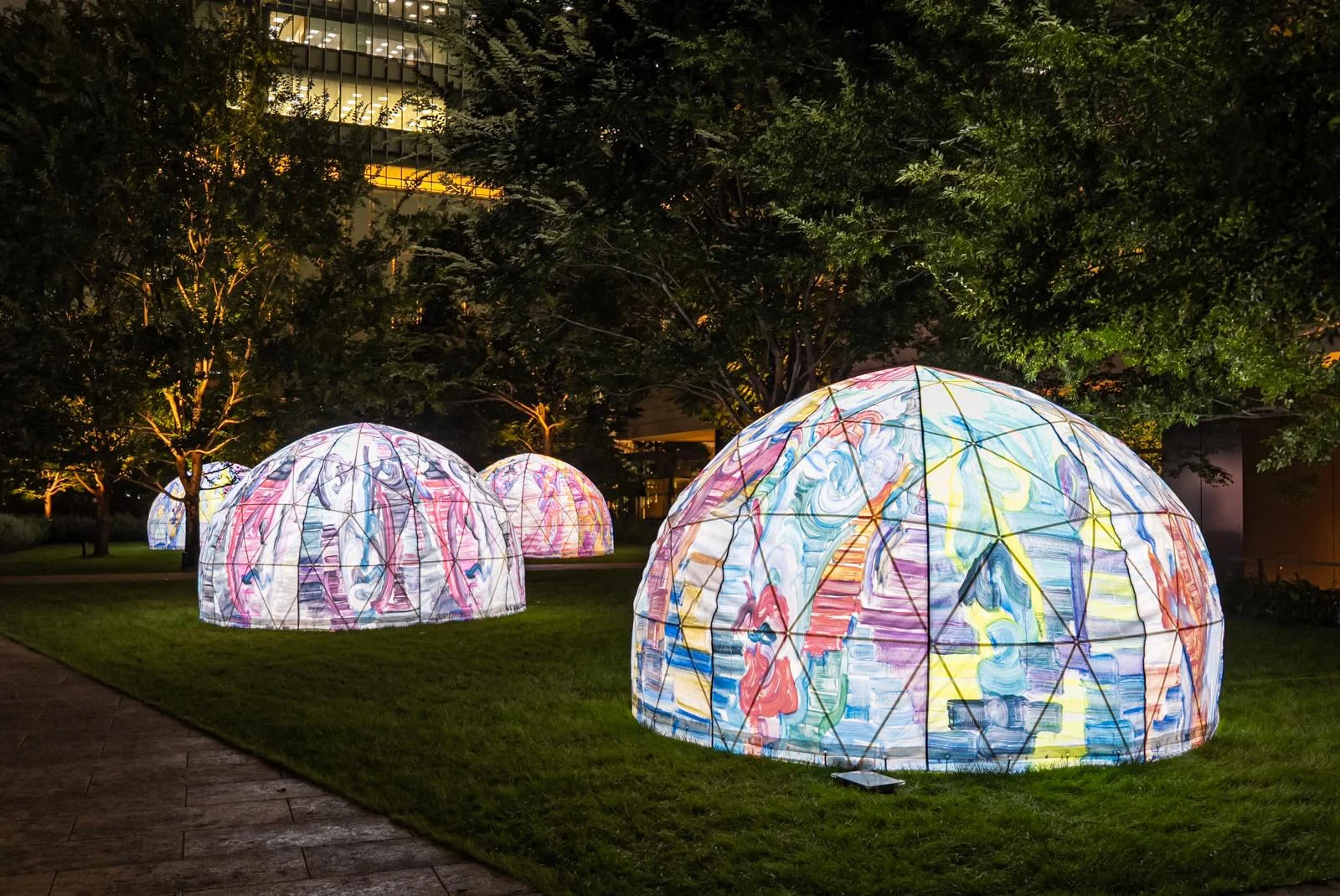
Glowing dome tents on an Otemachi lawn carry the faces of Van Gogh, Picasso, Renoir and John Lennon, the centerpiece of Etsu Egami’s first public art show in Japan.
After dark, Otemachi is glass, stone and rows of lit office floors, one of the densest business districts in Tokyo. Since September 28, the lawn at Otemachi One has held something else: a cluster of soft, tent-like domes glowing from within, their skins covered in looping colored lines that turn, from the right distance, into faces.
The domes anchor 「平行線が語る顔のゆくえ」, a title that translates roughly as Where Faces Go, as Told by Parallel Lines. The free public art program was produced by the painter Etsu Egami and runs across the complex until December 25. It is Egami’s first public art exhibition in Japan, and the first time the portraits she has spent years painting on canvas have been rebuilt as three-dimensional forms. The works treat communication less as a way of fully understanding someone than as a way of measuring the distance between two people, and the recurring images are parallel lines and gray zones, the spaces where meaning never quite lines up.
Signal. What happened: Etsu Egami produced Where Faces Go, as Told by Parallel Lines, her first public art exhibition in Japan, spreading four works across the garden, lobbies and windows of the Otemachi One complex in Tokyo. Exact object: Intersecting Light: Faces, Faces, Faces…, a set of illuminated portrait domes on the lawn; Dance of Rainbow Colors, her first folding screen; Nijiiro, her first window wrapping; and Imagine, a canvas portrait of John Lennon. When and where: September 28 to December 25, 2026, at Otemachi One, 1-2-1 Otemachi, Chiyoda-ku, Tokyo, free to view, with an artist talk on October 19. Source: Otemachi One’s official event page and a published event report with on-site photog. Why it matters: It moves a painter best known for gallery and museum shows into an open-air public setting in the mid of Tokyo’s business district, and it marks the first time her portraits have left the flat canvas.
stir
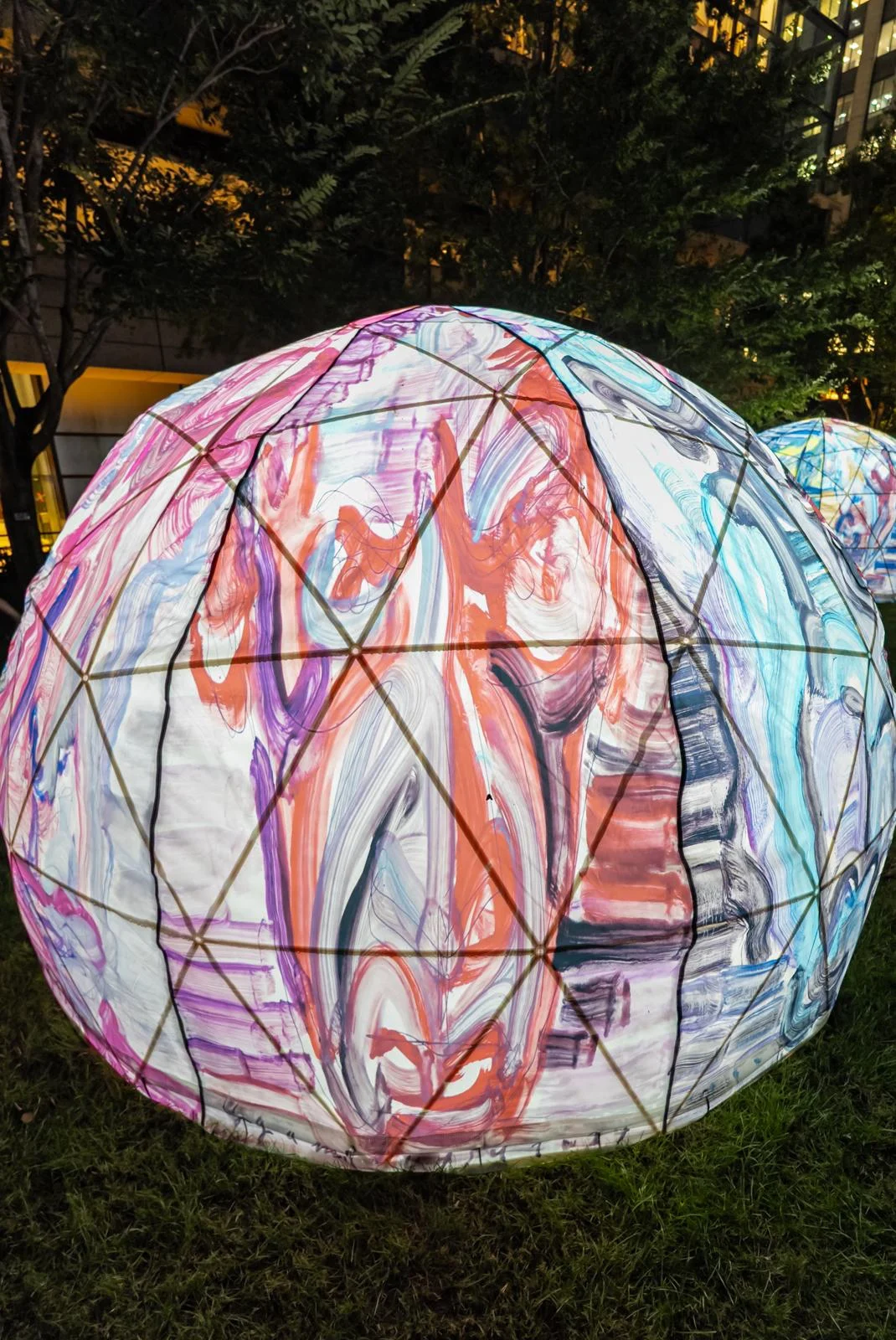
The dome work is titled Intersecting Light: Faces, Faces, Faces…, and it stands on the lawn of the Otemachi One Garden in an area the complex calls Imperial Green. According to value rely source, there are four domes in all, each layered with colorful curving lines that trace the faces of Vincent van Gogh, Pablo Picasso, Pierre-Auguste Renoir and John Lennon.
The tent shape is deliberate. The organizers say the rounded, organic form is meant to suggest community and the warmth of people gathering in one place, and Otemachi One’s own description leans into the night. It pictures a cluster of portraits switching on among the hard-edged towers, like a small constellation that has dropped into the city, and calls the result a garden of resonance, a place where the painted faces and the faces of passersby keep meeting each other’s gaze.
The choice of faces fits a long habit in Egami’s practice. From October to December 2022, the Woodone Museum of Artstaged a collaboration exhibition in which she painted in dialogue with modern Japanese Western-style painters such as Kuroda Seiki and Fujita Tsuguharu, as well as the European artists who shaped them, van Gogh and Renoir among them. The show set 55 of her new works beside 11 pieces from the museum’s collection. Her gallery portraits since then have included takes on Claude Monet and Jean-Michel Basquiat. The Otemachi domes carry that conversation with earlier artists out of the gallery and onto a lawn.
There is a practical caveat. The organizers note that the outdoor domes may be taken down without notice if the weather puts the works or visitors at risk, so what stands on any given evening depends partly on Tokyo’s autumn forecast.
flow
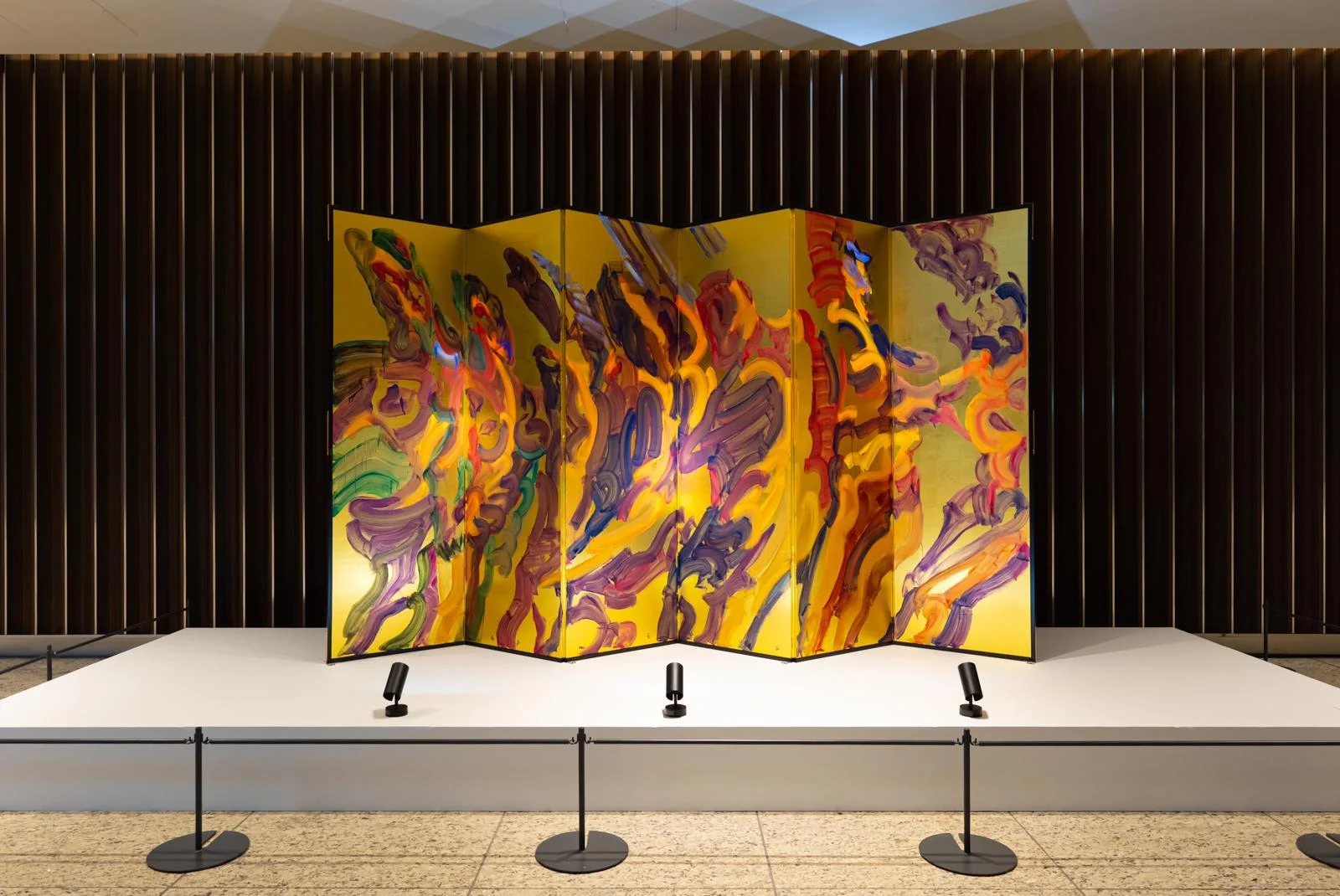
Inside, the program changes register. In the lobby stands Dance of Rainbow Colors, the first folding screen Egami has made. Its surface is gold, crossed by wavering lines that mix in fluorescent paint, and it is lit so that the image shifts as a viewer walks around it. Otemachi One frames the byōbu as a form long used to divide rooms and stage something out of the ordinary, and leaves the reading open: abstraction, a landscape in the sansui tradition, or women dancing inside rainbow light. The question it puts to the hotel guests and office workers passing through is simply what it means to recognize something at all.
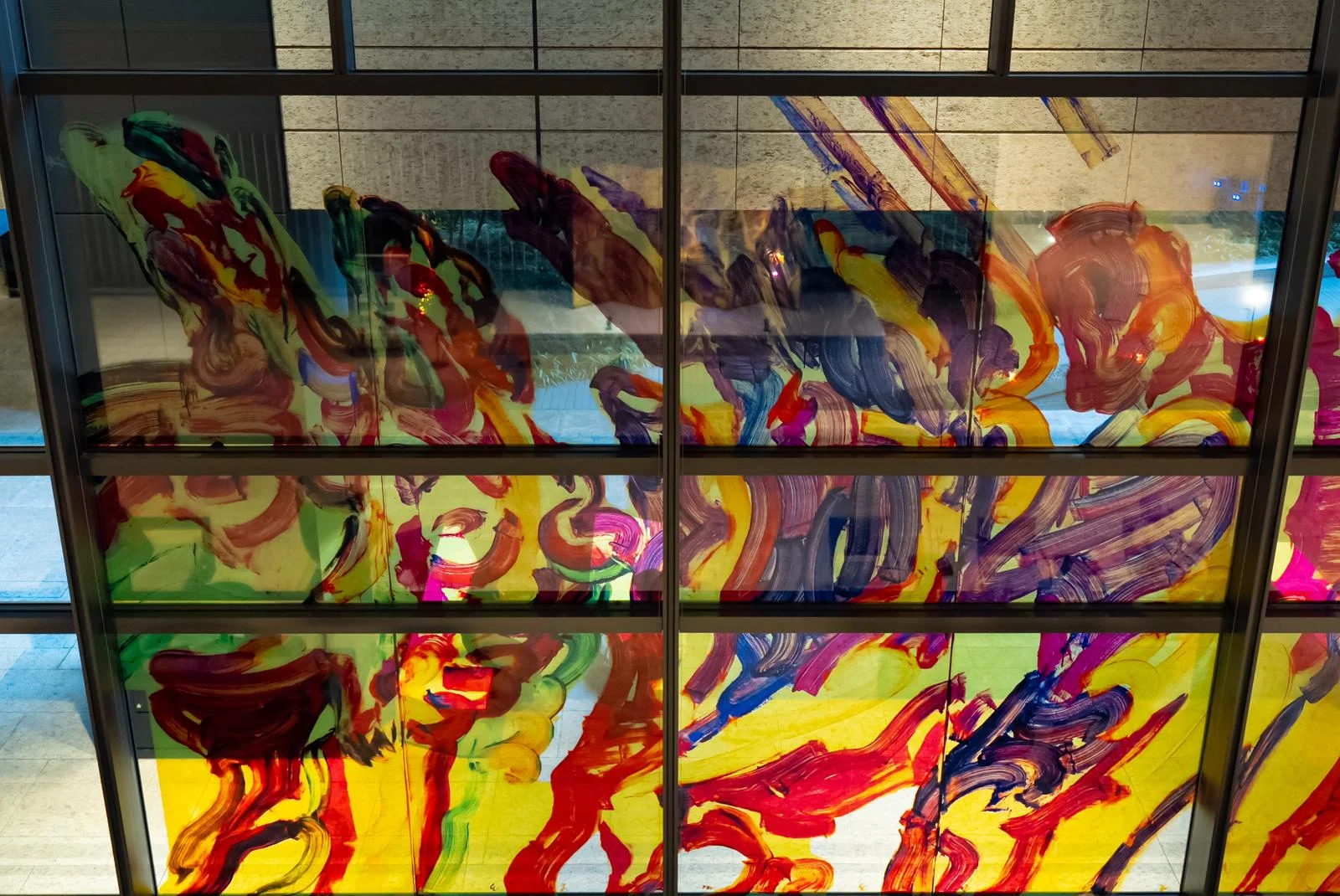
The screen feeds directly into the next piece. Nijiiro, Egami’s first window wrapping, carries the screen’s imagery onto the lobby glass in a translucent finish that keeps the space from feeling closed in. In daylight, colored light falls onto the ground much as it does through stained glass, and the effect moves with the hour. The concept text ties it back to the exhibition’s title: parallel lines that never meet, viewed in a positive light, turn a gray zone into rainbow colors, with the rainbow standing for hope, dreams and diversity.
The fourth work hangs at the entrance to the office lobby. Imagine is a canvas portrait of John Lennon in Egami’s forceful, looping line, intended to carry his message of world peace and diversity. The venue’s notes treat her line as something with a beginning and an end, a breathing mark that holds emotion, melody and physical energy, and suggest the portrait tries to make Lennon’s songs, life and philosophy visible together.
scope
Egami’s subject has stayed constant for more than a decade: the gaps that open when people try to understand one another. Born in Chiba in 1994, she spent part of her childhood in the United States and Europe, and the experience of being the outsider in several languages became the backbone of her work. She studied oil painting at Beijing’s Central Academy of Fine Arts, graduating in 2016, completed graduate study there under the painter Liu Xiaodong, spent a period at the art and design university in Karlsruhe, Germany, and earned her doctorate from the Beijing academy in 2022, followed by a postdoctoral post at Tsinghua University in Beijing.
Her early projects used voice recordings and video alongside painting to stage mishearing and mistranslation. Winning a new artist award from her home city of Chiba in 2018 pushed her the other way, toward roots: she researched the natural and human history of the area for a solo exhibition built around a dialogue spanning thousands of years, and later had a solo presentation at her home city’s municipal art museum. Over time the rainbow became her visual shorthand for communication itself: separate bands of color that sit side by side without merging and still add up to something people find beautiful. That idea runs straight through the Otemachi title. Parallel lines never meet, and in Egami’s reading that is not a failure.
Speaking at an Asia Society event in Tokyo in 2021, Egami placed herself within a third generation of postwar Japanese contemporary artists and said she hoped to contribute to the field as an Asian woman working internationally. Curators have tended to read her the same way, as someone who treats cultural friction as a source of creative richness rather than only a cause of misunderstanding.
Recognition came early. She was named to Forbes Asia’s 30 Under 30 list in 2021 as its youngest artist, and Japan’s Agency for Cultural Affairs selected her for its overseas program for emerging artists, sending her to New York. In 2024 she showed work in the Miss Dior exhibition at Tokyo’s Roppongi Museum, and Dior acquired the piece for its collection. In February 2025 she won the art karlsruhe Prize, shown in a one-artist presentation by Berlin’s Galerie Kornfeld, and the prize’s €15,000 goes toward acquiring the winning artist’s work for a public collection in Karlsruhe.
In 2025 a newly opened contemporary art museum in Gyeongju, South Korea, chose her for its inaugural solo exhibition, Echoes of the Earth, which ran from April to September. This March she opened Blessings from Afar, a solo exhibition with Tang Contemporary Art at its Wong Chuk Hang space in Hong Kong, built around large oil paintings with titles such as Thousands of Horses Galloping and Heavenly Horse on Clouds. Her canvases often run big; one 2023 painting, Social Distancing, measures nearly three meters across. Away from the studio, she holds a visiting professorship at a medical school in Tokyo and runs workshops and art therapy sessions, work that connects directly to the wellness theme of her Otemachi talk.
extend
The setting has its own backstory. Otemachi One is a joint development by Mitsui & Co. and Mitsui Fudosan that held its grand opening in May 2020, pairing a tower with a luxury hotel on its upper floors with the Mitsui & Co. Building, where the trading house moved its headquarters. The ground-level plaza, designed by SOM, sits across from the Imperial Palace East Gardens and covers roughly 6,000 square meters, which the architects describe as the largest outdoor green space in the area. The garden includes a reflecting pool and native planting, and the design also preserves the site of the shrine to the tenth-century warrior Taira no Masakado. Upstairs, the Mitsui & Co. Building’s third floor holds Otemachi Mitsui Hall, an event space of more than 2,000 square meters, along with the conference rooms that will host Egami’s talk.
Since the garden opened in December 2022, the complex has used it as a rotating stage. Florist Nicolai Bergmann created installations there in 2022 and 2023, and the multidisciplinary artist YOSHIROTTEN ran a three-season RING PARK series in 2024 that included a 35 by 9 meter graphic wrapped in light. In 2025 the program took the name Otemachi One ART BREAK, adding bamboo-lantern works and a set of large sculptures, and a floral light installation on the water followed this summer. Egami’s exhibition is the second ART BREAK program of 2026.
Light keeps recurring in that lineup, from YOSHIROTTEN’s glowing graphic to last year’s bamboo lanterns, and Egami’s domes slot into the pattern: works that come into their own after office hours, when the lawn fills with people heading home.
fin
The program is built around the people who work in the towers. On October 19, Egami joins a free talk titled, in translation, Thinking With Etsu Egami, an Artist Working Around the World: Art, Wellness and a Rich Way of Living. It runs from 6:30 p.m. to 7:30 p.m. in Room 03+04 of the Otemachi Mitsui Conference on the third floor of the Mitsui & Co. Building, with Kotaro Nakata, a physician who founded a wellness company, as moderator. The session seats 100, opened a priority booking window for Otemachi One’s own workers, and takes general sign-ups through a registration page on Peatix for anyone else.
The conversation is set to cover how artistic thinking approaches questions without clear answers, drawing on Egami’s years abroad and the misreadings that shaped her work, with attention to how people relate to others and to their own perceptions. Otemachi One pitches it at the people who work in the district as much as at art audiences, as an hour spent rethinking how they look at things.
Every Thursday in October, from 5 p.m. to 9 p.m., the lawn beside the domes also hosts GARDEN NIGHT OUT, a food-truck evening that ran as a special edition on the exhibition’s opening day. Vendors rotate weekly, and the options listed so far include craft beer, hot dogs and boxed mochiko chicken at ¥1,000. The complex describes the format as a slow evening on the grass for people leaving work, eating under the soft light of the domes. The evenings are canceled in rain.
The talk is the only fixed date on the art side of the calendar. The domes, the screen, the window and the Lennon portrait remain on view at 1-2-1 Otemachi, Chiyoda-ku, until December 25, in a complex directly connected to Otemachi Station through exits C4 and C5.
Related Articles

Sixteen Dancers, Sixteen Looks: How GapStudio Re-Dressed Robbins’ Ballet in Sneakers
Miami City Ballet opens its season October 16 with Robbins’ Opus Jazz in all-new GapStudio […]