DRIFT AUDIO
Listen to this story
Choose a voice, then press play.
Barrie, Chanel’s cashmere house in Hawick, has knitted a numbered capsule with Damien Hirst, a long-time client, launching October 14.
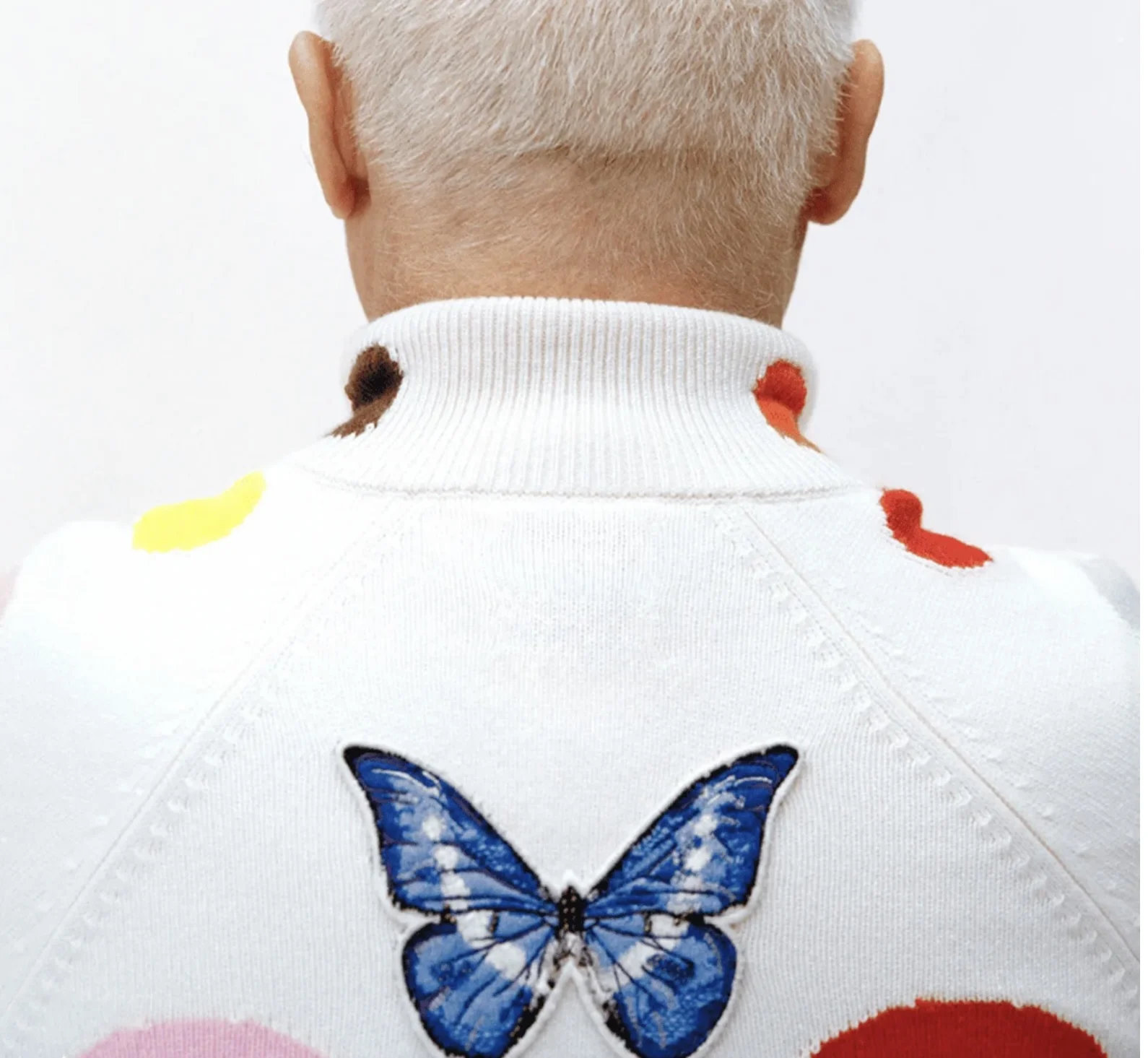
Before he was a convincer, Damien Hirst was a customer. Barrie, the cashmere house that has been knitting in the Scottish Borders town of Hawick since 1903, describes the artist as a long-time client, and the new Barrie + Damien Hirst capsule grew out of that relationship. Hirst, the brand says, imagined his ideal cashmere wardrobe in seven pieces, then handed over two of the most recognizable motifs in contemporary art to be worked into it: the Spots and the Butterflies. The knitting happened where all of Barrie’s knitting happens, at the historic mill on the banks of the River Teviot.
Signal. What happened: Barrie, the Hawick cashmere manufacture owned by Chanel since 2012, has announced a capsule co-created with Damien Hirst that translates his Spot and Butterfly motifs into knitwear. Exact object: a core cashmere wardrobe led by a Spot zip-up and a Spot round-neck, each numbered from 1 to 100 in each colourway (white with multicoloured spots, white with grey spots, black with multicoloured spots), a Butterfly hoodie and trousers in white, black, red and green, and a blanket in multicoloured or white, supported by a jersey hoodie, scarves, cotton Tee, embroidered patches and a range of collectibles; prices had not been published at the time of writing. When and where: early access through Barrie’s newsletter from October 7, 2026, then an official launch on October 14 on Barrie.com and in Barrie boutiques across Europe, Korea and the Americas, with China, Japan and Taiwan following from November 10. Source: Barrie’s own collision page, plus FashionNetwork’s October 5 report on the launch. Why it matters: one of Chanel’s specialist craft houses is producing numbered, edition-style knitwear with an artist whose career has been built on series and editions, and doing it entirely inside its own Scottish mill.
View this post on Instagram
flow
The Spots carry the edition logic. A zip-up cardigan and a round-neck jumper are each offered in three colourways (white with multicoloured spots, white with grey spots, and a black ground with multicoloured spots) and each piece is individually numbered from 1 to 100 within its colourway, according to FashionNetwork’s report on the launch. That is the language of a print run rather than a knitwear drop, and it suits an artist who has spent decades making work in series.
The Butterflies take a looser form. They appear on a hoodie and matching trousers offered in four colours (white, black, red and green), a set that reads as the collection’s lounge counterpart to the more formal Spot knits. A blanket completes the cashmere side, in a multicoloured version and a white one.
Around that core sits a supporting cast. There is a jersey hoodie, scarves and cotton Tee, plus embroidered patches that let buyers personalize their Barrie knitwear and style it however they like, which fits a house that already sells patches as a category of their own. The final layer is a set of collectibles that Barrie frames as a “playful nod to the souvenirs found in museum shops,” a line that lands with extra weight given how much of Hirst’s career has involved deliberately blurring the space between artwork and merchandise.
One detail worth noting: Barrie describes the core as a seven-piece wardrobe, but the pieces itemized so far (the Spot zip-up, the Spot round-neck, the Butterfly hoodie, the Butterfly trousers and the blanket) account for five. The full product breakdown is due when early access opens.
show
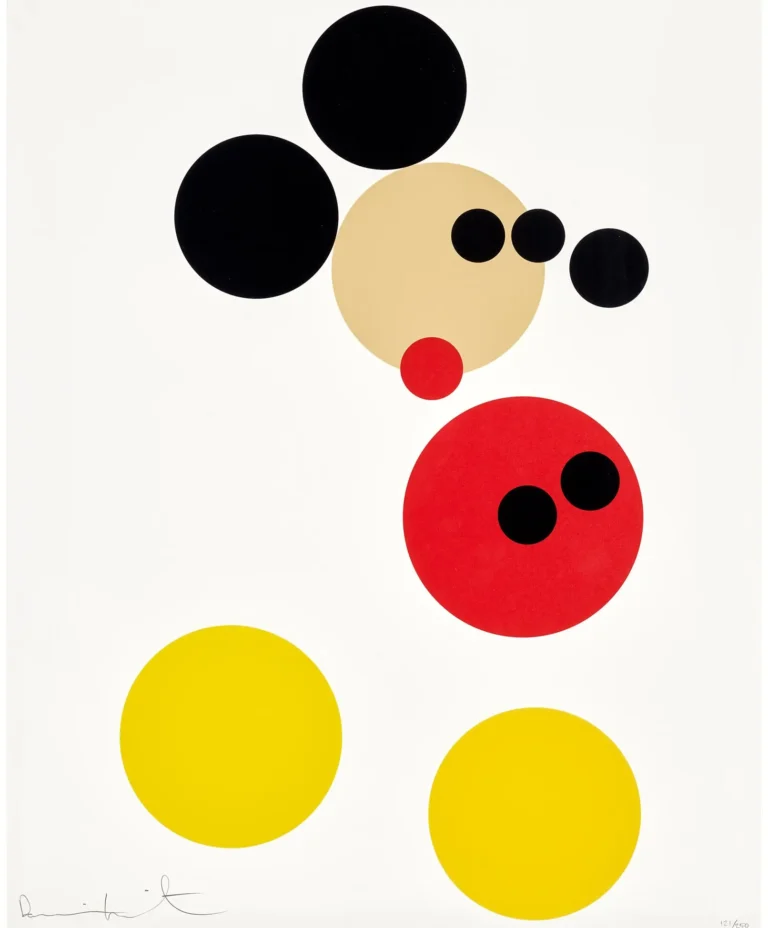
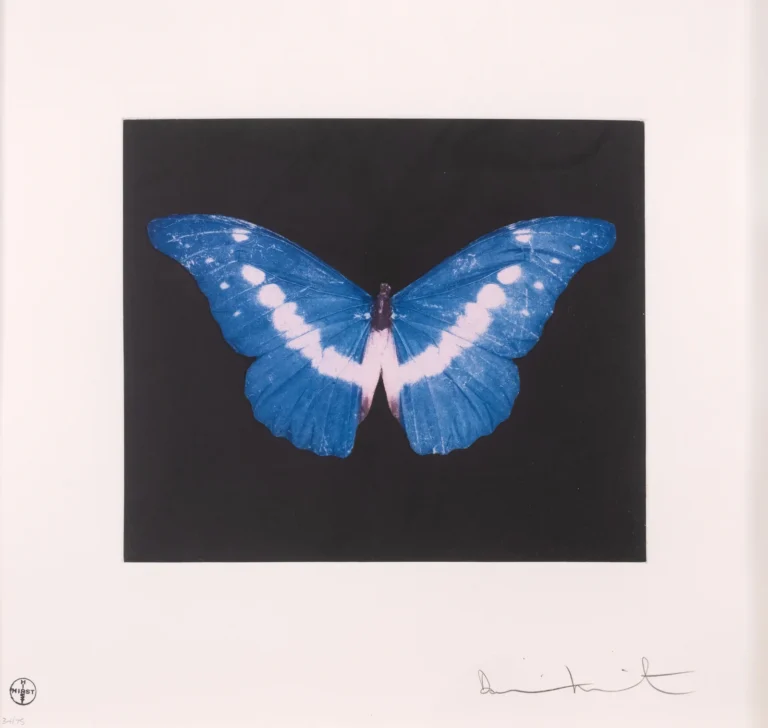
Hirst painted his first Spot painting as an art student in London in 1986, and the series has run ever since, through the Pharmaceutical paintings and well beyond them. Their best-known rule is simple and strict: no colour repeats within a single painting, and the spots sit in an even grid on a white or near-white ground. The Butterflies arrived in 1991 with In and Out of Love, an installation in which live butterflies hatched from pupae attached to monochrome canvases, while dead specimens were set into gloss paint downstairs. Both bodies of work have since been produced, reworked and editioned in enormous numbers. The butterflies have never been free of controversy, either: when Tate Modern restaged In and Out of Love for Hirst’s retrospective, the museum disclosed that around 9,000 butterflies died over its 23-week run, drawing criticism from animal welfare campaigners. In cashmere, at least, no living thing is involved beyond the goats that supplied the fibre.
Knitwear is an unusual home for either. A painted spot is a flat disc of household gloss; a knitted one is built stitch by stitch, its edges stepped rather than smooth. Barrie says the motifs stay faithful to the fundamental principles that define Hirst’s paintings while being translated through the mill’s savoir-faire. The colourway choices back that up. White with multicoloured spots is the canonical Spot painting, white with grey recalls the greyscale variations Hirst has produced, and the black ground with multicoloured spots inverts the formula.
The mill has the equipment for it. On its own House of Barrie page, the company describes looms around 70 years old running alongside modern Japanese computerized knitting machines, with the human hand involved from fibre selection through remeshing, washing and finishing. Barrie also says it is the only manufacture in the world that still judges the washing of each garment individually, and that every piece must pass three separate verification steps before it leaves the factory. A cardigan numbered 37 of 100 has to look like every other cardigan in its run, and Hirst’s grid leaves very little room for a misplaced dot.

in
Hawick sits on the River Teviot in the Scottish Borders, a region whose wool trade grew from an 18th-century cottage industry into an international reputation. Barrie opened there in 1903 and built its name as a manufacturer, producing knitwear for other houses long before it carried its own label. One of its long-standing clients was Chanel, which bought the company in 2012 and folded it into its circle of Métiers d’art houses, the specialist workshops the French house has acquired to protect skills that might otherwise disappear.
Barrie launched its own label in 2014. Since 2018, its Paris design studio has been led by artistic director Augustin Dol-Maillot, born in 1989, who worked at Chanel under both Karl Lagerfeld and Virginie Viard before taking the role. The design happens in Paris, the knitting in Scotland, and the mill trains its own workers through an in-house school linked to local colleges.
The supply chain is unusually documented for knitwear. Barrie holds Level 1 certification under the Global Organic Textile Standard and has been part of a Chanel initiative, launched in 2015, to trace cashmere back to herds on the high plateaus of Mongolia, batch by batch, down to the zone of origin and the herder’s name. After combing, washing and dehairing, the fibre travels to Scotland to be spun and dyed by a Scottish spinner founded in 1897 before it ever reaches Barrie’s machines.
Hirst is not the first outside name to pass through the mill under Barrie’s own label; the current menswear range already includes a Barrie x Mackintosh collaboration with the Scottish rainwear maker. But an artist co-creating the product is a different proposition from a brand partnership.
There is a neat symmetry in how the collide came about. Chanel was a Barrie client before it was Barrie’s owner. Hirst was a Barrie client before he became a collaborator.
stir
On Barrie’s flow page, Hirst’s position is summed up in a single line attributed to him: “Art you can wear is a great idea.” He has been making versions of that argument in interviews ahead of the launch. In one, rounded up by ARTnews this week, he framed fashion as art that can be worn and set it against the museum world he comes from, where the first instruction is not to touch. The same roundup carried his broader principle that “anything done well is art,” and noted that he sees real value in work made in a factory, or even sold as merchandise.
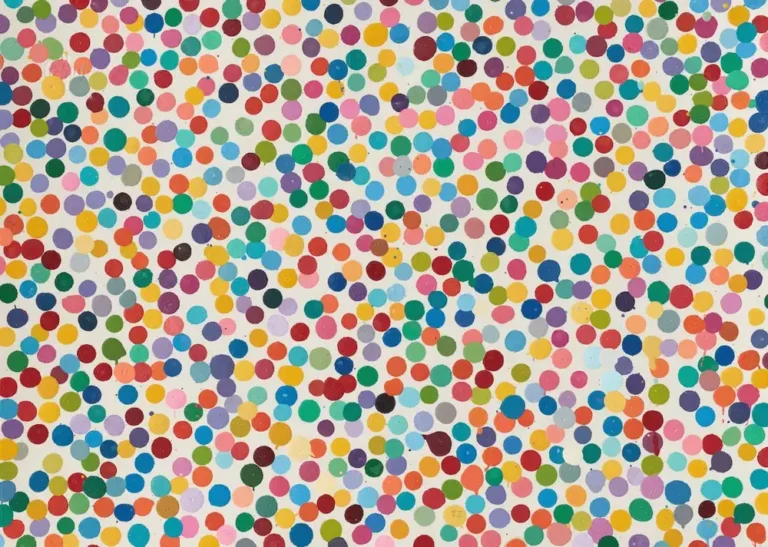
That position has a long track record behind it. In 2013, Hirst created 30 limited-edition designs for Alexander McQueen’sskull scarf on its tenth anniversary, rearranging butterflies, bugs and spiders from his Entomology paintings into the house’s skull motif, in chiffon, pongé, twill and cashmere, with prices starting at £135 when they went on sale that November. In 2021, The Currency turned 10,000 unique hand-painted Spot works into a test of value itself, pairing each with an NFT and asking collectors to choose between the physical work and the token, with the unchosen paintings later burned. Prints, editions and souvenirs have been part of how Hirst works for decades.

Barrie’s museum-shop collectibles slot into that history without much strain. A Spot jumper numbered out of 100 sits somewhere between a garment and an edition, and the collectibles beside it are pitched openly as souvenirs. The brand has also posted a video interview, Damien Hirst in Conversation with Cornelius Tittel, alongside the launch materials, giving the artist room to explain the project in his own words.
rel
Access comes in three waves. Barrie’s newsletter subscribers get privileged early access from October 7. The official launch follows on October 14, on Barrie.com and in Barrie’s boutiques across Europe, Korea and the Americas. From November 10, the collection reaches China, Japan and Taiwan.
Barrie had not published prices at the time of writing. For context only, pieces in the house’s current mainline collection run from €420 for a cashmere balaclava or a T-shirt with a cashmere logo patch to €1,200 for its iconic oversized cashmere jumper and €2,600 for an embellished cardigan. Numbered pieces from a named artist are unlikely to sit at the bottom of that range, though the house has given no indication either way.
Hirst was born in Bristol in 1965, curated Freeze while still a student in 1988 and won the Turner Prize in 1995. He now lives and works between London and Gloucestershire, and the Barrie page lays out that biography in full alongside the clothes. From October 14, his best-known painting system goes on sale as knitwear, numbered like a print run and made in the Borders.
Related Articles
Damien Hirst Built an Art Project Designed to Burn Half of Itself
Four years after the deadline forced a choice between painting and token, The Currency still […]