DRIFT AUDIO
Listen to this story
Choose a voice, then press play.
A reported look at Chipotle puts Brian Niccol’s past beside Starbucks’ unfinished rebuild. The question is what ownership would fix that better operations cannot.
Starbucks has explored buying Chipotle Mexican Grill, according to an October 8 report by the Financial Times. Advisers reportedly worked on the possibility in recent months, but a formal offer was not confirmed. Consider the burrito chain is not the same as agree to acquire it.
What makes the possible unusual is the timing. Starbucks has spent two years trying to improve its own customer experience. Chipotle, meanwhile, is pursuing restaurant openings and international expansion under a different chief executive. Buying it would ask Starbucks to explain why owning another operating business would strengthen, rather than compete with, the work already underway.
Signal. What happened: Starbucks reportedly explored buying Chipotle. Exact subject: a potential corporate acquisition, not a menu collide. When and where: reported October 8, 2026, involving two US restaurant chains. Source: the Financial Times report, with Reuters providing the company-response context. Why it matters: Starbucks would be considering another operating business while rebuilding its own. What remains open: a formal offer, agreed valuation and acquisition timetable are not established by the reporting summarized here.
Starbucks declined to discuss the speculation, emphasizing its turnaround in a response to Reuters. Chipotle did not respond to that news agency’s request for comment.
View this post on Instagram
The distinction is more consequential than coffee and barbacoa appearing under one corporate roof. The available reporting leaves the status of any negotiations unresolved. It supplies no agreement establishing a purchase price or a management structure. There is no basis for treating a possible ownership change as an announced product collaboration.
stir
Brian Niccol supplies the obvious connection. Starbucks’ chairman and chief executive previously led Chipotle from 2018 to 2024. He joined the coffee company in September 2024, carrying a reputation closely tied to the performance of the business now described as a potential acquisition target.
Starbucks made that record central to its appointment announcement. The company said Chipotle’s revenue had nearly doubled and profits had increased almost sevenfold during his leadership. It highlighted digital transformation, operating improvements and investment in employees. Those were reasons to hire an executive, however, not evidence that purchasing his former employer would generate comparable returns.
In his first public letter, dated September 10, 2024, Niccol identified inconsistent products, long waits, complicated menus and hectic handoffs as problems inside Starbucks. His initial priorities included better morning execution and a clearer distinction between orders consumed inside and taken away. He also promised additional investment in technology and mobile ordering. The assignment was specific: repair how the existing business worked, not simply revive affection for its name.
Chipotle is not an unattended business awa`iting his return. Scott Boatwright became its permanent chief executive in November 2024 after serving in the interim role. He had already led restaurant operations, having joined the company’s senior operating leadership in 2017. Any transaction would therefore involve an existing management structure, not a vacant position that Niccol could simply resume.
Familiarity might help a buyer ask better questions about kitchens, staffing and restaurant development. It cannot settle what shareholders should receive or how two management teams would work together. Those are separate decisions. The potential reunion explains the attention around this story, but experience running a company and a compelling reason to own it are different things.
show
The most visible parts of Back to Starbucks concern ordinary moments inside a café. Ceramic mugs, condiment bars and places to sit have returned to the company’s account of what distinguishes its stores. Its operating changes have also emphasized giving baristas more support and making service feel less impersonal.
That work moved through a Green Apron Service pilot before a national rollout announced in July 2025. Starbucks reported faster service after eight weeks across 1,500 stores. The sequence shows the practical work involved: testing operating changes, training employees and extending them across a network before judging whether results hold.
There is money behind that description. In an April update, Starbucks said it had invested more than $500 million in employees since starting the turnaround. It connected the spending to staffing, scheduling and more stable leadership. The company also said approximately 80% of its American company-operated coffeehouses were delivering café orders in four minutes or less. These are company-reported measures, not an independent assessment of every store.
The staffing figures give the spending a practical meaning. Starbucks said 98% of available shifts were filled and nearly 95% of employees were receiving their preferred schedules. More predictable coverage can make it easier to deliver consistent service, although the company’s own figures do not tell us how individual employees experience the changes or how evenly the improvements are distributed.
The physical setting is receiving a separate overhaul. A September design update said more than 1,000 coffeehouses across the United States and Canada had been refreshed since late 2025. Softer seating, warmer materials and locally informed artwork were among the changes. Starbucks was aiming for at least 1,500 completed refreshes by its fiscal year end, a target rather than a verified final tally.
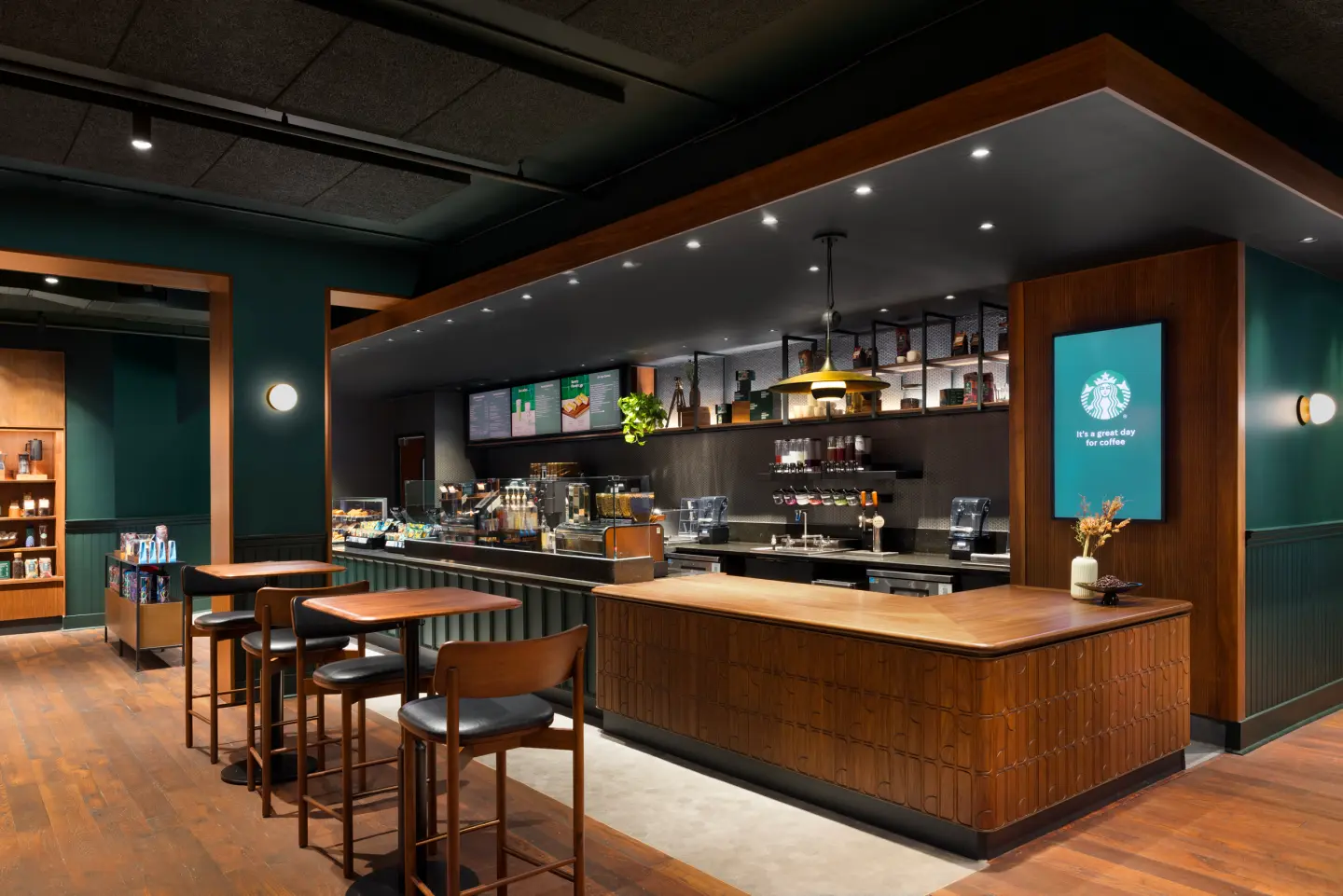
Those details explain why a restaurant acquisition could invite scrutiny even without changing anything on the menu. A company rebuilding the experience around one counter would be considering ownership of thousands more. The issue is not whether coffee drinkers also eat burritos. It is whether the additional responsibility would help management execute the promises it has already made.
flow
Starbucks’ third-quarter fiscal 2026 results show why the turnaround should not be described simply as failure. Global comparable store sales rose 7.9%, with comparable transactions increasing 4.2%. Its adjusted operating margin reached 14.4%, improving from the previous year. The company reported a fourth consecutive quarter of comparable sales growth and a second consecutive quarter of margin expansion.
Comparable sales measure performance within an established store base, helping distinguish improving visits and spending from growth produced by opening locations. Here, the transaction increase matters because it indicates more purchases, not merely a larger average bill. The numbers support a recovery narrative, although they do not establish that all operating problems have disappeared.
On September 24, Starbucks announced approximately 250 North American closures, identifying coffeehouses where it did not see acceptable financial performance or the customer experience it wanted. It said affected employees would be offered transfers where possible, with severance support when placement was unavailable.
Closing weaker locations while improving others can be consistent with a turnaround. It also shows that choosing where to invest remains an active management problem. A proposed acquisition would need to be evaluated alongside that work, not treated as evidence that it was finished.
strat
Chipotle’s second-quarter 2026 results describe a company adding restaurants while working through pressure on profitability. Revenue increased 9.3% to $3.3 billion, and comparable restaurant sales rose 2.2%. Operating margin nevertheless declined to 15.7% from 18.2% a year earlier. Growth and a thinner margin can occur together, which makes sales alone an incomplete account of its condition.
The company attributed higher food and packaging costs partly to beef and freight inflation, while compensation and additional restaurant labor increased staffing costs. It opened 100 company-owned restaurants during the quarter. Those figures describe an operating agenda that would remain in place under a new owner: serve more customers while controlling the expense of preparing each order.
Boatwright’s Recipe for Growth, introduced in February, combines restaurant execution with menu innovation, technology, employee development and expansion. It followed a 2025 in which annual comparable restaurant sales fell 1.7%, even as total revenue increased. That history helps explain the current emphasis on transactions. New locations can enlarge the business while established restaurants still need to win more visits, a distinction that matters when assessing whether another owner is necessary.
Development has continued beyond the earnings release. On September 29, Chipotle announced its 1,500th Chipotlane, in Bradenton, Florida. The format lets customers collect orders placed in advance without leaving their vehicles. The company said it had added 500 of these pickup lanes in less than two years and continued to favor them for new development.
That expansion is not contingent on Starbucks. Chipotle reiterated plans for 350 to 370 restaurant openings in 2026 and a longer-term ambition of 7,000 locations across the United States and Canada. These remain company targets. They establish that a buyer would be taking responsibility for an existing growth program, with its own operating assumptions and capital requirements, rather than supplying one from scratch.
money
Reuters put Chipotle’s October 8 market value at about $41 billion and Starbucks’ at about $107 billion. Those are public equity valuations, not an announced purchase price.
Market capitalization measures the value of outstanding shares at their public market price. An acquisition price would depend on negotiated terms. A buyer might offer a premium, while cash, debt and the structure of the agreement would affect the wider financing picture. Treating market value as a settled price skips the central negotiation.
The Financial Times characterized a purchase as potentially the largest restaurant acquisition on record. That comparison describes the possible scale, not an agreed valuation or a financing commitment.
The strategic test is straightforward even when the arithmetic is unavailable. Money used to acquire another business cannot simultaneously fund a different investment. Borrowing introduces repayment obligations; issuing shares changes existing shareholders’ ownership. A convincing proposal would need to show why the expected benefits justified those tradeoffs. Without published terms, claims about guaranteed savings, improved earnings or an easy payback would be speculation.
extend
International reach is one plausible attraction, but it needs qualification. Starbucks ended its fiscal third quarter with 41,304 stores worldwide, including a substantial licensed network. Chipotle’s September expansion materials described more than 4,200 restaurants as of June 30. The difference suggests a potential source of market experience and relationships, not a set of empty premises waiting for burrito assembly lines.
Ownership also changes the comparison. Starbucks said 67% of its worldwide stores were licensed at the quarter’s close, while Chipotle says it owns and operates its restaurants in the United States, Canada and Europe. A bigger international network therefore does not mean identical responsibilities at every location. Any comparison would need to examine the actual arrangements behind the store totals, rather than assume that all branded doors represent the same operating model.
Chipotle has already begun building its own route into Asia. Its September 2 announcement identified a first restaurant in Seoul, operated through a local joint venture. South Korea was presented as a reference market for further regional expansion. The company planned two additional South Korean locations by the end of 2026 and its first Singapore restaurant in 2027.
The same announcement explained the operational substance of that partnership: ingredient sourcing, cooking methods, training and restaurant management. Those responsibilities make the limits of a simple global expansion argument clearer. Knowing how to establish a coffeehouse in a market does not automatically establish the suppliers, kitchen workflow or customer demand for another restaurant format.
A combined owner could potentially share experience in property, development and working with local partners. That is an analytical possibility, not a benefit either company has promised from a deal. Chipotle’s existing venture also raises an obvious comparison: what would buying the entire company accomplish that partnerships and its current expansion program could not?
fin
The operating priorities overlap most clearly around convenience, consistency and the use of physical space. Starbucks is making room for customers who stay while trying to improve pickup for those who leave. Chipotle is adding lanes that separate collecting a digital order from waiting inside. Both approaches concern the visit, but they solve different problems in different formats.
Chipotle’s digital business already represented 38.3% of food and beverage revenue in the June quarter, up from 35.5% a year earlier. That includes its website, app and outside delivery platforms. Integrating customer systems would therefore involve an established business channel, not a blank screen on which a buyer could casually place another logo.
That matters when imagining efficiencies from shared ownership. A common parent could change budgets, leadership responsibilities and development decisions without producing a common menu. It could also leave the brands largely separate. Neither outcome is established here. Customers would still encounter the consequences through familiar details: whether an order is correct, how long it takes and whether the location feels worth returning to.
For now, the next fixed date belongs to the ordinary reporting calendar. Chipotle has scheduled its third-quarter results for October 28, with a release expected at approximately 4:10 p.m. Eastern and a conference call at 4:30 p.m. The announced agenda includes a business update on the fourth quarter to date.