DRIFT AUDIO
Listen to this story
Choose a voice, then press play.
A Nike-branded Poneglyph appeared on Cat Street with no explanation attached. A research lab under the Harajuku store followed.
The first sign in Harajuku was a monolith. A Nike-branded Poneglyph went up on Cat Street with no explanation attached, a cube of carved-looking symbols with a few of them lit white to form a Swoosh. Anyone who had never opened a volume of ONE PIECE could have taken it for odd street art. Anyone who had would have recognized the series’ ancient, indestructible stone tablets, inscribed in a lost lang, and understood that something was on its way.
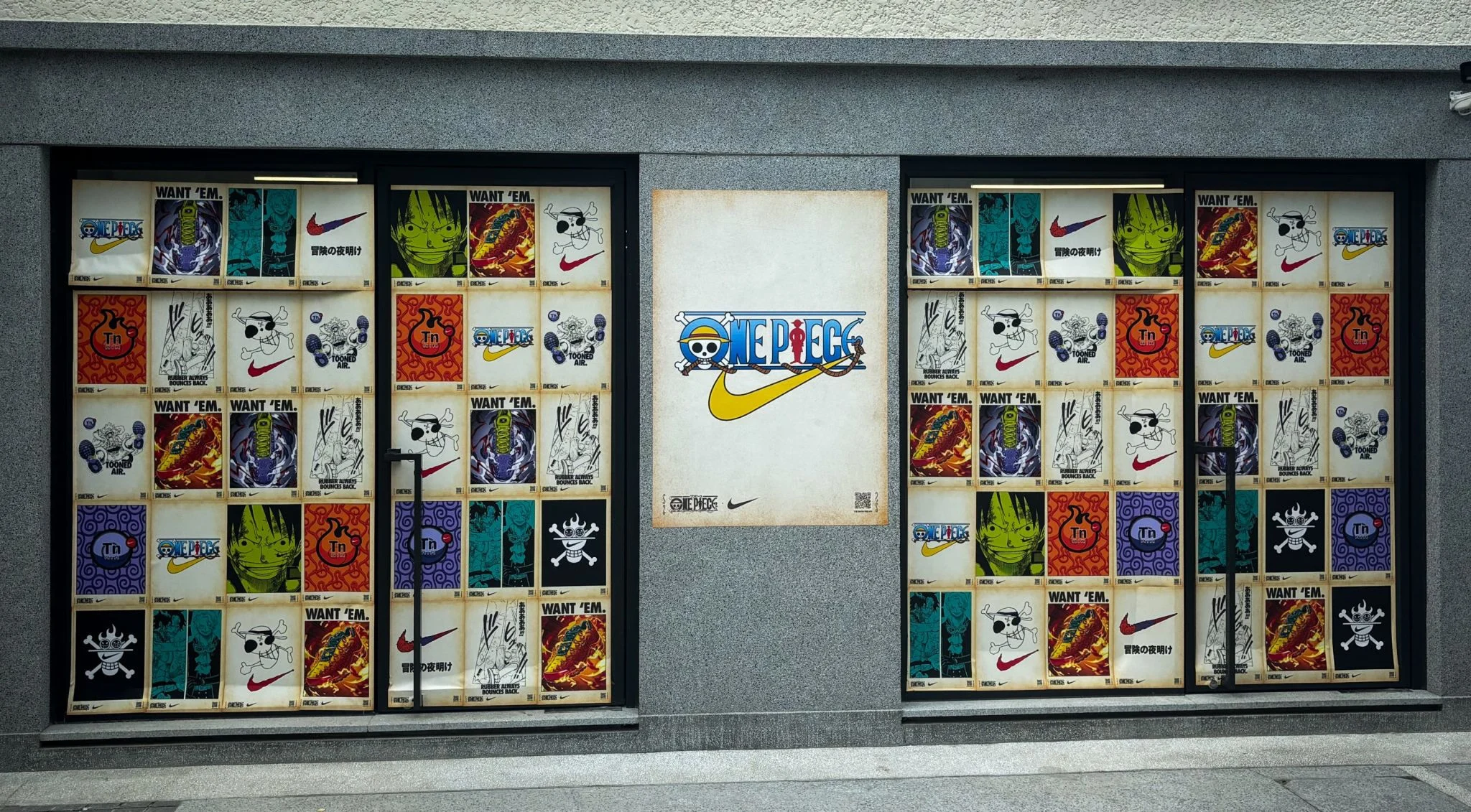
What arrived was Nike‘s collide with Eiichiro Oda’s ONE PIECE, the manga Oda began serializing in July 1997, five years after a short work called Wanted! earned him second prize in the Tezuka Award. The series went on to set a Guinness World Record in 2015 for the most copies published of one comic series by a single author, and Nike puts its circulation past 600 million copies. The work belonged to the .SWOOSH team inside Nike Virtual Studios, which answered a franchise of that scale with three Air Max Plus models, apparel packed with in-jokes, packaging built as a staged reveal, and a rollout that travels from city to city the way the Straw Hat crew travels from island to island.
Signal. What happened: Nike and ONE PIECE released a joint footwear and apparel collection built on three Devil Fruits, debuting in Harajuku on September 4, 2026 and rolling out city by city since. Exact object: the Nike Air Max Plus SP in Gomu Gomu (IR0968), Ope Ope (IW1282) and Mera Mera (IW1283), ¥27,500 each in Japan, alongside jerseys, caps, Tee and a vest. When and where: the Dr. B’s Research Lab pop-up in Tokyo on September 4 to 6, retail stops from September 11 through 19, a global SNKRS launch on September 25, and Sydney on October 16 to 18. Why it matters: the shoes, the vest and the box all draw on the manga’s internal rules, such as the sea turning against Devil Fruit users, so the collision reads as lore first and merchandise second.
stir
Ashwin Shinde runs product merchandise for energy gaming at .SWOOSH, and he put the project’s central problem as a question: what is a story only Nike could tell? The team’s answer was a parallel. In ONE PIECE, a Devil Fruit hands an ordinary person powers beyond human limits, and pushing people past those limits is the pitch Nike has made for decades. The idea the team settled on fit in one sentence: “If Devil Fruits existed in our world, they would be Nikes.”
Nick Remlinger, Nike’s general manager of Energy Gaming, describes the same instinct in the August 23 release: the surge a ONE PIECE character feels after eating a fruit, set beside what an athlete feels lacing up. That announcement also set the shape of the rollout, with Harajuku first on September 4 and a global SNKRS launch three weeks later on September 25. The design leads, Bryce Wong, Yuchung Chen, Sarah Kim and Heena Chung, then had to find a vehicle. Wong proposed the Air Max Plus, and Chen’s case for it was practical: the expressive cage and dimensional upper hand a designer a lot of surface to rework. The release also frames the pairing as a natural one, noting that ONE PIECE has long shaped the world of sport through athlete performances and celebrations in competition.
The silhouette’s own history makes the choice look less arbitrary. Sean McDowell designed the original in 1998 from a memory of a Florida sunset, turning palm trees bent by the wind into the wavy cage that wraps the upper. That cage was a drawn thing from the start, which suits a project that began with a designer tracing Oda’s Devil Fruit linework into it.
flow
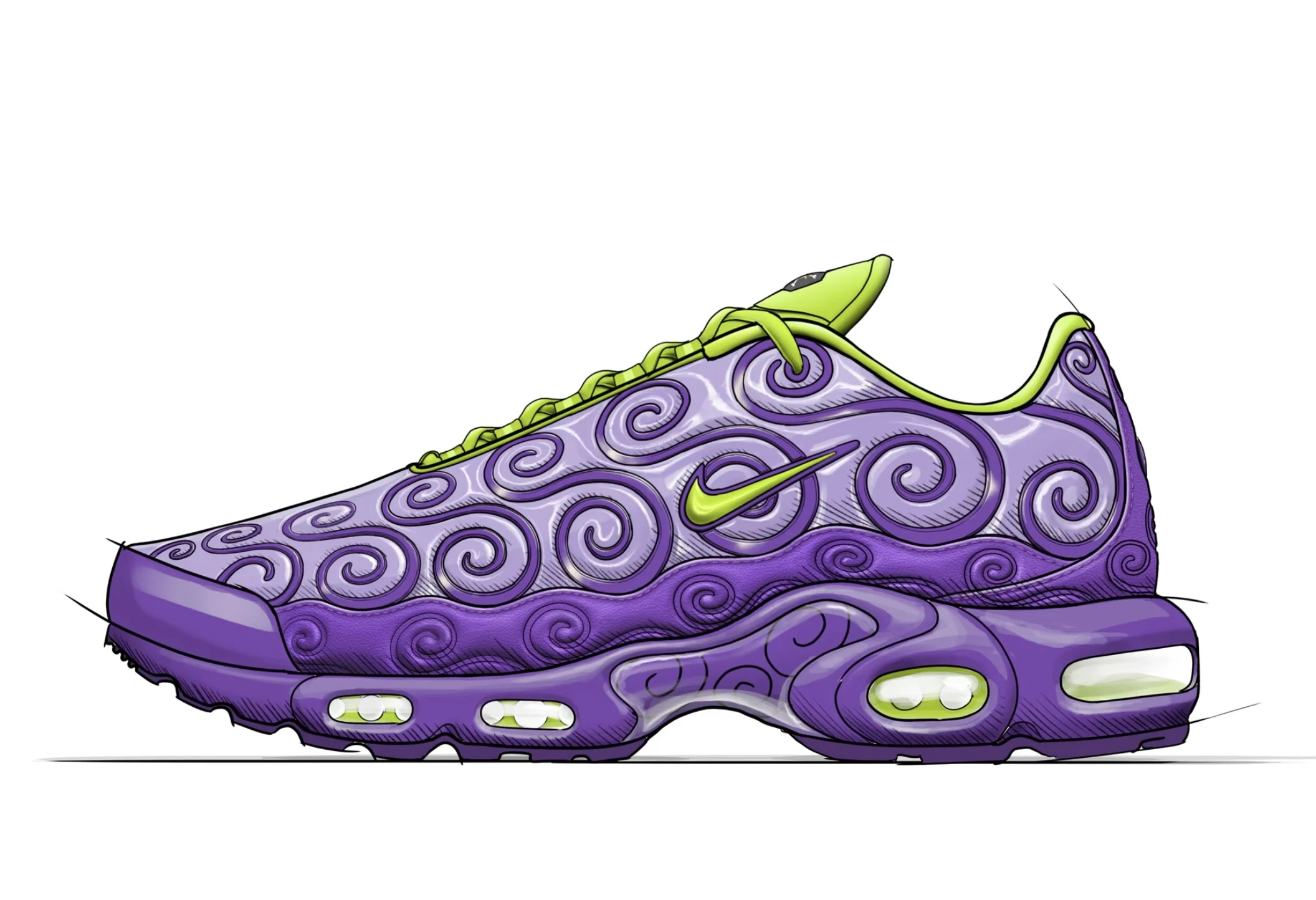
Purple with neon green laces, Gomu Gomu is the gummy one, its upper given a rubber-like finish that suits a hero whose limbs are rubber. Ope Ope gets a velvety, peach-fuzz texture. Mera Mera, the flame fruit, runs orange and yellow with teal laces, an on-fire sunset that circles back to the hue of the original Air Max Plus. The reference points to the Sunset colorway, which Nike revived in 2018 with an orange and fiery red fade across the upper.
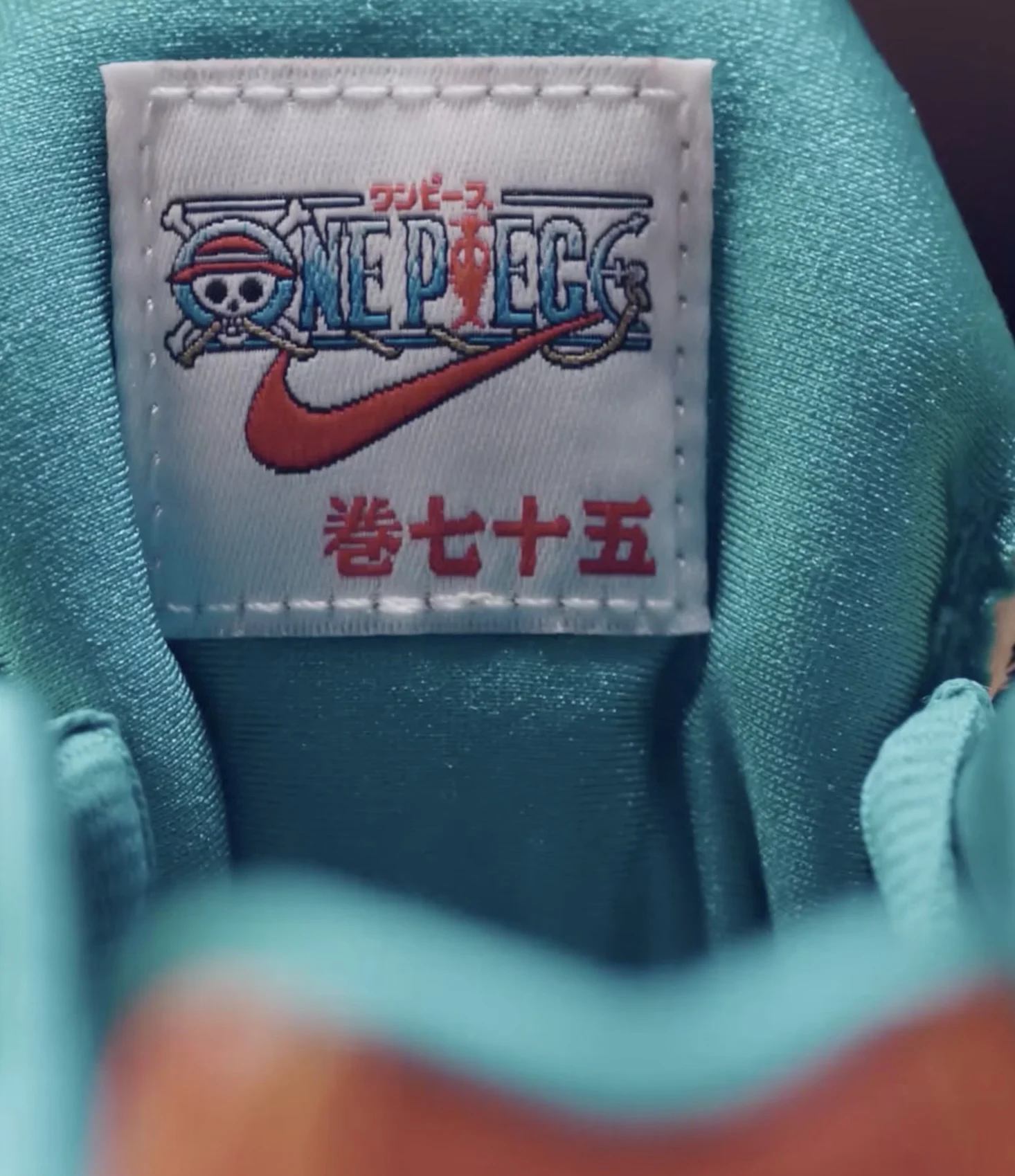
All three share a retooled upper made only for the collection, with each fruit’s pattern wrapped across the mudguard, cage and shank. Chen’s task was to keep the original cage’s motion and direction intact while the fruit graphics rode on it, and to keep the structure light and open, which meant solving the problem separately for each fruit. The most pointed detail sits on the medial shank, where a contrasting color bites a chunk out of the design, a reference to the panel in which Luffy eats the Gum Gum fruit.
In Japan the three pairs are priced at ¥27,500 including tax, and Nike Japan’s page sorts them by door: Gomu Gomu at the Tokyo pop-up and on SNKRS, Ope Ope at the pop-up alone, and Mera Mera at the pop-up and at Nike Umeda in Osaka, where the Mera Mera shoes, apparel and caps went on sale by lottery on September 12. The store sits in GRAND GREEN OSAKA, lot applications ran August 23 to 26 (the same window as the Tokyo pop-up), and winners had a special access period starting at 8:30, two and a half hours before the regular 11:00 opening.
straddle
The jerseys and caps come out of Nike’s own archive and are named for each fruit: three jerseys at ¥14,300 and three AW84 caps at ¥5,280 in Japan. The graphic pieces dig further into the manga. One T-shirt design is inspired by the Jolly Roger Luffy drew as a mark of a promise, others restyle manga show as classic Nike ads, and the apparel prints actual manga panels beside a Nike and ONE PIECE collaboration logo. T-shirts run from ¥6,930 to ¥9,680 in Japan, and one design was sold only at the Harajuku pop-up.
Kim, the Lead Global Brand Digital Designer on the apparel, enlarged and abstracted the shoes’ fruit patterns into layered graphics, so each piece works as a loose echo of the footwear. Her T-shirt graphics center on Laboon, the whale who waits years for his crew’s promised return, because his endurance lines up with both sides of the merge: resilience, perseverance and the habit of continuing.
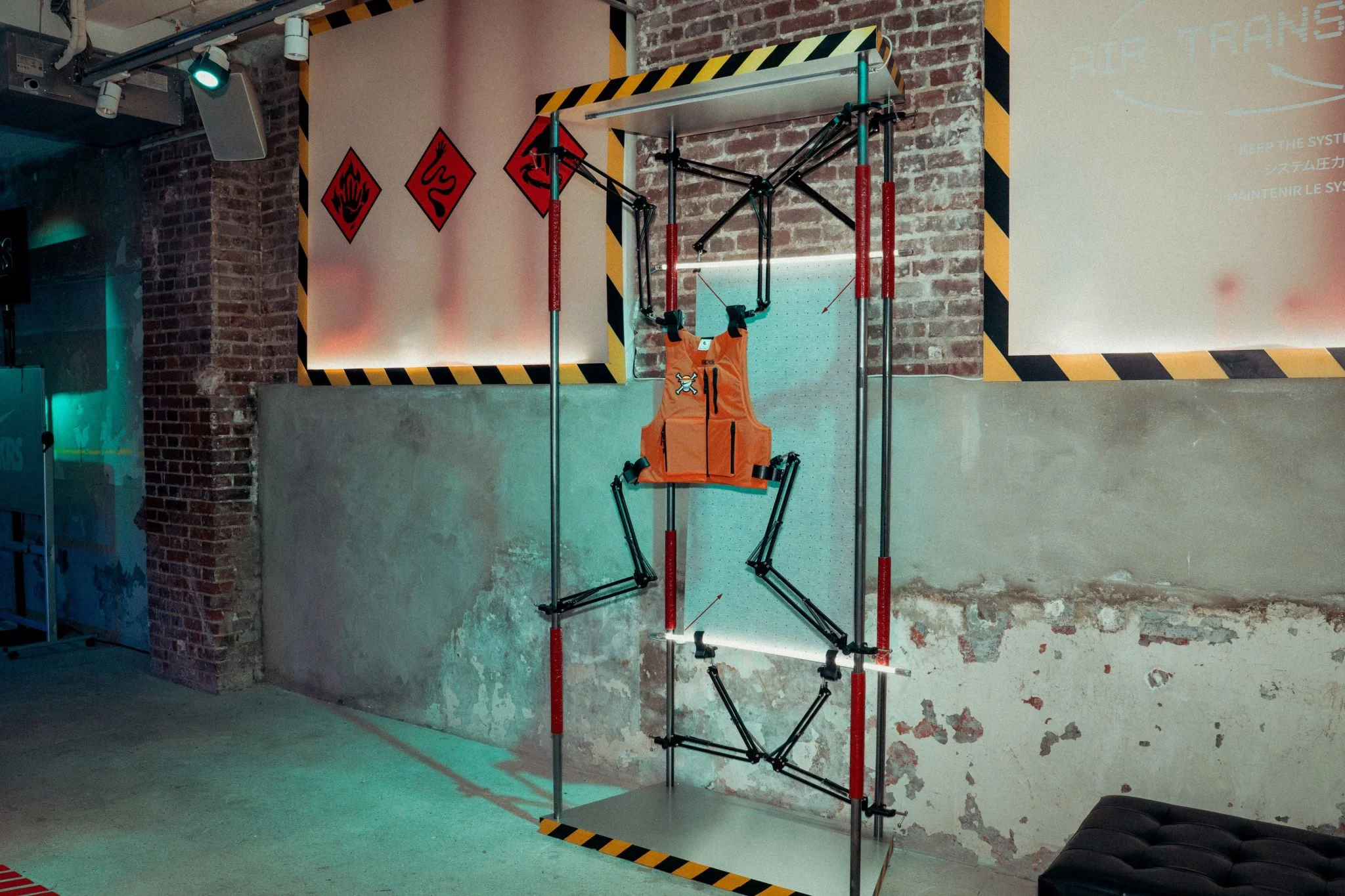
The vest is the collection’s private joke. In the manga, eating a Devil Fruit leaves a person “hated by the sea” and unable to swim, a trade the vest is built around, and it carries a ¥45,100 price tag at the Tokyo pop-up. Kim says it arrived late in development, a cheeky way to play with the lore once the team was deep inside it.
show
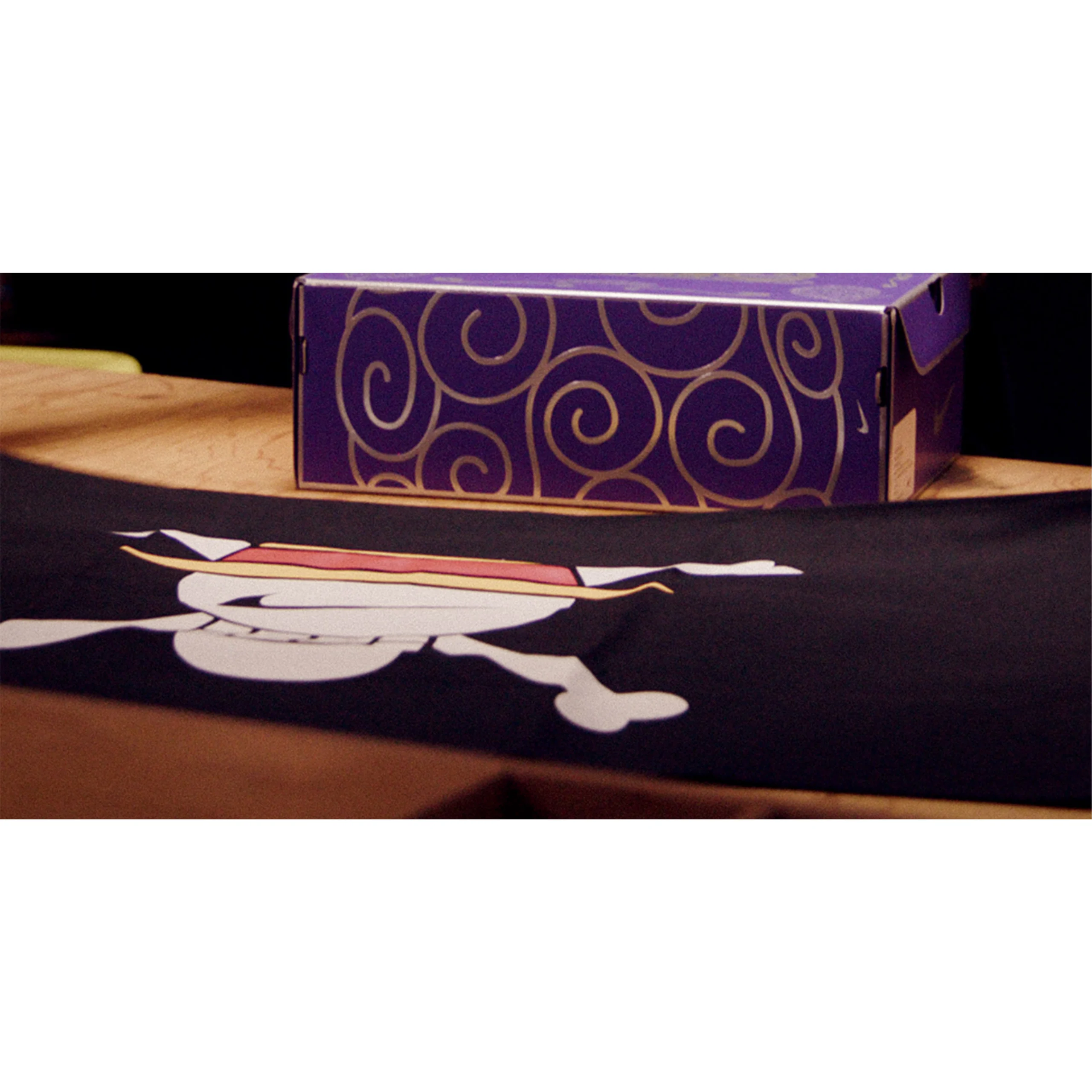
Nike designed the packaging to be opened in stages. Heena Chung, the Global Brand Experience Designer behind it, built a treasure chest with a staged reveal: an exterior that sets up the collection, printed tissue paper with its own ONE PIECE iconography, and a mirror as the final beat. The mirror is framed as a Wanted poster, which puts the buyer’s face where a bounty photo would go and casts them as one more pirate with a price on their head. The lid is embossed with Devil Fruit swirls, and completists get a reward, because the graphics on all three boxes connect into one panoramic artwork when lined up.
Chung says the goal was to capture the feeling of ONE PIECE rather than stack up Easter eggs, and that the box should be worth keeping after the shoes come out. Cards extend the idea. At the Tokyo pop-up, each pair of shoes came with a ONE PIECE CARD GAME DON!! Card in a Gomu Gomu design, and apparel or cap purchases earned an alternate-art P-099 Monkey D. Luffy card, one per transaction. At the later retail stops outside Japan, in-person footwear purchases come with an English-language DON!! Card in the matching colorway. Nike Japan also ran an application-based offer for subscribers to the digital edition of Weekly Shonen Jump, the magazine that carries the series.
extend
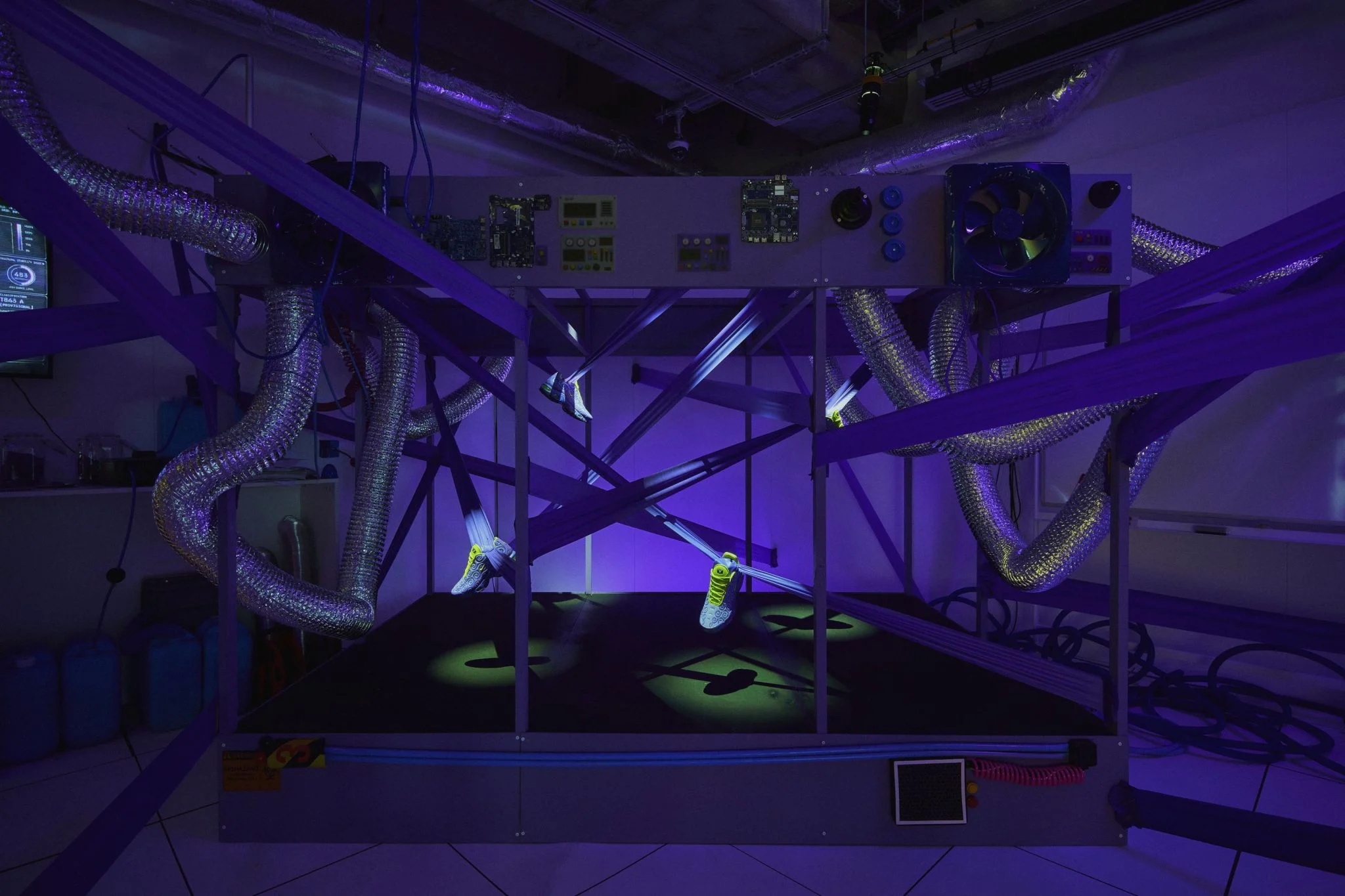
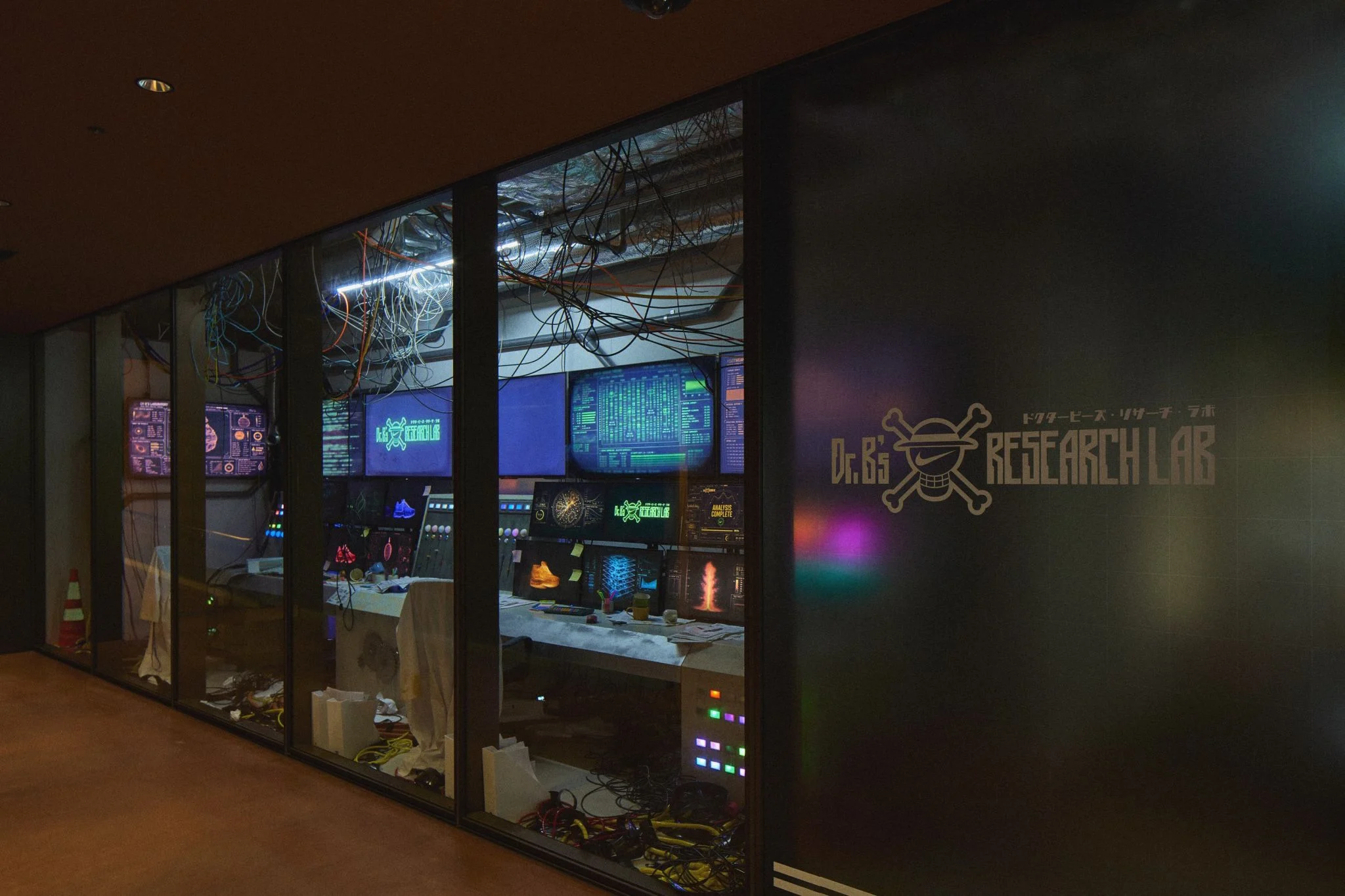
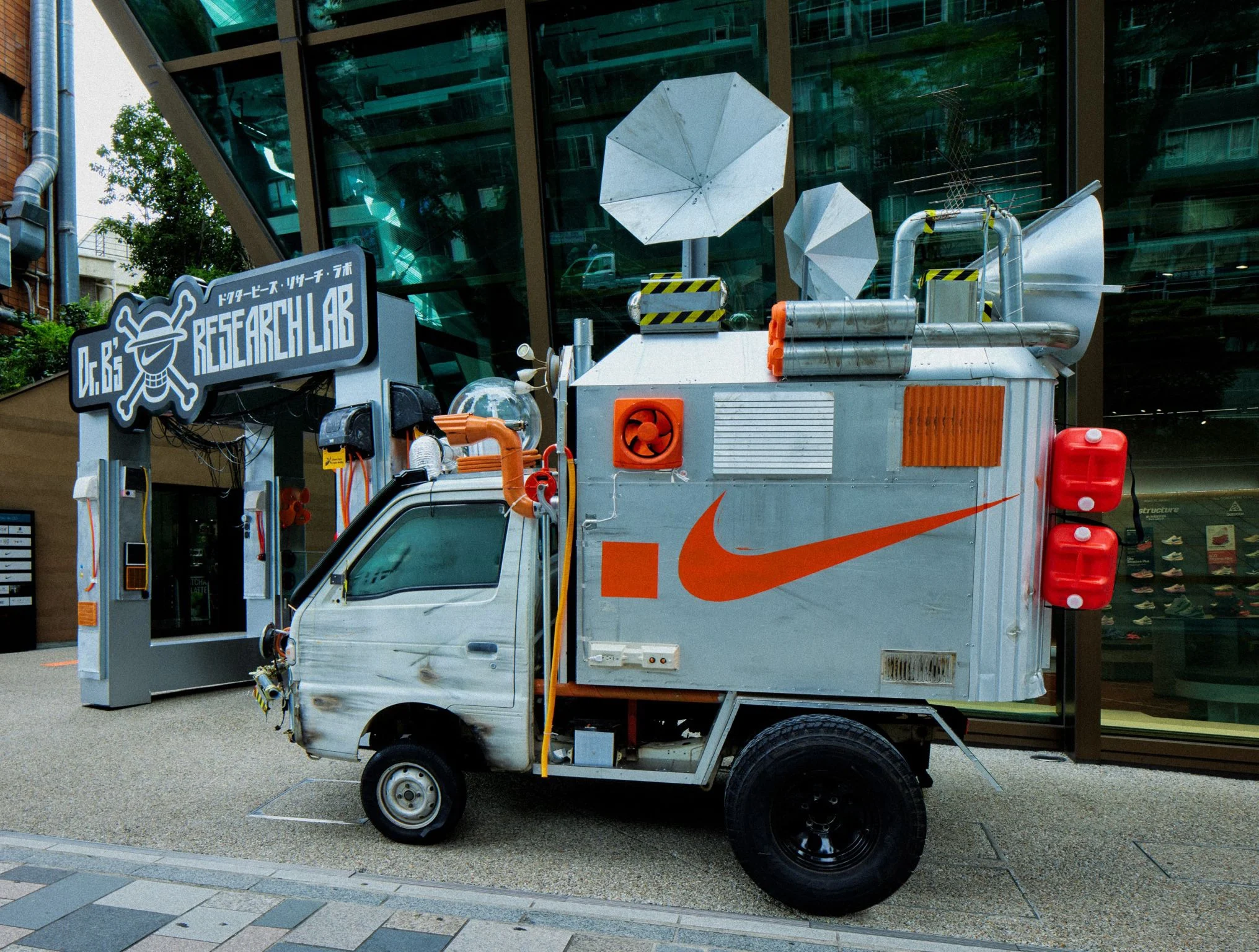
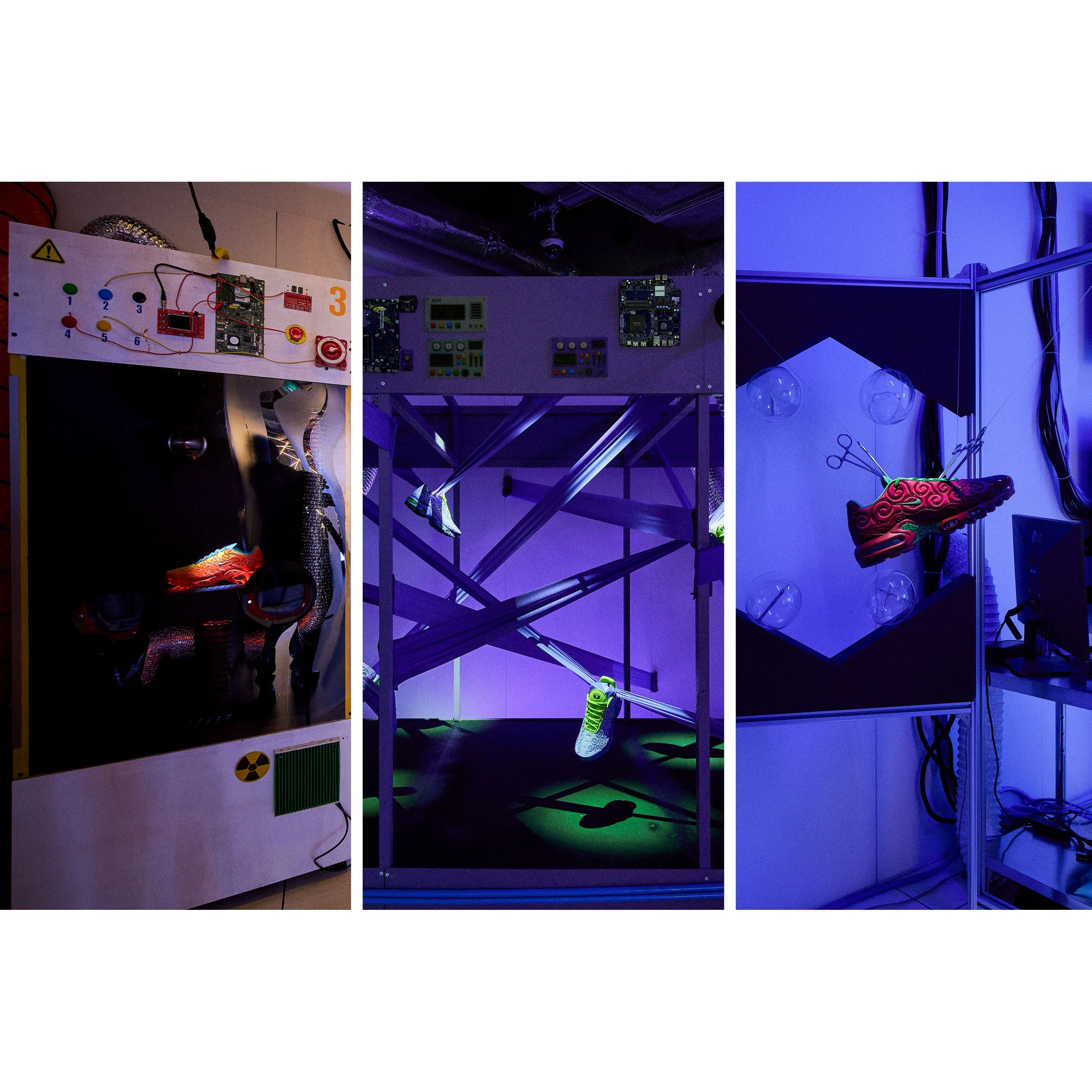
Dr. B’s Research Lab was the collection’s worldwide debut, a three-day pop-up on September 4 to 6 at THE HALL, in the basement of Harajuku Quest, open from 9:00 to 18:00. Entry and purchases went by lottery, with applications taken from August 23 to 26. The setting recast Bill Bowerman, the Oregon track coach who co-founded Blue Ribbon Sports, as the scientist in charge, Nike’s counterpart to Dr. Vegapunk, the series’ resident researcher of Devil Fruits. Inside, the three shoes hung suspended like specimens, and a mobile version of the lab was parked outside in Harajuku.
View this post on Instagram
The casting has a paper trail. Bowerman coached Oregon’s track program for 24 years and led it to four NCAA titles, but he did his lab work wherever he could find it, and in 1970 that meant the family kitchen: he contemplated the waffle on his breakfast plate, borrowed the household waffle iron, and poured melted urethane into it, an experiment that glued the iron shut on the first try and eventually produced the waffle sole.
The first hand-built versions turned up at the 1972 U.S. Olympic track and field trials in Eugene, glued onto nylon uppers for a handful of runners. The pattern they pressed into the dirt resembled the lunar footprints from the Apollo missions, so the prototypes picked up the name Moon Shoe, and the refined Waffle Trainer followed in 1974.
Tokyo figures in his own story too. In October 1964 he traveled there for the Olympic Games and stayed an extra week to meet the head of the Japanese shoemaker whose running shoes Blue Ribbon Sports was importing, and to tour its factories.
Nike By You adds a personal layer: nine graphics drawn from the manga that can be mixed onto select Nike Tee, offered at Nike’s Harajuku store from September 4 to 11 and at Nike Umeda from September 12 to 19. Reservations were first come, first served and closed once capacity was reached.
rel
Nike’s calendar for the collection reads like a map. Beyond the Tokyo debut, the release lists Hong Kong, Shanghai, Taipei, Jakarta, Mexico City, Seoul and Osaka on September 11 and 12; Amsterdam, Dallas, Decatur and Lawrenceville in Georgia, Düsseldorf, London, Madrid, Milan, San Diego, Stockholm and Washington, D.C. on September 19; a global SNKRS launch on September 25; and Sydney from October 16 to 18. That adds up to stops in about twenty cities.
The structure follows the source material. Wong’s reasoning was that Oda’s story already sends a crew around the world in search of treasure, so collecting sneakers could echo it, giving people a reason to find their crew and discover something along the way. Each stop got its own piece of the story rather than a copy of the last. In Shanghai, a building takeover flew a Straw Hats Jolly Roger reworked with a Swoosh for crossbones next to a flaming ad wrap, and Nike’s own account of the route adds Paris.
Shinde ties the scale to the audience. A fandom this large and this exacting, he says, deserves more than a Jolly Roger dropped onto a social post, because for many people ONE PIECE is a core part of life and identity. Wong’s version is plainer: nobody asked the team to go this hard, and they did it because they are fans too.
Remlinger’s own line in the rel was that more surprises are coming, as in any good adventure. The last stop on Nike’s published schedule, in Sydney from October 16 to 18, is still ahead.
Related Articles
Timberland Puts the Straw Hats’ Captain and Swordsman in Its Most Recognizable Boot
Timberland’s first One Piece collide puts Luffy and Zoro on its 6-Inch boot, launching in […]