Streep, Hathaway, and Blunt Return in Style: The Devil Wears Prada 2 Premiere

April 22, 2026
Two decades. Twenty years since the world first met Miranda Priestly—the ice-voiced editor-in-chief who could silence a room with a glance and dismantle a junior assistant with a single, perfectly timed “That’s all.” The Devil Wears Pradawas never just a film. It was a cultural recalibration—one that reframed fashion as power, hierarchy as language, and ambition as something both aspirational and dangerous.
Now, in the spring of 2026, that legacy returns. Not as nostalgia, but as continuation.
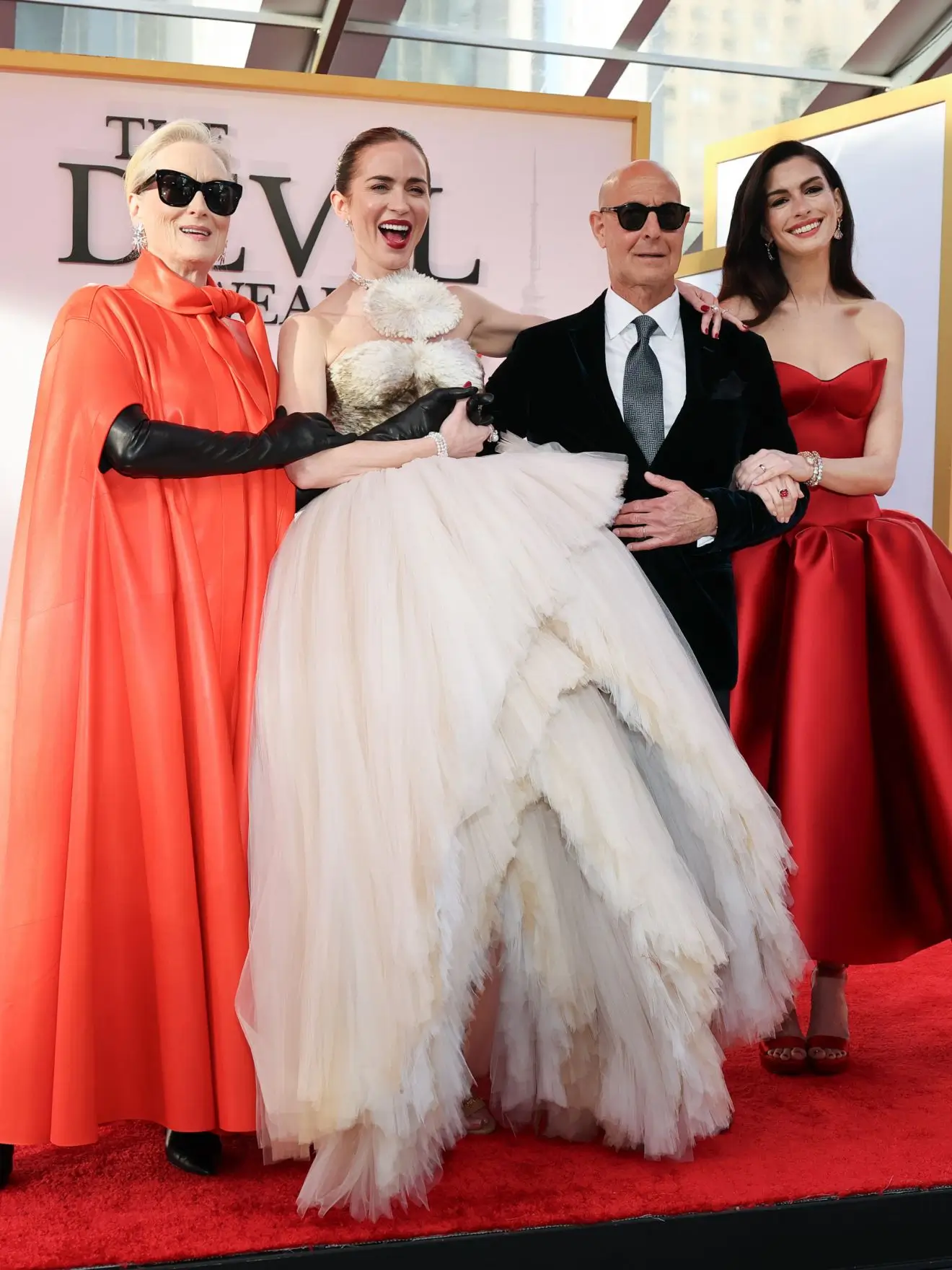
The world premiere of The Devil Wears Prada 2 unfolded at David Geffen Hall in New York City as something closer to a cultural summit than a film launch. The red carpet became a stage—one where legacy, reinvention, and authorship converged. At its center stood the trio that defined the original’s gravitational pull: Meryl Streep, Anne Hathaway, and Emily Blunt.
This was not a reunion.
It was a reassertion.
View this post on Instagram
a night
Outside Lincoln Center, the atmosphere carried a density that felt earned. Fans in vintage Runway magazine tees stood alongside editors, archivists, and a new generation of digital-native observers. Influencers and historians shared the same space—each, in their own way, shaped by what the original film had built.
The premiere did not function as spectacle alone. It operated as recognition.
Twenty years after its 2006 release, the sequel enters a world transformed—print fractured, digital ascendant, fashion reoriented around sustainability and access. Yet the film’s central tension remains intact: the seduction of power, and the cost required to sustain it.
As the cast arrived, it became immediately clear—fashion was still the primary language.
But it was being spoken differently.
articulate
In the original film, clothing functioned as armor—defensive, declarative, often unforgiving. At this premiere, it evolved into something more nuanced: a system of expression calibrated through experience.
streep
Meryl Streep arrived without theatrics. No escalation. No announcement.
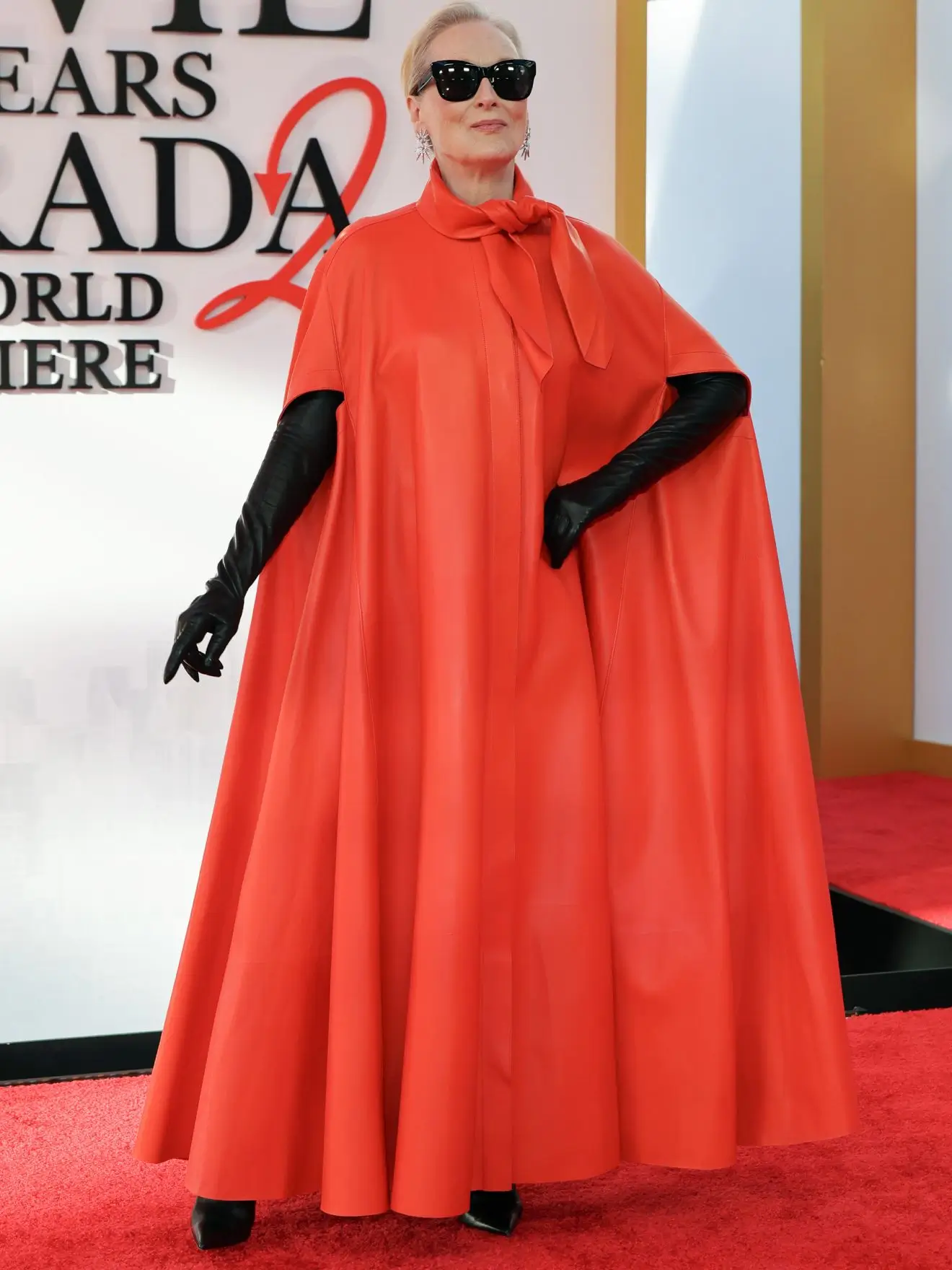
Dressed in a floor-length black leather cape from Givenchy’s Fall/Winter 2026 collection under Sarah Burton, her presence recalibrated the room before she reached the cameras. The garment—severe in line, controlled in movement—extended Miranda Priestly’s visual language without replicating it.
Where the original Miranda weaponized precision, this iteration embodied inevitability.
The leather drape, paired with gloves, boots, and darkened lenses, resisted ornamentation. It suggested a figure no longer performing authority, but inhabiting it fully.
Givenchy’s architectural restraint amplified that message. Nothing excess. Nothing explained.
Power, here, was not projected.
It was assumed.
anne athaway
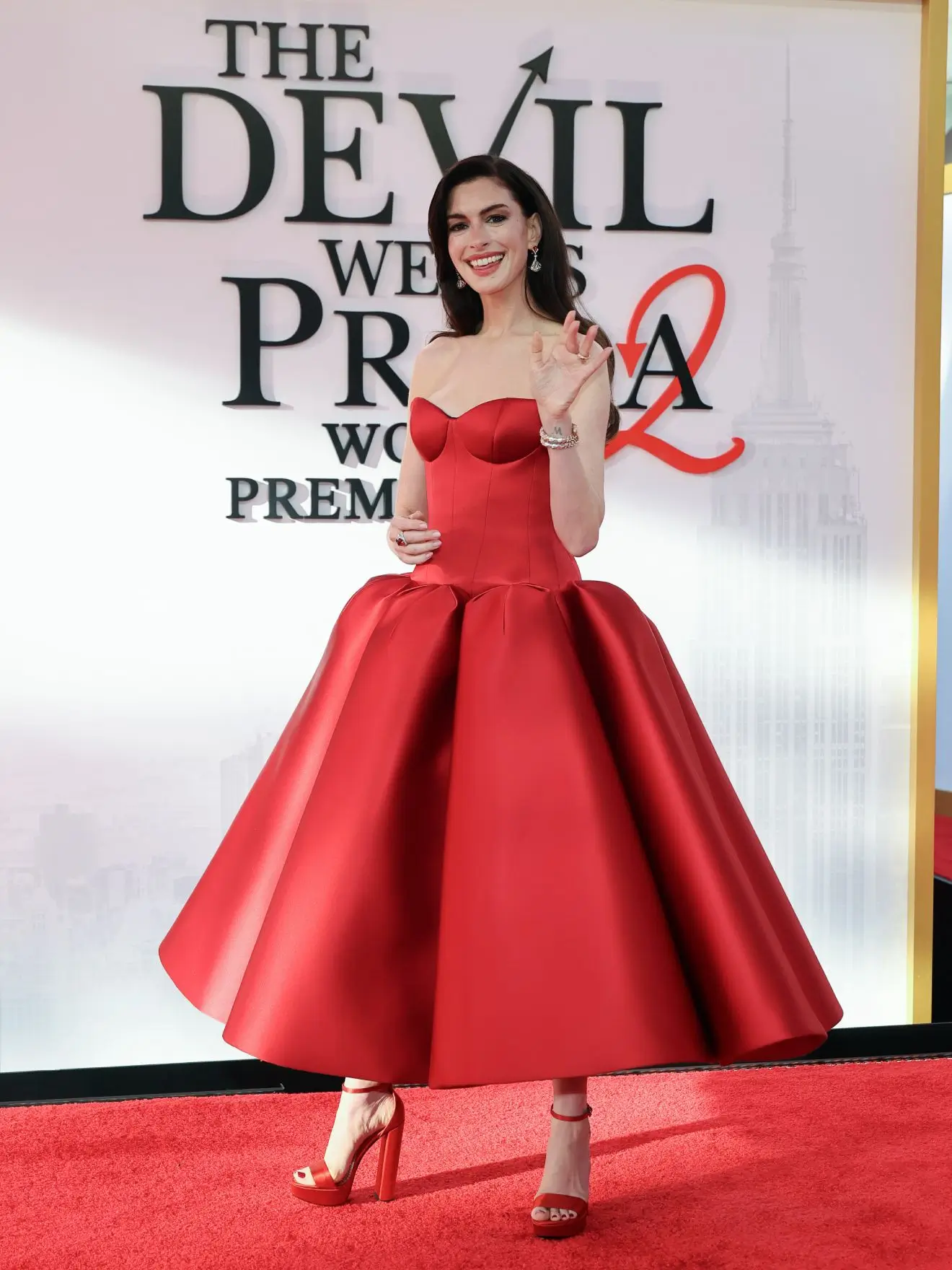
Anne Hathaway entered in red—a choice that immediately disrupted the tonal restraint of the carpet.
Her strapless gown by Louis Vuitton carried a voluminous drop-waist silhouette, merging historic glamour with contemporary structure. The color itself did the work—assertive, declarative, unambiguous.
In 2006, Andy Sachs borrowed identity through clothing. In 2026, she authored it.
The gown did not suggest arrival. It confirmed it.
There was no trace of hesitation in the posture, no residual negotiation in the styling. The look operated as a statement of completion—a narrative arc resolved not through rebellion, but through control.
Hathaway’s presence reframed the character entirely: not the assistant who survived, but the architect who learned.
emily blunt
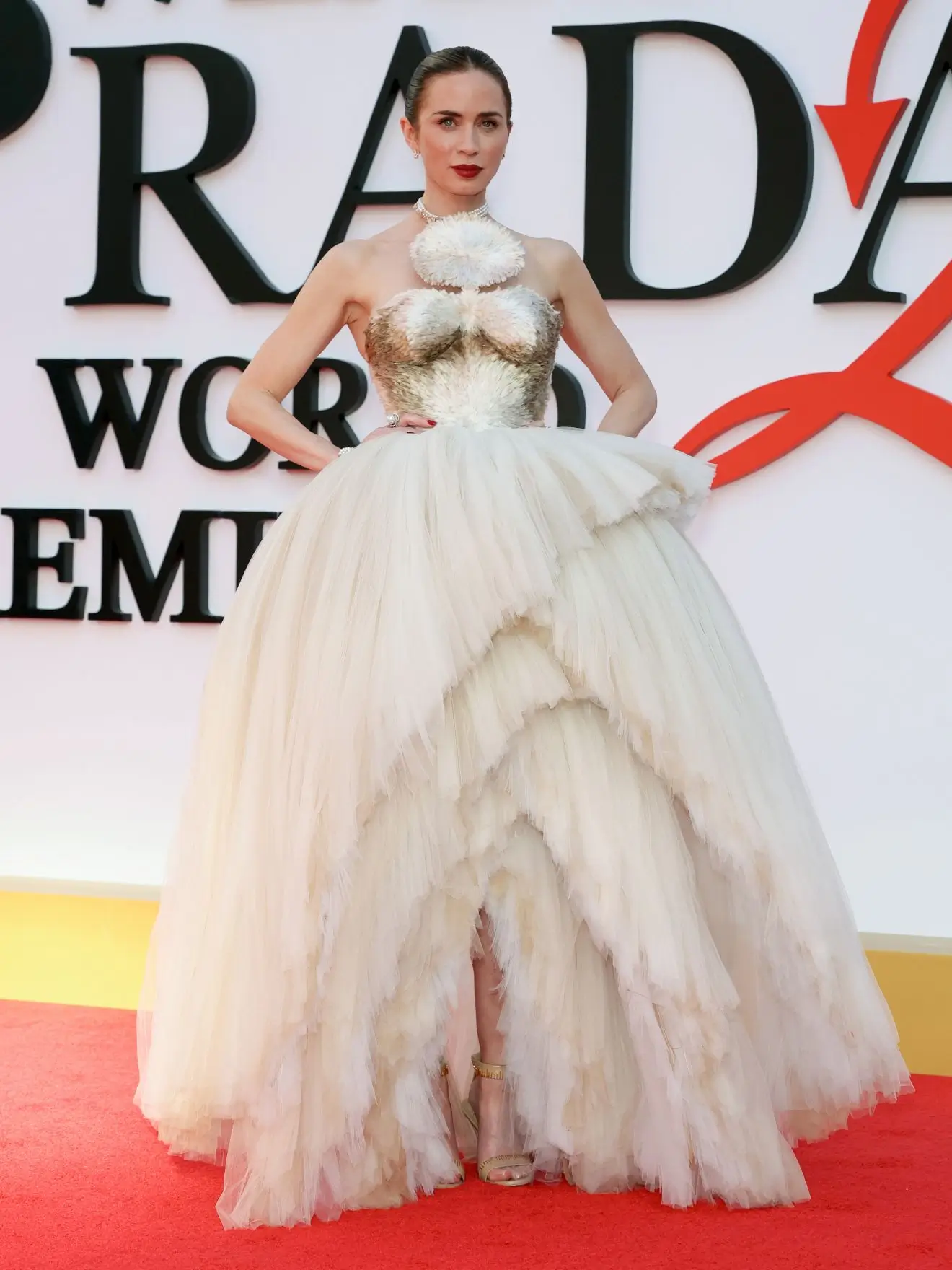
Emily Blunt provided the evening’s most precise counterpoint.
Wearing a cream-toned, layered tulle couture piece from Schiaparelli Spring/Summer 2026, her look shifted the conversation away from dominance toward resonance.
The construction—light, controlled, almost atmospheric—introduced a different register of authority. One that does not confront directly, but stabilizes the environment around it.
Where Streep’s black absorbed space, and Hathaway’s red disrupted it, Blunt’s neutral palette redistributed it.
The effect was not secondary. It was directional.
A suggestion of leadership that operates without spectacle.
stir
The Devil Wears Prada 2 does not simply revisit its characters. It relocates them.
The industry they once dominated no longer exists in the same form. Print has dissolved into fragments. Editorial authority has decentralized. Influence has migrated to platforms where immediacy outweighs hierarchy.
And yet, the central question persists:
What does power look like when the structures that once defined it no longer hold?
Miranda Priestly, once the fixed axis of the fashion system, now exists within a dispersed network. Her authority is no longer absolute—but neither is it obsolete. The tension lies in adaptation.
Andy Sachs returns not as an outsider, but as a parallel force—someone who has internalized the system without replicating it. Her position reflects a generational shift, where ambition is no longer hidden but articulated openly.
And Blunt’s character—positioned as a digital-native editor—introduces a third framework entirely. One built on fluidity rather than control.
The film does not attempt to resolve these dynamics.
It allows them to coexist.
culture
In the lead-up to the premiere, the cast moved through London, Paris, and Los Angeles—each stop reinforcing the film’s positioning not just as cinema, but as cultural artifact.
Early screenings have been received with a level of attention that extends beyond critique. Reviews note the sharpness of the script, but more significantly, the weight of its context.
On platforms, the response has been immediate. Archival lines resurface—“Florals? For spring?”—now reframed through a contemporary lens.
The conversation is no longer limited to fashion. It extends into labor, authorship, and identity.
Millennial audiences revisit the narrative with new proximity—many now occupying roles similar to those they once observed. Gen Z encounters it without the original context, interpreting its themes through burnout culture and digital view.
The film exists between these perspectives.
A bridge, rather than a mirror.
why
The timing is not incidental.
The original film emerged during the height of print dominance—a moment when editorial authority was centralized and largely unquestioned. The sequel arrives in a landscape defined by fragmentation.
Movements around equity, labor, and authorship have redefined expectations within creative industries. The structures that once enabled figures like Miranda Priestly have been interrogated, if not dismantled.
And yet, the mechanisms of power remain.
They have simply shifted form.
The sequel engages this tension directly. Not by offering resolution, but by extending the question:
What does success mean when the system itself is unstable?
What remains when the ambition that defined you has already been achieved?
a sys
The premiere functioned as more than view spectacle. It operated as narrative architecture.
Black, red, cream—each look positioned within a continuum.
Streep: endurance.
Hathaway: transformation.
Blunt: emergence.
The sequence felt deliberate. Not styled independently, but constructed relationally.
Each presence informed the next.
Each look extended the story beyond the screen.
clue
As the evening closed and the cast stepped inside, the applause carried something beyond approval. It registered recognition—of time, of evolution, of continuity.
Meryl Streep, Anne Hathaway, and Emily Blunt did not return to Runway. They recontextualized it.
They demonstrated that power is not static. It shifts, adapts, recalibrates.
The devil still wears Prada.
But now, she operates differently.
Less visible. More embedded.
Not louder—
More precise.
Related Articles
Rose Byrne and Mary Bronstein Are Doing It Again, and This Time They Brought Jenna Ortega
A coach and her prodigy are about to become the most dangerous relationship in a […]