The Dawn of Autonomous Trucking: A Transformative Shift in Freight Transport

May 6, 2025
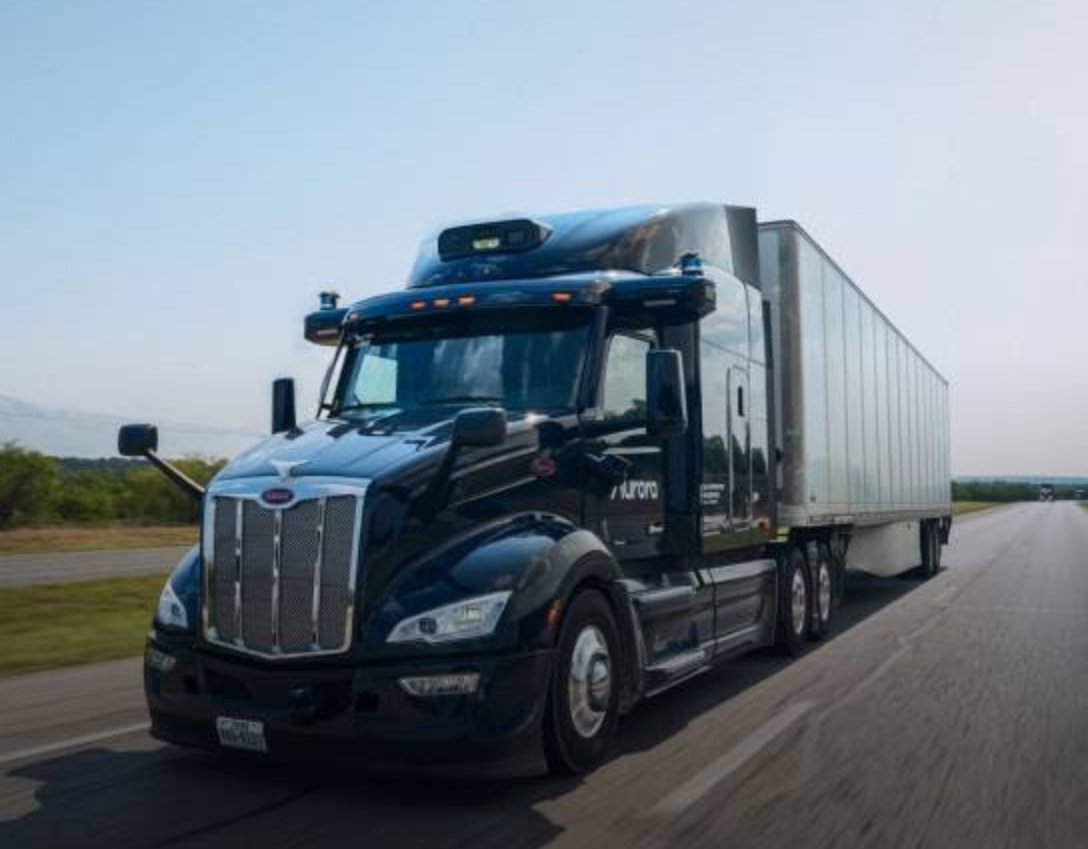
The freight and logistics industry is entering a new epoch. What was once a speculative frontier has now materialized into a present-day disruption: driverless semi-trucks are on the road, operating without human intervention. This transformation, quietly years in the making, took a dramatic leap forward as Aurora Innovation, a leading autonomous vehicle (AV) technology company, confirmed the launch of fully driverless freight operations between Dallas and Houston. The trucks—navigating without safety drivers, backup systems, or remote teleoperation—are not test units. They’re part of live, revenue-generating freight runs in a real supply chain ecosystem.
This milestone marks a historical shift in long-haul trucking and invites serious examination. What does it mean when the 18-wheeler barreling down the interstate has no human behind the wheel? How will this technology reshape the economies of scale in shipping, the daily lives of millions of truck drivers, and the regulatory framework around our highways? Aurora’s achievement is not just a breakthrough—it is a signal flare. The age of autonomous logistics has arrived.
Aurora’s Breakthrough: Driverless Freight Without a Safety Net
Last Thursday, Aurora announced the successful completion of over 1,200 fully autonomous miles between Dallas and Houston, with no safety driver present in the cab. The clients—Uber Freight and Hirschbach Motor Lines—represent the first commercial adopters of this fully autonomous transport model. The trucks are loaded, dispatched, and operated as part of real-world freight operations, not laboratory simulations or public relations demonstrations.
The corridor between Dallas and Houston serves as a strategic proving ground. With minimal elevation, predictable traffic patterns, and favorable weather, the I-45 route presents the ideal training environment for AI-based navigation systems. Aurora’s vehicles rely on a suite of sensors, including lidar, radar, high-definition cameras, and precision GPS, all processed through proprietary AI algorithms that simulate real-time decision-making modeled after human cognition—but optimized for reaction time, data intake, and consistency.
According to Aurora co-founder and CEO Chris Urmson, “This is the beginning of a commercial product that can scale nationally.” Four years of rigorous simulation, closed-loop testing, and supervised on-road operations culminated in this deployment—an event that rewrites the rules of modern logistics.
The Economic Drivers of Autonomy: Cost, Continuity, and Capacity
Why is the freight sector so eager to embrace autonomous vehicles? The answer lies in basic economics. Long-haul trucking has long struggled with volatility in labor supply, rising costs, and limited flexibility.
A McKinsey & Co. report forecasts that 10% of all U.S. freight vehicles will be autonomous by 2035, with cost-per-mile reductions approaching 42% once the technology achieves full deployment. These savings derive from several key changes:
- Elimination of driver compensation and rest requirements, allowing trucks to operate 24/7 without mandatory breaks.
- Reduction in fuel consumption through optimized speed, braking, and acceleration protocols driven by AI modeling.
- Lower accident rates, with up to 90% of collisions currently attributable to human error.
- Minimized insurance premiums and liability exposure as AV safety data improves.
At present, the American Trucking Associations estimates a shortage of over 80,000 drivers, a figure that continues to climb. Driver recruitment is increasingly difficult, and turnover rates remain high. Autonomous trucking does not merely supplement labor—it replaces the most challenging routes first: multi-hour, interstate, repetitive long hauls. These are the jobs most prone to fatigue-related errors, most difficult to fill, and most ripe for automation.
The Labor Reckoning: Displacement, Retraining, and Resistance
But every technological leap casts a shadow. The rise of driverless trucking raises a profound challenge for the 3.5 million truck drivers who currently form the backbone of U.S. freight logistics. Unions like the Teamsters have mounted aggressive opposition, warning of economic destabilization, safety lapses, and the erosion of worker protections.
“This isn’t just about job loss—it’s about public safety, ethical oversight, and accountability,” says a Teamsters representative. “If an autonomous truck crashes, who is held responsible? The algorithm? The manufacturer? The logistics company?”
Truck driving isn’t merely a job—it’s a cultural identity, an economic necessity for rural America, and often a generational career. Entire towns depend on the rhythms of the freight economy. If automation replaces thousands of positions, the social consequences will be massive.
However, advocates counter that autonomous systems will create new employment categories—including remote fleet supervisors, AV software maintenance engineers, logistics analysts, and regulatory compliance specialists. The key, they argue, is transition management: ensuring that displaced workers are retrained and absorbed into adjacent industries, not abandoned.
A Regulatory Wild West: The Absence of Federal Policy
One of the most pressing issues surrounding autonomous freight is the lack of comprehensive federal regulation. While the National Highway Traffic Safety Administration (NHTSA) has issued guidelines, no binding national framework governs the deployment of driverless trucks. This vacuum leaves regulation to the states—creating a patchwork of permissive and restrictive policies.
Texas and Arizona have emerged as pro-autonomy havens, embracing AV testing with minimal bureaucratic friction. In contrast, states like California and New York impose stricter rules, limiting or outright banning certain autonomous operations.
This legislative inconsistency introduces both opportunity and risk. While early AV companies can fast-track deployment in friendly states, nationwide scalability will require uniform standards. Legal ambiguity over liability, insurance, cybersecurity, and accident response remains unresolved.
Without federal legislation, the U.S. risks falling behind international competitors—particularly China, which has heavily invested in AV freight as part of its broader AI infrastructure strategy.
A Crowded Field: Competitors and the Commercial Sprint
Aurora’s success places it at the forefront of a rapidly growing field, but it is far from alone. At least 10 autonomous trucking companies are actively developing or piloting AV solutions. Major players include:
- TuSimple, which has already completed autonomous freight runs in Arizona and is backed by UPS and Nvidia.
- Waymo Via, Alphabet’s commercial trucking branch, currently testing in the Southwest.
- Kodiak Robotics, focused on highway autonomy with streamlined sensor architecture.
- Embark, which has developed a “transfer hub” model that combines AVs with short-distance human delivery.
Billions of dollars in venture capital and corporate partnerships have poured into the space. The competitive edge lies not merely in software sophistication, but in scalability, safety validation, customer acquisition, and—ultimately—public trust.
The next 12 to 18 months will prove decisive. The AV companies that demonstrate not just technological readiness, but operational reliability, will likely lock down exclusive freight corridors, build brand loyalty, and accelerate regulatory acceptance.
Public Perception and the Safety Debate
Despite the technical progress, consumer skepticism remains high. Accidents involving Tesla’s Autopilot and other semi-autonomous systems have colored public opinion with caution—if not outright suspicion.
The skepticism is rational. Trucks weighing 40 tons traveling at 65 miles per hour must demonstrate an error margin approaching zero. Any system glitch, data corruption, or sensor failure could result in catastrophic outcomes.
To counter this, companies like Aurora are pursuing transparency in safety metrics, publishing disengagement reports, scenario testing simulations, and collaborative research with academic partners. They argue their trucks can process millions of data points per second, offering faster response times, better peripheral awareness, and immunity to fatigue or intoxication.
Still, human psychology remains a barrier. Until AV systems prove consistently safer than human drivers—under rain, fog, detours, and mechanical strain—their widespread acceptance will remain fragile.
Infrastructure Overhaul: Highways for the Future
Autonomous trucks will also force a redesign of logistics infrastructure. Existing freight networks, rest stops, and depots were designed with human drivers in mind. AV-specific infrastructure will require:
- Dedicated AV lanes or zones on major corridors.
- High-speed charging or refueling stations optimized for continuous operation.
- Remote diagnostics and intervention centers.
- Digital infrastructure overlays, including smart signage, 5G connectivity, and V2X (vehicle-to-everything) communication hubs.
These investments will require public-private cooperation, particularly if AV freight is to play a central role in national economic growth. At stake is not just operational efficiency—but a new spatial logic for the American road system.
The Global Stakes: Automation as Geopolitical Leverage
The implications of autonomous freight extend far beyond U.S. highways. Countries around the world are racing to build AV infrastructure and capture a share of what analysts expect to be a $1 trillion global market by 2040.
China has made AV trucking central to its Belt and Road digital strategy. Germany’s autobahn is already equipped with AV-compatible corridors. Singapore and South Korea are piloting urban freight bots. The U.S. must move quickly—not just in regulation, but in education, workforce development, and technological standardization—to maintain leadership.
The Road Writes a New Future
The sight of a driverless 18-wheeler humming along the I-45 corridor is not a test—it is the new status quo. Autonomous freight is no longer a concept—it is a commercial force, a logistical transformation, and a societal challenge.
In the next decade, we will witness the systematic phasing-out of human long-haul drivers, the restructuring of freight labor, and the rewriting of how goods move through the economy. This change will not happen overnight, and it will not come without resistance. But the wheels are already turning.
Aurora’s achievement represents more than a milestone. It marks the dawn of a post-human highway, where algorithms, sensors, and code inherit the most American of dreams: the open road.
Related Articles

France Just Banned Social Media for Kids Under 15, and the Fight Over Anonymity Is Only Getting Started
France becomes the first EU nation to bar under 15s from social platforms, and critics […]