DRIFT AUDIO
Listen to this story
Choose a voice, then press play.
Franklin’s 1742 stove promised warmth from less wood — but a flawed flue nearly doomed it before another inventor made it work, decades before coal ever entered the picture.
In This Story
- A Philadelphia Problem in 1742
- What Franklin Actually Built
- The Flaw Franklin Didn’t Anticipate
- Wood’s Long, Unrivaled Dominance
- The Slow Handoff to Coal
- Franklin’s Invention in Context
By the early 1740s, Philadelphia was a growing colonial city with an old, wasteful habit: heating homes with open masonry fireplaces. These hearths were simple and familiar, but they were also spectacularly inefficient. Most of the heat gen by a roaring fire didn’t warm the room at all — it rushed straight up the chimney along with the smoke, pulling cold outside air in through every crack and window to replace it. Rooms near the fire baked while the rest of the house stayed cold. Firewood, which had to be cut, hauled, and dried by hand, was consumed at an alarming rate for the small amount of comfort it delivered. In a city facing rising fuel costs and periodic wood shortages, that inefficiency was a real economic burden on ordinary households.
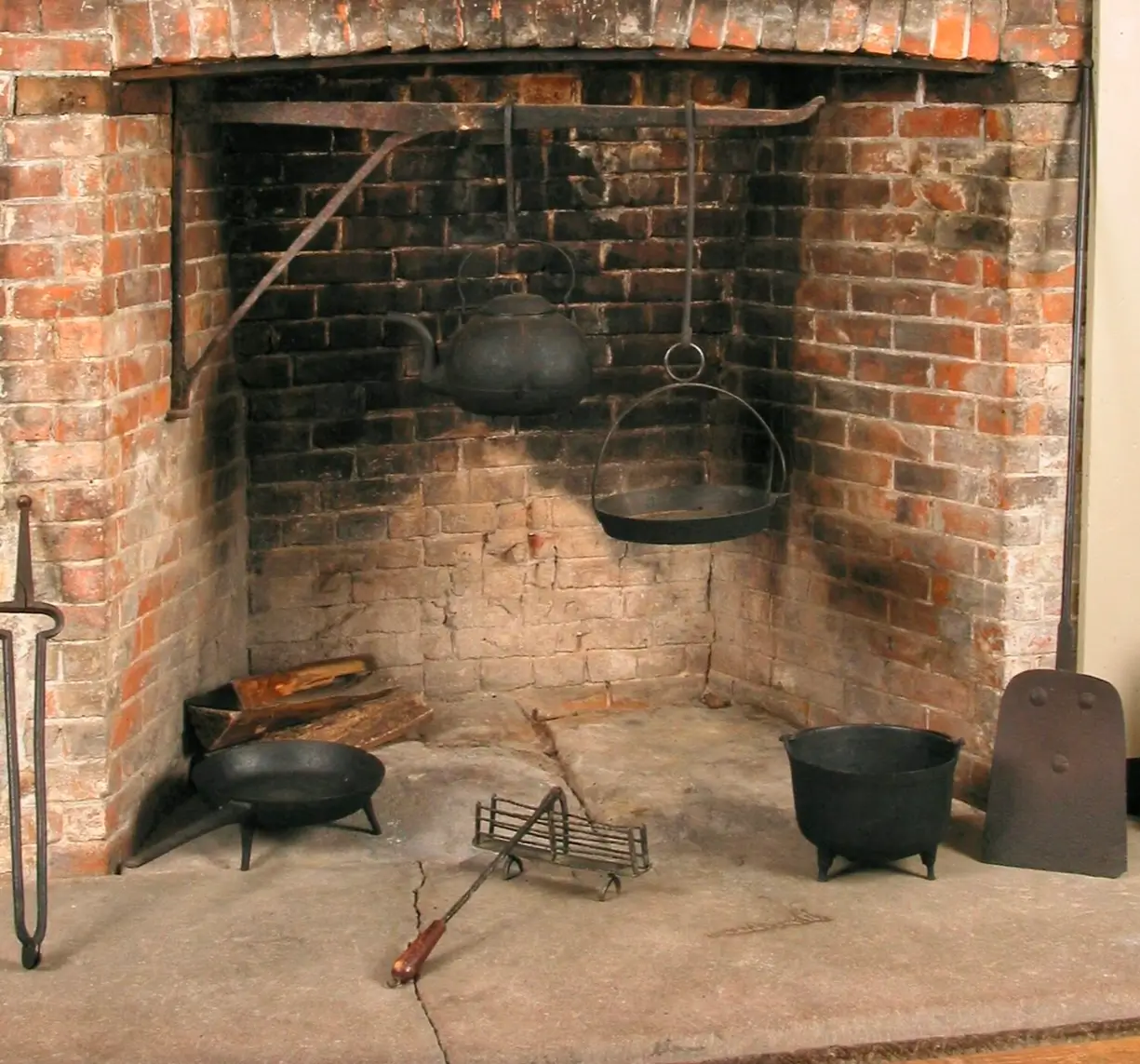
Historic colonial brick hearth equipped with an adjustable iron crane, cast-iron cookware, and traditional fireplace tools used for open-hearth cooking and home heating in early American households.
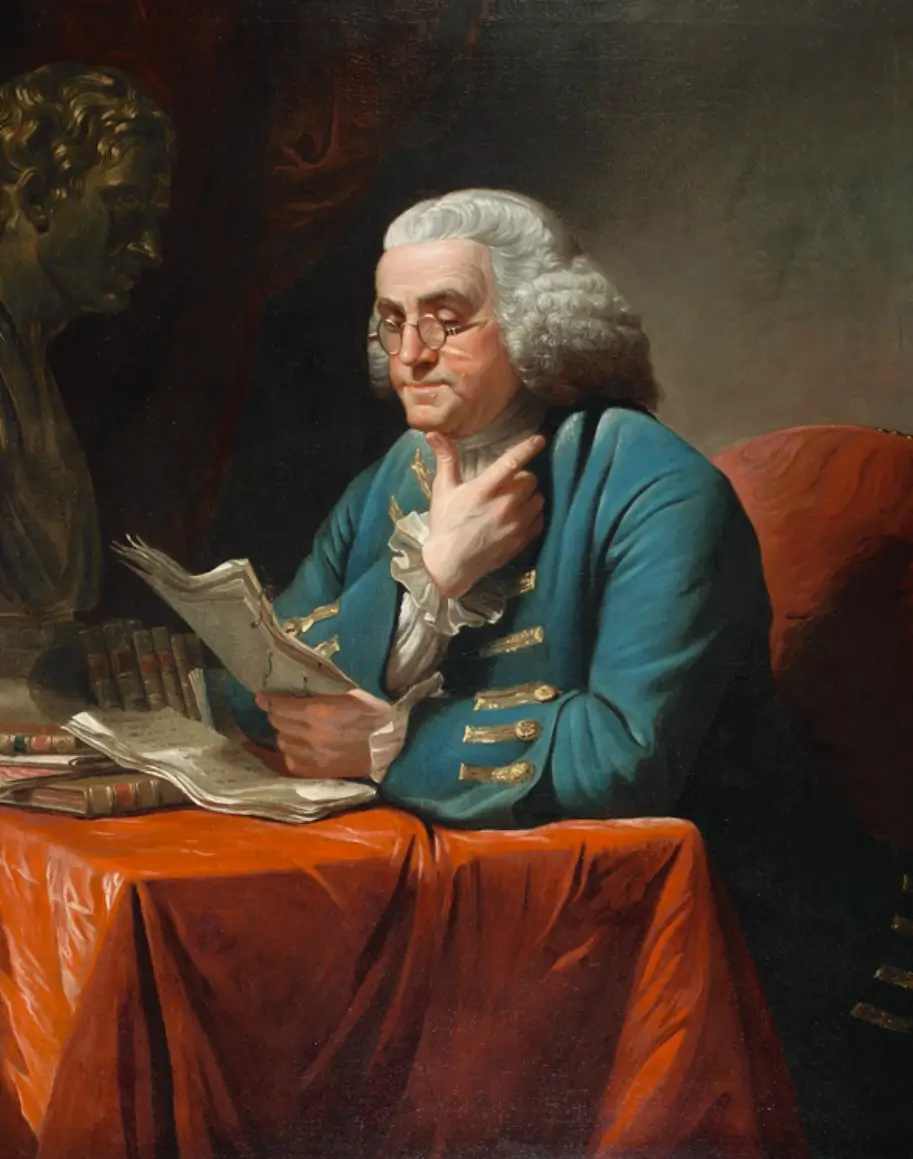
Benjamin Franklin, then in his mid-thirties and already a successful printer, publisher, and civic-minded tinkerer, saw an opportunity to apply the scientific thinking of his era to a very practical domestic problem. He was reading contemporary work on heat and combustion, including ideas developed by the Dutch physician Herman Boerhaave, and he drew inspiration from earlier European experiments — a seventeenth-century inverted-siphon baffle design credited to Franz Kessler, and the experiments of the Frenchman Jean Desaguliers, which suggested cast iron radiated heat far more effectively than the masonry used in traditional fireplaces. Franklin synthesized these existing ideas into a single practical device, something he did often as an inventor: he was less interested in wholly novel principles than in combining known ones into something people could actually use.
stir
In 1742, Franklin finished the design of what he called the “Pennsylvania Fireplace” — the device history would come to know as the Franklin stove. It’s worth being precise about what this invention was, because its reputation has stray somewhat over the centuries. The Franklin stove was, first and foremost, a home-heating appliance, not a cooking stove. Its entire purpose was to make room heating more efficient and less wasteful of fuel — cooking was, at most, a secondary and incidental use.
The stove was a freestanding, cast-iron, box-like unit designed to be inserted into an existing fireplace opening, projecting out into the room rather than sitting flush against the back wall. It had two key engineering features. The first was a hollow baffle — a metal panel positioned near the rear of the unit that redirected the fire’s hot fumes through a longer path before they escaped, giving the iron more time and surface area to absorb heat before radiating it into the room. The second was what Franklin called an “inverted siphon”: a flue arrangement that pulled the fire’s hot gases downward and around the baffle rather than letting them shoot straight up the chimney. In principle, this meant far more of the fire’s heat stayed in the room instead of being lost, while the iron walls of the stove radiated warmth outward long after the flames themselves had died down.
Franklin had his prototype cast in iron sourced through Robert Grace and the ironmaster William Branson, with production beginning at furnaces in the Reading, Pennsylvania area, operated by the Van Leer family. In 1744, he published a pamphlet explaining the stove’s design and operation — partly a sales tool, partly a piece of public education in the Enlightenment spirit he embraced throughout his life. Consistent with that spirit, when Pennsylvania’s deputy governor George Thomas offered to help Franklin secure a patent on the design, Franklin declined. He wanted the design available to anyone who could benefit from it, and he said as much in his later writings, framing free access to useful inventions as a public good rather than a private windfall.
challenge
Despite the elegance of the theory behind it, Franklin’s original Pennsylvania Fireplace had a serious practical flaw, and it very nearly sank the whole project. The inverted siphon depended on the flue staying hot enough to maintain a steady draft. But Franklin’s flue ran through a cold channel set into the floor before connecting to the chimney. Once the fire dimmed even slightly, that below-floor section of ductwork cooled quickly, and a cooled flue couldn’t gen enough of a pressure difference to keep smoke moving upward and outward. The result, ironically, was often the opposite of what Franklin had promised: smoke escape back into the room instead of venting cleanly outside.
This wasn’t a minor inconvenience. Early sales were thin — by Franklin’s own account, initial commercial uptake was modest, hampered both by the smoke problem and by the stove’s cost, which ran to several weeks’ wages for an ordinary laborer. A heating appliance that didn’t reliably heat, and that sometimes filled a parlor with smoke, was a hard sell regardless of the sound engineer theory behind it.
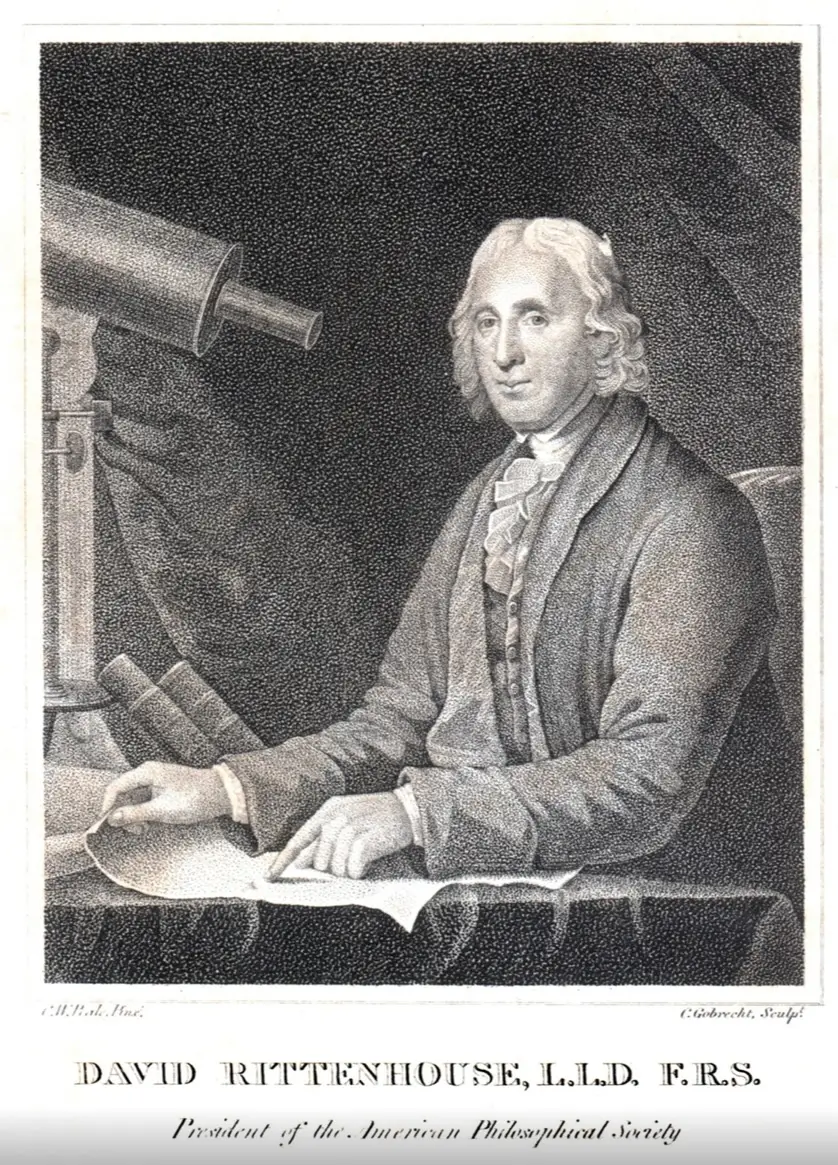
Historic engraving depicting David Rittenhouse, pioneering American astronomer, inventor, and instrument maker, portrayed with a telescope, books, and scientific manuscripts that symbolize his lasting contributions to astronomy, engineering, and early American scientific discovery.
The fix arrived from someone else. Decades later, in the late 1770s and 1780s, the Philadelphia clockmaker, astronomer, and instrument-maker David Rittenhouse modified Franklin’s design by adding an L-shaped flue. This change kept the ductwork hotter for longer and dramatically improved the draft, solving the smoke problem that had dogged the original stove for a gen. Rittenhouse’s improved version — which he reportedly called his own “Rittenhouse Stove” — is the design that finally caught on widely across colonial and early American households. But popular memory being what it is, Franklin’s fame eclipsed Rittenhouse’s contribution, and the corrected, functional version of the stove is still remembered today under Franklin’s name rather than its actual perfecter’s.
There’s a useful lesson buried in that history: Franklin’s real contribution was identifying and popularizing the underlying principle — that an enclosed cast-iron chamber with a longer, more deliberate path for hot gases could radiate dramatically more usable heat into a room than an open hearth ever could. The specific mechanical execution of that principle needed real refinement by another inventor before it worked as intended. Invention and successful engineering, in this case, were two separate acts carried out by two different people.
sustenance
Firewood wasn’t one energy option among several — it was, for the vast majority of colonial households, the only practical fuel available for heating, cooking, and a wide range of early industrial processes such as iron smelting, brick-making, and glassmaking. Coal existed and was known in some regions, but large-scale coal mining and distribution infrastructure simply hadn’t developed yet in most of North America. Wood was abundant, close at hand in a heavily forested continent, and required no complex extraction or transport network — just an axe, a saw, and physical labor.
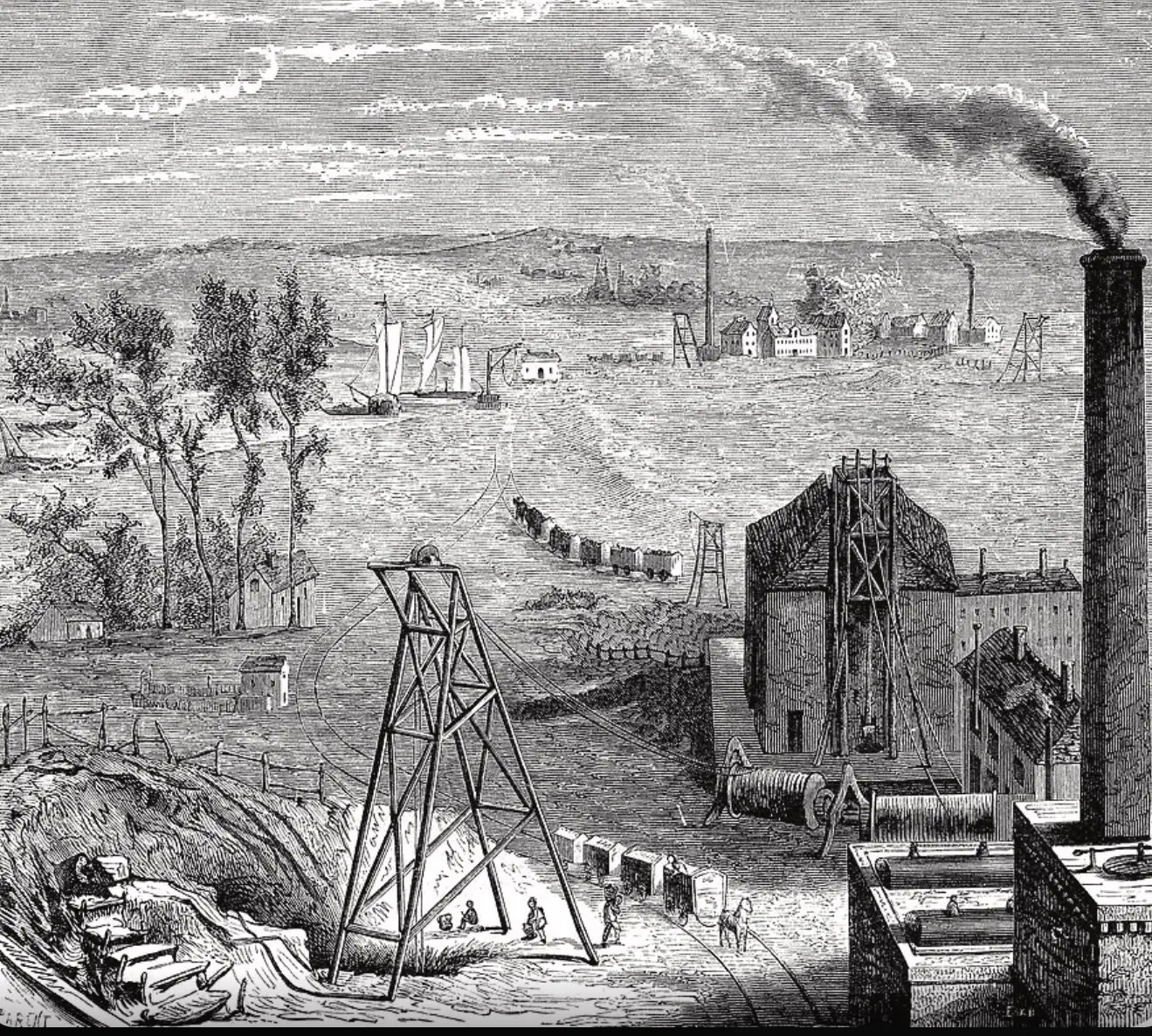
Nineteenth-century engraving illustrating an early industrial mining operation with steam-powered machinery, rail transport, factory buildings, and a smoking chimney, capturing the rapid growth of mining, manufacturing, and transportation during the Industrial Revolution.
This dependence on wood shaped colonial life in very concrete ways. Households spent enormous amounts of time and effort each year cutting, splitting, hauling, and drying enough firewood to survive winter. Near rapidly growing towns, nearby forests were steadily depleted, driving up the price and hauling distance for fuel — precisely the kind of localized wood scarcity Franklin was responding to in Philadelphia. Anything that made a household’s wood supply stretch further, as the Franklin stove promised to do, had genuine economic value beyond simple comfort.
Wood’s dominance as America’s primary fuel source didn’t end with the colonial era — it persisted for well over a century afterward. Through the Revolutionary period, into the early republic, and across most of the nineteenth century, wood remained the leading source of energy in the United States, powering not just home heating and cooking but also early steam engines, riverboats, and rail locomotives. It’s a common misconception that America’s Industrial Revolution ran on coal from the start; in reality, wood supplied the overwhelming majority of the nation’s energy needs until quite late in the 1800s.
slow
The shift away from wood as the nation’s primary fuel was gradual rather than sudden, driven by a combination of factors: deforestation near major population centers made wood progressively more expensive and harder to source locally; the expansion of railroads made it economically feasible to transport heavy, dense coal over long distances from mining regions to cities and factories; and coal’s much higher energy density made it increasingly attractive for industrial applications like iron and steel production, which demanded intense, sustained heat that coal could deliver more efficiently than wood or even wood-derived charcoal.
By the final decades of the nineteenth century — commonly cited as occurring around the 1880s — coal overtook wood as the dominant energy source in the United States for the first time. This transition tracked closely with the broader industrialization of the American economy: growing cities, expanding railway networks, and heavy industry all favored coal’s portable, energy hull, and compatible with the furnaces and boilers that powered the era’s factories and locomotives. Coal, in turn, would eventually be challenged by petroleum and natural gas in the twentieth century, continuing a long-running pattern in which no single fuel source has permanently dominated — each has eventually been displaced as new extraction technologies, transportation networks, and industrial demands shifted the economics of energy.
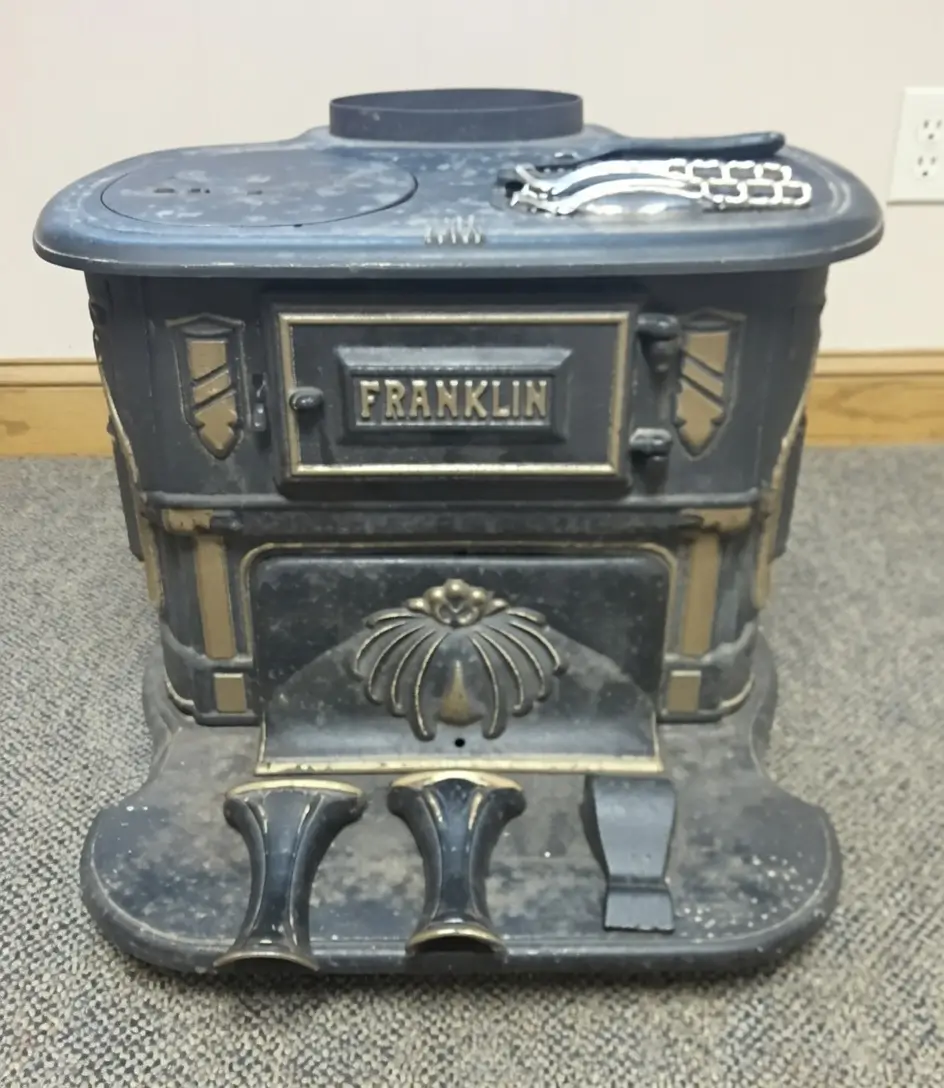
Antique Franklin cast-iron parlor stove featuring ornate brass accents, embossed branding, and a classic heating design that reflects late 19th- and early 20th-century craftsmanship.
invent
Seen against this backdrop, the Franklin stove looks less like an isolated eighteenth-century curiosity and more like an early, thoughtful response to a real resource constraint. At a moment when wood was the only fuel most Americans had access to, and when that fuel was becoming scarcer and costlier in growing towns like Philadelphia, an invention that could meaningfully reduce the amount of wood needed to heat a home represented genuine economic value — not just comfort, but conservation of a limited household resource.
That the original design didn’t quite work as intended, and needed a later fix from David Rittenhouse to become genuinely popular, doesn’t diminish Franklin’s contribution so much as it reflects a familiar pattern in the history of invention: a good idea, correctly identified, sometimes takes more than one attempt — and more than one inventor — to become a good product. Franklin identified the problem and the underlying physical principle with real insight. It fell to someone else to work out the last stubborn engineering detail that made the whole thing draft properly. Together, their contributions produced a heating device that would remain influential and recognizable for the next two and a half centuries, long after the wood-fired hearths it was designed to improve upon had themselves been displaced by coal, then oil and gas, then electricity.
Related Articles

WACKO MARIA Brings Its Leopard Lining to the Big Leagues
Black nylon outside, leopard fur inside: WACKO MARIA’s first Major League Baseball collection reached Japan […]