DRIFT AUDIO
Listen to this story
Choose a voice, then press play.
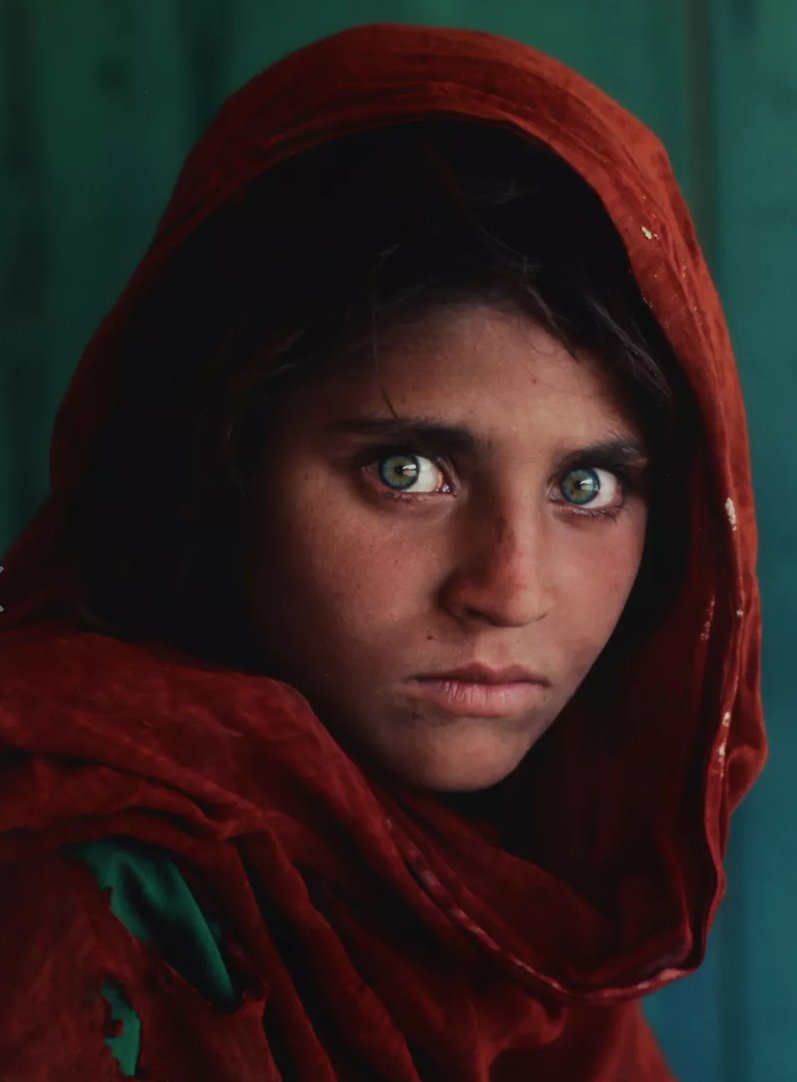
In the lexicon of modern photography, few images carry the resonance—visceral, cultural, and historical—of Afghan Girl, captured by Steve McCurry in 1984. Her green eyes—startled, piercing, and sorrowful—are perhaps the most recognized in photographic history, burned into the collective consciousness as more than just a portrait. They are a portal into the 20th century’s moral crises, its displacements, its wars and unmoored childhoods. This image, taken in a refugee camp on the outskirts of Peshawar, Pakistan, during the Soviet-Afghan War, has transcended the context of its origin to become a symbol of endurance, exploited beauty, and the uneasy contract between photojournalist and subject.
The girl’s name, unknown at the time of the image’s publication on the cover of National Geographic in June 1985, was Sharbat Gula. For seventeen years after the photograph circulated globally, she remained anonymous—a cipher, not a citizen. It wasn’t until 2002 that McCurry and a National Geographic team rediscovered her in Afghanistan, confirming her identity through iris recognition technology, as if the truth could only be verified by the very part of her that the world remembered: her gaze.
The Image as Icon, the Icon as Artifact
What is it about this particular photograph that strikes so deeply, so lastingly? Part of the answer lies in formal composition. McCurry’s use of Kodachrome film saturates the reds and greens to painterly effect: the girl’s tattered burgundy scarf mirrors the clay-warm tones of her sun-baked skin, while her sea-green eyes take center stage, flanked by chiaroscuro shadows that sharpen her outline. The background is a canvas of green and blur—evoking a world fading into abstraction, while she remains unnervingly present.
Yet the true magnetism of the image lies beyond aesthetic mastery. It is what Roland Barthes called the punctum—that which wounds the viewer. Her eyes confront us. They do not plead. They do not smile. They do not perform. They assert a raw, unfiltered existence. They resist simplification into “refugee,” “victim,” “subject.” Her gaze both indicts and elevates the viewer.
And yet, in elevating the image, we must also interrogate it. It was, after all, made by an outsider, an American man, in a refugee camp in a foreign land—plucked from anonymity, frozen in time, and disseminated across the globe without her consent or comprehension of the medium’s reach. In that act is a violence all its own, however unintentionally performed. The image has thus come to represent not only the power of photojournalism but its deeply ethical complications.
A Portrait of Displacement
Sharbat Gula’s story is not unique in the scale of human tragedy, but its visual memorialization is. She represents the unspoken millions who have suffered the dislocations of imperialism, war, and political machinations far beyond their control. Born in the early 1970s in the mountainous province of Nangarhar, Gula became an orphan during the Soviet invasion of Afghanistan. She fled with her siblings and grandmother to the Nasir Bagh refugee camp in Pakistan, where she would eventually be photographed.
At that moment, she was just one among 3.3 million Afghans who had fled into Pakistan by the mid-1980s. What McCurry captured—perhaps unknowingly—was the embodiment of that statistic. She became the accidental symbol of the world’s largest refugee crisis at the time. And therein lies the double-bind of her image: she is both uniquely herself and tragically anonymous, the avatar of a population, yet singular in aesthetic representation.
That she was not named until 2002 is not a minor fact—it is the linchpin of the image’s ethical dilemma. For nearly two decades, Afghan Girl was celebrated, reproduced, commodified, even fetishized—while the woman herself lived in obscurity, poverty, and often danger. Her body and face circulated freely while her real identity remained imprisoned by war, patriarchy, and the vagaries of survival.
Orientalism and the Western Gaze
Edward Said’s concept of Orientalism—where the “East” is defined as a passive, exotic, feminized foil to the rational and dominant “West”—finds eerie echo in the reception of McCurry’s photograph. The Afghan Girl is not just a young woman captured in a vulnerable moment—she becomes the Afghan woman, her singular image standing in for an entire nation’s womanhood, suffering, and silence.
In the West, her gaze was often romanticized as tragic beauty, her headscarf exoticized, her pain aestheticized. The photograph, especially in the 1980s, operated as a bridge between the Cold War era’s ideological theater and a kind of guilt-ridden humanitarian voyeurism. It allowed Western viewers to feel empathy without context, to project benevolence without action, to indulge in feeling rather than understanding.
That Sharbat Gula was later arrested by Pakistani authorities in 2016 for possessing forged identification documents—while millions still recognized her iconic image—is the bitter irony of it all. The face known around the world could not secure her the most basic dignity in the countries whose wars uprooted her life. That moment, too, was photographed. But no cover stories were printed in glossy magazines.
The Photographer’s Role, The Image’s Fate
Steve McCurry is often lauded for his rich, humanistic vision, and indeed, his body of work testifies to an enduring commitment to documenting the intimate human cost of conflict. But Afghan Girl presents a dilemma: does an image’s power justify the process by which it was taken?
To his credit, McCurry has expressed genuine concern for Gula, aiding in her later legal troubles and reuniting with her after their long separation. He did not anticipate the image’s iconic status. Few could have. And yet, the systems that profited off the image—National Geographic, galleries, print houses, academic programs—seldom translated that fame into material support for its subject until she became rediscovered and retroactively acknowledged.
This disjuncture prompts a reevaluation of what it means to capture an image: is it to take ownership, or to bear witness? And can the two ever be truly separated in a medium born from colonial invention, frequently deployed in the service of imperial narratives?
From Silent Symbol to Active Personhood
The rediscovery of Sharbat Gula in 2002, and again in the public eye in the years since, challenges the photo’s original reception. Now, viewers are forced to confront the fact that this girl, once mythologized, has grown into a woman—one with her own will, losses, children, and voice.
She reportedly disliked the photograph when she first saw it. It had caused her discomfort, confusion, and later, legal trouble. She never asked to be the Afghan Girl. She simply was. Her later deportation from Pakistan to Afghanistan in 2016, after having lived there for decades, underscores the tragic incongruence of fame and reality. Her face could travel anywhere, but her body was detained and expelled.
In 2021, as the Taliban retook Afghanistan, Gula was evacuated to Italy, where she now lives under asylum. Once again, her fate is entwined with the geopolitical chaos of Afghanistan’s modern history. But this time, she has become more than an image. She is a living witness.
Toward an Ethics of Representation
The Afghan Girl continues to be taught in classrooms, displayed in galleries, and circulated across social media platforms. But in our contemporary moment—more aware than ever of power dynamics, representation, and exploitation—her image demands new modes of engagement.
We must ask:
- Who gets to photograph whom?
- What are the responsibilities that come with photographic fame?
- How does one honor the life behind the image rather than merely consuming its form?
These are not questions with easy answers. But they are necessary to ask in a world where visibility can be both salvation and incarceration. Gula’s story is a reminder that every portrait contains multitudes, every frame a constellation of contexts, every photograph a contract—often unsigned—between viewer, subject, and maker.
The Afterlife of an Image
Afghan Girl is no longer simply a photograph. It is an artifact, a lesson, a relic, a mirror. It has lived a longer and perhaps more public life than its subject ever intended or desired. In that gap between image and life lies the crux of photography’s dilemma in the modern world: its power to witness is equaled by its capacity to abstract, to displace, to commodify.
And yet, we are not without hope. If we can use this image as a fulcrum for deeper inquiry, if we can shift from admiration to accountability, from aesthetic appreciation to ethical engagement, then perhaps its legacy can evolve. Not just as a symbol of suffering—but as a call to listen more closely to those whose lives we glimpse only in flashes.
Final Glance
In the end, the most profound element of Afghan Girl is neither the composition nor the fame. It is the unknowability that persists behind those eyes. For all the words written and prints made, the interiority of that moment remains hers alone.
She looked into the lens. The lens looked back. History made her an icon. Now, it is up to us to make her human again.
Postscript: The Gaze Returned
In 2022, photographer Breshna Musazai—herself an Afghan woman—recreated Afghan Girl in tribute, but with a vital shift. In her version, the subject looks not with alarm or apprehension, but with calm defiance. It is a reclamation. A visual statement that Afghan women are not just symbols of suffering, but agents of change, dignity, and authorship.
Perhaps that is where Afghan Girl must now reside—in dialogue, not domination; in complexity, not myth. And in doing so, maybe the gaze that once haunted the world can finally find its own reflection.
End
Related Articles
Modigliani’s Limestone ‘Tête’
Carved from a single block of limestone in Montparnasse more than a century ago, one of Modigliani's rare stone heads goes to auction for the first time…