

DRIFT AUDIO
Listen to this story
Choose a voice, then press play.


In a world increasingly marked by climate anxiety, traffic congestion, and a collective craving for simplicity, the way we move through our cities is undergoing a profound shift. Transportation—once dominated by gas-powered giants and gridlocked commutes—is slowly being reimagined around sustainability, agility, and individual agency. Electric cars promise a cleaner future, but they’re still large, costly, and tethered to infrastructure that remains unevenly distributed. Electric scooters and bikes, on the other hand, offer freedom and mobility but come with limitations: solo capacity, vulnerability to weather, and lack of cargo room. Somewhere between those polarities lies a fresh solution—a new type of everyday travel machine. Enter: the Acticycle.
The Acticycle is not merely a new vehicle—it is a new category. A four-wheeled electric hybrid, compact and clean, it takes the accessible frame of a bicycle and fuses it with the shelter, stability, and comfort of a microcar. What emerges is a design that is startling in its logic, designed for modern needs yet romantic in its nod to slower, more intentional travel. This is a mode of transportation that doesn’t shout its arrival, but rather hums along, inviting new rituals of movement and connection with the world.
A Design Born from Urban Tension
Urban environments today are typified by a tension between speed and intimacy, efficiency and experience. We want to get places fast—but we also want to enjoy the journey, minimize our footprint, and maybe even look good doing it. In this increasingly conflicted context, the Acticycle represents a design that doesn’t try to do everything, but does a few things extraordinarily well. It is purpose-built for short- to medium-range travel, optimized for individuals and couples who navigate cities, suburbs, and small towns with intention. Think daily commutes, weekend markets, riverside rides, and morning coffee detours—not road trips.
With its light frame, electric assist, and aerodynamic shell, the Acticycle blends familiar pedal-powered mechanics with a modest electric motor system that allows riders to glide through urban sprawl without breaking a sweat. But it’s the addition of a weather-resistant shell and four-wheel stability that repositions the Acticycle as more than just a fancy e-bike. It’s a statement about what mobility should feel like: safe, responsive, and human-centered.
Between Machine and Ritual
There’s something charmingly analog about riding a bike. The sense of rhythm between body and motion, the feeling of the wind slicing through your clothes, the intimacy with streets and sidewalks. The Acticycle does not remove that—it augments it. What’s particularly notable about the Acticycle is its interface: a cockpit that remains intuitive and tactile. There are no sprawling dashboards or invasive screens. Instead, riders are greeted with a clean layout, essential data displays, and a riding experience that keeps them grounded in the world around them.
This isn’t tech for tech’s sake. There’s no voice assistant or AI-narrated directions. Instead, Acticycle focuses on restraint—a modern minimalism that privileges simplicity and joy. The canopy protects against weather, the ergonomic seat supports posture, and the light suspension absorbs the rough edges of urban terrain. The experience is more like slipping into a favorite jacket than boarding a piece of machinery.
Sustainability by Design
At the heart of the Acticycle’s appeal is its approach to sustainability—not merely as a feature, but as a philosophy. The vehicle’s lightweight construction means reduced materials and energy in production. Its electric motor draws from a swappable, rechargeable battery system that encourages circular ownership and lower dependence on grid infrastructure. And perhaps most importantly, it doesn’t demand entire new lanes or parking systems to be integrated into urban life.
Parking, in fact, becomes an afterthought. The Acticycle is narrow enough to be wheeled into apartment foyers, stored in bike rooms, or locked at street-level like a bicycle. Unlike cars, which create urban sprawl by requiring garages, driveways, and parking decks, the Acticycle tucks neatly into the folds of existing cities. Its scale respects the density of urban living rather than fighting against it.
Moreover, the production pipeline has been engineered with longevity in mind. Acticycle plans to support a modular repair system, allowing users to easily swap out worn parts instead of replacing entire vehicles. Tires, seats, shells, and motors are all designed with accessibility in mind, inviting a new culture of hands-on ownership akin to the DIY bike repair shops that flourish in dense cities.
Shifting Culture, Not Just Traffic
More than just a tool, the Acticycle reflects a cultural shift—a desire to decouple identity from car ownership, to value efficiency over dominance, and to embrace gentler forms of progress. Car culture, long entangled with ideas of freedom and adulthood, is losing its grip on the urban psyche. Younger generations, especially, are turning away from the mythos of the muscle car, SUV, or even the electric sedan, instead favoring vehicles that are honest in purpose and light in footprint.
The Acticycle supports this transition. It doesn’t try to be everything for everyone. Instead, it meets people where they are: tired of traffic, conscious of emissions, and craving mobility that feels more like an extension of the body than a command center on wheels. It opens the possibility of new routines: leaving home a little earlier to enjoy the ride, taking scenic routes to work, picking up groceries without the stress of a parking lot.
And there’s a social layer to this as well. Because the Acticycle occupies bike lanes and slower traffic routes, riders naturally move through the world more socially. They’re more likely to wave at neighbors, stop for impromptu chats, and engage with their environments. This return to visible presence is something cars have long eliminated. The Acticycle, by contrast, reestablishes a human scale to travel.
Comparative Innovation and Competitive Context
In recent years, the micro-mobility sector has exploded with experimentation—from one-wheeled skateboards to foldable scooters to ultracompact EVs. Yet most of these designs focus on portability and novelty. The Acticycle distinguishes itself through permanence. This isn’t something you fold up and stash under your desk. It’s something you inhabit, something you design your life around.
Compared to electric cars like the Smart EQ or Citroën Ami, the Acticycle is even more compact, more affordable, and requires zero licensing or traditional auto insurance in many jurisdictions. It dodges the bureaucracy of car ownership while offering a tangible upgrade from exposed bicycles or scooters. And unlike e-bikes, it often comes with built-in cargo compartments, weather protection, and seating for a passenger, making it genuinely practical for two-person living.
Price point, too, is central to the Acticycle’s promise. With an estimated retail starting price far below that of any electric car and roughly comparable to high-end e-bikes, the Acticycle reclaims affordability as part of the sustainability equation. Eco-mobility, after all, shouldn’t be a luxury. It should be a baseline.
The Future of Micro-Mobility Is Personal
What happens when we stop seeing vehicles as status symbols and start seeing them as tools for joyful living? That’s the question the Acticycle invites us to ask. It’s not trying to replace every other vehicle. It doesn’t want to race down highways or conquer off-road trails. It wants to make the 2–15 kilometer range—the space where most human journeys happen—smarter, smoother, and more delightful.
The Acticycle thrives in neighborhoods, campuses, seaside towns, and market districts. It beckons retirees and students alike. It could become the preferred vehicle of freelancers, florists, food couriers, or anyone tired of the daily grind of gas stations and gridlock. It promises not just efficiency, but relief—from rising fuel prices, from soul-sucking traffic, from the stress of vehicle maintenance and the noise of modern transport.
A Vehicle for the Age of Enough
Ultimately, what the Acticycle represents is more than a new category of transportation. It represents a philosophy: that enough is a beautiful place to be. That we don’t need to dominate the road, but simply flow through it with grace. That movement can be light, beautiful, and sustainable—not just in emissions, but in spirit.
Where the car was once a symbol of having arrived, perhaps the Acticycle is a symbol of being present. A way to reinsert pleasure into the act of going from point A to B. A return to the joy of the ride, the feel of wind on your face, and the permission to slow down—just enough to see what you’ve been missing.
Because sometimes the best way forward is not faster or louder—but smaller, softer, and smarter.
Related Articles
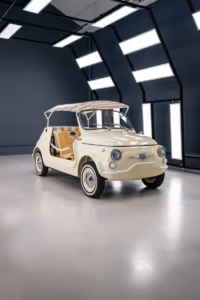
Garage Italia’s Electric Spiaggina Puts the Fiat 500’s Riviera Years on Battery Power
Ten kilowatts, rattan seats and a €85,000 starting price: Garage Italia's 500 Spiaggina rebuilds Ghia's 1958 beach car for the yacht crowd.