Thirty-Six Views of Mount Fuji: The Great Wave Off the Coast of Kanagawa by Katsushika Hokusai

December 7, 2024
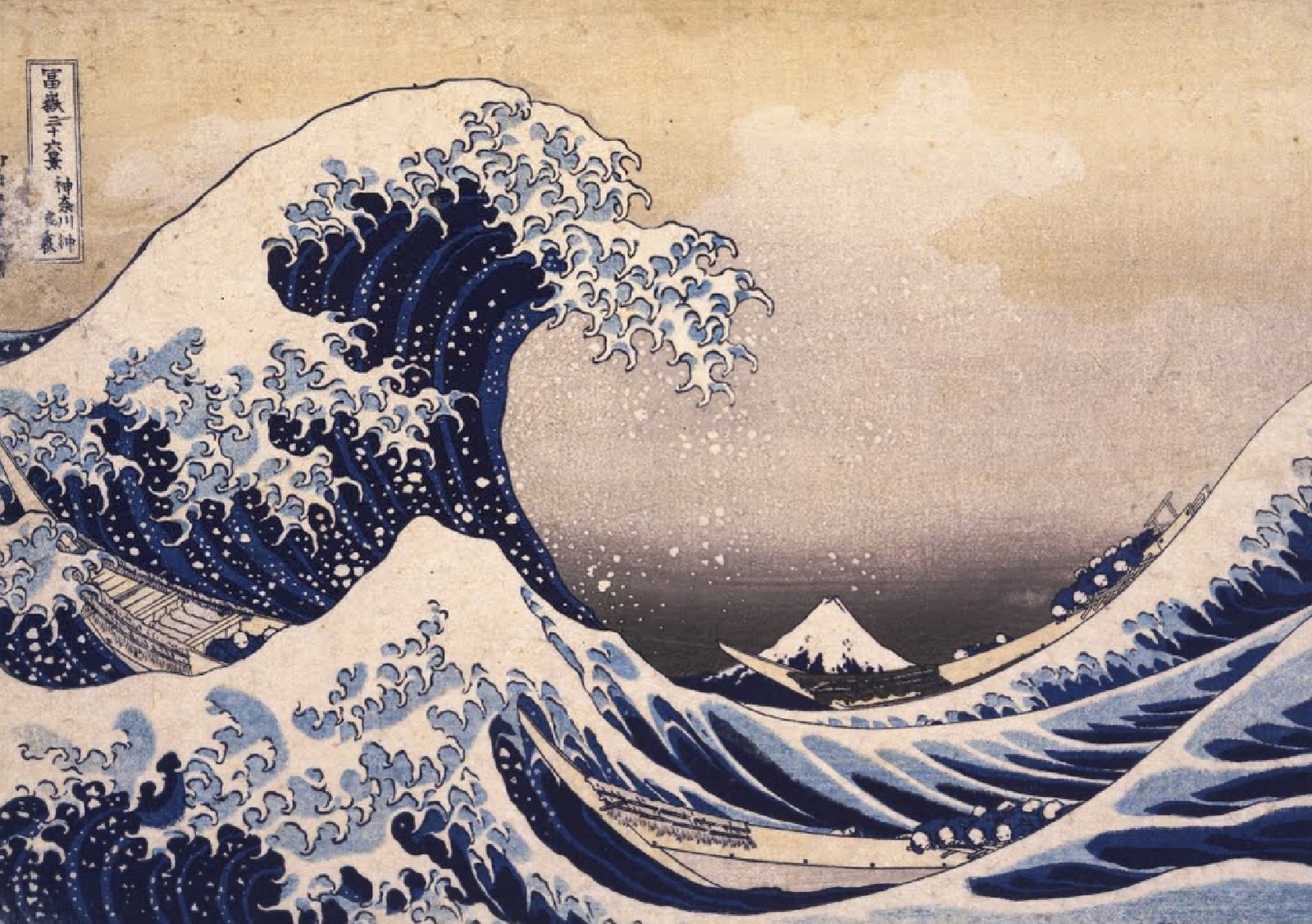
Katsushika Hokusai’s The Great Wave Off the Coast of Kanagawa, often referred to simply as The Great Wave, is arguably the most recognized and celebrated work of Japanese art worldwide. As the first print in Hokusai’s series Thirty-Six Views of Mount Fuji, created in the early 1830s during Japan’s Edo period, The Great Wave stands as a testament to the confluence of artistic innovation, cultural reverence, and the expanding reach of ukiyo-e woodblock printing.
The Edo period (1603–1868) was a transformative era in Japanese history, characterized by relative peace, political stability under the Tokugawa shogunate, and the flourishing of arts and culture. Urbanization, particularly in cities like Edo (modern-day Tokyo), Kyoto, and Osaka, fostered the rise of a merchant class with disposable income and a growing appetite for art, entertainment, and literature. This cultural vibrancy gave birth to ukiyo-e (“pictures of the floating world”), a genre of art that depicted the pleasures and transience of life in urban Japan.
Initially focused on kabuki actors, courtesans, and scenes of daily life, ukiyo-e evolved by the 19th century to include landscapes, thanks in part to pioneers like Hokusai. By this time, ukiyo-e prints were more affordable, made possible by advancements in woodblock printing and the use of imported Prussian blue pigment, which became a defining feature of The Great Wave.
The Edo period was also notable for its strict sakoku (“closed country”) policy, which limited foreign trade and cultural exchange to a handful of locations, such as Nagasaki. Despite these restrictions, Dutch merchants introduced European art techniques, including linear perspective and shading, which influenced Japanese artists like Hokusai. The Great Wave demonstrates this synthesis of Eastern and Western aesthetics, blending traditional Japanese stylization with European depth and perspective.
Born in 1760 in Edo, Katsushika Hokusai was a prolific artist who explored various styles and mediums throughout his career. Known for his insatiable curiosity and innovation, Hokusai produced thousands of works, including paintings, prints, and illustrated books. His artistic identity underwent multiple transformations, reflected in the numerous names he adopted during his lifetime.
By the time Hokusai began working on Thirty-Six Views of Mount Fuji, he was in his seventies, an age when many artists of his time would have retired. However, Hokusai viewed this phase of his career as his artistic prime. In fact, he famously remarked that he hoped to continue improving until the age of 110, demonstrating his relentless pursuit of mastery.
The series Thirty-Six Views of Mount Fuji was conceived as a celebration of Mount Fuji, a sacred symbol in Japanese culture. Revered as a site of pilgrimage and a source of artistic inspiration, Mount Fuji was often depicted in literature and art as a symbol of endurance, permanence, and spiritual enlightenment. Hokusai’s series explored the mountain from various perspectives and distances, situating it within different contexts to highlight its universality and cultural significance.
The Great Wave became the most iconic image of the series, not only because of its striking composition but also because of the symbolic interplay between the wave and the mountain. While the series ostensibly centered on Mount Fuji, this particular print draws the viewer’s attention to the dramatic wave, relegating the mountain to the background. This inversion of focus underscores Hokusai’s ability to reinterpret traditional motifs in innovative ways.
This is masterpiece of composition as characterized by its dynamic interplay of motion and stillness, power and tranquility. The central wave dominates the scene, its curling crest forming a dramatic arc that seems to envelop the boats caught in its path. The wave’s frothy tips resemble claws, imbuing it with an almost menacing, anthropomorphic quality. In contrast, Mount Fuji, rendered in soft, serene tones, stands as a distant and immovable anchor.
The use of perspective is particularly noteworthy. Hokusai employs Western techniques to create a sense of depth, with the wave occupying the foreground, the boats in the middle ground, and Mount Fuji in the background. The wave’s curve mirrors the contours of the mountain, creating a visual harmony that unites the elements despite their contrasting scales.
One of the defining features of The Great Wave is its vibrant use of Prussian blue, a pigment imported from Europe that became widely available in Japan during the Edo period. This pigment allowed for richer, more enduring hues, which contributed to the print’s lasting appeal. The deep blues of the wave contrast starkly with the white foam and the muted tones of the sky and mountain, creating a striking visual balance.
Today, The Great Wave is one of the most reproduced and recognized images in art history. It has appeared on everything from posters and T-shirts to currency and emojis, transcending cultural and geographic boundaries. Its enduring popularity speaks to its universal themes and timeless aesthetic.
Related Articles

Jason Limon Rips Open Vintage Packaging to Find a Skeleton Waiting Underneath
San Antonio painter Jason Limon’s latest trompe l’oeil work turns torn matchbooks, tins and biological […]