DRIFT AUDIO
Listen to this story
Choose a voice, then press play.
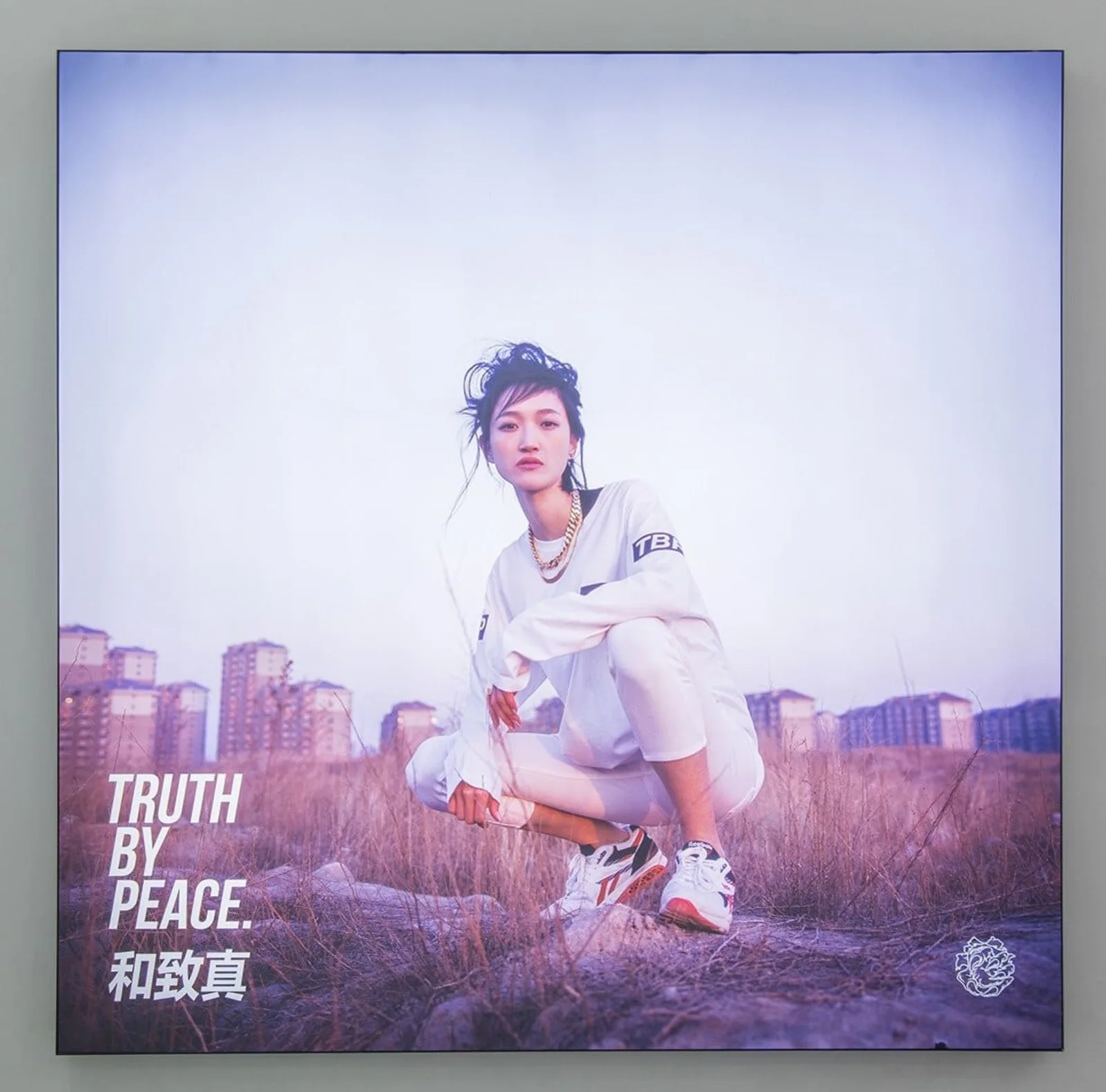
Truth by Peace II, a 2015 backlit fabric lightbox, comes from the Beijing show where Timur Si-Qin invented a streetwear label to study why images attract.
A model crouches on barren rock at the center of a square of light. In its catalogue note for Truth by Peace II, Phillips describes her in a white long-sleeve with bold lettering it transcribes as TBC, thick gold chains and shoe, a look the auction house ties to mid-90s street style. The artist and his gallery abbreviate the brand as TBP, for Truth by Peace, a fashion label Timur Si-Qin created for a Beijing exhibition in April 2015. The picture is printed on fabric, stretched over an aluminum frame and lit from behind by LEDs, and the whole object measures 200 by 200 centimeters. It is a fashion campaign built like a piece of trade-show hardware.
Signal. What happened: Truth by Peace II was offered as lot 43 in Phillips’s Satellite: Online Auction in Hong Kong, September 7 to 14, 2023, with no reserve and an estimate of HK$20,000 to HK$40,000, and the concluded-sale listing shows no sale price for it. Exact object: a backlit tension fabric display with an LED light system in an aluminum frame, 198.2 by 198.2 centimeters for the work and 200 by 200 centimeters framed, executed in 2015. When and where: made for Biogenic Mineral at Magician Space in Beijing, April 3 to May 17, 2015. Source: Phillips’s lot page, the artist’s exhibition page and a May 2015 LEAP interview. Why it matters: the work shows the method Si-Qin still uses, borrowing the hardware and lang of commercial display to test why image attract, in a format he has kept using for nearly a decade.
stir
Truth by Peace II was made for Si-Qin’s first solo exhibition in China, Biogenic Mineral, which ran at Magician Space from April 3 to May 17, 2015 and was curated by Aimee Lin, according to the artist’s own page for the show. Magician Space later described the project as a personal return to his homeland: Si-Qin, born in Berlin in 1984, grew up in Berlin, Beijing and the American Southwest, and the gallery’s contact details place it in Beijing’s 798 Art Zone. Phillips’s catalogue adds that he graduated from the University of Arizona in 2008 and has exhibited at Bonner Kunstverein, CCS Bard, Museum Fridericianum in Kassel and the Taipei Biennial.

The Concrete Cathedral: A Study in Palimpsest
to the exhibition text, Si-Qin took the way rock minerals form under heat and pressure as a metaphor for a consumer culture that is compressed until it yields new patterns and forms. In the main hall stood rock-like sculptures fabricated at a factory in Heiqiao Village, Beijing, alongside octagonal structures lined with LED lights, which the text calls “visual attractors.” Magician Space names The 8th Gate Sorting Processor as the show’s central work, and the LEAP interview lists it as a mixed-media construction of printed perspex, metal, resin and LED measuring 285 by 195 by 171 centimeters.
The fashion apparatus was built with the seriousness of a real launch. Magician Space says Si-Qin worked with a professional stylist, models and a photographer to produce the brand’s imagery. In the LEAP interview he said the outdoor shoots for the brand drew on China’s housing developments, which he sees as part of a country working as a giant processor of raw materials, and that he wanted to emphasize that geological process.
flow
Truth by Peace began as a deliberate imitation. The exhibition text says Si-Qin mimicked the sub-brand HBA of the New York label Hood by Air, with a nod to K-pop culture and the production of large-scale commercial images. Si-Qin was more blunt in the interview: the brand is a knock-off of Hood by Air, or a play on it. He liked the idea of taking a word and stripping it of its meaning, and Hood by Air’s name is two distinct words with no real associations. He wanted a vague pop image, hip-hop or K-pop, and said the logo came from a stock illustration he found on a stock-photo site. Its octagonal shape echoes the octagonal sculpture in the gallery, which he calls a play on traditional Chinese landscaping.
The label he copied was at its peak of recognition. Hood by Air was launched in 2006 by Shayne Oliver and Raul Lopez, won a special award at the inaugural LVMH Prize in 2014 and a CFDA menswear award in 2015, and went on indefinite hiatus in April 2017, SHOWstudio records. According to 032c, it began as a T-shirt line that exaggerated the graphics and fit of 1990s streetwear brands. The chain of imitation therefore runs from 1990s streetwear to Hood by Air to Truth by Peace, which fits Phillips’s reading of the model’s gold chains and sneakers as a return to mid-90s style.
show
Backlit tension fabric displays are an off-the-shelf commercial product. Vendors such as MODdisplays describe an aluminum frame with LED lights hung inside it and a printed fabric graphic that slides over the frame and zips shut, sold for trade shows and dimly lit interiors, with the illumination pitched as a way to draw attention and lift brand visibility.
Si-Qin’s interest in that logic is stated in the LEAP interview. Advertising, he said, understands things such as the preference for shiny, reflective images, which trace back to a subconscious link with water, and the plain fact that people prefer brighter pictures. Being aware of those mechanisms, he argued, offers a small emancipation of free will.
The format runs through his work for years. Reviewing his 2014 show Premier Machinic Funerary: Part II at Carl Kostyál in London, Frieze described three large, Abercrombie & Fitch-inspired black-and-white photographs of models in a pastoral lake setting, backlit with an LED light system, next to a canvas print covered in yin-yang symbols and the word PEACE, a word the critic read as implying both a funeral rest and peace on earth. The Schirn Kunsthalle in Frankfurt presented two of his 2016 landscape images printed onto a backlit fabric display. His 2018 presentation at Art Basel Hong Kong, Campaign for a New Protocol, Part II, is listed by Art Basel as a backlit tension display with an aluminum frame, LED light system, fiberglass rocks and a virtual reality presentation. And Société lists Wadi Sunbreak West, 2023, as a backlit tension display in an aluminium frame with an LED light system.
straddle
Behind the brand is a phil position Si-Qin laid out in the interview. He named new materialist thinkers including Levi Bryant and Manuel DeLanda as influences and argued that art criticism often reads signs as symptoms of a consciousness or of capitalism, a model he called prone to pareidolia, the tendency to see faces where none exist. His alternative is to ask what images do as material things. An attractor, in DeLanda’s sense, is a pattern that a system settles into: soap bubbles and salt crystals look different but share one, because both minimize energy. Si-Qin adds that an attractor is not eternal, just a feedback loop. His 2013 show Basin of Attraction, he said, was a first step at identifying image attractors, and Biogenic Mineral widened the idea beyond the cold, sterile look of that earlier work to include traditional cultural motifs and brands.
Exaptation supplies the second idea. In biology it means a trait that evolved for one job and ends up serving another, as with feathers first used for heat regulation before flight. Si-Qin applies that to symbols, combining unrelated ones, stripping most of their original meaning and repurposing them. The PEACE brand pairs the word with a white and grey Taoist Taiji symbol, and Schirn notes the brand dates to 2014. Truth by Peace, a separate brand made for the Beijing show, the artist described, as quoted in Phillips’s catalogue, as “a kind of materialist cult from the future.” The same catalogue note argues that Si-Qin uses commercial imagery not to reproduce material ideologies in a Warholian way but to align with the material universe.
In his essay “True Lies,” published in Texte zur Kunst in September 2015 and republished by OFLUXO with an image captioned Truth by Peace, 2015, he explains why commercial photography attracts him: it is the standard view lang of mass consumer goods, and using it loosens the structural power of associations. He also cites Ikea’s catalogs, where 3D-rendered images rose from 12 percent in 2012 to 25 percent in 2013 and up to 75 percent in 2014, as evidence that a rendered image works because it simulates how humans really perceive. In the interview he put the stance more simply: “Culture is the self-organizing matter.”
to
According to Phillips, the work’s provenance is short: Magician Space, then the Tiroche DeLeon Collection in Gibraltar, which acquired it from the gallery. Phillips’s lot listing cites Biogenic Mineral as the exhibition history and lists two pieces of literature, Simon Zhou’s review in Timeout and Lai Fei’s LEAP interview. The Tiroche DeLeon Collection was established in 2011 by Serge Tiroche and Russ DeLeon, focuses on contemporary art from Asia, Africa, the Middle East and Latin America, and became, in Ocula’s words, the first art investment fund modeled on a private collection.
Phillips offered the work in Satellite: Online Auction, a 70-lot sale it timed to coincide with Frieze Seoul 2023. Lots closed independently at one-minute intervals. Lot 43 carried no reserve and an estimate of HK$20,000 to HK$40,000, which Phillips converted to US$2,600 to US$5,100 and €2,400 to €4,800. For scale, MutualArt lists Si-Qin’s auction record as US$45,911, set by an untitled work at Sotheby’s London in 2018. On Phillips’s concluded-sale page, neighboring no-reserve lots 46, 47 and 48 show prices of HK$25,400, HK$40,640 and HK$40,640, while lot 43 shows none. Phillips does not say what happened to it, and this piece cannot confirm whether it sold.
fin
Si-Qin’s practice has moved on from logos on lightboxes. In 2016, Team Gallery in Los Angeles presented A Place Like This, where he imagined a materialist-spiritual institution called New Peace, an update of the PEACE brand. He describes the New Peace brand, Schirn says, as a topological sculpture whose form and content should change over time. Magician Space’s description of his second solo show there, East, South, West, North, in 2018, presents New Peace as a secular spirituality for the 21st century. Critics have pressed on the turn: a 2019 Artforum review asked whether embracing new materialism in a Chinese economy driven by ecologically destructive manufacturing and real estate speculation means giving up political critique.
The recent work leans on the natural world directly. In a 2020 review, Frieze described tree sculptures built from hundreds of photographs stitched algorithmically and 3D-printed, including La Guardiana del Río Rinquia, from a tree he encountered in the Peruvian Amazon. His 2023 Société show Natural Origin presented photographic prints that look like a dense forest but are shots from virtual cameras in a 3D rendering he modeled on flora and fauna of Upstate New York. His galleries include Société in Berlin, Magician Space in Beijing, Albion Jeune in London and von ammon co. in Washington, D.C., according to his website, which lists Trust the River at Albion Jeune in 2024 and A Reflected Landscape at the 9th Berlin Biennale in 2016.
At Art Basel 2026, he showed Mariposita in the fair’s Unlimited section. Domus reported that a renaco tree he 3D-scanned in the Peruvian Amazon’s Ucayali region was rebuilt in steel and suspended over a pixelated surface displaying images of water and vegetation. Si-Qin told Domus that humans are organisms whose tools are part of their extended phenotype, so a camera or a 3D scanner is no more separate from nature than a seashell or a beaver dam. The original tree, renamed La Guardiana de Rinquia, continues to grow in the Amazon.
Related Articles
Etel Adnan’s Untitled (2016): A Mountain Painted From Memory and Lit From Within
In 2016, the year she opened solo shows in London and Paris, Etel Adnan made […]