DRIFT AUDIO
Listen to this story
Choose a voice, then press play.
Ten meters high, sixteen meters wide. First century. Museum of the Baths of Trajan on the Oppian Hill. Francesco Pacetti still looking for the end of the wall.
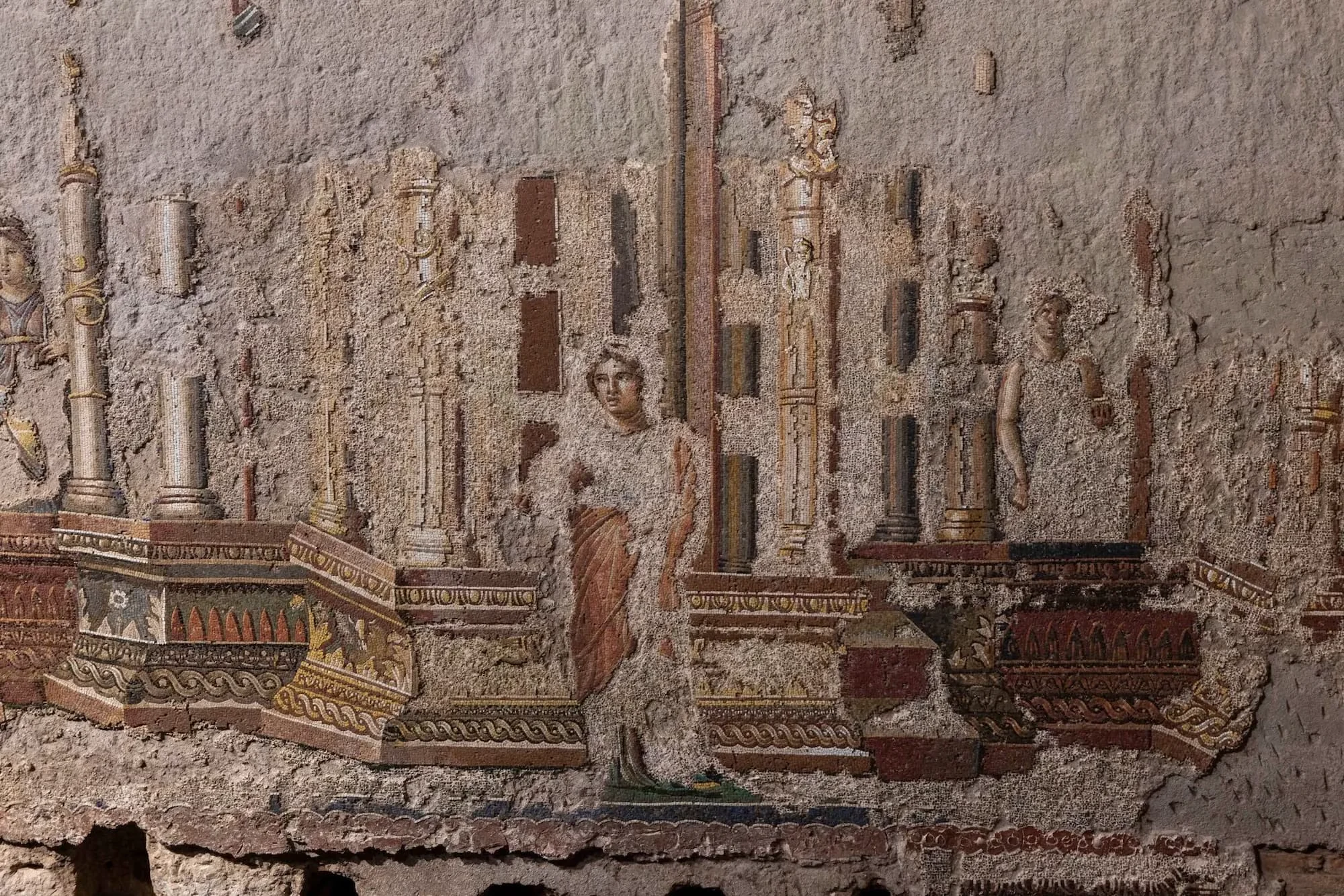
Rome opened the Museum of the Baths of Trajan and put the public in front of a wall officials are willing to call the largest mosaic yet found in the Roman world. The Great Mosaic is about 10 meters high and 16 meters across (33 by 52.5 feet). It lives under the Oppian Hill, near the Colosseum, inside a bath complex Emperor Trajan dedicated in 109 CE. The baths cover something like 15 acres. The mosaic is older than that dedication. First century. Whether it belonged to Nero’s Domus Aurea or to a rich private house later buried by Trajan’s engineers is not a closed question.
The Painted City hangs in the same campaign of opening: a fresco of a walled port town from above, theater and temple and towers included. Francesco Pacetti, one of the excavators, said the mosaic is still growing in the trench. Largest found, he said. Still digging to see where it stops. Mayor Roberto Gualtieri stood for the unveil after a restoration that several accounts clock at fourteen years. Tesserae walked off when the baths were built. New cuts show a maritime view sharp enough that a gate with two towers reads like a plan. Real harbor or ideal harbor is another open file.
Signal. What happened: the city opened the Great Mosaic and the Painted City inside the new Trajan baths museum. Exact object: first-century wall mosaic roughly 10 by 16 meters. When and where: Oppian Hill, public unveil September 2026. Source: excavation comments and civic presentation. Why it matters: a wall that size resets the word largest until the next meter comes out of the dirt. Earlier DRIFT: none on this museum.
stir
Readers of the mosaic treat the upper registers as a scaenae frons, the decorated face of a Roman stage: stacked columns, walls pretending to be marble inlay, statues in niches, human and mythic bodies in the intervals. Muses. A bearded philosopher. Apollo in some descriptions. A poet receiving laurel. A centaur in others. Lower down, the architecture turns into a port seen from the air. Blue and white stone, some chips described as gem-like, stand in for light on water. That is how restorers talk. From the room it is a city. From a foot away it is a grid.
The Painted City fresco is the clearer plan. Walls, streets, a theater, a temple, housing, a waterline. About 107 square feet in one published measure. It does not settle either the town had a name. Detail is not an address. Pacetti’s comment on the mosaic’s port is the same shrug. You can see the masonry and still not know the harbor.
Another stretch now coming out shows harvest and wine-making. The wall is not a finished rectangle. It is a surface that keeps gaining subject matter as dirt leaves.
First spotted in the 1990s, then worked in campaigns, then restored. The public is late to a room archaeologists have been arguing with for three decades.
flow
Apollodorus of Damascus planned Trajan’s baths. Dedicated in 109. Largest of that generation. Park land, exercise, water, an exedra with niches that look like library shelves. Nero’s Golden House became foundation and political cover. Building on a damnatio is a Roman habit. The mosaic predates the habit. The baths cut the top of the wall. Workers lifted tesserae for reuse. Art became substrate. Bathers faced a ruined theater of stone without needing the program.
The museum puts visitors back into that order: the imperial bath first, the older decoration second. Planned book events in the exedra are a civic joke about the shelves. The mosaic does not participate.
Domus Aurea or private domus is the fork that will produce papers. A palace theory gives Nero another room of excess. A private-house theory gives an unnamed patron the money to commission a stage in stone. Either way Trajan’s project treated the wall as something to build over. Either way the patron liked architecture as picture.
Oppian Hill is not a quiet site. The Colosseum is the neighbor. This room will be the quieter ticket if timed entry holds. Quiet is relative.
still
Pacetti’s line is the scale that matters. Biggest found. Still digging. Top cut in 109. Bottom not fully freed. Largest is a provisional title. The next meter can change the adjective or confirm it.
Fourteen years of restoration is payroll and patience. Missing chips stay missing. What the public sees is a repaired argument about a first-century interior, not a time machine. Limited hours at opening are likely. Confirm with the Sovrintendenza. Do not treat a news photograph as a floor plan of the whole museum.
A grape scene still in the trench means the wall’s subject list is incomplete. A port that may be imaginary means the geography is incomplete. A cut top means the original height is incomplete. Completeness is the wrong demand.
fin
Museum of the Baths of Trajan. Great Mosaic. Painted City. Ten by sixteen meters on the published tape. The tape may grow. Walk the hill when the hours are posted. The wall will still be there. The edge may not.
Related Articles
Etel Adnan’s Untitled (2016): A Mountain Painted From Memory and Lit From Within
In 2016, the year she opened solo shows in London and Paris, Etel Adnan made […]