DRIFT AUDIO
Listen to this story
Choose a voice, then press play.
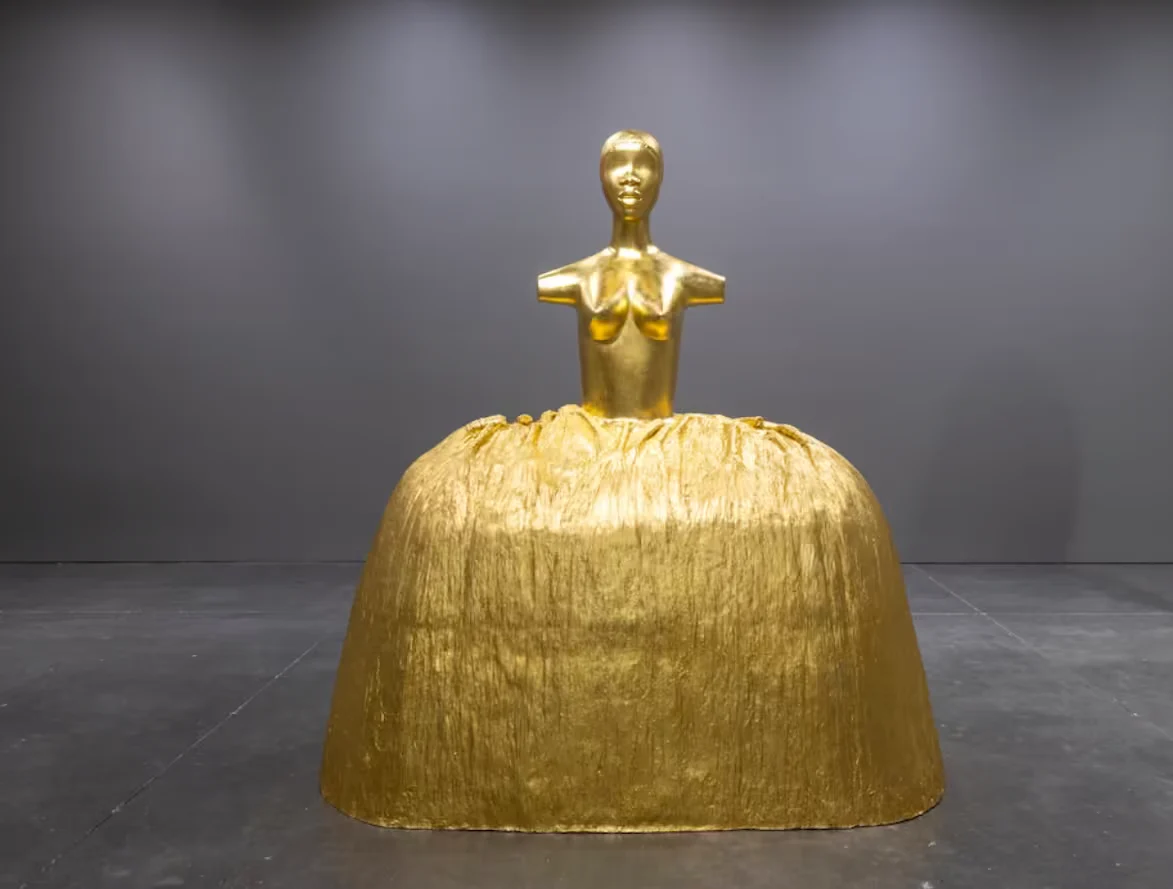
A bare-chested bronze woman in a hooped gold skirt meets visitors first at Simone Leigh’s museum survey, built from the shape of a segregation-era diner.
Framed by the entrance to Simone Leigh‘s first museum survey stands Cupboard (2022), a gilded bronze figure of a Black woman, bare above the waist. Below her torso, the skirt fans out into thick vertical pleats, as if raffia had been bundle and stretch over the hooped frame of an eighteenth century European gown. The finish work measures 88 and a half by 85 by 45 inches, bronze and gold leaf, and stands taller than most visitors filing past it into the galleries.
The shape did not come from nowhere. It is drawn from Mammy’s Cupboard, a roadside restaurant built in 1940 on U.S. Highway 61 south of Natchez, Mississippi, in the shape of a mammy archetype: a 28 foot concrete woman whose brick skirt holds a dining room and gift shop, with horseshoes for earrings. The building opened the same year Gone with the Wind swept American theaters, and its form drew on decades of the same stereotype, running back through minstrel songs and the Aunt Jemima trademark. Leigh worked not from the diner itself but from a 1941 Edward Weston photograph of it, titled simply Mammy’s Cupboard, Natchez, Mississippi.
The mammy figure herself was painted a dark complexion for decades before being repainted several shades lighter under later ownership, and the restaurant has since relocated under a new name, The Cupboard, away “Mammy” from the sign entirely. Leigh’s gilded answer got there first, recasting the same sil in gold rather than paint.
Leigh told WBUR she was drawn to how the building fused conflicting ideas into one form, describe the archetype behind it as a “selfless Black maternal.” Rather than repeat the caricature, she stripped it down: no serving tray, no pillbox cap, no fixed grin. What remains is a solemn, faceless figure with none of the diner’s cartoon detail, gilded and installed as the first work a visitor meets.
Cupboard is not the only work in Leigh’s catalogue built on this sil. Las Meninas, made in 2019 and later remade as Las Meninas II, swaps a European ballgown for the same raffia over hoop shape: a nude terracotta torso set into an oversized skirt that nods toward Afro-Caribbean religious dress rather than an American diner. The title borrows from Velázquez‘s seventeenth century court paint of the same name, whose subject, the Infanta Margarita, was the daughter of a monarch who sanction the slave trade his empire ran. Leigh strips the gown from that original portrait of its court finery and replaces it with the lang she uses everywhere else: raffia, a faceless head, a body reduce to its structure shape. Cupboard, made three years later, runs the same operation on an American vernacular source instead of a European one, a diner sign instead of a royal portrait, yet the underly gesture, replace an inherit garment with something closer to the body’s own history, stays the same.
stir
Cupboard opens Simone Leigh, the artist’s first museum survey, on view at the Institute of Contemporary Art/Boston from April 6 through September 4, 2023. The ICA, founded in 1936 and now housed in a glass and steel building by Diller Scofidio and Renfro completed in 2006, gathers more than 35 works spanning nearly twenty years of ceramics, bronze and video for the show, organized by curator Eva Respini with curatorial assistant Anni A. Pullagura. Respini has since moved on to the Vancouver Art Gallery. The galleries are painted a warm gray rather than the standard white cube, a choice one reviewer likened to a theatrical stage set built for the sculptures rather than around them.
Nearby, in the same first gallery, sits Jug (2022), a glazed stoneware vessel more than five feet tall that trades the skirt for the shape of a pot, Martinique (2022), a headless stoneware figure whose torso ends where a lid might sit on a container, and a run of works from the Village Series, in which cornrowed hair finished in an ash glaze stands in for architecture, the braid read as a roofline rather than a hairstyle. The substitution repeats across nearly everything in the show, body for vessel, a way of treating the female form as something built to hold and carry rather than something built to be looked at.
Outside the building, a 24 foot bronze titled Satellite stands in the plaza. Inside, the survey closes with Last Garment(2022), a bronze based on a nineteenth century souvenir photograph of a Jamaican laundress, installed in a reflecting pool the ICA rebuilt larger for this presentation specifically, positioned to line up with a view of Boston Harbor. Between the two, the show moves through domestic vessels, face jugs and cowrie shell architecture built from motifs that recur across Leigh’s career: bowls, braids, rosettes, and faces left deliberately without eyes.
Simone Leigh Sculpture in Urban Plaza
Reviewers of the Boston survey generally agreed the installation succeeded as both spectacle and argument. One assessment, published in the Brooklyn Rail, noted that Leigh’s sculptures carry embedded narratives drawn from sub-Saharan imagery, the American folk tradition of face vessels, and colonial and literary sources all at once, and that each piece tends to tell more than one story simultaneously, with the feminist and sexual readings sometimes overshadowed by the racial one in public discussion of the work. That tension, between what a piece like Cupboard says about race and what it says about womanhood on its own terms, runs through most of the writing the show generated, without either reading fully displacing the other.
flow
The Boston show exists because of what happened in Venice the year before. In 2022, Leigh became the first Black woman to represent the United States at the Venice Biennale, filling the U.S. Pavilion with a body of work titled Sovereignty: ceramic, bronze and raffia figures inside, plus a monumental bronze in the forecourt. The project was commissioned by the ICA under director Jill Medvedow and curator Eva Respini.
That year’s central exhibition, The Milk of Dreams, was curated by Cecilia Alemani and ran separately from the national pavilions. Leigh’s Golden Lion for Best Participant recognized her contribution there specifically, built around Brick House and other early bronzes shown inside Alemani’s own curated exhibition, distinct from Sovereignty, the body of work built for the U.S. Pavilion in the Giardini. She was present twice over in the same Biennale: once as the country’s official representative, and once as an individually honored artist inside the central show.
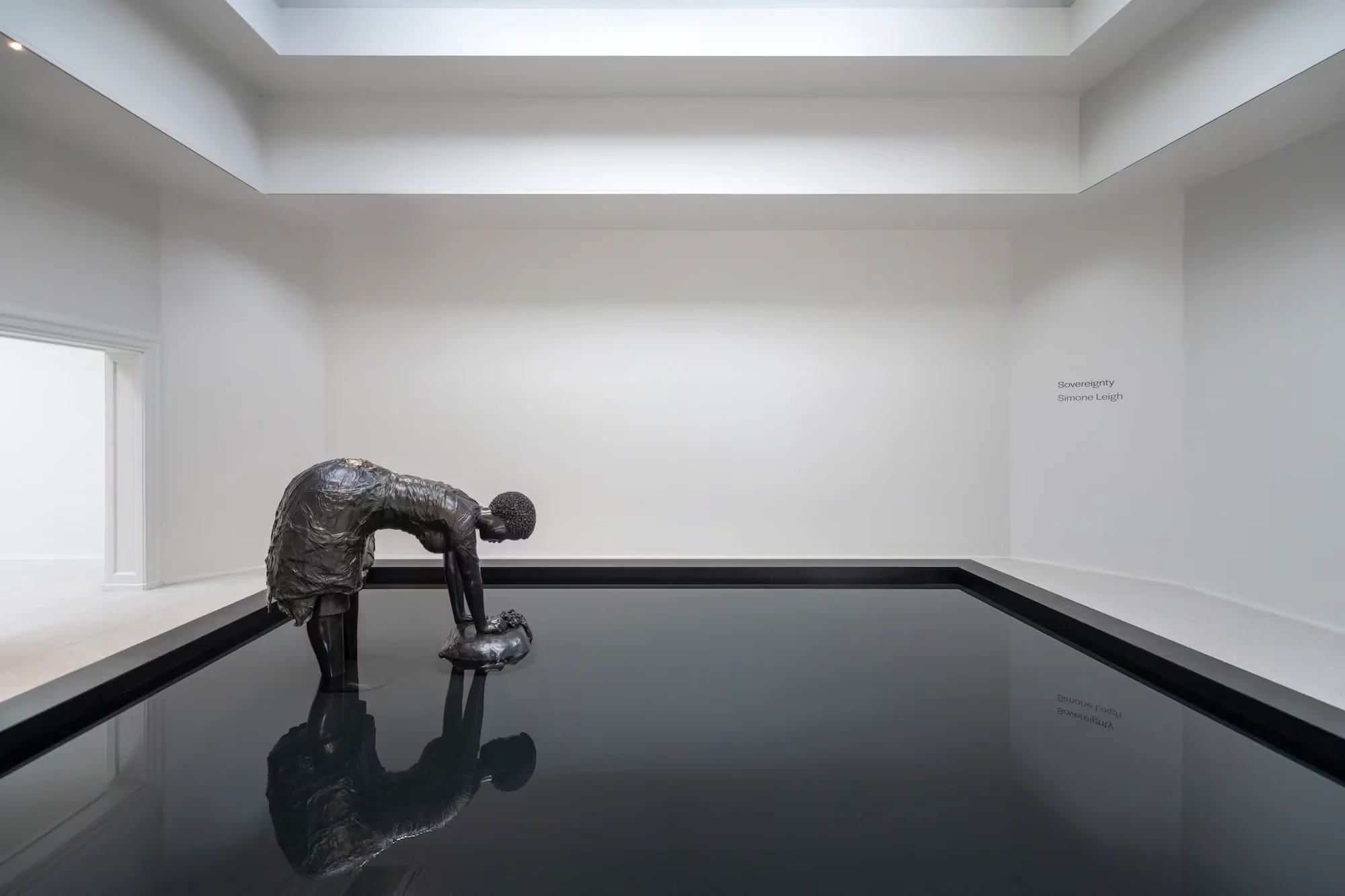
Simone Leigh, Sovereignty
Nine of those Venice works now sit inside the Boston sequence, giving American audiences their first look at an installation most had only seen in photographs. That October, Leigh followed the win with Loophole of Retreat, a series of talks and performances she organized in Venice, bringing Black academics, writers and artists together around questions her sculptures were already raising next door. It was not the first time she had run the gathering: a similar convening grew out of her 2019 solo show at the Guggenheim Museum following the Hugo Boss Prize, and the Venice edition effectively revived that earlier format on a much bigger stage.
length
Leigh was born in 1967 in Chicago to Jamaican missionary parents and studied art and philosophy at Earlham College in Indiana, graduating in 1990. A course on Nigerian pottery pulled her toward ceramics, and she trained in a lineage traceable to the British studio potter Bernard Leach, work that would eventually scale up into the bronzes now touring the country.
Long before the bronze, Leigh’s practice ran through social work as much as sculpture. In 2014 she opened the Free People’s Medical Clinic in Weeksville, Brooklyn, a functioning clinic offering HIV testing, herbalism and yoga. She followed it in 2016 with The Waiting Room at the New Museum, providing free health services to Black women. That same year, all six ceramic rosette busts she showed at the Park Avenue Armory art fair sold during the preview, a moment often pointed to as the turn in her market visibility.
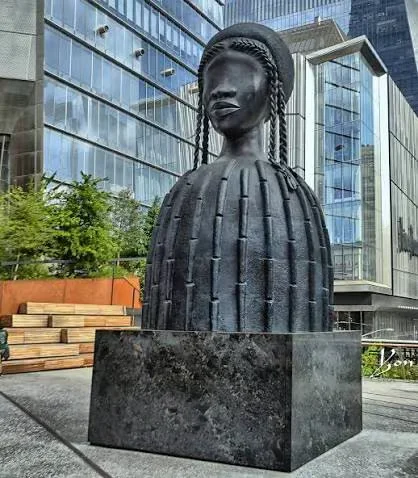
The recognition compounded from there: a Guggenheim Fellowship, the Louis Comfort Tiffany Foundation Biennial Award, and the Studio Museum in Harlem‘s Joyce Alexander Wein Artist Prize preceded the Hugo Boss Prize in 2018, which came with a solo show at the Guggenheim Museum, and a place in the 2019 Whitney Biennial. That year she also completed Brick House, a sixteen foot bronze bust commissioned for New York’s High Line, her first major move into the large scale bronze work that would define the Venice presentation three years later.
In the years since Venice, institutions have moved to acquire the work outright. The National Gallery of Art in Washington brought a cast of Sentinel, an elongated bronze column with a bowl shaped, faceless head, into its permanent collection, the first piece by Leigh to enter that museum’s holdings. Editions of the same Sentinel form have spread elsewhere too: one stands at Harvard Business School with a bronze snake coiled around its base, another sits in the University of Texas at Austin‘s collection. The same vessel headed, faceless column keeps turning up in different cities under different owners, each acquired independently rather than through a single touring loan. Critics have generally read that bowl shaped head as standing in for labor and consumption at once, and for the historical invisibility of Black women more broadly, the same absence of individuated features that defines Cupboard‘s own face.
extend
Leigh’s commercial representation has moved almost as fast as her institutional profile. She showed for years with Luhring Augustine in New York and David Kordansky Gallery in Los Angeles before joining Hauser and Wirth in 2020. She left that gallery after roughly 21 months and joined Matthew Marks Gallery in 2021, shortly before the Venice announcement. She remains represented by Matthew Marks today, and showed new ceramic work, skirted figures built from giant cowrie shells, at the gallery’s Chelsea space in the fall of 2024.
The auction market followed the museum calendar with a lag. Las Meninas II (2023), a work in the same raffia skirt vocabulary as Cupboard, sold for 3.08 million dollars at Sotheby’s in May 2023, days after the ICA show opened. It held her auction record for two years until Sentinel IV (2020) sold for 5.737 million dollars at Christie’s New York in May 2025, an 85 percent jump over the previous high. Both records were set after Venice, not before it, in a market still being priced in real time rather than through a long trading history.
where
From Boston, Simone Leigh moved to the Hirshhorn Museum and Sculpture Garden in Washington, D.C., running from November 3, 2023 through March 3, 2024 as a full floor installation and debuting three new bronzes, Bisi, Herm and Vessel, alongside a cast of Satellite installed at the museum’s own entrance. Hirshhorn director Melissa Chiu framed the show at the time as an extension of the museum’s modernist sculpture holdings into a newer perspective, the kind of framing museums tend to reach for when folding a living artist’s work into a collection built mostly around an earlier generation.
The tour concluded in Los Angeles, in a joint presentation at LACMA and the California African American Museumrunning from June 2024 through January 2025. It was accompanied throughout by the artist’s first monograph, co-published by the ICA and DelMonico Books in 2023 and edited by Respini, the first book length study of a career that, by the time the show reached Los Angeles, had already reset its own auction record twice.
Cupboard traveled with the rest of the show at every stop, the same diner shaped silhouette recast in gold standing at the entrance of three different museums over roughly twenty months.
Related Articles
fnnch Revives the Honey Bear Hunt for Halloween, No Tape Required
San Francisco’s honey bear artist is turning porch season into a scavenger hunt again, five […]