DRIFT AUDIO
Listen to this story
Choose a voice, then press play.
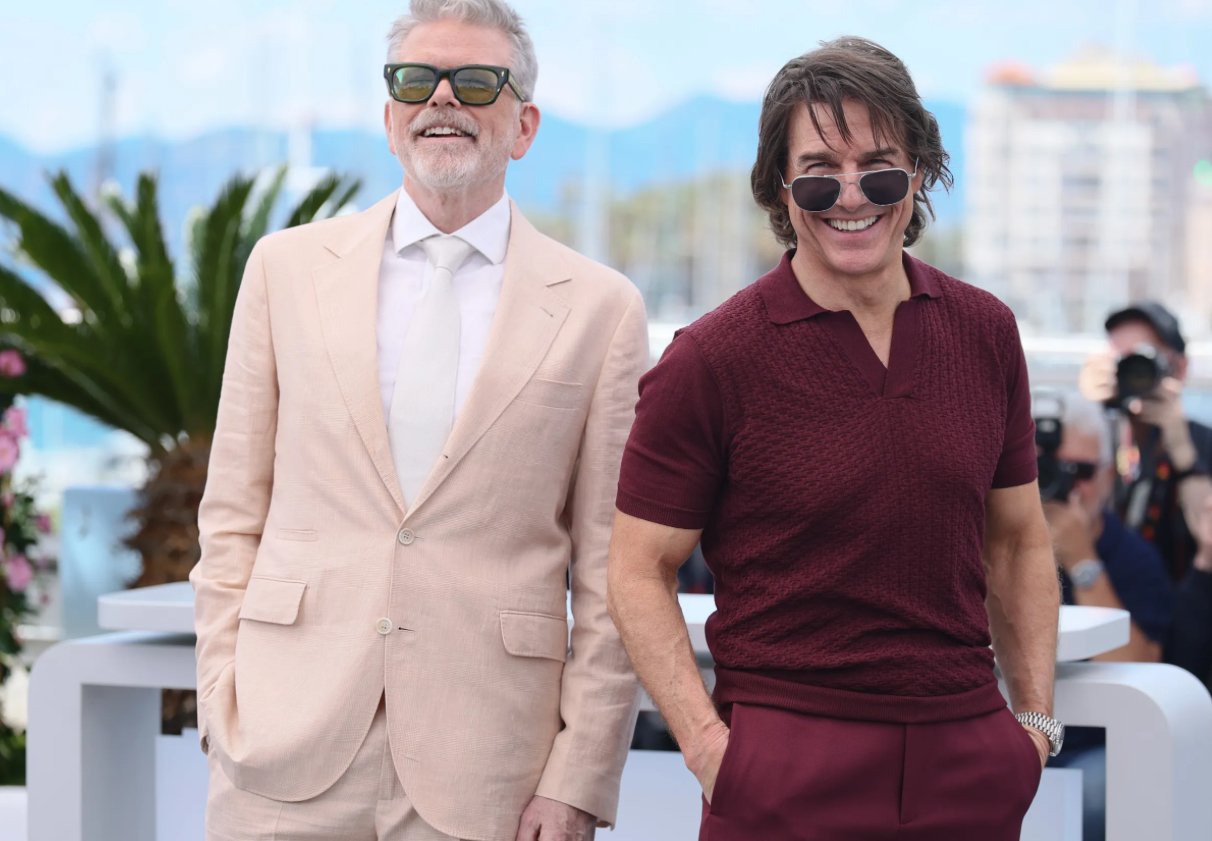
Tom Cruise has always chased the impossible. Not just as Ethan Hunt in Mission: Impossible, but as a living, breathing force of Hollywood. At the 2025 Cannes Film Festival, Cruise and his long-time collaborator, writer-director Christopher McQuarrie, sat down for a rare, in-depth conversation about the making of Mission: Impossible – The Final Reckoning, the latest and supposedly last entry in the legendary action franchise. The centerpiece of the conversation? The film’s most jaw-dropping stunt — a feat that redefined the word “crazy,” even by Cruise’s standards.
This editorial breaks down that conversation, exploring the physicality, philosophy, and ferocity behind the stunt — and why it matters, not just to fans of the franchise, but to cinema itself.
Setting the Stage: Cannes, 2025
Cannes is known for red carpets and prestige. But on this occasion, the Croisette buzzed with a different energy — anticipation, bordering on disbelief. Word had already spread about The Final Reckoning’s outrageous motorcycle stunt. Cruise, now 62, had apparently outdone himself. And now, here he was, in the Palais des Festivals, flanked by McQuarrie, ready to unpack it all.
The room was electric. No film clips were shown. No gimmicks. Just two men, a stage, and a shared obsession with pushing boundaries.
The Stunt: A Motorcycle, a Cliff, and Freefall into History
Let’s get straight to it.
The stunt in question, teased in trailers and leaked on social media, involves Cruise driving a motorcycle off a Norwegian cliff at high speed — then BASE jumping into a canyon below. No green screens. No digital fakery. Just raw execution.
“I’ve been wanting to do this since I was a kid,” Cruise said at Cannes, leaning forward, his eyes still lit with adrenaline. “This was the purest expression of action as story.”
He’s not exaggerating. The stunt required years of preparation. Literally. Cruise trained in motocross, skydiving, and BASE jumping. He did over 500 skydives and more than 13,000 motocross jumps before cameras even rolled.
McQuarrie added, “We didn’t just shoot it to show off. The whole film is built around it. The stunt had to mean something.”
The Philosophy of Danger
Cruise’s stunts have always walked the line between cinematic spectacle and death wish. From clinging to the side of an Airbus A400M in Rogue Nation to scaling the Burj Khalifa in Ghost Protocol, Cruise’s commitment is total.
But The Final Reckoning marked a shift. This wasn’t about escalation for its own sake. It was about resolution. Finality.
“There’s no safety net when you’re that far out,” Cruise said. “You either believe in your training or you don’t go.”
McQuarrie, ever the architect of Cruise’s madness, confessed the weight of responsibility: “If he dies, I’m the guy who wrote the scene. Who asked for the impossible. That’s not something you take lightly.”
Anatomy of a Stunt
Let’s break down what it actually took to pull this off:
- The Ramp: A custom-built platform had to be constructed on the edge of the cliff. It had to allow the motorcycle to accelerate to over 60mph in under 100 feet. It also had to disintegrate upon takeoff, so it wouldn’t interfere with the jump trajectory.
- The Jump: Cruise had to hit a precise angle of takeoff. Too shallow, and he would smash into the cliff wall. Too steep, and he’d overshoot the safe drop zone.
- The Freefall: After letting go of the bike mid-air, Cruise dropped over 4,000 feet. He had just under six seconds to stabilize himself before pulling the chute.
- The Catch: Ground crew had to track his descent via GPS and drones, coordinating with airspace control to ensure no interference from weather or wildlife.
- Multiple Takes: Cruise did the jump six times. That’s not a typo.
“No one else does that,” McQuarrie said. “No one else can.”
Why Cruise Still Matters
In an age of digital doubles and AI-generated action, Cruise’s commitment to doing it for real stands out like a flare in a snowstorm.
It’s not just about spectacle. It’s about trust. When Cruise jumps off a cliff, audiences know it’s him. They feel the risk. The stakes are not only narrative — they’re physical.
“I’m trying to preserve something,” Cruise said. “A kind of filmmaking that respects the audience. I want them to know we bled for it.”
It’s not nostalgia. It’s principle.
Behind the Scenes: The Emotional Core
What became clear at Cannes wasn’t just the technical mastery behind the stunt — it was the emotional drive beneath it.
The Final Reckoning is a film about ends: of friendships, of ideologies, of human control in an increasingly digital world. Cruise’s Ethan Hunt is no longer just a spy. He’s a man fighting for relevance, for the value of doing in an age of simulation.
That’s mirrored in Cruise himself.
“There’s something primal about risking your life for something you believe in,” Cruise said. “I’m not saying everyone should do it. But that’s what this character demands. And honestly? That’s what I demand from myself.”
McQuarrie added: “We talked a lot about legacy. This film is our letter to the industry. To say: don’t forget what’s possible when you care.”
Industry Impact: What It Means for Hollywood
Cruise and McQuarrie aren’t just making action movies. They’re making a case for a certain kind of cinema — physical, precise, intentional.
At Cannes, the message landed hard. Studios are increasingly chasing volume over vision. But The Final Reckoning reminds filmmakers what happens when you give a team time, trust, and an unrelenting standard.
The film doesn’t just entertain. It dares.
It dares other filmmakers to rise above the algorithm. It dares audiences to demand more. It dares the system to take risks again.
And Cruise? He dares gravity — and wins.
The Legacy of ‘Mission: Impossible’
If this really is the end — and Cruise was vague on that point, winking as he said, “We’ll see” — then The Final Reckoning closes the franchise on an unparalleled high note.
Over nearly three decades, Mission: Impossible has evolved from a cerebral spy thriller to the gold standard of action cinema. And through it all, Cruise has never used a stunt double for the major set pieces. He’s redefined the action hero, not as a beefed-up fantasy, but as a man obsessed with earning your attention.
That philosophy hits its apex in this final film. And the Cannes conversation, stripped of PR filters and marketing polish, made one thing clear: Cruise doesn’t care about outdoing others. He cares about outdoing himself.
Final Thoughts: A Reckoning, Indeed
Mission: Impossible – The Final Reckoning is more than a movie. It’s a testament to obsession, craft, and conviction. It’s about staring down the void — literal and metaphorical — and jumping anyway.
At Cannes, Cruise didn’t just explain the stunt. He revealed its soul. He framed it not as a gimmick, but as a statement.
“This wasn’t about shock value,” he said. “It was about saying something you can’t fake.”
That’s the real mission. And in a world of shortcuts and substitutes, it’s more impossible — and more vital — than ever.
Read the related Drift profile examining Tom Cruise’s preparation for Mission: Impossible – The Final Reckoning.
Related Articles
Garage Italia’s Electric Spiaggina Puts the Fiat 500’s Riviera Years on Battery Power
Ten kilowatts, rattan seats and a €85,000 starting price: Garage Italia's 500 Spiaggina rebuilds Ghia's 1958 beach car for the yacht crowd.