




DRIFT AUDIO
Listen to this story
Choose a voice, then press play.
It’s 7:03 AM. You’re half-awake, squeezing toothpaste, peeling a banana, chasing the drip of soft serve before it hits your hand. These are the quiet rituals of morning—mundane, tactile, oddly comforting. They don’t announce themselves; they repeat, grounding the body before the day fully begins. Now imagine holding all three, not in your hand, but in your handbag.
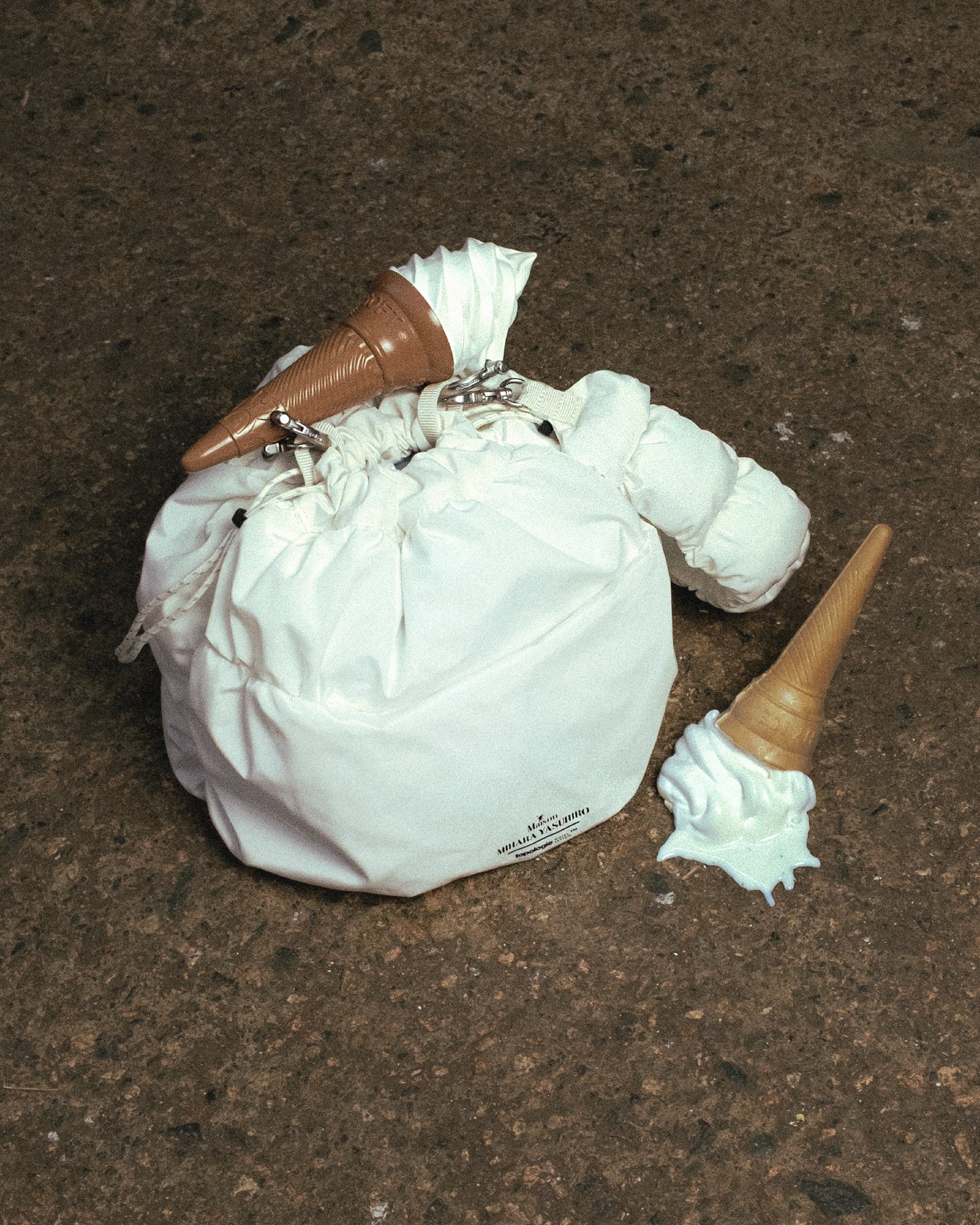
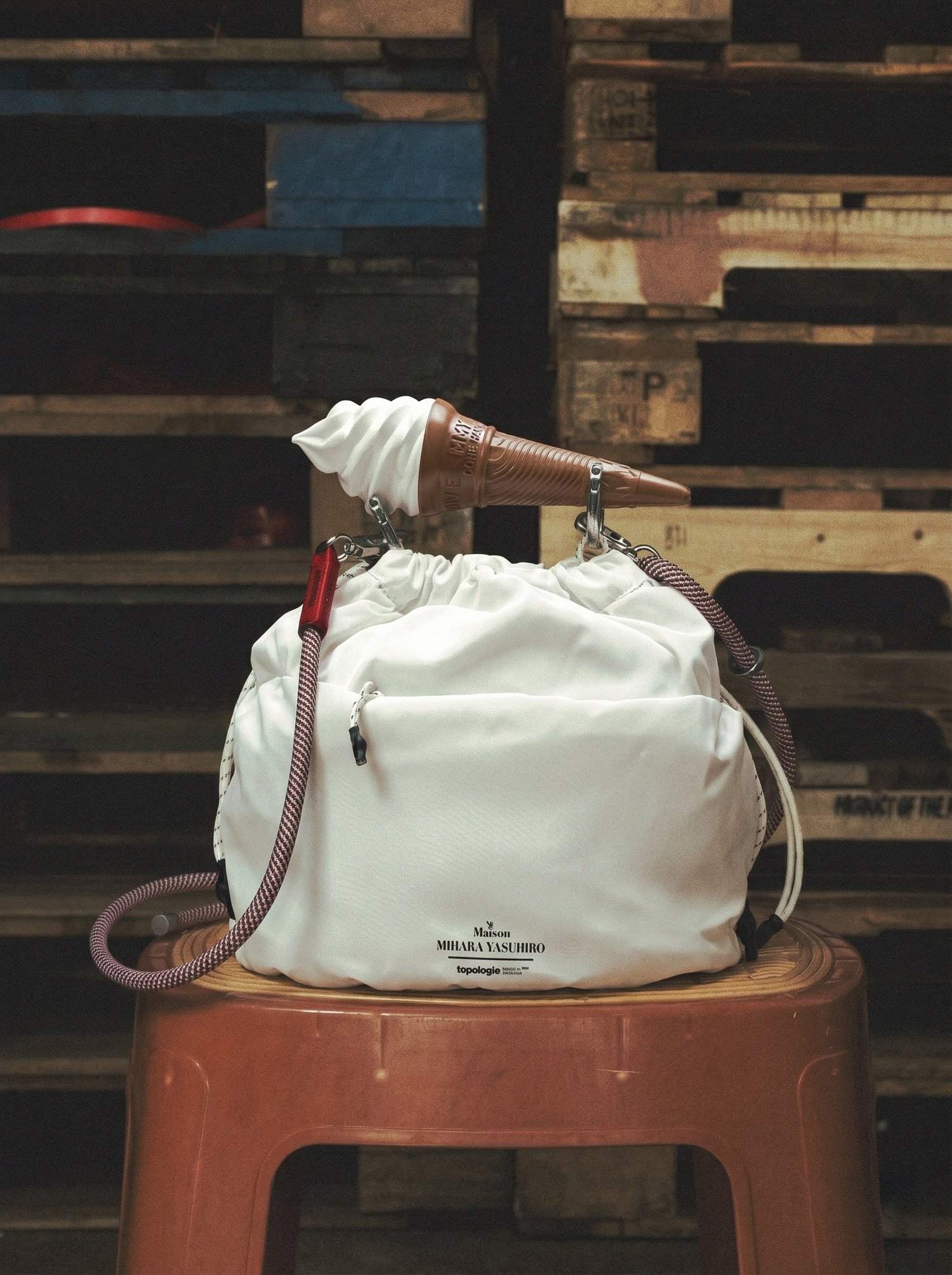
That’s where the shift begins. The genius of the Topologie x Maison MIHARA YASUHIRO capsule isn’t rooted in spectacle, but in displacement. Banana, soft serve, toothpaste—icons of daily repetition—are removed from their context and reintroduced as design.
Not as symbols or references, but as objects reengineered for grip, for carry, for use. They become handles—functional, sculptural, and quietly disorienting—marking a moment where fashion no longer gestures toward art, but absorbs it fully and returns it to the body as something lived with rather than observed.
stir
The collision between Topologie and Maison MIHARA YASUHIRO reads less like a partnership and more like an alignment of internal logics. Topologie operates through restraint, having built its identity around modularity, adaptability, and a philosophy where design recedes into function.
Its Wares System™ is not simply a product line but a framework—objects stripped down to purpose and refined until they disappear into use. In contrast, Maison MIHARA YASUHIRO, led by Mihara Yasuhiro, thrives in distortion, where familiar forms are bent, exaggerated, and destabilized.
A shoe appears melted, a garment looks unresolved, and every object exists somewhere between recognition and confusion. When these two approaches meet, the result is not contradiction but clarity. Both brands ultimately ask the same question—how does an object behave once it enters daily life?—and they answer it differently: Topologie through silence, Mihara through disruption. Together, they produce a system where absurdity resolves into ergonomics and conjure resolves into structure.
View this post on Instagram
fx
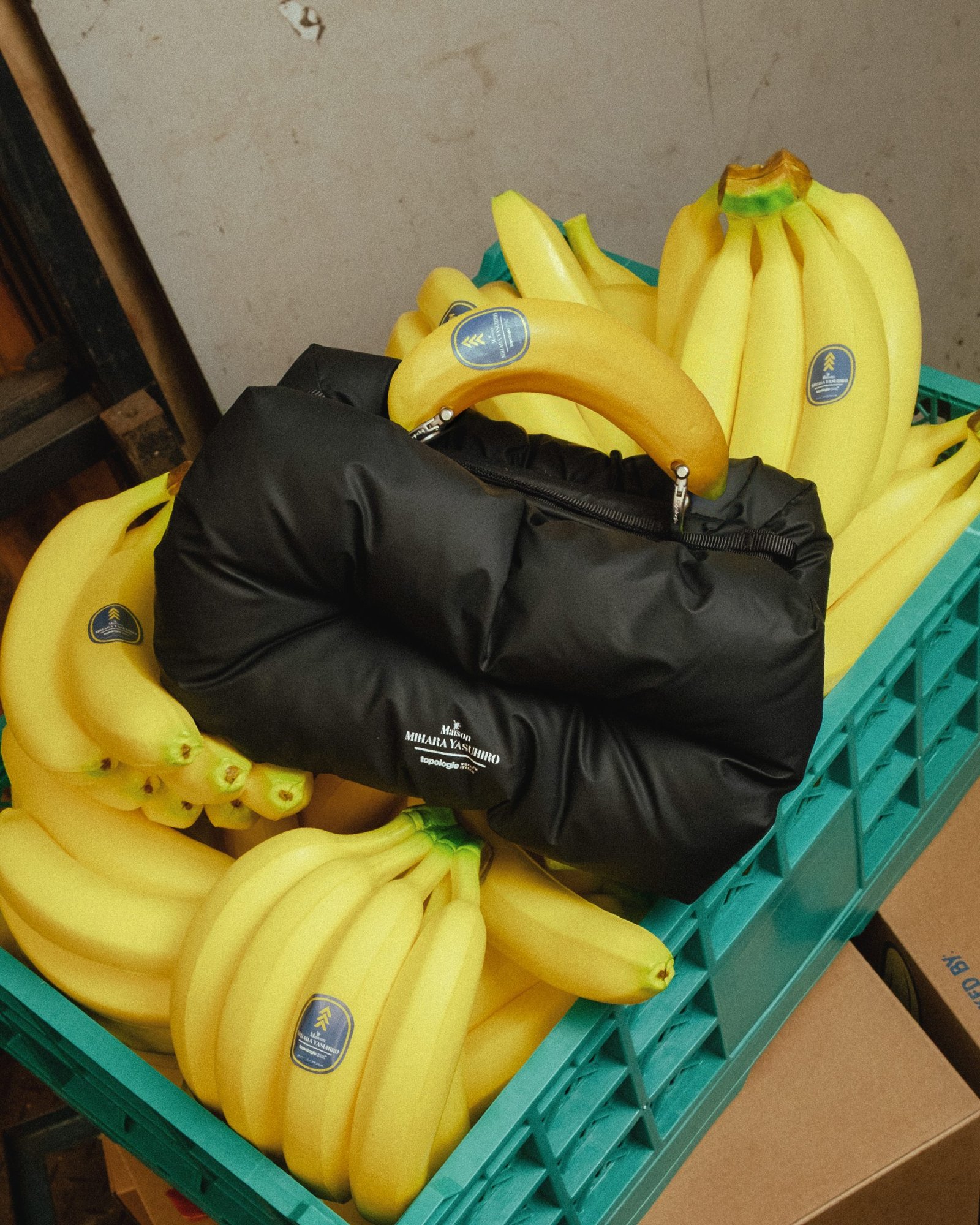
What initially reads as humor—the banana, the soft serve, the toothpaste—quickly stabilizes into something more precise when held. The banana handle follows the natural arc of the hand, its silicone surface calibrated for softness and grip rather than visual novelty. It is neither oversized nor exaggerated, but scaled with intent, transforming from reference into solution.
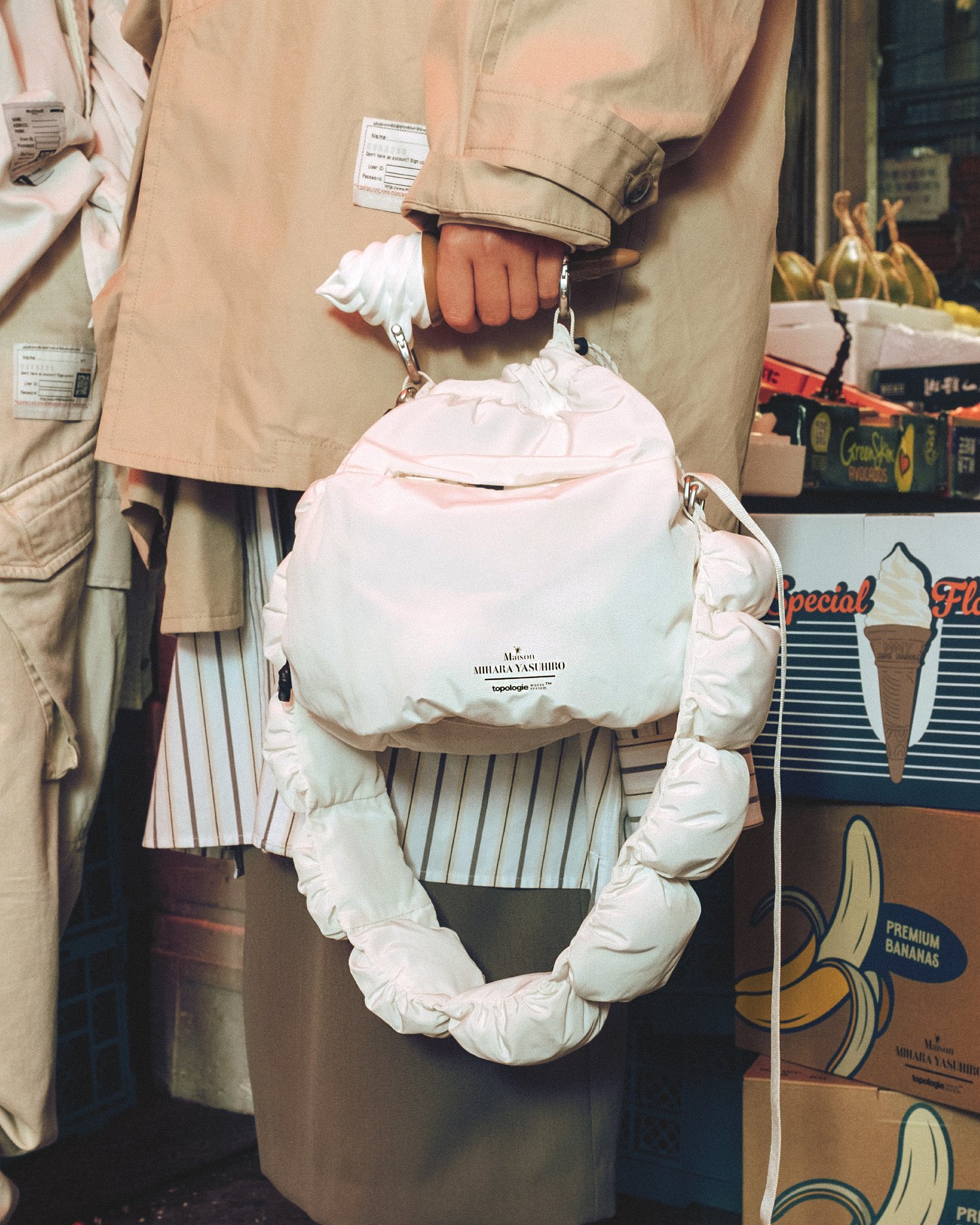
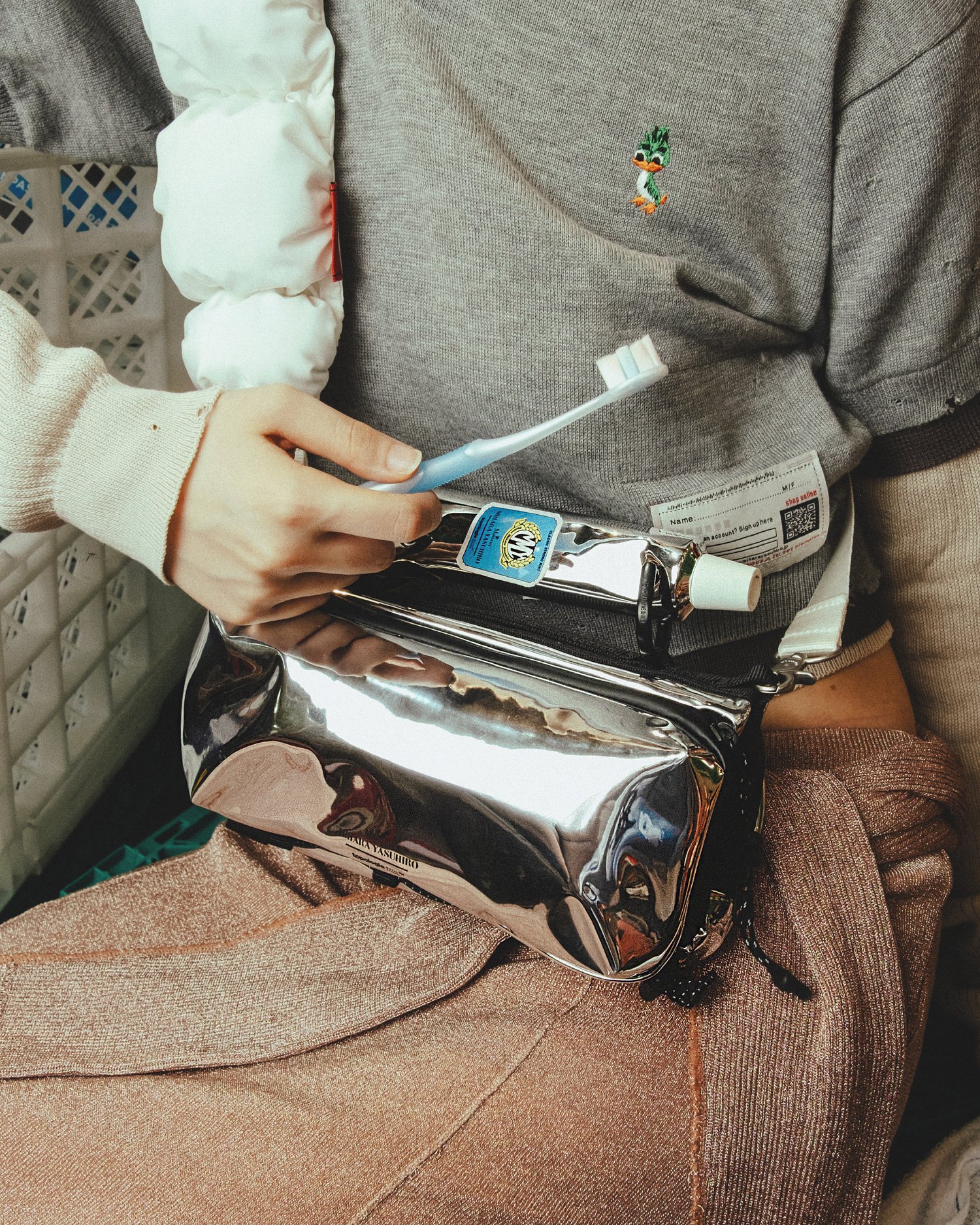
The soft serve swirl, similarly, becomes a vertical grip engineered for comfort, its spiral guiding the hand into place while maintaining subtle resistance to prevent fatigue. The toothpaste loop offers the most nuanced interaction, flexing slightly under pressure and responding rather than resisting, giving the sense that the object is not static but reactive. In each case, the surreal dissolves into use.
The joke does not disappear—it becomes functional, absorbed into the logic of the object itself, where recognition is secondary to performance.
idea
Not every user will engage with the collection at its most expressive level, and the design anticipates that. The same motifs are translated into smaller, quieter applications, most notably within the Phone Strap Adapter.
Here, the surreal shifts from public statement to private detail, functioning less as a visual anchor and more as a tactile nuance. Once attached, the phone subtly transforms—not in appearance alone, but in the way it is carried, handled, and perceived.
Paired with the Rope Strap, the system becomes fluid, moving with the body without friction or interruption. The design does not insist on attention; it allows discovery, offering layers of engagement that can be scaled up or down depending on the user’s preference.
mode
At the core of the collide lies the Wares System™, which operates not as customization in the decorative sense but as structural agency.
Each component exists independently yet integrates seamlessly, allowing the user to shift between configurations without disrupting the overall system. A banana handle can be replaced with a Puffer Strap, a Rope Strap added or removed, the object recalibrated according to need rather than fixed identity.
The Puffer Strap exemplifies this logic, its soft, cloud-like construction redistributing weight while remaining visually understated. It performs without announcing itself, revealing its value through absence—no strain, no imbalance, no interruption. In this way, Topologie’s engineering becomes visible only through its effects, reinforcing the idea that good design is often felt more than seen.
culture
This collision emerges within a broader shift in fashion, where minimalism no longer satisfies but excess no longer convinces. Instead, a post-ironic sensibility is taking shape, where objects can be playful without losing seriousness and surreal without losing function. The demand is no longer for objects that simply signify taste, but for those that create interaction and emotional response.
While previous moments of exaggerated design often remained visual—constructed for the image rather than the experience—this capsule resists that tendency. It does not prioritize how it appears on a screen, but how it integrates into routine. The emphasis shifts from visibility to intimacy, from spectacle to sensation, positioning the object not as content but as companion.
day
The materials underpinning the collection reinforce this philosophy. Food-grade silicone is chosen not for novelty but for its balance of durability and softness, allowing for repeated use while maintaining tactile comfort. The Rope Strap, constructed from recycled nylon and elastane, introduces a controlled elasticity that adapts to movement, reducing strain without becoming perceptible.
Over time, this adaptability becomes the defining feature—not through visibility, but through the absence of discomfort. The Puffer Strap continues this approach, combining a structured interior with a breathable exterior to maintain form while supporting the body. Each material decision is calibrated, contributing to an experience where the object recedes into the background of daily life while quietly improving it.
frame
Within the broader market, the capsule occupies a space between utility and expression. It aligns with brands that prioritize construction and material intelligence, yet diverges through its willingness to incorporate personality.
This is not expression as spectacle, but as subtle deviation—objects that feel distinct without demanding recognition. The absence of overt branding reinforces this position, shifting value away from logos and toward experience. What is being offered is not status, but interaction, where the object’s worth is revealed through use rather than display. In this sense, the collaboration reframes quiet haute, not as minimalism, but as confidence—design that does not need to explain itself.
rel
The decision to launch the capsule without excessive fanfare aligns with its internal logic. There is no need for amplification when the object itself carries the narrative. By avoiding the usual mechanisms of hype, the release emphasizes proximity over view, encouraging engagement through use rather than anticipation.
It is a strategy that trusts the product, allowing it to enter the world without mediation and to build meaning through interaction rather than spectacle.
fin
The collision proposes a subtle but significant shift in how objects are understood.
This an integration of absurdity into everyday function does not disrupt routine—it becomes part of it. When engineered with precision, the surreal loses its distance and becomes intuitive, familiar, even necessary.
n
From the DRIFT archive: Ssstufff Reversible Shirt Down Puffer: A Dual-Identity Layer Redefine