DRIFT AUDIO
Listen to this story
Choose a voice, then press play.
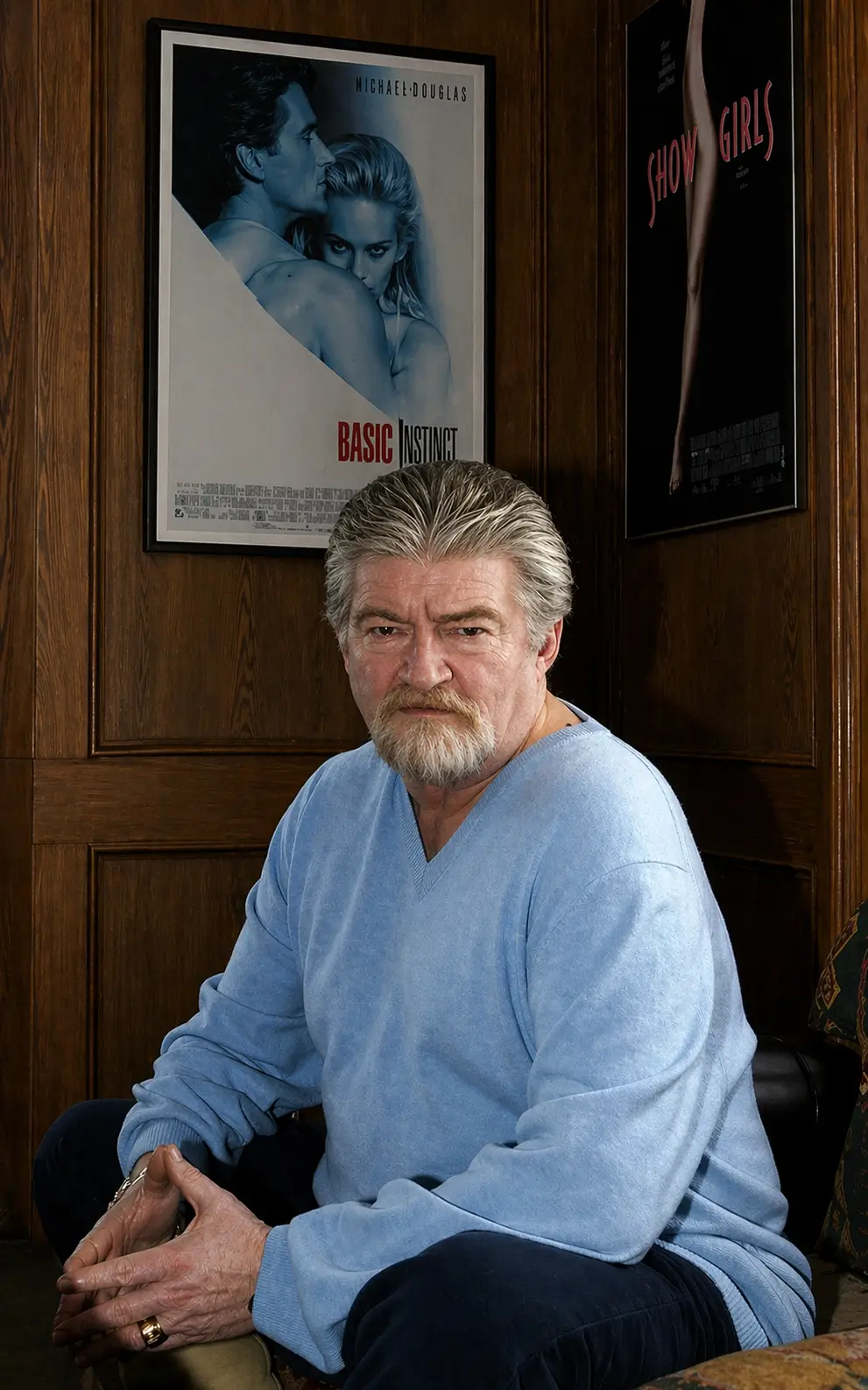
He doesn’t move like a legend. At 80, Joe Eszterhas rises slowly from his chair, one hand braced against the wall, the other holding a glass of water—no whiskey now, not after the liver transplant. But when he speaks, the old fire returns. “I was the id of Hollywood,” he says. “And the id always wins.”
This isn’t nostalgia. It’s testimony. In an era shaped by algorithmic polish and PR-managed narratives, Eszterhas stands as one of the last unfiltered voices of American cinema—the screenwriter behind Basic Instinct, Showgirls, and Jagged Edge—films that didn’t just provoke but lingered. The truth, though, extends beyond the work. He didn’t simply write those stories; he lived through them, absorbed them, and carried their consequences.

The cost is view: a body worn down by excess, a reputation shaped as much by ego as by output, and a legacy that resists simplification. What remains is not nostalgia, but evidence—of a man who turned disorder into authorship, and of an industry that no longer tolerates that kind of volatility.
stir
1970s New York carried the density of cultural upheaval, and Rolling Stone’s office on West 23rd Street functioned as both newsroom and nerve center—ink, smoke, music, and proximity to something forming in real time. Eszterhas was still emerging, writing from within that environment, observing as much as producing, until figures like Huey Newton began to pass through the space.
Newton didn’t arrive for strategy or messaging; he arrived to exist within the narrative itself. “He came to be seen,” Joe recalls, recognizing even then that presence could be as deliberate as action. Newton, a fugitive at the time, understood the mechanics of myth-making—the way visibility could shape permanence. It was in that setting that Eszterhas absorbed something foundational: narrative is not just reflection, it is control. And once understood, it becomes a tool that can be sharpened.
flow
Los Angeles presented a different pressure—faster, more transactional, but no less consuming. When Eszterhas began writing Basic Instinct, it wasn’t approached as a constructed screenplay so much as an unfiltered release. “No outlines. No notes. Just instinct,” he says, describing a process defined less by discipline than by immersion. The now-defining interrogation scene, later synonymous with Sharon Stone, was written in a single, extended stretch—sixteen hours without interruption, driven by momentum rather than revision. “The script wasn’t crafted,” he says. “It bled.”
The studio’s reaction was immediate resistance—too explicit, too volatile, too difficult to contain within conventional boundaries. Yet the material held. The tension sustained itself, the dialogue remained sharp, and the absence of restraint became the film’s defining quality.
Even the moment that would define the film view—the leg cross—wasn’t authored in the script. “That wasn’t mine,” Joe admits, “but when I saw it, I understood it.” The film’s success was measurable—hundreds of millions at the box office—but so was the toll. Health began to collapse under the same intensity that had fueled the work. “I sold my health for it,” he says, without correction.
fuel
The call from Mel Gibson came late, direct, and without explanation. When Eszterhas arrived at the Malibu property, the context was already clear: this wasn’t a professional consultation, but something closer to confrontation—with material, with belief, with self. Gibson, immersed in what would become The Passion of the Christ, spoke not in terms of production but of purpose. “I’m making a weapon,” he said, collapsing the distinction between film and intention.
The conversation that followed didn’t attempt to resolve that tension. Instead, Eszterhas reframed it: not direction, but exorcism; not performance, but release. The exchange lingered not because it produced work, but because it revealed alignment—two individuals operating at extremes, driven by different forces but defined by similar intensity. “Same fire,” Joe would later say. “Different fuel.”
challenge
By 1995, Eszterhas had reached a position where his work carried both value and risk. When Steven Spielberg called regarding Sacred Cows, it wasn’t to reshape the script but to assess either it could exist publicly. The screenplay itself functioned less as satire and more as dissection—a narrative that moved through figures of power and collapse without softening its conclusions. Spielberg’s response was direct: the work was strong, but producing it would carry consequences beyond the screen. Internal reactions echoed the same concern.
Early reads didn’t fail—they unsettled. Audiences responded, but not in ways that could be managed. “Too close,” as one executive put it. The project stopped there. Yet the script remained in circulation, not officially, but persistently, passed between those aware of its existence. Its absence from production became part of its identity.
bend
The interruption came through the body. Cancer, then failure, then intervention. The sense of distance that had defined earlier work collapsed under immediacy.
Writing Hollywood Animal became less about narrative construction and more about direct accounting. “I hated the game,” he wrote. “I just loved winning it.” The tone remained consistent—unfiltered, resistant to revision, unwilling to reposition itself for acceptance. Names were included. Damage was acknowledged. Not as correction, but as record.
The response divided along predictable lines, but by that point, the reaction had limited relevance. “You stop editing,” he says, describing a shift from show to exposure.
fin
The absence of figures like Eszterhas in contemporary Hollywood isn’t accidental. The environment has adjusted—toward predictability, toward control, toward systems that minimize volatility rather than accommodate it. The kind of authorship he represents—unfiltered, excessive, unstable—is no longer scalable within that structure.
“They want products,” he says, reducing the distinction to its simplest form. And yet the work persists. Basic Instinct remains disruptive. Showgirls continues to be reassessed. Even Sacred Cows survives through absence, its reputation sustained by circulation rather than release. The stories endure because they were never neutral to begin with. They carry the imprint of their conditions.
“I was the id of Hollywood,” he repeats.
And the id, once expressed, doesn’t disappear.
n
From the DRIFT archive: Jodie Foster Narrates Morgan Neville’s Breakdown: 1975: A Cultural Autopsy of the Most Radical Year in American Cinema
Related Articles
American Horror Story Opens the Vault for a Thirteen-Episode Reunion of Its Own Ghosts
Three half-hour episodes land September 24 on FX and Hulu, with Jessica Lange, Sarah Paulson […]