DRIFT

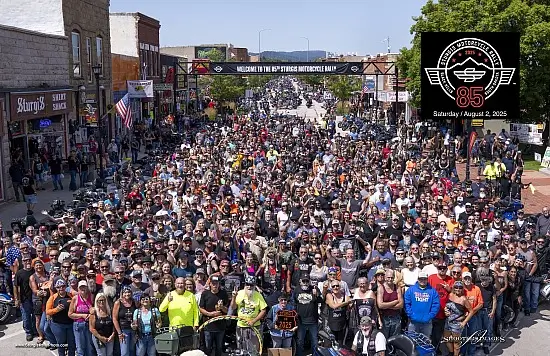
There are road trips, and then there are pilgrimages. The distinction is subtle until you feel it—until the miles stop behaving like distance and begin to accumulate like meaning. A road trip is itinerary-driven, often optimized, frequently photographed. A pilgrimage is something else entirely: it absorbs you, alters your tempo, rewrites your sense of arrival. Riding west toward the Sturgis Motorcycle Rally belongs firmly in the latter category. It is less about reaching a destination than it is about entering a condition—of motion, of noise, of shared mythology built on asphalt and repetition.

Each August, the small town of Sturgis transforms into a gravitational center for motorcycle culture. But to reduce the experience to the town alone is to misunderstand it. The rally radiates outward, spilling into the wider geography of the Black Hills, where roads coil through granite formations, forests, and sudden clearings that feel almost cinematic in their timing. The rally is not contained—it expands, pulses, and redefines the entire region for ten days.

stir

The Sturgis Motorcycle Rally is often described in numbers: attendance in the hundreds of thousands, economic impetus in the hundreds of millions, a lineage stretching back to 1938. These facts are true, but they miss the more elusive quality of the gathering—its ability to dissolve hierarchy. CEOs ride alongside mechanics, first-timers ride beside veterans who have been making the trip for decades. The motorcycle becomes the great equalizer, a shared language spoken through throttle control and road cognizant.

There is a distinct choreography to rally week. Mornings begin early, often before the sun has fully asserted itself. Riders move out in loose formations, dispersing into the hills, tracing routes that have become ritualized over time. Midday brings a different rhythm: roadside stops, impromptu conversations, the quiet inspection of machines that function as both transportation and personal statement. By evening, the energy condenses back into town—into music, light, density, and the particular hum of thousands of engines idling in proximity.

the surge

The real argument for the journey west is not the rally itself, but the terrain that frames it. The Black Hills are uniquely suited to motorcycle travel—not because they are extreme, but because they are protean. The roads do not simply connect points; they compose experiences.

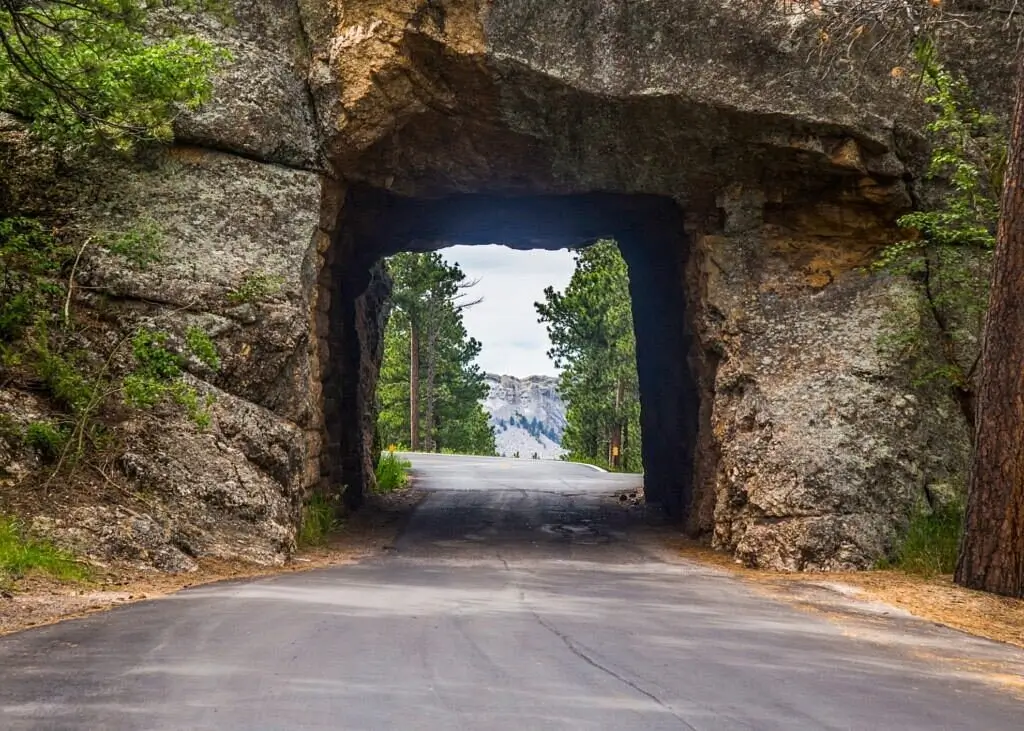
Take Needles Highway. It is a road that feels deliberately improbable, threading itself through narrow rock formations and tunnels that demand precision. Riding it requires attention—not the distracted awareness of highway cruising, but a focused engagement with line, speed, and timing. It rewards restraint as much as it rewards confidence.

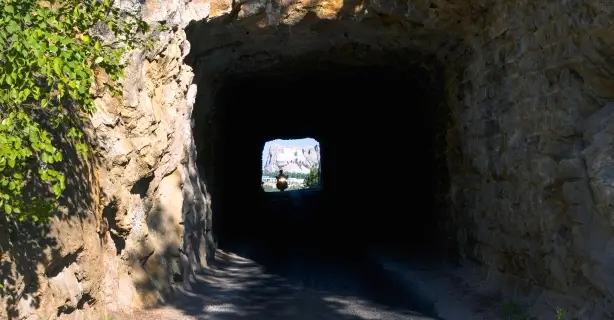
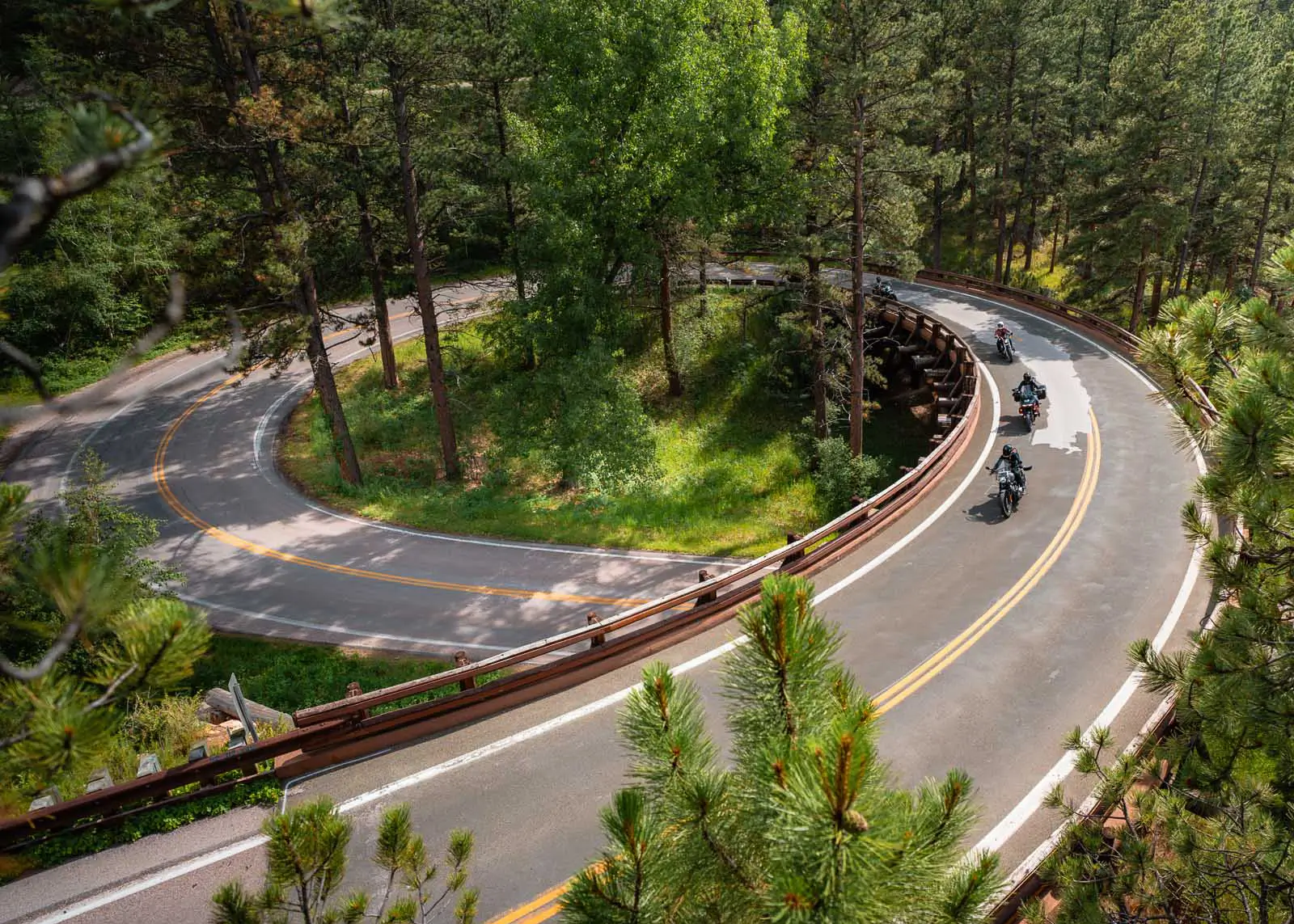
Then there is Iron Mountain Road, a route famous for its “pigtail” bridges—spiraling wooden structures that fold the road back onto itself. It is engineering as spectacle, but also as narrative. The road builds anticipation, revealing glimpses of Mount Rushmore through prudential framed tunnels, turning the act of arrival into something staged and deliberate.

Further north, Spearfish Canyon offers a different register entirely. Here, the ride becomes meditative. The curves are smoother, the elevation changes more gradual. Waterfalls appear without announcement, cliffs rise without drama. It is less about technical riding and more about immersion—about allowing the landscape to recalibrate your internal pace.

a traverse

For riders departing from the East Coast—New Jersey, New York, or anywhere along that corridor—the journey to South Dakota is itself a defining component of the experience. It is not a single ride but a sequence of transitions.

The first phase moves through density: urban sprawl, layered infrastructure, the constant negotiation of traffic. It is a reminder of why the open road holds such appeal. As the miles accumulate, the environment begins to simplify. The Midwest introduces a different scale—fields that extend to the horizon, highways that stretch with minimal interruption, towns that appear and recede with quiet regularity.

By the time you cross into South Dakota, the shift is unmistakable. The land opens, then folds, then rises. The air feels different—drier, more expansive. The road ceases to be a means of transit and becomes the primary event.

This progression is essential. It creates contrast. It allows the rider to feel the arrival not just geographically, but psychologically. The Black Hills are not just a place you reach; they are a place you become ready for.

attract

At the rally, motorcycles operate as extensions of self. They are curated, modified, maintained with a level of attention that borders on ritual. Paint jobs tell stories—of regions, of affiliations, of personal taste. Engine configurations signal priorities: performance, sound, endurance.

Brands carry their own cultural weight. Harley-Davidson maintains a dominant presence, its view and sonic identity deeply intertwined with the rally’s history. But the landscape is increasingly diverse. Indian Motorcycle, revived and recontextualized, commands its own following. European manufacturers, custom builders, and independent fabricators all contribute to a visual field that is constantly shifting.

What emerges is less a competition than a conversation. Riders observe, compare, appreciate. The bike becomes a point of entry—a way to initiate dialogue without preamble.

eco

The rally is also an economic engine, transforming the region in ways that are both visible and infrastructural. Temporary campsites expand into full-scale communities. Vendors arrive with mobile storefronts, offering everything from custom parts to apparel to food designed for speed and efficiency.

Accommodation becomes a strategic consideration. Traditional lodging fills months in advance, pushing many riders toward alternative solutions: camping, shared rentals, improvised setups that prioritize proximity over comfort. Prices rise accordingly, reflecting the intensity of demand.

Yet within this economy, there is also a sense of mutual understanding. Transactions are often accompanied by conversation, by shared knowledge, by the recognition that everyone present has committed to the same journey.

obstacle

It would be incomplete to describe the rally without acknowledging its inherent risks. The convergence of high-performance machines, variable terrain, and dense traffic creates conditions that demand respect. Accidents occur every year, a reality that underscores the importance of discipline.

Experienced riders approach the rally with a specific mindset. They ride early to avoid peak congestion. They plan routes with contingencies. They understand that the objective is not to prove capability, but to sustain it over time.

This awareness does not diminish the experience; it refines it. It introduces a layer of intentionality that aligns with the broader ethos of the journey.

flow

Interestingly, some of the most compelling experiences occur just outside the official dates of the Sturgis Motorcycle Rally. Arriving a few days early or staying a few days after allows riders to engage with the same roads under different conditions. The crowds thin, the pace shifts, the environment becomes potentially more contemplative.

In these moments, the Black Hills reveal another dimension. The spectacle recedes, leaving behind the underlying structure—the roads, the landscapes, the quiet logic that made the rally possible in the first place.

venture

Every pilgrimage includes a return, and the ride back east carries its own significance. The same roads are traversed, but the perspective has changed. The rider is no longer anticipating; they are processing.

There is a tendency to compress the return—to cover more distance, to move more quickly. But there is also value in resisting that impulse, in allowing the experience to extend, to settle.

The memory of the Black Hills does not dissipate immediately. It lingers, influencing how subsequent miles are perceived, how future routes are imagined.

idea

The enduring appeal of the Sturgis Motorcycle Rally lies in its ability to operate on multiple levels simultaneously. It is a festival, a marketplace, a social gathering. But it is also a framework—a structure within which individual journeys can unfold.

For some, it is about community. For others, it is about solitude achieved within a crowd. For many, it is about the simple act of riding—of moving through space with intention, of engaging with the environment in a way that is both immediate and sustained.

The Black Hills provide the setting, but the meaning is constructed by those who travel through them.

clue

In the end, the question is not either the trip is worth taking. It is either you are ready for what it asks. Not in terms of skill or endurance, but in terms of openness—to unpredictability, to discomfort, to the possibility that the journey will reshape your expectations.

Because that is what a pilgrimage does. It reframes. It recalibrates. It leaves you with a different sense of scale—not just of distance, but of experience.

And somewhere between the first mile and the last, between the departure and the return, the road begins to feel less like a path you follow and more like a narrative you inhabit.

Related Articles

Skeletor stands at the center of a fiery battlefield in Masters of the Universe, wielding a ram-skull staff while surrounded by armored skeletal warriors, glowing red eyes piercing through the smoke and flames of Eternia's dark war-torn realm

Masters of the Universe Review: Nicholas Galitzine Powers a Surprisingly Fun Fantasy Epic

In the post-COVID era of fragmented attention and cultural exhaustion, launching a big-budget franchise film […]

Modern data center facility with a solar-panel-clad exterior, bright green administrative offices, and secure perimeter fencing, showcasing sustainable digital infrastructure and renewable energy integration

Lombardy’s Data Center Boom: Balancing Digital Ambition with Environmental Responsible

Lombardy has emerged as Italy’s primary hub for new digital infrastructures, particularly data centers—vast complexes […]

In a highly anticipated reunion after 24 years, Adidas Originals and Coca-Cola have joined forces once again to celebrate the FIFA World Cup 2026™. The collaboration revives their iconic 2002 partnership from the Japan-South Korea tournament, now reimagined for the biggest global sporting event of 2026, co-hosted by the United States, Canada, and Mexico. Set to launch on June 6, 2026, this collection masterfully blends Adidas' streetwear heritage with Coca-Cola's timeless branding, creating a vibrant fusion of football culture, nostalgia, and modern style. The drop arrives at a perfect moment. With the World Cup kicking off on June 11, 2026, fans worldwide are gearing up for a summer of football excitement. This collaboration isn't just merch—it's a cultural statement that merges two legendary brands under the banner of "Originals are the Real Thing," a clever twist on Coca-Cola's famous slogan. Historical Context: A Reunion 24 Years in the Making Adidas and Coca-Cola first collaborated during the 2002 FIFA World Cup, producing limited-edition pieces that captured the era's energy. That partnership helped define early 2000s football-streetwear crossover culture. Fast-forward to 2026, and the brands are back with fresh energy, leveraging Adidas' deep FIFA ties (as an official partner) and Coca-Cola's long-standing sponsorship of the tournament. The 2026 edition promises to be historic as the first 48-team World Cup, spanning three countries and generating unprecedented global hype. This collab taps into that momentum, offering fans wearable pieces that celebrate both brands' legacies while looking forward to the future of football fashion. Collection Overview and Design Philosophy The Adidas Originals x Coca-Cola collection fuses 2000s street style with classic sporting aesthetics. Expect bold reds, creams, whites, and silver accents inspired by Coca-Cola's iconic packaging—think classic script logos, droplet detailing, and can-inspired motifs. The lineup spans footwear, apparel, and accessories, divided into two visual directions: one logo-heavy and graphic-forward, the other drawing from vintage advertising aesthetics. Designs pay homage to Coca-Cola's visual language while staying true to Adidas Originals' archival roots. High-quality materials, attention to detail, and versatile silhouettes make these pieces suitable for both match-day wear and everyday street style. The campaign, featuring young football star Lamine Yamal and a diverse cast in everyday scenes building anticipation for the tournament, reinforces themes of originality and shared cultural moments. Footwear Highlights Footwear takes center stage in this collaboration, with reimagined takes on iconic 2000s Adidas silhouettes: Samba and Superstar Models: These classics get Coca-Cola treatment with white/cream/red colorways and prominent script branding. The Samba blends street heritage with football roots, while the Superstar II features weathered bases and bold side panels. Expected pricing around $110–$130. Adistar Control 5: A standout with droplet detailing mimicking condensation on a cold Coke can. This model brings performance-inspired design into lifestyle territory. Predator Sala: Indoor/hybrid style with silver-and-red accents, nodding to predatory precision on the pitch and Coca-Cola's bold energy. Climacool 1: Revived with breathable tech and Coke-inspired graphics, perfect for warm summer days. Megaride F50: A highlight paying tribute to the iconic Coca-Cola glass bottle, with unique contours and refreshing design cues. Each pair incorporates thoughtful details like embroidered logos, custom insoles, and packaging that mimics vintage Coke crates or cans. These shoes are built for durability and comfort, appealing to sneakerheads, football fans, and casual wearers alike. Apparel and Accessories Beyond kicks, the collection offers a full lifestyle range: Track Tops and Jerseys: Standout jerseys fuse retro Coca-Cola advertising from different eras into cohesive football designs. Track jackets feature signature three stripes alongside Coke branding, in vibrant reds and classic whites. Shorts and T-Shirts: Relaxed fits with graphic prints, ideal for casual wear or layering. Expect motivational football motifs blended with refreshing beverage references. Accessories: A bright red airliner bag stands out as a functional statement piece. Additional items may include caps, socks, and tote bags carrying the collaborative spirit. The apparel emphasizes comfort with premium cotton blends, mesh panels for breathability, and oversized silhouettes popular in contemporary streetwear. Unisex sizing and inclusive fits make the collection accessible to a broad audience. Cultural Impact and Fan Appeal This collaboration resonates on multiple levels. For football fans, it represents national pride and global unity ahead of the 2026 tournament. Sneaker enthusiasts will appreciate the nostalgic 2000s revival mixed with modern execution. Streetwear collectors see it as a prime example of how heritage brands can innovate through partnerships. In an era where sports and fashion increasingly intersect, Adidas and Coca-Cola deliver pieces that transcend the pitch. Wear them to watch matches at home, attend watch parties, or hit the streets in any host city—New York, Los Angeles, Toronto, or beyond. The designs are versatile enough for gym sessions, festivals, or daily commutes. The timing aligns perfectly with rising interest in football in North America, boosted by the co-hosting nations. Young talents like Lamine Yamal in the campaign help bridge generational gaps, attracting newer fans while satisfying longtime supporters. Where to Buy and Release Details The collection launches globally on June 6, 2026, via: Adidas CONFIRMED app (for early access and raffles) Adidas.com Select retailers and flagship stores worldwide Some regions may see staggered drops, with Japan and other markets getting early access. Prices are expected to range from $50–$150 depending on the item, making it relatively accessible compared to ultra-limited drops. Pro Tips for Copping: Enable notifications on the CONFIRMED app. Check local stock at Adidas stores in major cities. Monitor resale platforms post-drop for exclusive colorways, but be wary of markups. Size up slightly for oversized apparel fits. Given the World Cup hype, popular items like the Sambas and jerseys are likely to sell out quickly. International shipping is available, but factor in potential customs delays. Styling Suggestions Match Day Look: Pair a collaborative jersey with classic black shorts and Samba sneakers for effortless fan style. Streetwear Rotation: Layer a track top over a graphic tee with wide-leg pants and the Megaride F50 for a bold urban ensemble. Casual Summer: White Superstar with denim shorts and the airliner bag for a refreshing, vacation-ready vibe. These pieces mix seamlessly with existing Adidas or neutral wardrobes, maximizing versatility. Broader Context in 2026 Fashion and Sports The Adidas x Coca-Cola drop is part of a larger wave of high-profile collaborations tied to the World Cup. Adidas continues its dominance in football kit design, while Coca-Cola leverages its sponsorship with collectibles, bottles, and experiential activations like the Trophy Tour. In the sneaker industry, this collab exemplifies the ongoing trend of lifestyle reinterpretations of performance silhouettes. It also highlights how global brands use major events to drive cultural conversations around unity, originality, and joy—core values for both companies. Sustainability notes (based on Adidas' broader initiatives) suggest some pieces may incorporate recycled materials, aligning with modern consumer expectations. Looking Forward: Legacy and Excitement As the countdown to kickoff continues, this collection serves as the perfect prelude to an unforgettable summer of football. Whether you're a die-hard supporter, a fashion-forward collector, or someone seeking motivation through style, the Adidas Originals x Coca-Cola FIFA World Cup 2026 lineup delivers. Expect potential restocks, special event exclusives in host cities, and continued campaign content featuring more athletes. This isn't just clothing—it's a ticket to participate in the global celebration of the beautiful game. Mark your calendars for June 6, 2026. Refresh your wardrobe, lace up those Sambas, and get ready to cheer on your team in style. The "Real Thing" meets the Originals in what promises to be one of the most talked-about releases of the year. This collaboration captures the essence of football's universal appeal: bringing people together through shared passion, iconic brands, and unforgettable moments. As the world prepares for 2026's expanded tournament, Adidas and Coca-Cola remind us that some partnerships are truly timeless.

Adidas Originals x Coca-Cola Collection: FIFA World Cup 2026

In a highly anticipated reunion after 24 years, Adidas Originals and Coca-Cola have joined forces […]