DRIFT AUDIO
Listen to this story
Choose a voice, then press play.
The animated view for “THAT GIRL” turned Tyla into the latest test case for a question the internet keeps asking about every glossy new release: did a person actually draw this.
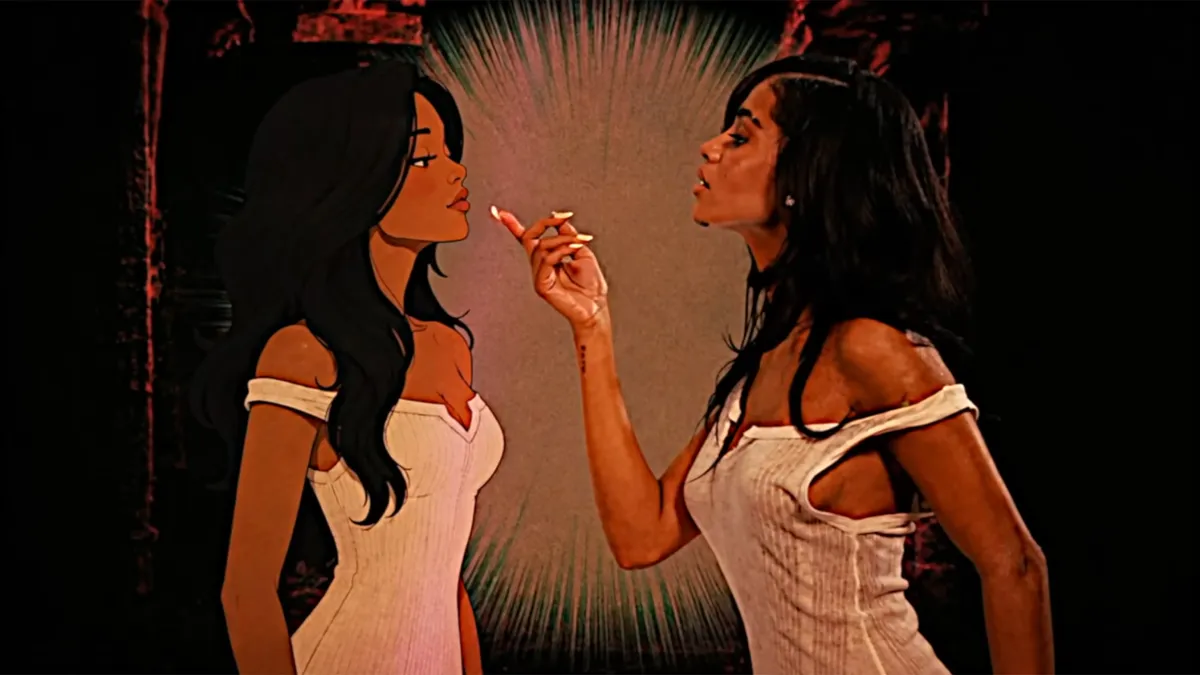
Tyla released the official music video for “THAT GIRL” on July 29, one of the standout tracks from her sophomore album A*POP, and within hours the comment sections had split into two very different conversations. Directed by Mila Rowyszn and Oliwia Drożdż, the video drops Tyla into a neon, fantasy tinged world that blends live action footage with retro style animation, following her and an animated tiger companion through a run of scenes built around designer handbags, jewelry, and dance breaks. One moment sends her sparring with the tiger, another has her facing off with an animated double of herself in front of a mirror, and the whole thing carries a comic book texture that critics quickly connected to the look of the 1992 animated fantasy film Cool World.
View, it is a continuation of the world A*POP has been building all year, the same neon palette and play character work that has defined the album’s rollout since its release. Where earlier singles from the record leaned into live action glamour, “THAT GIRL” pushed further into a fully realized fantasy setting, treating Tyla less like a pop star in a video and more like a character dropped into her own cartoon. The haute signifiers that run through the clip, designer bags, layered jewelry, a wardrobe that shifts scene to scene, sit inside that cartoon frame rather than a conventional glossy set, which is part of why the animation itself became the story rather than the styling.
The clip arrived during what was already a packed week for Tyla, sitting alongside a run of high profile appearances and fresh certifications for the album’s singles. Tyla has spent the two years since her 2023 breakout single “Water” turning herself into one of the most closely watched pop exports out of South Africa, and A*POP, her sophomore full length, has kept that momentum going with a steady run of singles, magazine covers, and award show appearances. Under different circumstances, “THAT GIRL” would likely have been just another entry in that busy release calendar. Instead, it became the center of one of the loudest AI debates the music video format has seen this year.
stir
The suspicion started almost immediately after release, with viewers pointing to a set of view tells that have become shorthand for AI generated animation: hands with an inconsistent number of fingers, physics that behave strangely from one frame to the next, and character models that shift noticeably in style within the same scene. One widely shared post pointed specific to a shot where Tyla’s animated likeness looks distinctly different across two consecutive frames, using that inconsistency as evidence the artwork was not built with a single, consistent hand drawn process.
Community fact check style annotations on X pointed to the same set of errors, citing incorrect finger counts and odd physics as the basis for their claim that the video used AI tools somewhere in its pipeline. The allegation spread quickly across TikTok as well, where clips dissect individual frames of the video racked up substantial view counts, many of them frame the debate less as a technical question and more as a referendum on whether a Grammy winning artist should be using gen tools at all. Some of the online reaction went further, arguing that an artist with Tyla’s resources had no excuse to lean on anything but traditional produced animation, a version of the argument that keeps surfacing whenever a big budget project is suspected of leaning on AI shortcuts rather than paying a full animation team.
Other viewers pushed back on the frame before any studio credit had even surfaced, arguing that stylized, slightly uncanny character animation has existed for decades without AI involvement and that treating every view quirk as evidence of gen tools risks flattening a real, ongoing conversation about labor and craft in animation into a simple guessing game over finger counts. That tension, between wanting to hold major label budgets accountable and wanting to avoid turning every stylistic choice into an accusation, ran through nearly every thread discussing the video, well before Biuro’s own public statements entered the conversation and gave critics something more concrete to point to.
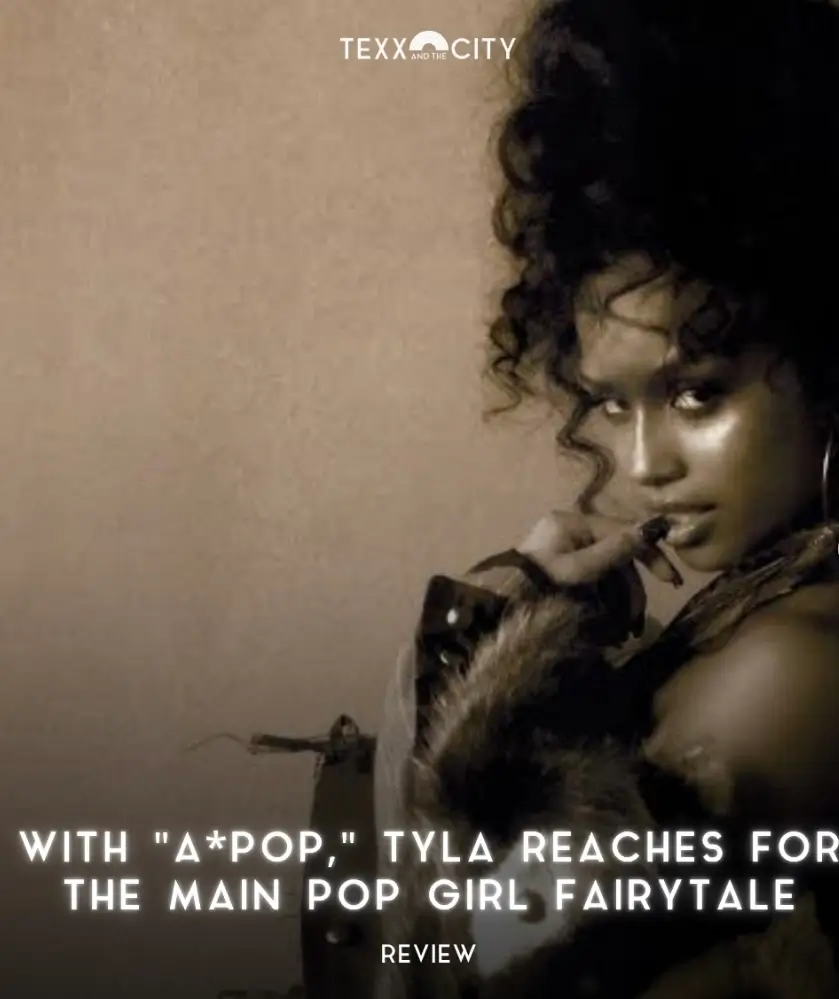
The TEXX AND THE CITY review examines Tyla’s A*POP, positioning the South African singer’s latest project as a confident step toward global pop stardom while exploring how she expands beyond the sound that first brought her international recognition.
huh
Much of the suspicion has centered on Biuro, the design and animation studio credited with the video. Critics researching the studio found that its own public facing material, including an interview with Coevall magazine, describes artificial intelligence as central to how the studio works, a detail that did little to quiet the allegations once it started circulating alongside the frame by frame breakdowns. Biuro’s own Instagram has also been cited by critics as evidence of a broader house style that leans on AI assisted tools across multiple projects, not just this one.
That context turned what might have been a passing frame count argument into a more pointed conversation about whether a studio’s known working method should change how an audience reads its output. It is worth separating two claims that have gotten blurred together online: that Biuro uses AI in parts of its practice, which the studio itself does not appear to dispute, and that the “THAT GIRL” video specifically was generated by AI rather than produced through a hybrid process. The first is closer to settled fact. The second remains the actual point of dispute.
Biuro’s own framing of its practice, describing artificial intelligence as something that has always sat at the center of its work rather than a recent addition, means the studio was never going to be able to fully separate itself from the conversation once its name attached to the video. For some viewers, that framing alone was enough to settle the question in their own minds regardless of what technique produced any individual frame. For others, it simply raised the more interesting question of where the line actually sits between a studio that uses AI as one tool among many and a studio that lets AI generate finished frames wholesale, a distinction that got lost fast once the discourse moved from Instagram comment threads onto TikTok stitches and X quote posts.
held
Tyla’s creative team pushed back directly on the idea that the video was AI generated, telling outlets that the project relied on traditional production methods: green screen filming of Tyla herself, motion design, hand built animation, and compositing layered on top of that live action footage rather than generated from scratch. That account lines up with a more detailed breakdown offered by animator Kat Blaque, a CalArts trained character animator who watched the video closely and argued that what critics were calling obvious AI slop was actually a hybrid technique: still frames and short clips of Tyla shot on green screen, then pushed through post production work that included hand edited comic book textures and background effects.
Blaque’s read was more nuanced than either side of the online argument wanted to hear. She agreed the video was not the kind of frame by frame, hand drawn 2D animation some viewers seemed to be picturing when they defended it, while also pushing back on the idea that everything digital automatically counts as AI generated. Her larger point was that Biuro is a studio that has been open about AI being part of its process, which made the specific reaction to this video less about detecting something hidden and more about how differently fans and critics respond once they know a tool was used at all.
Tyla’s fanbase largely rallied around the denial, framing the allegations as an overreaction to a stylistic choice rather than evidence of anything generated. Others in the comments were less convinced, arguing that even a hybrid process built on AI forward tools crosses a line for a major label release with the budget to hire animators working entirely by hand. The gap between those two positions has not closed, and neither side has produced anything close to definitive proof for their side of the argument.
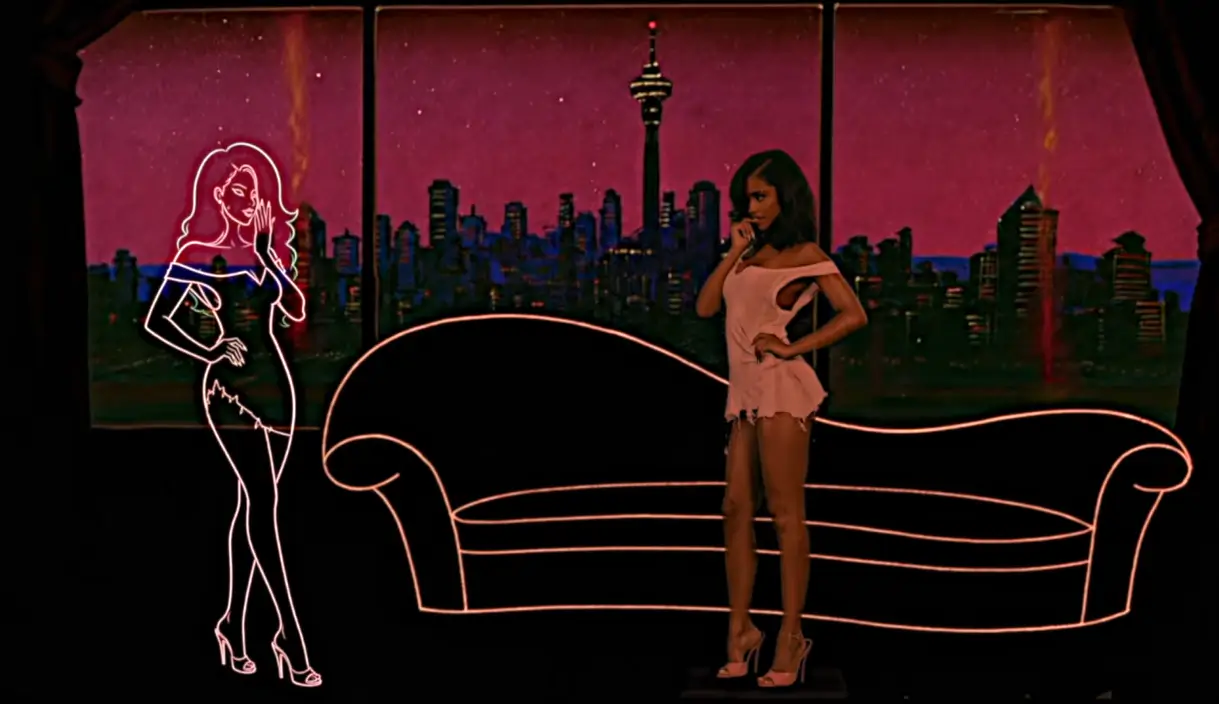
The music video blends live action with stylized animation, placing Tyla alongside glowing illustrated elements in a neon-lit apartment overlooking a vibrant city skyline, creating a play view contrast between reality and fantasy.
look
Whatever the truth of the animation pipeline, the controversy landed at an unusually high traffic moment for Tyla. A*POP has been generating fresh commercial milestones throughout the year, with “Water” recently certified 4x Platinum by the RIAA, “PUSH 2 START” reaching Platinum, and “ART” earning Gold certification, all layered on top of an album era that has already produced a run of singles and a heavily covered visual campaign. “THAT GIRL” was meant to be another beat in that campaign rather than its centerpiece, and the AI conversation around it has, if anything, given the single more attention than a quieter release cycle might have.
The video also arrives just months ahead of the A*POP World Tour, set to launch in October, adding a layer of stakes to how the views era around this album gets remembered. Tyla has spent the two years since her Grammy winning breakout with “Water” building a profile that extends well past music. She became the youngest African artist ever to win a Grammy when “Water” took the inaugural award for Best African Music Show in 2024, a milestone that arrived alongside her self titled debut album and a string of MTV, BET, and MTV Europe Music Award wins that followed. Since then she has become a fixture on fashion’s biggest stages, from a custom Balmain look at the 2024 Met Gala to a spot on the 2025 host committee alongside Anna Wintour, and a controversy over a single music video is unlikely to meaningfully slow any of that momentum.
It does, however, sit inside a much larger and increasingly familiar pattern: any view stylized release from a major artist now arrives with an automatic audience of viewers scanning it frame by frame for evidence of AI, whether or not that scrutiny turns up anything conclusive. Streaming numbers, certifications, and awards momentum used to be the main measure of whether a single’s rollout succeeded. Increasingly, a second scoreboard runs alongside that one, tracking either the view side of the campaign can survive public scrutiny over how it was actually made, and that scoreboard does not care how many Grammys or platinum certifications an artist already has on the shelf.
That pattern has jured out across other high profile creative projects in recent months, with studios and artists alike finding that a distinctive visual style, on its own, is now enough to trigger AI suspicion regardless of how the work was actually made. For Tyla, an artist who has built her image around maximalist views and constant reinvention, “THAT GIRL” becomes a data point in that wider conversation rather than an isolated incident, and probably not the last time a stylized video from her camp draws the same kind of scrutiny.
Related Articles

Inside The Airstream Elon Musk Calls His Memphis Palace
Elon Musk says he is living in an Airstream trailer parked beside xAI’s Colossus supercomputer […]