DRIFT AUDIO
Listen to this story
Choose a voice, then press play.
Elon Musk says he is living in an Airstream trailer parked beside xAI’s Colossus supercomputer campus in Memphis, and calling it his palace.
Elon Musk called into the All-In Podcast‘s live summit on Monday, September 14, appearing by video from Memphis rather than sitting onstage at the Shrine Auditorium in Los Angeles, where the three-day event has run since September 13. The show is hosted by four venture capitalists, Chamath Palihapitiya, Jason Calacanis, David Sacks, and David Friedberg, whose show has run since 2020 and now draws more than a million subscribers on YouTube alone. Musk is something of a recurring fixture at their live gatherings, having appeared at the summit’s stage events in Miami Beach in 2022 and at UCLA’s Royce Hall in both 2023 and 2024. This year he skipped the flight entirely and used the opening seconds of his segment to explain where he actually was. Not a house. Not a hotel. A trailer he called a palace, parked next to the Colossus supercomputer complex his AI company, xAI, has been racing to expand. Gwynne Shotwell, the president and chief operating officer of SpaceX, sat in on the same segment and did the framing work the aluminum couldn’t manage on its own.
Signal. What happened: Musk told the All-In Podcast’s live summit he is currently living in an Airstream trailer outside Memphis. Exact object: an unspecified Airstream model, parked beside xAI’s Colossus campus. When and where: Monday, September 14, 2026, during a remote appearance in the summit’s Los Angeles taping. Source: the exchange itself, reported the same week by Fortune and picked up widely within hours. Why it matters: Musk’s living arrangement is now folded into the story of how fast xAI is trying to build. Earlier DRIFT: none on this trailer.
stir
The quote itself ran thirteen words once you strip the preamble: “the palace that I live in in Memphis, which is an Airstream trailer.” Shotwell answered with the sentence doing the real work of the segment. She frame it as typical of him, doing, as she put it, what people don’t quite believe he does, then added the specific claim: “He sleeps on the factory floor. He’s in Memphis, helping build buildings.” Laughter followed in the room. A studio laughs at a punchline. It doesn’t measure a trailer’s square footage.
Her dep carries some weight. Shotwell joined SpaceX in 2002 as its eleventh employee and has served as president and chief operating officer since 2008, running the company’s day-to-day operations through Falcon 9’s evolution into the world’s dominant launch vehicle and Starship’s early test flights, well before this year’s public listing. SpaceX now employs more than 10,000 people and has flown astronauts to the International Space Station since 2020, one of the many programs that fall under Shotwell’s day-to-day management rather than Musk’s.
No model number left Musk’s mouth. Airstream has been building trailers like this since 1931, when founder Wally Byam started riveting aluminum panels into the rounded silhouette the brand has barely changed since, a shape modeled on the earlier Bowlus Road Chief. The company, now a division of Thor Industries, still manufactures every trailer in Jackson Center, Ohio, and its compact line can fit a bed, a kitchen, and a bathroom into roughly sixteen feet of that polished shell. The brand’s entry-level model, the World Traveler, starts around $64,400, though nothing confirms that’s the unit Musk is using, or any specific configuration at all. Airstream currently sells roughly nine distinct models, from that entry-level Basecamp-style trailer up through the 33-foot Classic, so even a confirmed model name wouldn’t settle much about the floor plan. Treat the interior as catalog geometry until someone photographs the actual trailer.
This isn’t a new habit dressed up as news. Musk has a long, indie documented pattern of sleeping close to whatever he’s building, and this year’s coverage traced it back further than usual: stretches on the factory floor during Tesla’s Model 3 production crunch in 2018, a couch at the offices of X, the platform still called Twitter when he bought it for roughly $44 billion in 2022, and, more loosely, a habit some accounts trace all the way back to Zip2 in the 1990s, though the details from that early period are thinner than the Tesla and Twitter chapters. A trailer with a hitch fits the pattern and adds one structural wrinkle. It can also drive away at 3 a.m., which a couch cannot.
There’s a stranger echo here too, and it isn’t about Musk at all. When NASA’s Apollo 11 crew splashed down in the Pacific in 1969, the agency quarantined Neil Armstrong, Buzz Aldrin, and Michael Collins inside a converted Airstream, the Mobile Quarantine Facility, out of a genuine, if ultimately unfounded, fear that they might have carried something back from the Moon. NASA reused the same design for two more splashdowns, Apollo 12 and Apollo 14, before retiring the quarantine program once it became clear the Moon carried no biological threat after all. It’s a 1969 NASA fact, not a Memphis floor plan, but it means this isn’t the first time the brand’s aluminum shell has been asked to carry more cultural weight than a camper usually does.
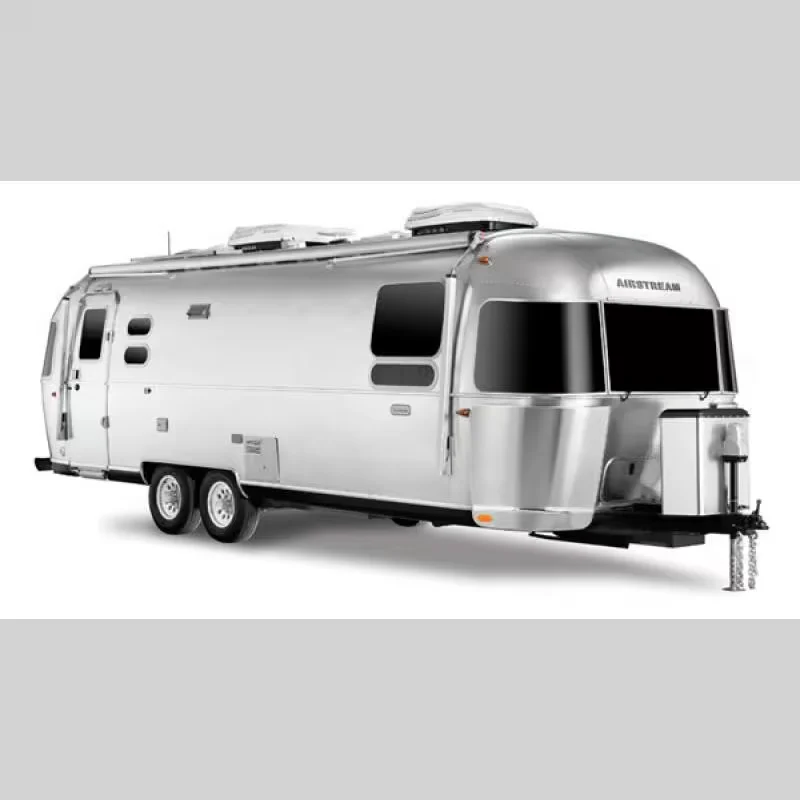
Airstream Travel Trailer
flow
Colossus is the reason there’s a trailer in Memphis at all. Construction began in 2024, and xAI has repeatedly cited a 122-day timeline for bringing the first phase online, a speed that has become something like the project’s own origin myth. The site is widely understood to run on dense clusters of Nvidia chips, dedicated primarily to training xAI’s Grok models, with the rest sold off as spare capacity. The campus has grown past that first hall. Reporting on the expansion describes a second structure sometimes labeled Colossus 2 and sometimes referred to by the nickname Macrohard, plus a further building called Minihard that surfaced in coverage this past July. The names aren’t settled. Different outlets use them differently, and until xAI prints one fence sign with an official designation, the safest move is to treat Macrohard and Minihard as informal shorthand rather than confirmed site names.
The scale is part of a broader arms race. xAI is racing to keep Grok competitive against rivals built by OpenAI, Google, and Anthropic, all of whom have spent the past two years locked in an escalating buildout of their own data center capacity, and Colossus is xAI’s answer to that pressure: more chips, faster, closer to home. It’s also part of why the Google and Anthropic rental deals make sense on paper. Both companies lean heavily on outside cloud infrastructure rather than building out data centers of their own at anything close to xAI’s pace, which leaves room for a fast-moving builder like xAI to sell what it doesn’t immediately need.
What’s better support is the demand side. xAI has struck deals to rent out spare Colossus capacity, with Google and Anthropic both named as customers for the overflow compute the site now produces beyond what’s needed to train Grok. One account puts the campus at roughly a gigawatt of AI compute capacity by the middle of 2026, though that figure comes from a single outlet rather than a number xAI itself has confirmed, worth flagging rather than treating as settled.
The corporate structure around all of this moved fast this year. In February 2026, SpaceX announced it had acquired xAIin a deal that valued xAI at $250 billion and SpaceX itself at $1 trillion, putting the combined entity, sometimes referred to informally as SpaceXAI, at roughly $1.25 trillion. SpaceX confirmed the news in a statement posted to its own site, signed by Musk, framing the deal as unifying his space and artificial intelligence ambitions under one roof. Musk described the merger’s goals in typically maximalist terms at the time, language built around understanding the universe and extending human reach beyond Earth, a register that stood in sharp contrast to the far more modest trailer he’d be living in seven months later. It wasn’t the first time Musk had folded one of his companies into another. xAI itself had already absorbed X, the social platform formerly known as Twitter, in a roughly $33 billion deal the year before, bringing the two companies’ data, models, compute, and distribution under one roof. The SpaceX-xAI combination briefly positioned the newly merged company to leapfrog OpenAI as the world’s most valuable startup, a distinction that shifted again once the IPO turned SpaceX into a public company entirely, competing on a different scoreboard from its privately held AI rivals. The combined company went public in a Nasdaq listing under the ticker SPCX in June, with a roadshow that ran from June 3 through June 11, a subscription price of $135 a share, and a first day of trading that closed up nineteen percent, pushing the market capitalization above $2 trillion. Musk retained the large majority of voting control through the listing, reportedly somewhere in the 82 to 85 percent range, and he and other insiders agreed to a lock-up period of just over a year before they can sell shares.
That same All-In appearance touched a related question directly. Asked whether Tesla and SpaceX might eventually combine the way SpaceX and xAI just did, Musk didn’t rule it out, pointing instead to how closely the two companies already collaborate. Nothing was announced. The door was simply left open, which is its own kind of answer.
what
The number that keeps getting glued to this story is $917 billion, the Bloomberg Billionaire Index‘s current estimate of Musk’s net worth, an index built from disclosed stakes, public share prices, and known compensation packages rather than any single confirmed bank balance. Alongside it sits the fact that he briefly became the world’s first trillionaire for twelve days in June, a milestone driven largely by the same SpaceX and xAI valuations discussed above. That trillionaire figure reflected a paper peak tied to a specific stretch of trading days rather than a sustained status; by the time of the Memphis appearance, the index had settled back to $917 billion, still comfortably enough to make him the wealthiest person alive. Both are index calculations, not deeds to the Airstream, and they travel with the trailer story because a twelve-figure number sitting next to a small aluminum shell is an easy contrast to reach for. It’s also not one that measures anything about the actual arrangement.
A large fortune parked next to a small trailer doesn’t tell you how many megawatts the Memphis site draws, how much water its cooling systems use, how loud it runs at 3 a.m., or whether the rental agreements with Google and Anthropic survive a full fiscal quarter. It doesn’t measure how many nights the hitch actually stays down versus how many nights a camera happens to be pointed at Musk’s face. Sleeping on-site is a management style with its own long history, admired by some as commitment and mocked by others as theater, and both readings will attach themselves to this clip regardless of which one is closer to true.
What’s confirmed is narrower than the headlines suggest. Musk said, on record, that he is living in an Airstream in Memphis. Shotwell corroborated that he sleeps near his work as a matter of habit. Colossus is real, expanding, and profitable enough to rent out its overflow. Everything else, the exact trailer model, the precise building names, the durability of the compute deals, sits somewhere between reported and unconfirmed. The campus is not a trailer. The trailer is not a verdict on the campus. Both are still under construction.
Related Articles
Emporio Armani Names Its First Creative Director From Outside the Armani Family
Dario Vitale, who lasted one season at Versace, is now the first person outside the […]