
DRIFT AUDIO
Listen to this story
Choose a voice, then press play.
Kaili Smith’s “You Raised Me, I Raised You” encapsulates the intricate, cyclical relationships that define personal and societal growth. Known for his ability to merge fine art with street culture, Smith delivers a poignant narrative about mutual influence, using his signature hyperrealistic style. The title itself is a powerful statement, suggesting a symbiotic exchange between individuals and their environments, mentors, and peers. It acknowledges that while people are shaped by those around them, they also contribute to shaping others in return.
The painting is marked by Smith’s characteristic use of vibrant colors and striking detail, pulling the viewer into an intimate yet universally relatable moment. The scene likely features human figures engaged in an emotional or symbolic exchange, reinforcing the theme of interconnectedness. Smith often situates his characters in urban settings, incorporating graffiti and street elements to root his work in contemporary culture. This choice highlights the influence of community spaces on identity formation, particularly for youth, and positions the artwork as both a personal reflection and a broader social critique.
Smith’s work often focuses on themes of cultural identity and youth, and this piece is no exception. The figures in “You Raised Me, I Raised You” likely represent different roles—challenges stemmed by experiences while social roles are conjured between peered relationships. The dynamic interplay between them underscores the idea that no relationship is one-sided. Whether through intentional guidance or unconscious action, people leave lasting impressions on each other, creating a ripple effect of influence across generations and communities.
This piece also speaks to the duality of personal growth—how we are shaped by external forces and our ability to transform those forces in return. The vibrant urban elements in the painting serve as metaphors for this exchange, symbolizing the noise, chaos, and beauty of shared experiences.
Ultimately, “You Raised Me, I Raised You” is a visual narrative of shared humanity. By portraying the push and pull of influence with such raw emotionality and technical precision, Smith invites viewers to reflect on their own roles in this reciprocal process. The piece resonates as a reminder that growth is never a solo endeavor but a collective journey shaped by countless unseen connections.
Related Articles
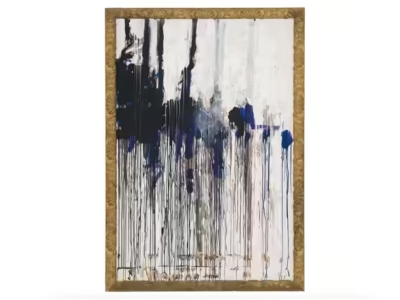
Winter Ran Down A Plywood Panel In Gaeta
Cy Twombly, Untitled (Winter Picture), 2004. Acrylic on plywood in the artist’s frame. Gagosian, Madison […]