DRIFT AUDIO
Listen to this story
Choose a voice, then press play.
YouTube has taken a bold step toward giving users more direct control over the endless scroll. The platform announced this week a new AI-powered feature that lets you create a personalized video feed simply by typing a prompt describing what you want to watch. This marks a notable shift from the traditional algorithm-driven experience that has defined YouTube for years.
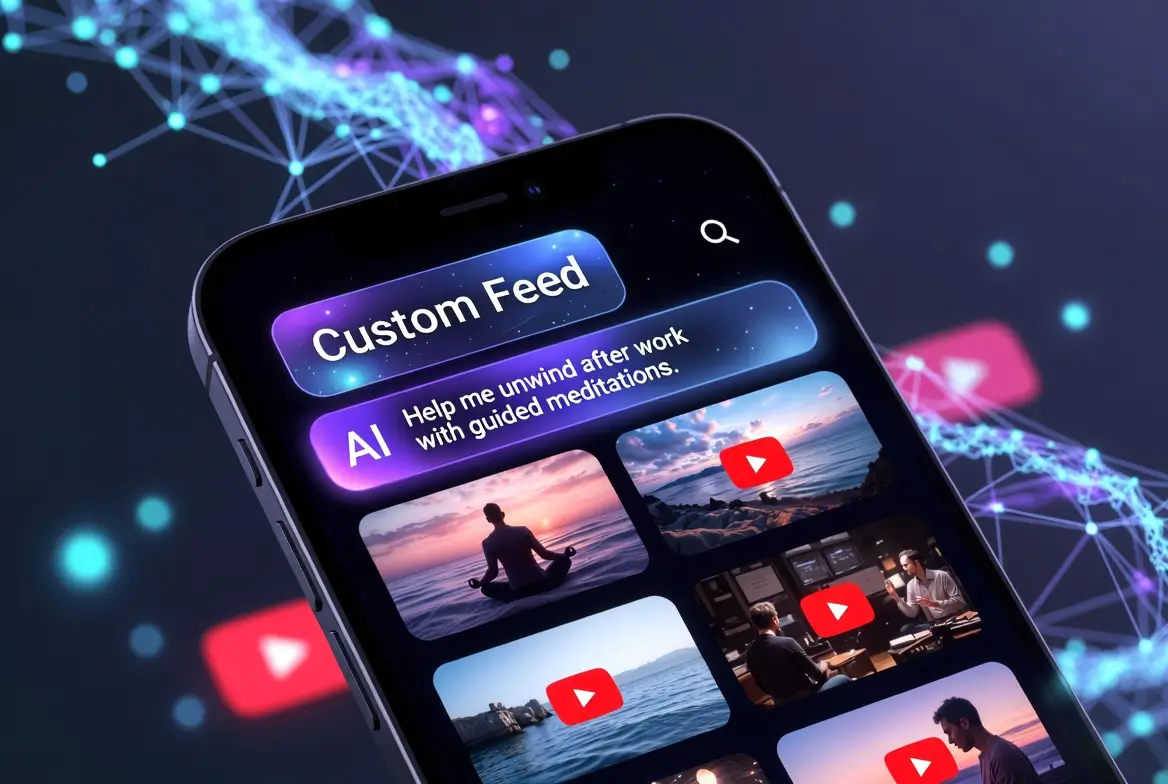
In its announcement, YouTube suggests practical and creative prompts: unwinding after a long workday with 10-minute guided meditations, exploring topics outside your usual interests, diving deep into niche hobbies, or curating mood-based viewing sessions. Once generated, you can save the prompt as a pinned chip at the top of your Home page for quick access anytime. The feed refreshes constantly with new recommendations tailored to your description.
The feature launched on Wednesday alongside other AI-related updates, including improved automatic detection and clearer labeling for AI-generated content. It is currently rolling out to signed-in users in the United States on the YouTube mobile app and desktop site. Availability on TV apps or internationally remains unclear at this time.
YouTube is rolling out an AI feature that builds your feed from a text prompt. Tell it what you want—”guided meditations under 10 minutes” or “deep-dive tech podcasts about AI”—and it surfaces a custom feed. You can pin it to your homepage. pic.twitter.com/78vpu5KYgl
— 38twelveDaily (@38twelveDaily) May 28, 2026
stir
The new tool appears as a chip labeled something like “Your custom feed” next to the standard Home tab. Tapping or clicking it opens a prompt box where you describe your desired experience in natural language. YouTube’s AI then builds a dedicated, constantly updating feed based on that input.
Examples from YouTube include:
- “Help me unwind after work with guided meditations under 10 minutes”
- “Show me something completely different from my usual interests”
- “Focus on 1980s synthwave music videos and cyberpunk aesthetics”
- “Recommend beginner-friendly urban gardening tutorials in short format”
You can edit the prompt later to refine results, and the system respects your existing watch and search history (provided those features are enabled). This hybrid approach combines user intent with the platform’s vast understanding of content.
Unlike one-off searches, this creates a persistent, bookmarkable feed. It functions more like a custom channel or playlist that evolves over time rather than a static list. Early reports suggest it pulls from both popular and long-tail content, potentially surfacing videos that traditional recommendations might overlook.
why
For over a decade, YouTube’s recommendation engine has been both celebrated and criticized. It excels at keeping users engaged through sophisticated machine learning but often traps people in echo chambers, pushes sensational content, or serves irrelevant suggestions based on fleeting views.
This new feature represents a know pivot. Instead of passively accepting what the algorithm thinks you want, users can actively steer discovery. It acknowledges that human intentions are sometimes too nuanced for pure behavioral tracking to capture perfectly.
Product experts see this as part of a broader industry trend. Platforms like TikTok and Instagram have experimented with interest-based feeds, but YouTube’s prompt-driven version feels more conversational and flexible. It could reduce frustration for users who feel their Home page no longer reflects their current mood or evolving tastes.
Parents might create dedicated feeds for educational content. Fitness enthusiasts could prompt for progressive workout routines. Language learners might request immersive content in their target language. The possibilities appear nearly endless.
archetype
While YouTube has not released full technical details, the feature likely builds on existing recommendation systems enhanced by large language models (similar to Google’s Gemini ecosystem). The prompt is interpreted to extract key themes, formats, durations, tones, and topics, then matched against YouTube’s enormous video catalog and metadata.
This goes beyond simple keyword matching. The AI can understand context — for instance, distinguishing between “relaxing” piano music for sleep versus upbeat piano for focus. It also factors in freshness, video length preferences, and content quality signals.
The rollout requires search and watch history to be enabled, suggesting the system still benefits from personalization data while adding explicit user direction on top.
support
The custom feed announcement came bundled with meaningful updates to AI-generated content handling. Starting in May 2026, YouTube is rolling out automatic detection for significant photorealistic AI use. If creators don’t disclose realistic AI alterations but the system flags it, a label will be applied automatically.
Labels are becoming more prominent:
- For long-form videos: Placed directly below the player
- For Shorts: As an overlay on the video itself
These changes respond to growing concerns about deepfakes, synthetic media, and viewer trust. YouTube emphasizes that labels do not affect monetization or recommendations but aim to inform audiences clearly. Creators can appeal incorrect labels.
This dual focus — empowering users with AI tools while increasing transparency around AI content — shows a maturing platform strategy. YouTube wants AI to enhance discovery without undermining authenticity.
scope
For Viewers:
- Greater agency over content consumption
- Easier discovery of new interests or “reset” periods
- Reduced decision fatigue
- Better support for specific moods, learning goals, or time constraints
For Creators:
- Potential to reach audiences actively seeking their niche
- New opportunities for educational, therapeutic, or highly targeted content
- Data on which prompts drive views could inform future production
- Challenge: Competing in prompt-optimized environments may require clearer titles, descriptions, and thumbnails
Smaller creators in specialized areas could benefit if users prompt for exactly their expertise. Conversely, mainstream viral content might see slightly less dominance in custom feeds.
bulwark
No feature is without risks. Critics worry about:
- Filter Bubbles on Steroids: Users might create highly insular feeds, limiting serendipitous discovery that has long been YouTube’s strength.
- Prompt Engineering Inequality: Users skilled at writing effective prompts may get better results than casual users.
- Content Moderation Challenges: Ensuring custom feeds don’t amplify harmful material requires robust safeguards.
- Data Privacy: More explicit inputs could reveal deeper user intentions.
- Algorithm Gaming: Creators might optimize content specifically for common prompts.
Early user feedback on social platforms has been mixed — excitement about control tempered by skepticism about whether the AI will truly understand nuanced requests.
There are also accessibility questions. Will the feature work well for non-English prompts? How will it handle complex or contradictory instructions?
hurdle
If successful, prompt-based feeds could become standard across social media. Imagine Netflix suggesting rows based on natural language (“dystopian thrillers with strong female leads under 2 hours”), or TikTok offering mood-curated For You alternatives.
It also raises interesting questions about the future of algorithms themselves. Will explicit prompts eventually replace passive behavioral modeling as the primary discovery mechanism? Or will the two coexist and cross-pollinate?
For the media industry, this accelerates the shift toward intent-based consumption. Advertisers may need to adapt to feeds with more predictable themes. News and educational creators could see opportunities in “explain like I’m curious about X” style prompts.
look
YouTube’s move signals confidence in users’ ability to articulate their desires and in AI’s capacity to interpret them usefully. It’s an experiment in human-AI collaboration at massive scale.
From the DRIFT archive: PANTONE’s 2026 Color of the Year Takes Shape With Play-Doh and Post-It Editions
Related Articles
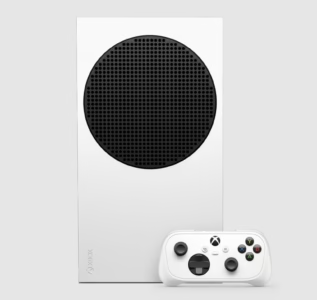
Pocket-sized Xbox Ctrl
Xbox Nano Controller. Announced 14 October 2026 by James Hunter. $49.99. Rechargeable battery. Programmable Action Button. Xbox Wireless and Bluetooth.