DRIFT AUDIO
Listen to this story
Choose a voice, then press play.
Pierre Paulin drew the Dune landscape in 1970 and never saw it built. Fifty-six years later, it hosted a 50-hour mixtape session in Mexico City.
In 1970, Pierre Paulin drew a piece of furniture that had no real precedent. He called it Dune, and the idea behind it was almost architectural in ambition: rather than designing a sofa as a discrete object, Paulin wanted to design a landscape, a modular, fluid seating system that people could move through and rearrange rather than simply sit on. It was conceived at the height of his experimentation with stretch fabrics and continuous form, the same period that produced his Mushroom and Tongue chairs, but Dune was never manufactured during his lifetime. The idea sat unrealized in his archive for decades, a footnote in a career that was already, by 1970, defining an entire era of French design.
It took his son to bring it into the world. Benjamin Paulin, who took on the task of managing his late father’s design legacy, founded the studio Paulin, Paulin, Paulin with his wife Alice Paulin on the premise that preserving that legacy meant something closer to continuing it than archiving it. Dune became one of the studio’s signature projects, released in an extremely limited edition and treated less as a historical reissue than as a living piece of the elder Paulin’s unfinished body of work. It has since become one of his most celebrated designs, despite, or perhaps because of, the fact that it spent most of its existence as an idea on paper rather than an object in a room.
That history is what makes its latest appearance feel unusually fitting. This August, Dune became the physical setting for a very different kind of creative act: the recording of a connective mixtape between British producer Fred again.. and the Mexico City trio Latin Mafia.
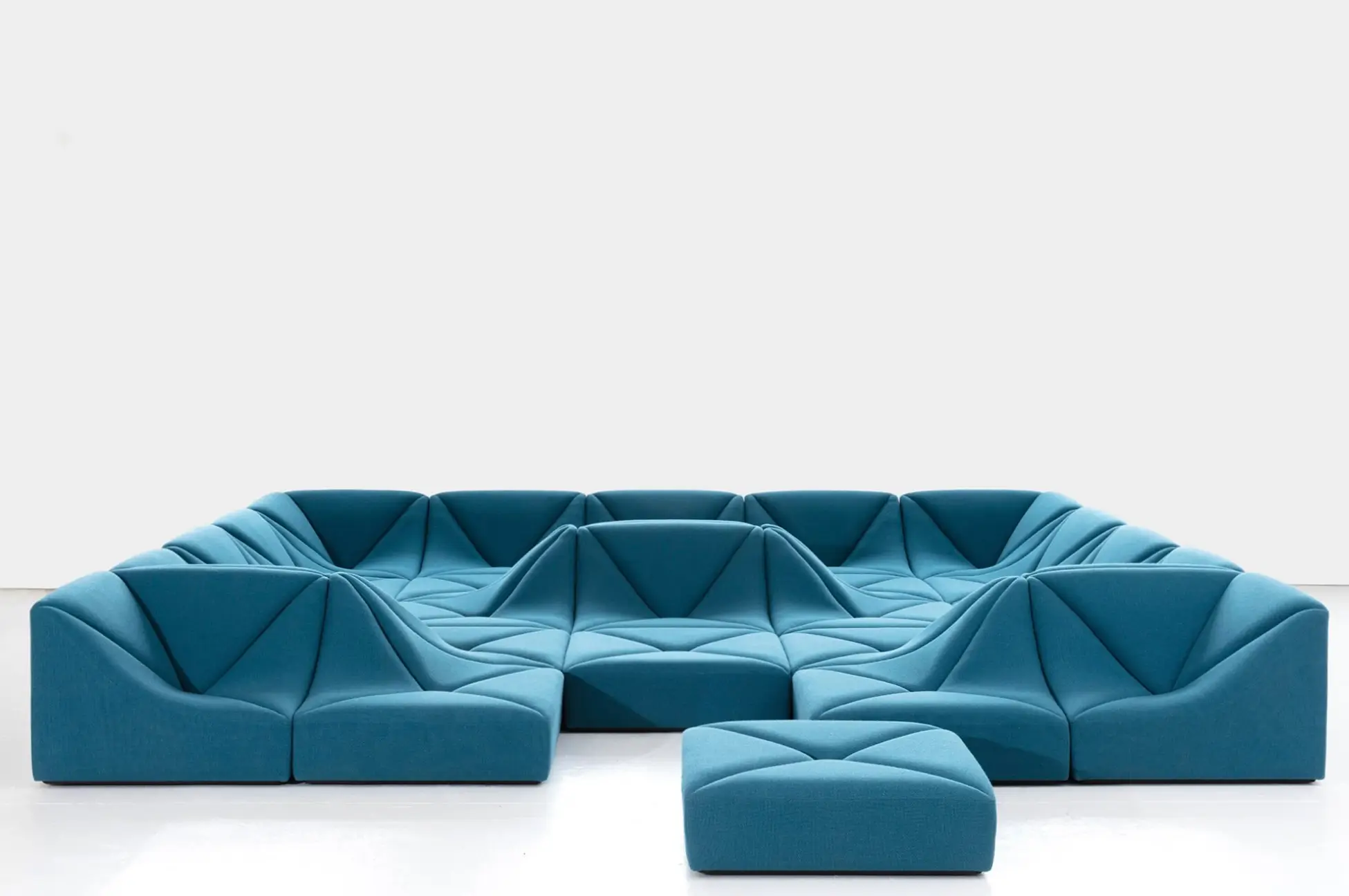
Blue modular sofa with sculptural geometric upholstery and matching ottoman displayed against a minimal white background.
in
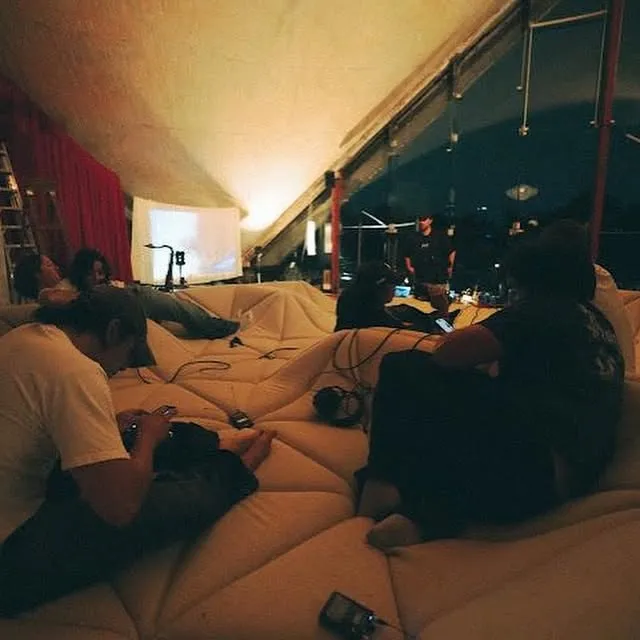
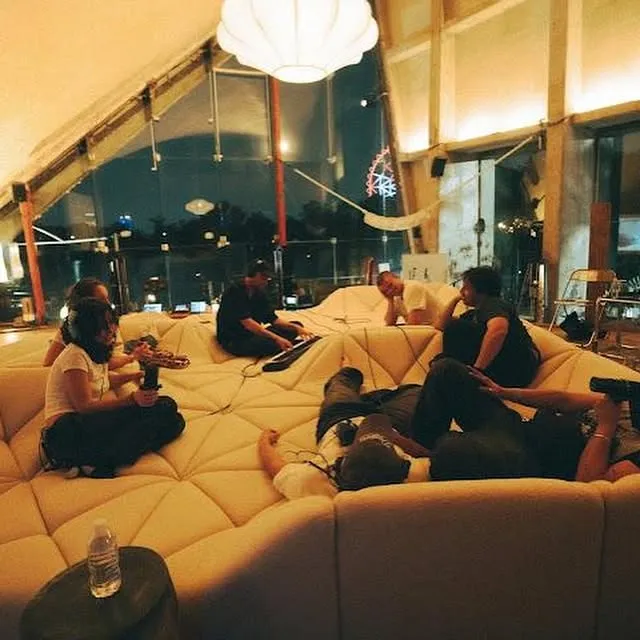
The session took place at LagoAlgo, a cultural centre built into a restored 1964 lakeside pavilion in Mexico City’s Bosque de Chapultepec. Originally designed by architect Alfonso Ramírez Ponce as the Restaurante del Lago, the building’s hyperbolic paraboloid roofline made it a minor landmark of 1960s Mexican modernism long before it reopened in 2022 as a hybrid gallery and restaurant, managed by the Mexico City gallery OMR alongside restaurant group CMR. It is now a working exhibition space as much as a dining destination, and it was there, on July 28, that Fred again.. and Latin Mafia locked themselves in with the stated goal of finishing a mixtape and not leaving until it was done.
What followed was recorded almost entirely in public. The pair launched a continuous YouTube livestream titled “making a mixtape with latin mafia and staying here until we finish it,” broadcasting everything from late night vocal takes to sudden production breakthroughs for roughly 50 unbroken hours. A custom McIntosh sound system, built around the company’s XRT2.1K floorstanding speakers, served as the session’s reference monitors, later showing up prominently in the music video for the tape’s “Te Estoy Correteando.” By the night of July 30, the tape, titled ‘9 months & 50 hours’ in reference to how long the two acts had been quietly trading ideas before this session, was finished. Hours later, Fred again.. and Latin Mafia played it live for the first time at a sold out show at Palacio de los Deportes.
Fourteen tracks made the final cut, ranging from club oriented cuts like “Bonita” and “Quiereme” to reworked versions of songs by Brian Eno and Jon Hopkins, alongside collaborations built in with Lil Yachty and composer Mabe Fratti. The project arrived as the second act of a longer rollout: a week earlier, the duo had released “Under the fabric (Mexico City, 11th December 2025),” a 35-minute film documenting an earlier, spontaneous live session recorded under a separate fabric installation by Dutch artist Boris Acket.
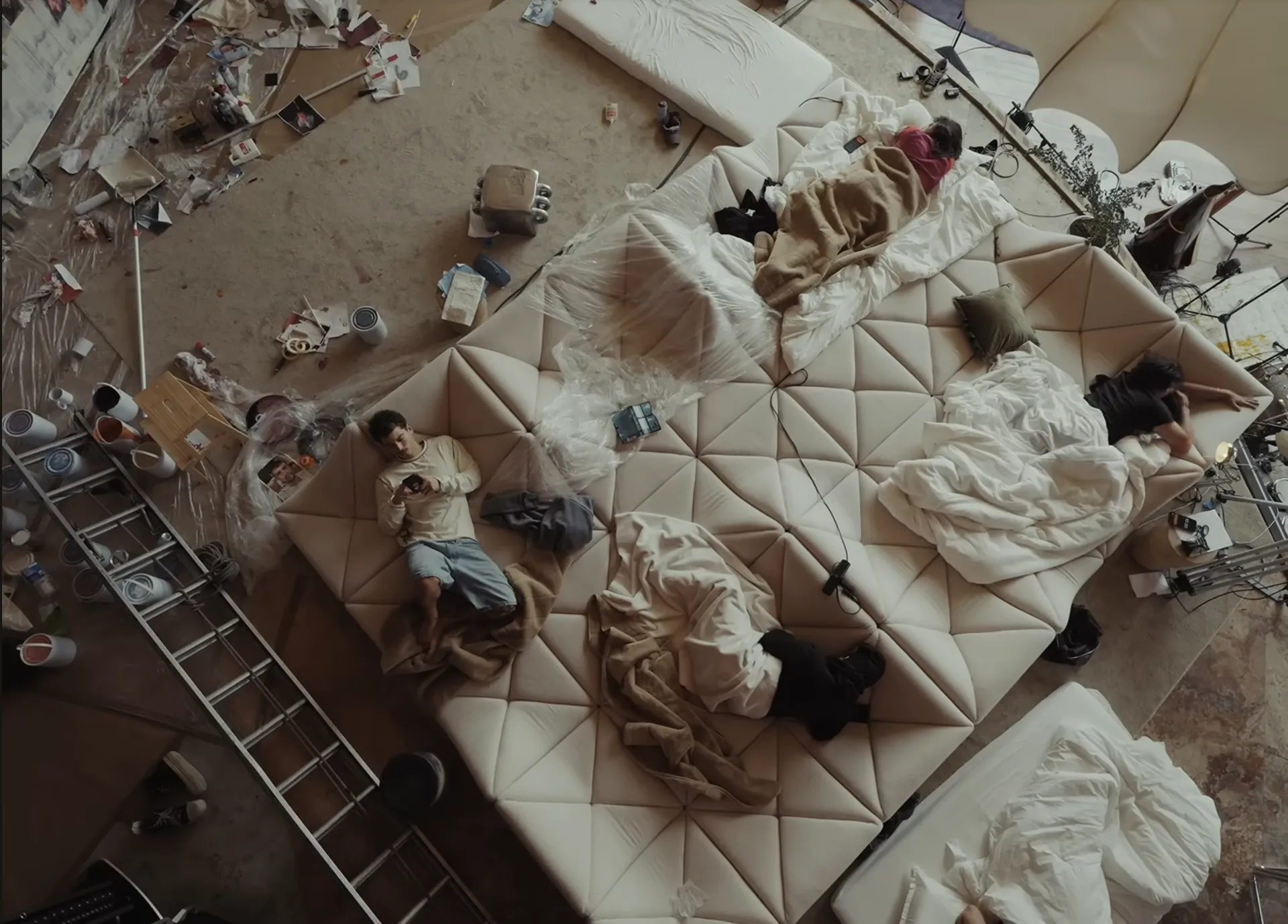
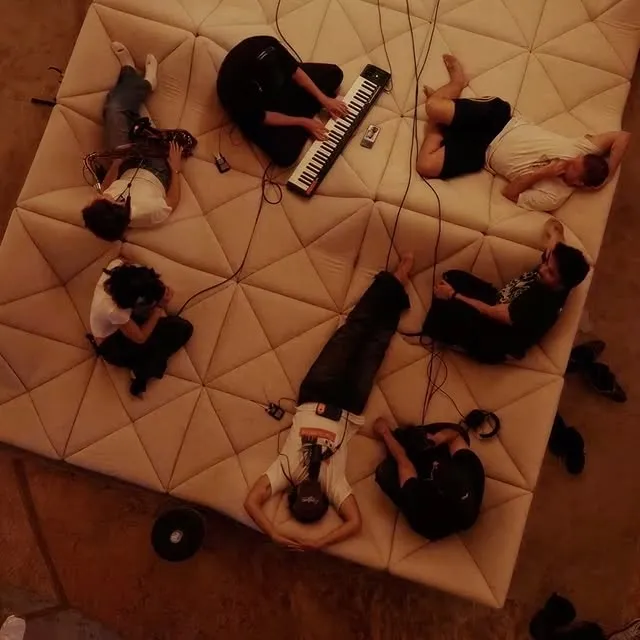
Throughout the 50-hour livestream, though, it was Paulin’s Dune landscape that anchored the room. Fred again.. and Latin Mafia worked from directly within the piece, lounging across its continuous, dune-like forms as they built out the tape’s tracklist, treating the furniture less as a backdrop than as an active part of the creative process.
who
Understanding why a nearly 60-year-old chair idea feels at home in a livestreamed recording session requires understanding what Paulin was actually trying to do with furniture in the first place. Born in Paris in 1927, Paulin trained at the École Camondo after an earlier, aborted attempt at becoming a sculptor and stone carver. He began design in the 1950s, working first with Thonet and then, starting in 1958, with the Dutch manufacturer Artifort, for whom he would eventual design more than 200 pieces of seating. It was during that period that he patented a method for using stretch jersey fabric, an idea borrowed directly from swimwear construction, that let his furniture achieve continuous, seamless curves rather than the paneled, upholstered forms that had defined furniture design before him.
That technical innovation became the foundation for a body of work, include the Mushroom chair, the Tongue chair and the Ribbon armchair, that read as sculpture objects as much as function seating, and that quickly earned institution recognition: the Museum of Modern Art acquired his F300 lounge chair and F577 Tongue chair into its permanent collection in 1968. Paulin’s reputation eventually carried him into a very different kind of commission. In 1971, President Georges Pompidou tasked him with redesigning private rooms at the Élysée Palace, work that Paulin himself describe as bringing modernity into the mid of French political power. He returned to the Élysée again in 1984 to design offices for President François Mitterrand, cementing a leg that stretched across furniture, interiors and, in his words, an understanding that in every commission, context was everything. When Paulin died in 2009, President Nicolas Sarkozy called him the man who made design an art.
leg
The LagoAlgo install is not an isolated gesture for Paulin, Paulin, Paulin. Since taking over stewardship of his father’s archive, Benjamin Paulin has repeatedly positioned the studio’s work at intersections with contemporary culture rather than treating it purely as historical preservation. Earlier this year, he launched Sounds Like Paulin, a culture label built around music, which he has described as an attempt to turn the idea of the salon into an immersive sound based meeting place, an environment designed to bring together artists and friends who might never otherwise have crossed paths. Placing Dune inside a mixtape session between a British electronic producer and a Mexico City R&B trio fits squarely inside that project’s logic.
In a statement introducing the studio’s involvement in the Fred again.. and Latin Mafia session, Paulin, Paulin, Paulin described the collide as a continuation of an ongoing dialogue with contemporary culture figures, framing the goal as placing the elder Paulin’s timeless designs at the center of present-day artistic expression rather than preserving them behind glass. It is a fitting way to treat a piece that was, by definition, always meant to be inhabited rather than displayed: Dune was conceived as a landscape for people to move through and gather in, and for 50 hours in Bosque de Chapultepec, that is more or less exactly what it became.
n
From the DRIFT archive: Cornell Team Develops Ultrablack: The “Darkest Fabric Ever” That Reflects Close to No Light
Related Articles

Miffy Gets Her Ceremony Best: United Arrows Dresses Dick Bruna’s Rabbit for KIDDY LAND’s 80th
A Miffy mascot in United Arrows’ formal-occasion wardrobe, and a pouch where she peeks out […]