DRIFT AUDIO
Listen to this story
Choose a voice, then press play.
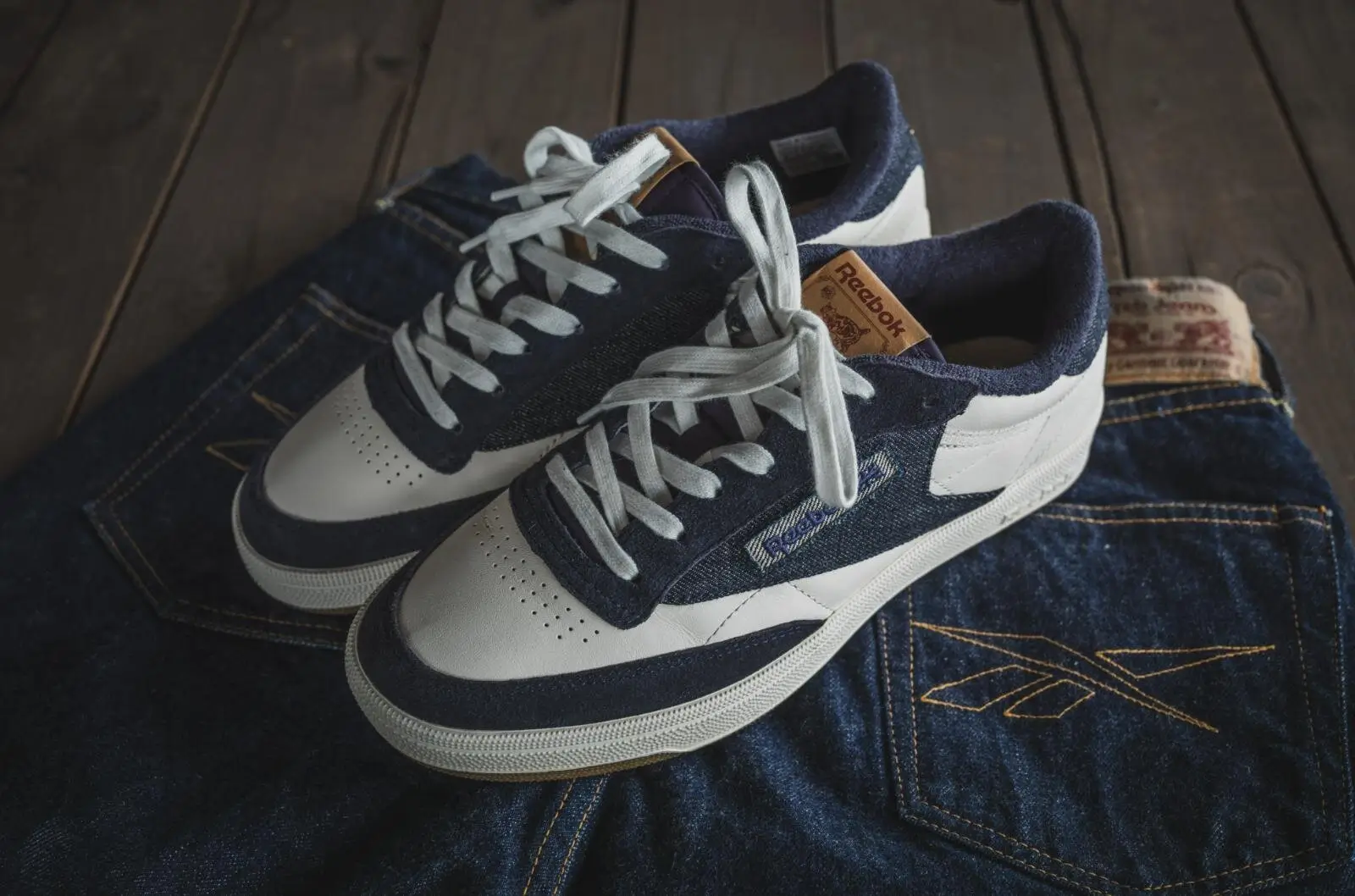
Reebok and TCB Jeans extend their collision from denim into footwear with the Club C 85 Vintage TCB Jeans, arriving July 24.
A pair of white leather court shoes, laced up and sitting in a shop window, rarely announces much on its own. The context around this one does the talking. On July 24, Reebok‘s directly managed stores in Japan begin selling the Club C 85 Vintage built in partnership with TCB Jeans, the Kurashiki, Okayama denim maker known for chasing the exact weight, weave, and fade of 1950s American workwear. It is a unisex release, distributed through Reebok’s own retail network rather than a wider wholesale rollout, which keeps the drop tight and largely confined to Japan at launch.
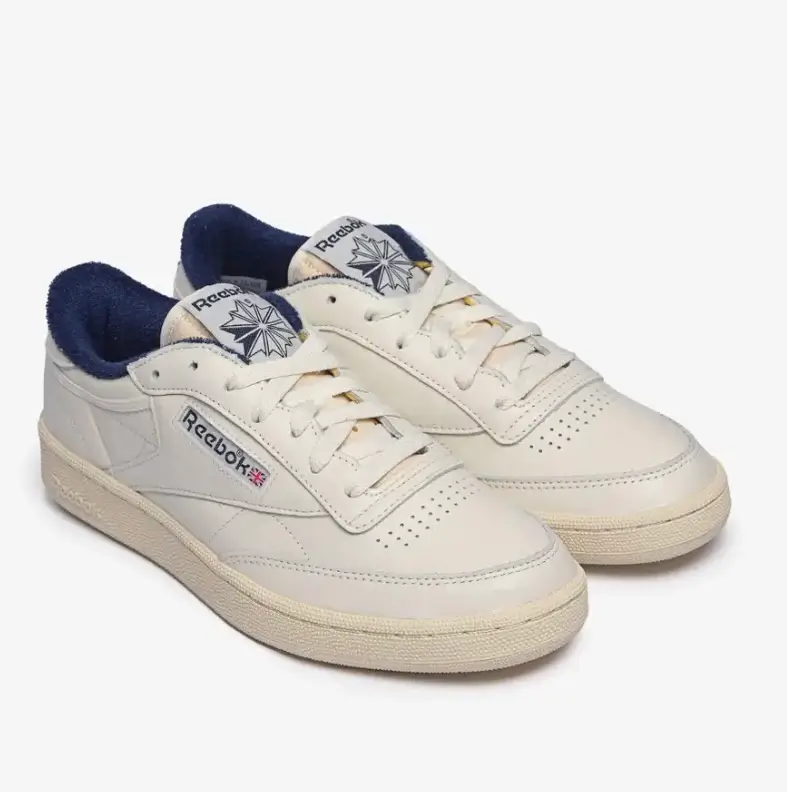
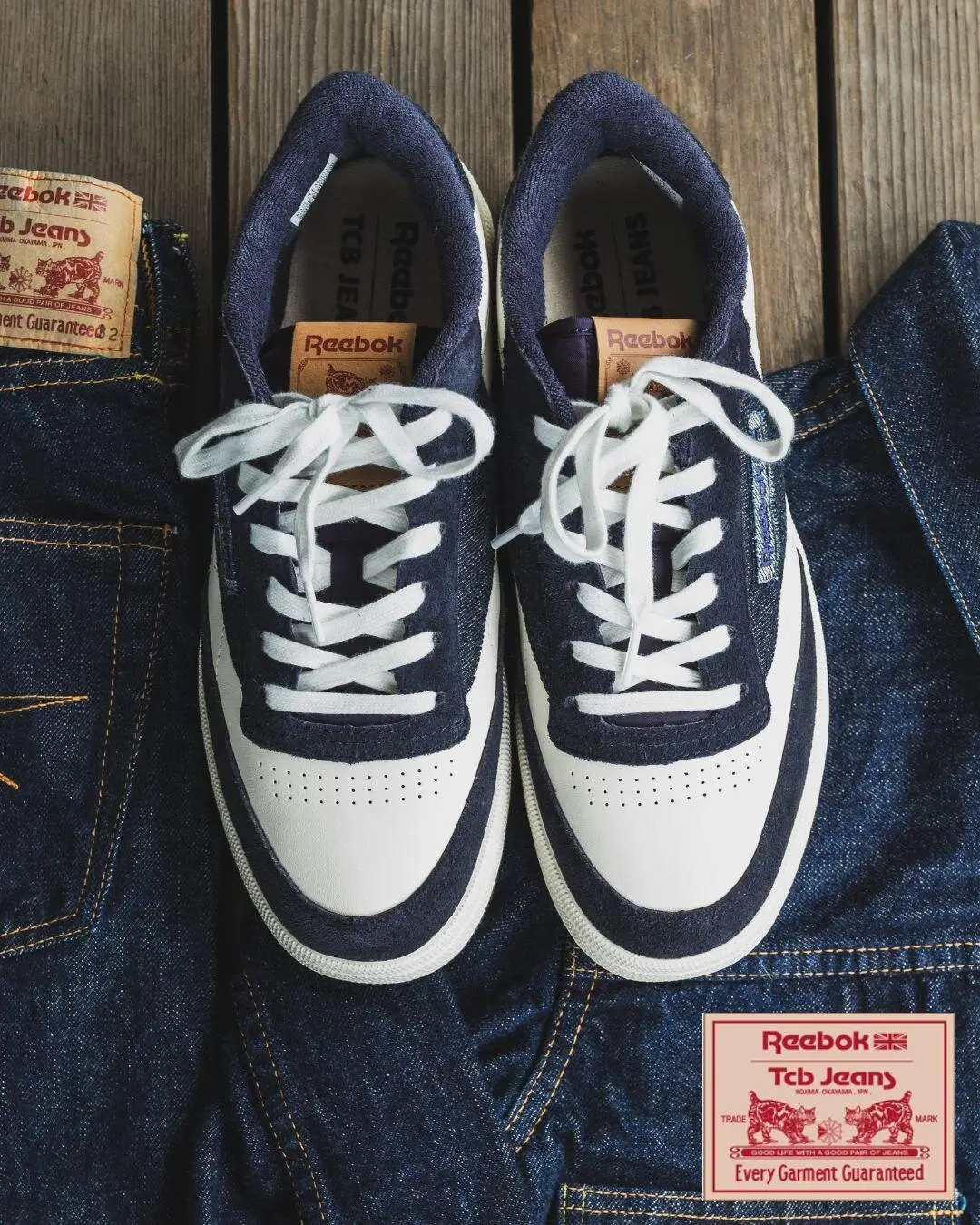
Reebok Club C presented in an off-white leather finish with navy terry lining and heritage branding, emphasizing the model’s understated vintage aesthetic.
The pairing is not an obvious one on paper. Reebok built its name on tennis courts and gym floors. TCB Jeans spends its days replicating shuttle loom selvedge denim inside a converted Kojima textile factory. But look at the last twelve months of Japanese footwear collaborations and the logic becomes clearer: heritage sportswear brands have been reaching further into workwear and denim culture for texture, and TCB has become one of the go-to partners for that kind of crossover, following its earlier collaboration with the same sports brand.
Kojima itself matters here as much as either brand name. The area, part of Kurashiki in Okayama Prefecture, has spent the better part of a century as Japan’s denim manufacturing center, home to dozens of small mills and finishing workshops that grew out of the region’s earlier trade in school uniforms and workwear. TCB operates out of a converted factory space there, with a small retail shop built into the same building where the jeans are cut and sewn. A shoe collision born out of that environment carries a different weight than one designed purely as a marketing exercise from a design studio elsewhere, if only because the people signing off on stitch counts and hardware choices are the same people running the sewing machines downstairs.
stir
TCB Jeans was founded in 2012 by Kojima native Yuichi Inoue, and its very first release was the 50’s line, a reconstruction of a 1950s-era jean silhouette that the brand still treats as its internal benchmark for cut, fabric weight, and fade character. Every subsequent TCB model gets measured against that original pair. It is worth knowing that history here, because the brand has now built two collaborations with Reebok around that same 50’s foundation rather than a newer, more fashion-driven pattern.
The first of those came in October 2025, when TCB and Reebok released a limited jacket and pair of jeans built on the 50’s silhouette, with a Reebok vector-mark stitch worked into the back pocket and a co-branded patch depicting the TCB house cat wearing an Instapump Fury. Inoue wrote about the project himself on the TCB Jeans news page, tracing it back to being a teenager in the 1990s who paired vintage XX-model denim with technical Reebok sneakers and could never afford the pairs he wanted. He described finally making jeans with the brand as circling back to that same obsession from the other direction, less a marketing tie-up in his telling than a personal loop closing.
That original apparel drop sold in limited numbers at Reebok Classic stores and through TCB’s own retail points around Kurashiki. The footwear extension releasing this week reads as a continuation of the same idea rather than a separate campaign: take the reference points of vintage American workwear, TCB’s exacting reproduction methods, and Reebok’s own archive, then apply them to a shoe instead of a jean.

Dark indigo selvedge jeans feature a slim straight fit with rolled cuffs, paired with black leather boots for a clean heritage-inspired look.
TCB’s whole identity rests on precision most casual denim buyers never notice: fabric woven on old shuttle looms that produce a narrower bolt than modern industrial mills, indigo dyed in small batches, and pattern shapes lifted from period-correct source garments rather than a modern fit block wearing a vintage label. The brand’s 50’s line, the one both Reebok merge draw from, is described on TCB’s own site as the internal yardstick the company measures every other model against, the silhouette, thickness, and shading it treats as its own definition of correct. That kind of stated obsession with getting a single reference point exactly right is a very different starting position than the average streetwear collaboration, and it shapes how a partner brand like Reebok gets folded into the process. Rather than asking TCB to chase a trend, Reebok effectively borrowed TCB’s fixation on historical accuracy and applied it to its own 1985 archive.
first
The original Reebok x TCB Jeans apparel collision, a jacket and a pair of jeans built on that same 50’s pattern, arrived at Reebok Classic stores and TCB’s own retail points in mid October 2025.
Reebok’s vector logo appeared stitched into the back pocket of the jeans, a detail easy to miss unless a wearer already knew to look for it, and the collaboration’s limited-run patch put a playful spin on the partnership: TCB’s house cat mascot, illustrated wearing a pair of Instapump Fury sneakers, a nod both to Reebok’s own archive and to Inoue’s teenage fixation with the shoe. It is the kind of detail that rewards close attention rather than demanding it, consistent with how TCB tends to handle outside collide gen.
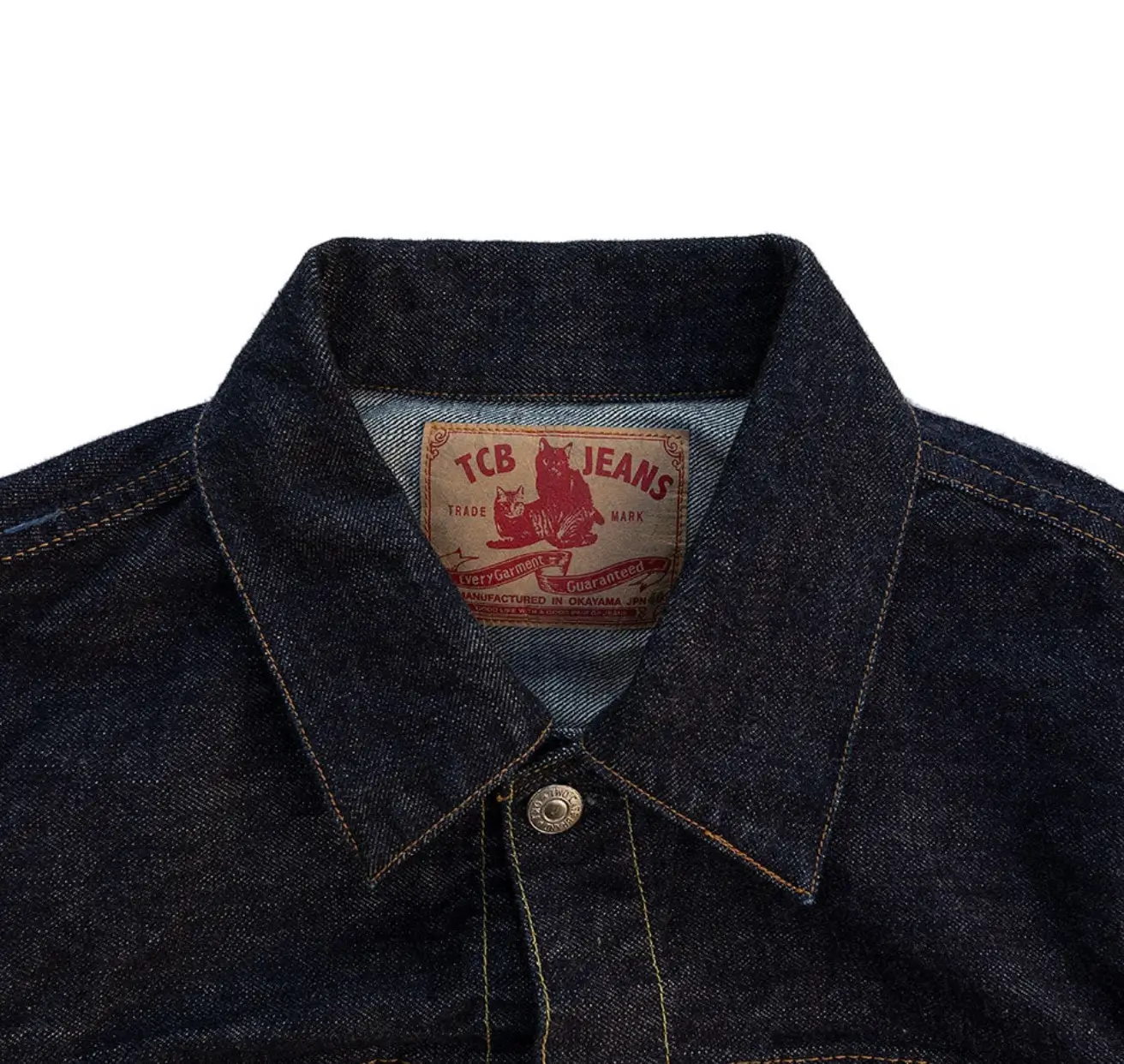
A close-up highlights the dark indigo selvedge denim, crisp pointed collar, contrast stitching, and signature TCB Jeans leather label at the neckline.
read
The base silhouette is the Club C 85 Vintage, Reebok’s own reworking of the original 1985 Club C tennis shoe using heavier garment leather and a construction meant to echo the shoe’s earliest production runs rather than its later, mass-market versions. Reebok’s own product copy for the Vintage line describes it as built around premium full-grain leather with a low profile and terry-lined tongue and collar, a fairly faithful nod to a shoe that started life on a tennis court in Boston four decades ago.
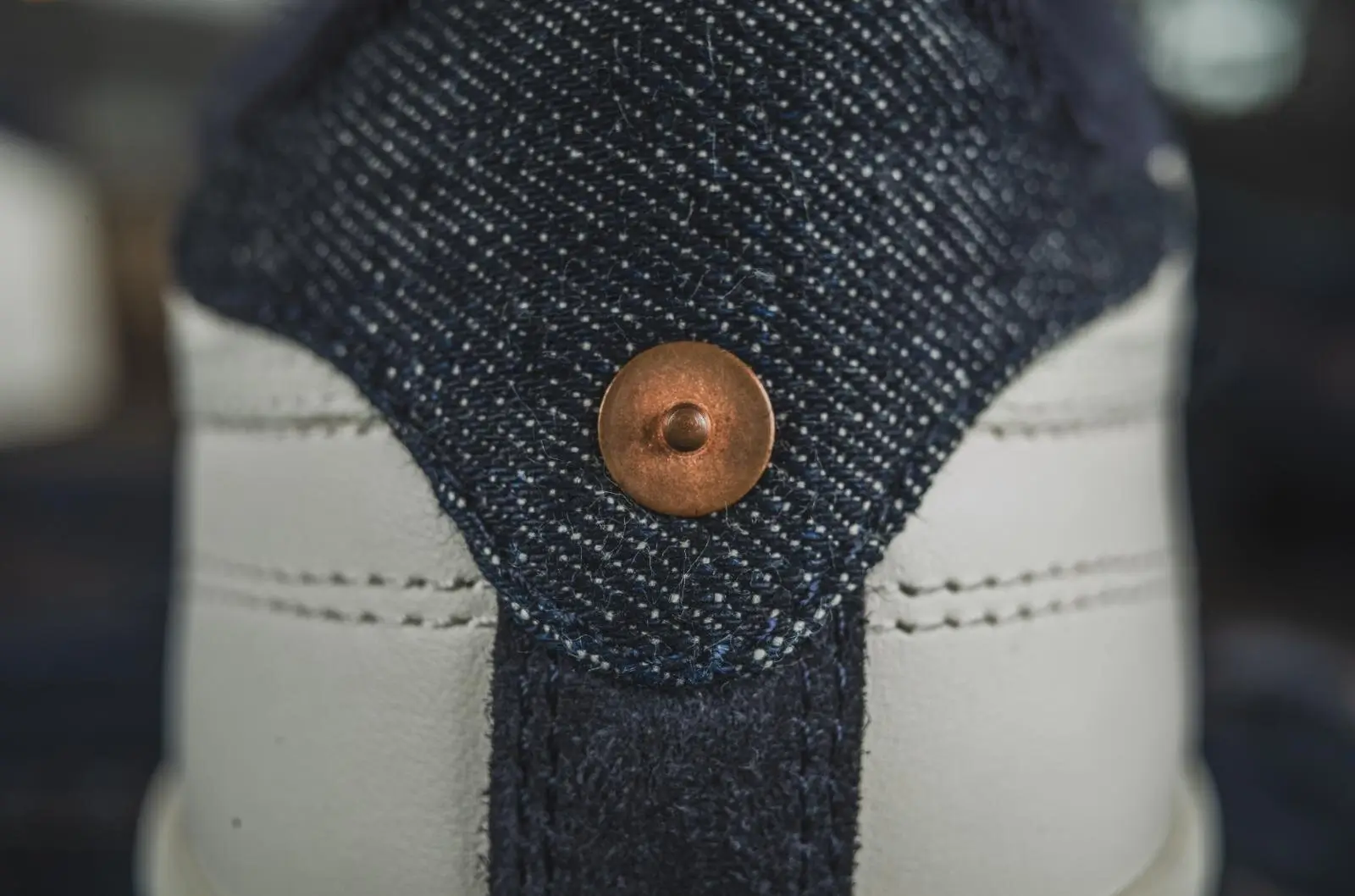
What TCB adds to that base has not been fully detailed at the time of writing, and the release listing does not itemize each construction change. Given the pattern set by the apparel collaboration, expect the collaborative touches to land on TCB’s usual register: subtle branding worked into stitching or a heel patch rather than a loud graphic treatment, and likely a colorway or material choice that leans toward the aged, off white tones TCB associates with early denim rather than Reebok’s typical bright whites. That restraint has defined nearly every TCB collision to date, whether with Reebok or with the small workwear labels it has partnered with domestically.
The choice of the Club C 85 as a vehicle also makes sense stylistically. It is one of Reebok’s most heavily reissued archive shoes, having been reworked by everyone from White Mountaineering to JJJJound to Eames Office over the past several years, and its simple leather upper and low profile leave room for a denim-adjacent brand to make a mark without fighting the base silhouette’s own design vocab.
It also happens to be a shoe with an established life next to denim already. Reebok’s own marketing for the Vintage line leans on exactly that pairing, describing the shoe as something to wear with jeans, shorts, or a skirt without needing to think too hard about it. That everyday versatility is part of why Club C 85 collaborations tend to read as wardrobe additions rather than statement pieces, and a TCB-built pair, whatever finish it ends up wearing, is likely to slot into an outfit the same understated way TCB’s own jeans do: recognizable up close, easy to miss from across a room.
A garment-leather sneaker paired with a Kojima-made jean has become something of a known combination in Japanese streetwear circles already, largely because both categories reward the same kind of patience. Leather breaks in. Denim fades. Neither looks finished on day one, and both improve with wear in ways a synthetic sneaker or a pre-distressed jean simply cannot replicate. Whether or not TCB’s design touches on the Club C 85 reference that idea directly, the pairing of brands makes the connection almost automatically.
different
There is a case for reading this release less as a single drop and more as a slow-burn partnership. TCB’s founder framed the first Reebok collaboration in explicitly personal, long-arc terms, tying it to a specific memory of wanting an Instapump Fury as a teenager and never getting one. A brand that talks about its own history that way tends to keep building on a relationship rather than treating it as a one-time licensing deal, and the fact that Reebok brought TCB back for a footwear piece within roughly nine months of the original apparel launch supports that reading.
It also fits a broader pattern in how Japanese denim and workwear labels have been engaging with international sportswear brands recently. Rather than a splashy, one-season logo mashup, these partnerships increasingly look like ongoing conversations between craftspeople, where a shoe brand hands its archive over to a denim maker and lets that maker’s own production philosophy, precise stitch counts, aged hardware, historically accurate weights, shape the outcome instead of overwriting it.
interpret
Part of the reason the Club C 85 keeps attracting this kind of treatment traces back to what the shoe actually was. Reebok introduced it in 1985 as a tennis shoe originally known as the Club Champion, built around garment leather that gave it a softer, more supple feel than most court shoes of its era. It found its way off the court almost immediately and has stayed in near-constant rotation ever since, cycling through collaborations with skate brands, outdoor labels, fashion houses, and now denim workshops. Reebok marked the shoe’s fortieth anniversary in February 2025 with a dedicated anniversary edition built in the shoe’s original full-grain garment leather, a release that doubled as a reminder of how closely the brand still ties the Club C 85’s identity to its earliest production runs, the same instinct now guiding the TCB collaboration.
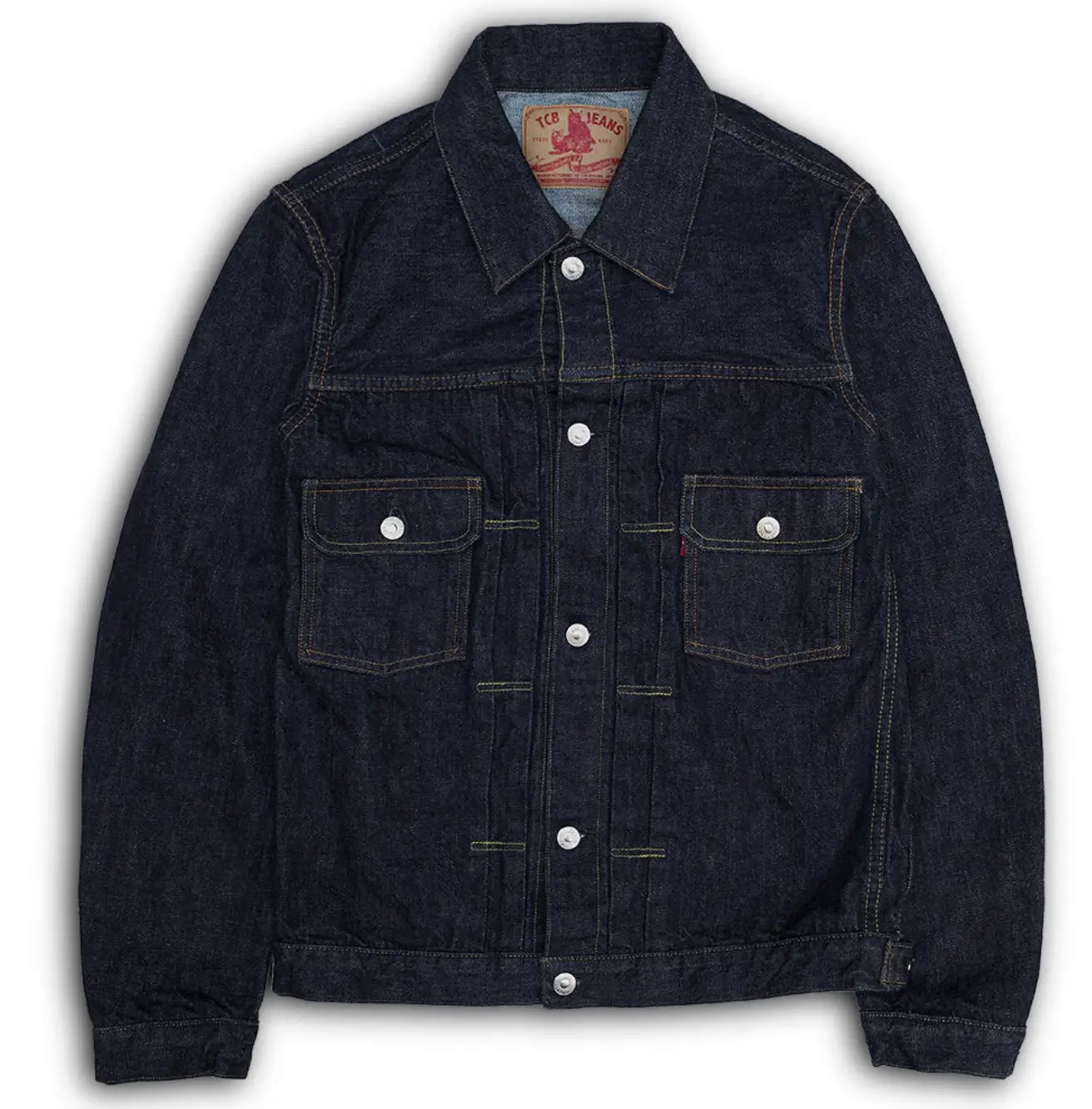
The TCB Jeans selvedge denim jacket pairs a classic Type II-inspired silhouette with dark indigo denim, contrast stitching, and traditional workwear detailing.
That longevity gives a brand like TCB something rare in a collaboration: a base product old enough, and simple enough, to carry a genuinely different cultural reference without losing its own identity. A shoe built in 1985 sitting next to jeans patterned after a decade earlier is, in its own quiet way, two different eras of American manufacturing meeting inside a Japanese factory and a Japanese retail network, filtered through the two brands’ shared interest in getting old things exactly right.
The Club C name itself is a shortened version of Club Champion, and the shoe’s earliest advertising leaned heavily on the tennis court pedigree it shared with contemporaries built for players like Boris Becker and John McEnroe. None of that tennis lineage carries much weight in how the shoe gets worn today, but it explains the low profile, the flat sole, and the wide, stable toe box that has made the silhouette so adaptable to reinterpretation. A shoe originally engineered for lateral movement on a hard court turns out to also be a fairly ideal blank canvas for a convincer working in an entirely different material.
hint
The Club C 85 Vintage TCB Jeans releases Friday, July 24, 2026, through Reebok’s directly managed stores. As with the apparel drop that preceded it, expect quantities to be limited and concentrated in Japan at launch, with resale markets likely to pick up any international demand that Reebok’s own retail footprint does not cover. Reebok has a track record of following limited domestic Club C releases with wider distribution later in a given cycle, though nothing has been confirmed publicly about an international rollout for this particular pair.