DRIFT AUDIO
Listen to this story
Choose a voice, then press play.
Sharmistha Ray did not paint a wall in Pittsburgh. They painted the floor people actually play on, and the game itself became part of the composition.
Public murals almost always mean a wall. Sharmistha Ray’s newest commission skips the wall entirely and goes straight to the ground people stand on. Titled Geometry of Play, the work spans three pickleball courts at Arts Landing, a new civic space in downtown Pittsburgh, and it is being described by multiple outlets covering the unveiling as the first artist designed pickleball court project in the country.
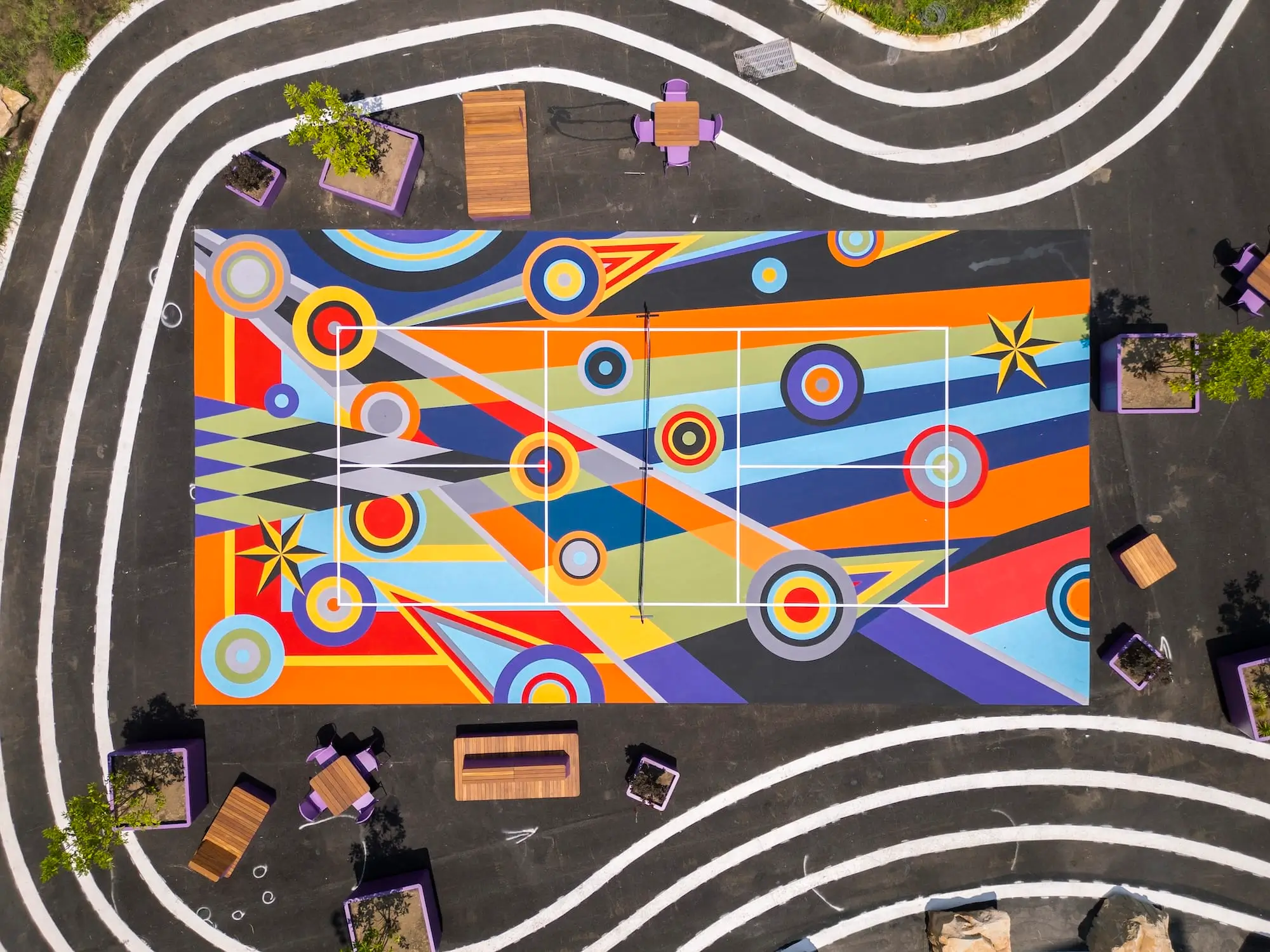
Each court measures a standard 22 by 40 feet, a footprint that most people would call nondescript before Ray got to it. Painted directly onto the playing surface rather than mounted or applied around it, the mural transforms three ordinary rectangles of pavement into a single, continuous visual field that only fully reveals itself once players and spectators are actually standing inside it.
The commission comes from the Pittsburgh Cultural Trust, which selected Ray as one of ten artists contributing to Arts Landing’s inaugural public art program, a slate that ultimately grew to twenty three individual works across the site.
stir
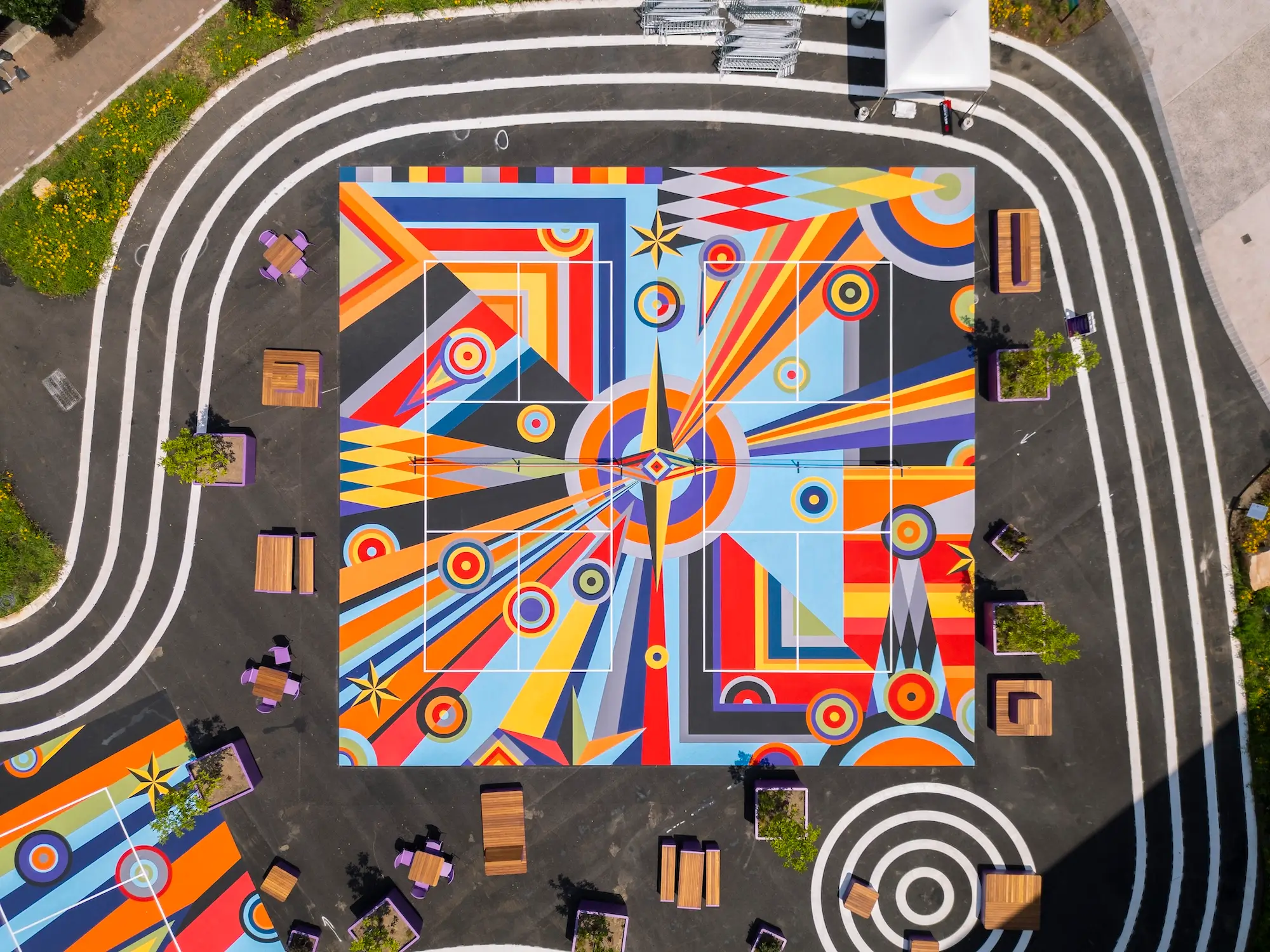
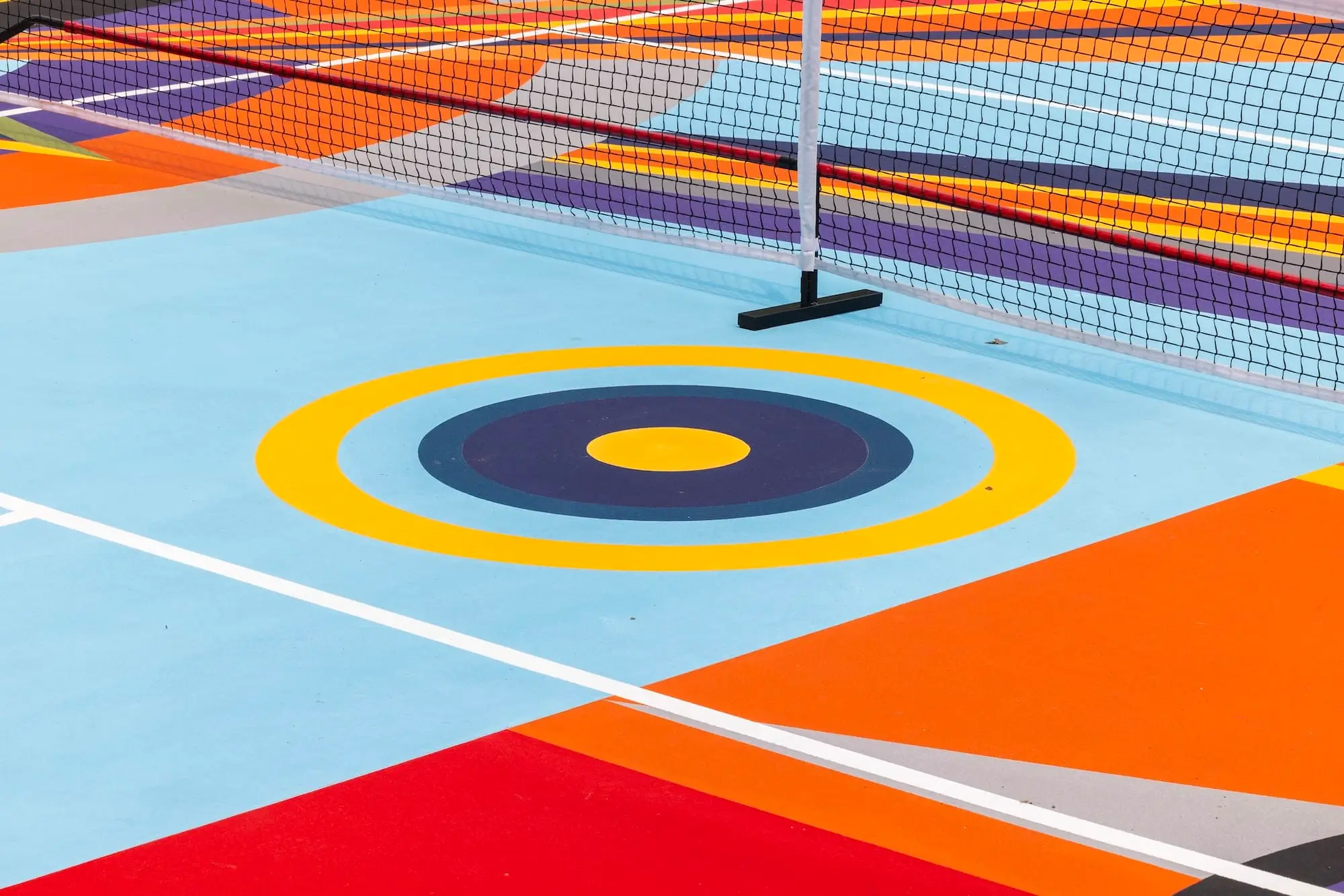
Up close, Geometry of Play reads the way a Ray painting usually reads: interlocking circles, triangles, grids, and radiating pathways layered into a dense, kaleidoscopic field. Target like spheres, diamonds, and star shapes intersect across the rectangular planes of each court. Where two of the courts sit side by side, their combined geometry forms a near square with a compass like dial at the center, a shape one writer covering the unveiling described as almost readable as an eye when seen from above.
The palette runs the full ROYGBIV spectrum, a choice Ray and the Cultural Trust have both framed as a deliberate nod to inclusion rather than a purely aesthetic decision. Seen from a drone, the effect has been compared to architecture, a quilt, and a mandala all at once, while at ground level, standing inside the composition, it functions more like an active painting that changes depending on where a player happens to be standing or moving at any given moment.
That shifting quality is the actual engine of the piece. A conventional mural holds still no matter who is looking at it. Geometry of Play does not, because pickleball itself keeps moving through it, so the visual experience of the work is inseparable from whether a game happens to be in progress, who is playing, and where the ball currently is.
For a licensed placement, this section would carry an aerial photograph of the completed courts by Ross Ribblett, credited to the Pittsburgh Cultural Trust.
arrive
Ray has described the composition as drawing from the visual logic of historic board games, most directly Pachisi, the ancient Indian cross and circle game that was later adapted into Parcheesi in the United States. That lineage runs alongside the kaleidoscopic mandalas and architectural ornamentation that have anchored Ray’s abstract painting practice for years, a visual vocabulary rooted in South Asian traditions that Ray has consistently filtered through questions of queerness, migration, and belonging across bodies of work that extend well beyond this commission.
It is a fitting source for a piece built around a game board’s worth of rules. Pachisi’s cross shaped board already encodes structure, movement, and turn taking into pure geometry, long before anyone touches a paddle, and Ray’s mural effectively layers a second rule system, the actual boundaries and mechanics of pickleball, directly on top of that older one, letting both readings sit in the same physical space at once.
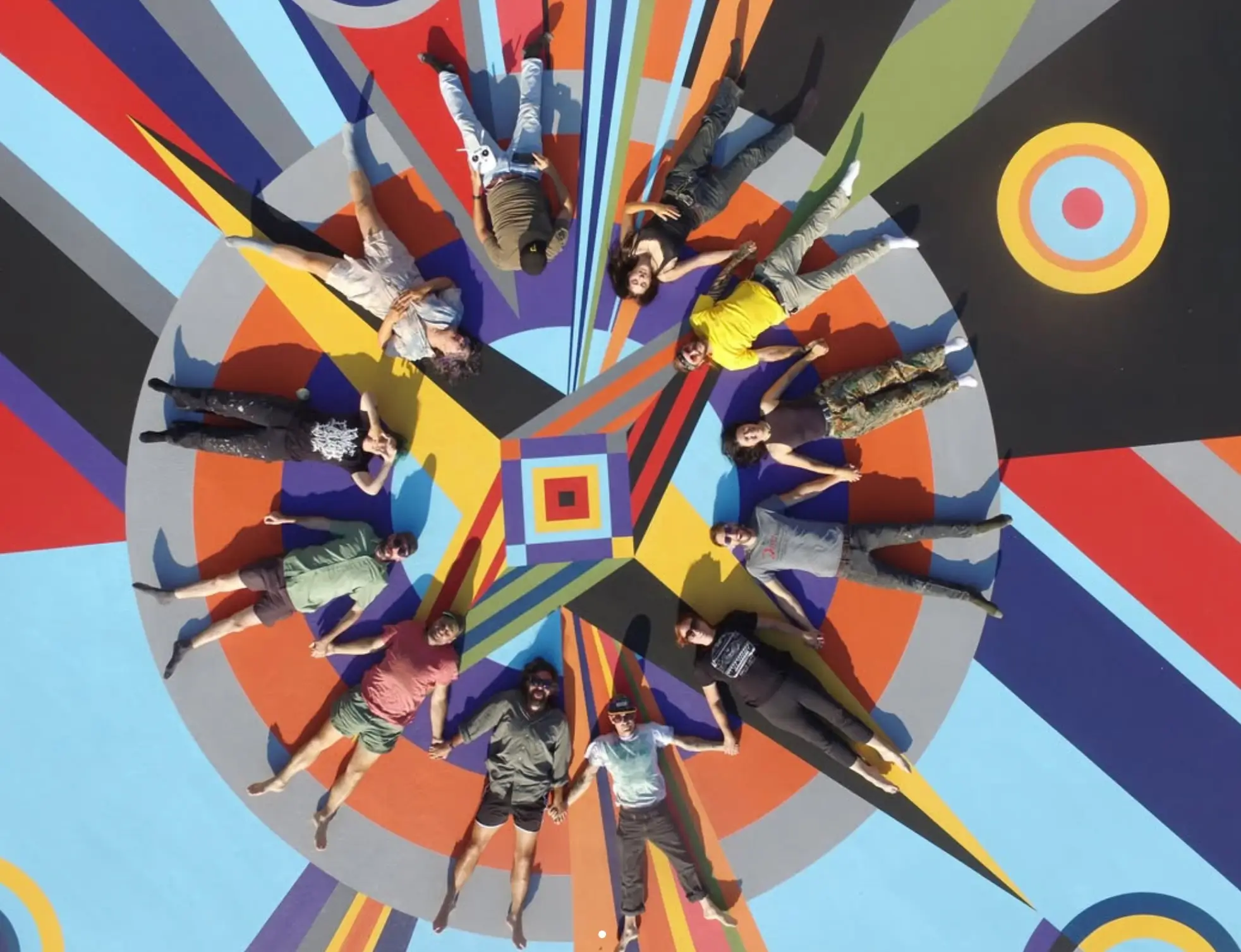
Participants gather in a circle on Sharmistha Ray’s vibrant geometric mural, highlighting the artwork’s role as a shared public space for community and recreation.
who
Sharmistha Ray, who uses they and them pronouns, is a visual artist and the Estella Loomis McCandless Assistant Professor of Art at Carnegie Mellon University, teaching in the same city where Geometry of Play now lives. Born in Kolkata and raised partly in Kuwait before settling in the United States, Ray works primarily in painting and drawing, with additional work in sculpture, installation, and electronic media, alongside a substantial body of critical writing on contemporary art practice.
Ray is also a co-founder of Hilma’s Ghost, a spiritualist feminist art collective that focuses on abstraction and research as collaborative, communal practice, an ethos that lines up closely with the participatory logic of Geometry of Play itself. Ray’s work has shown at institutions including The Aldrich Contemporary Art Museum, the Museu de Arte de São Paulo, and Pen Plus Brush, among many others, and Ray has received a Joan Mitchell MFA Grant, a Montblanc Young Artist Worldwide Patronage Award, and a TED Fellowship over the course of their career.
For a licensed placement, this section would carry a portrait of Sharmistha Ray credited to photographer Zachary Riggleman, per the artist’s own official materials.
extend
Geometry of Play is one piece inside a much larger civic project. Arts Landing, developed by the Pittsburgh Cultural Trust with landscape architecture firm Field Operations, is reported as a roughly 31 million dollar public space intended to host performances, gathering space, and now tournament level pickleball alongside free instructional clinics for the sport.
The public art program at Arts Landing, curated by Anastasia James, includes work by a wide roster of artists beyond Ray, among them vanessa german, Thaddeus Mosley, Shikeith, Mikael Owunna and Marques Redd, Lenka Clayton and Phillip Andrew Lewis, Darian Johnson, and John Peña. The pickleball courts specifically are part of an expansion tied to Picklesburgh, the city’s established pickleball festival, with the Pittsburgh Downtown Partnership citing investment in Arts Landing as what finally made a permanent, purpose built home for the sport possible downtown.
why
Pickleball has spent the last several years becoming one of the fastest growing recreational sports in the country, and its culture leans heavily social rather than solitary, with mixed skill levels and generations frequently sharing the same court. That communal, slightly chaotic energy is precisely what several writers covering the unveiling pointed to as the reason the sport, rather than a more solemn or competitive one, made sense as a home for this kind of work.
Ray’s broader practice has long circled questions of belonging, shared encounters across identity and generation, and inclusion expressed through abstraction rather than direct representation. A pickleball court, by design, already gathers exactly that mix of people. Painting directly onto the court rather than around it means the artwork cannot be separated from that social function even if someone wanted to; the mural and the game are, quite literally, occupying the same surface at the same time.
There is also a practical logic underneath the conceptual one. Public art commissioned for walls tends to be looked at, photographed, and passed by. Public art commissioned for a playing surface has to survive contact, weather, foot traffic, and the wear of an active sport, which puts real constraints on materials and application that a mural on a vertical wall would never have to negotiate. That the composition still reads clearly, and still functions as abstraction rather than simple decoration, once accounted for those constraints, is part of what has made the project stand out to the design and art press covering its unveiling this week.
The unveiling itself doubled as a small public event, with guests invited to actually play a round of pickleball across the finished courts rather than simply view the work from the sidelines, a detail that underlines how central participation is to the piece’s actual premise. Photography from that event shows the mural functioning exactly as intended: partially obscured by moving players, its geometry only fully legible in the gaps between rallies.
next
Geometry of Play is arriving alongside a notably full slate of public commissions for Ray. Forthcoming projects include a permanent glass mosaic mural at Grand Central Station in Manhattan, roughly 2,000 square feet of glass art at Pittsburgh International Airport’s renovated terminal, and an entire floor of artwork inside the University of Pittsburgh Medical Center’s new flagship hospital, alongside past public work completed for New York’s transit system.
Taken together, the run suggests an artist increasingly drawn to spaces defined by movement and transit rather than the traditionally static walls of a gallery, either that is an airport terminal, a subway platform, a hospital corridor, or, now, a sport played by moving across a marked rectangle of ground.
Related Articles
Winter Ran Down A Plywood Panel In Gaeta
Cy Twombly, Untitled (Winter Picture), 2004. Acrylic on plywood in the artist’s frame. Gagosian, Madison […]