DRIFT AUDIO
Listen to this story
Choose a voice, then press play.
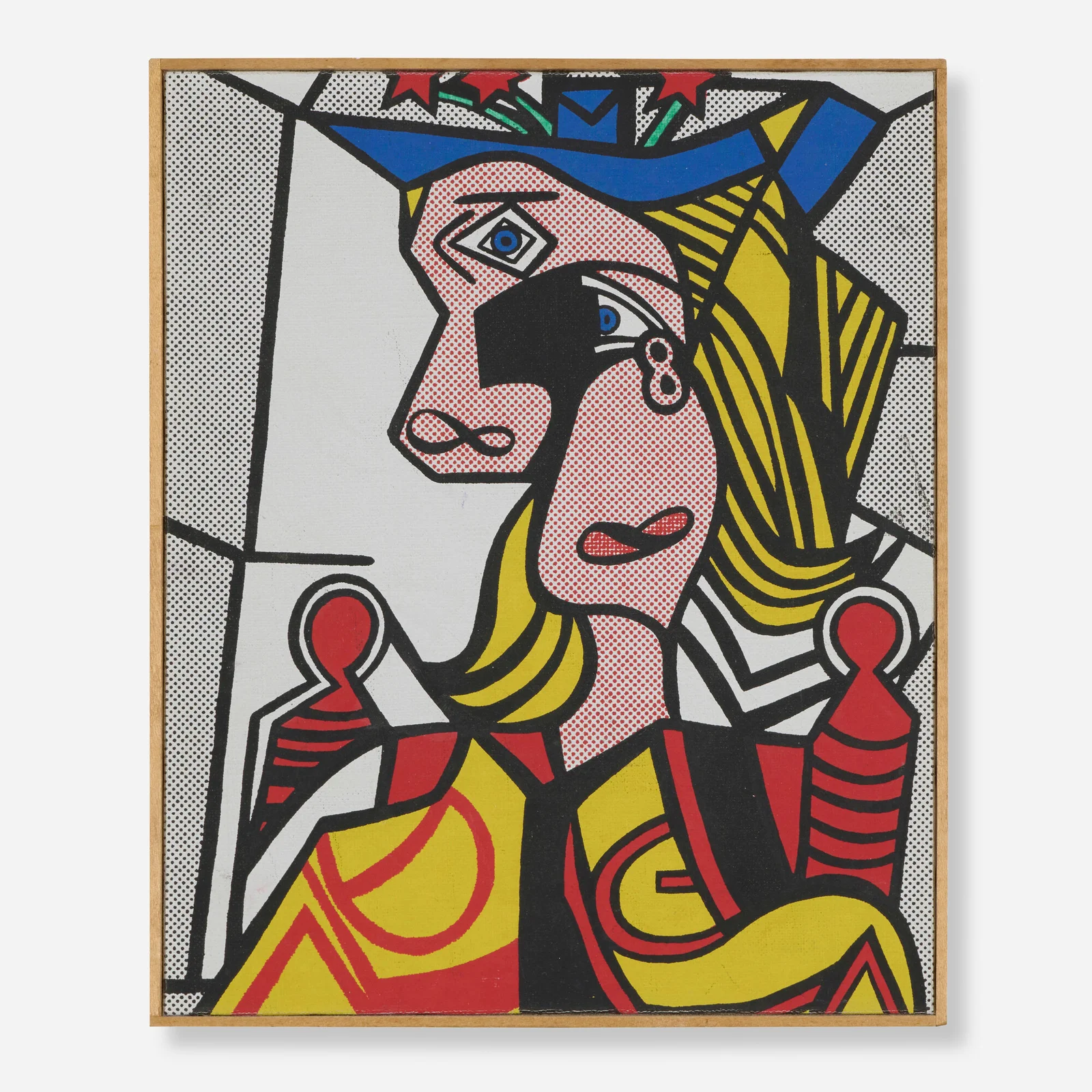
A palm sized 1970 silkscreen by Richard Pettibone, remaking Roy Lichtenstein’s own remake of a Picasso, sits at the center of one of postwar art’s strangest lineages.
Measure it and it barely clears seven inches on its longer edge. Acrylic and silkscreen on canvas, stretched over its own miniature bars, housed in its own tiny wood frame, the whole object could sit comfortably in two cupped hands. That scale is the entire argument. Richard Pettibone titled the work exactly the way an auction catalog would title the original, Roy Lichtenstein, Woman with Flowered Hat, 1963, then added his own date in parentheses, 1970, the year he actually made it. The title alone does the work of three artists and two eras of art history in a single line of text.
Pettibone made an edition of these, the Bonhams sale record lists number fifty three from a run of one hundred, and Phillips has moved multiple examples through its editions sales in the years since, with the Guy Hepner gallery citing an edition of twenty five for a related casting of the same subject. The exact edition size shifts slightly across dealer listings, a small inconsistency that is itself very on brand for an artist whose whole practice questioned what counts as an authoritative version of anything.
flow
Pablo Picasso painted the original Woman with Flowered Hat between 1939 and 1940, a portrait of his lover and muse Dora Maar, rendered with the fractured planes and jarring color he had spent decades refining. It is a serious, difficult picture, made in the years leading into the Second World War, and it eventually entered the collection of diamond dealer Laurence Graff, selling at auction in 2013 for a price that set a new benchmark, though for the Lichtenstein version rather than the Picasso.
That is because in 1963, Roy Lichtenstein took Picasso’s painting and ran it through his own visual machinery, translating the cubist portrait into his signature Ben Day dots and comic strip outlines. The Norton Simon Museum, which holds one of Lichtenstein’s own studies related to the subject, frames the move plainly: Lichtenstein re-created the Picasso in his simplified style, flattening a canonical modernist painting into the visual language of mass produced print. It was already an act of appropriation dressed up as homage, years before either word carried the critical weight it would later acquire in art writing.
Seven years after that, Pettibone added his own layer. He shrank Lichtenstein’s already-borrowed composition down to dollhouse scale, hand fabricating the stretcher bars and the frame so the object replicated not just the image but the entire physical apparatus of a painting, the Norton Simon’s own description notes that even the back of the stretcher was built to match. Three artists, three separate decades, one continuous argument about ownership passed hand to hand like a folk song.
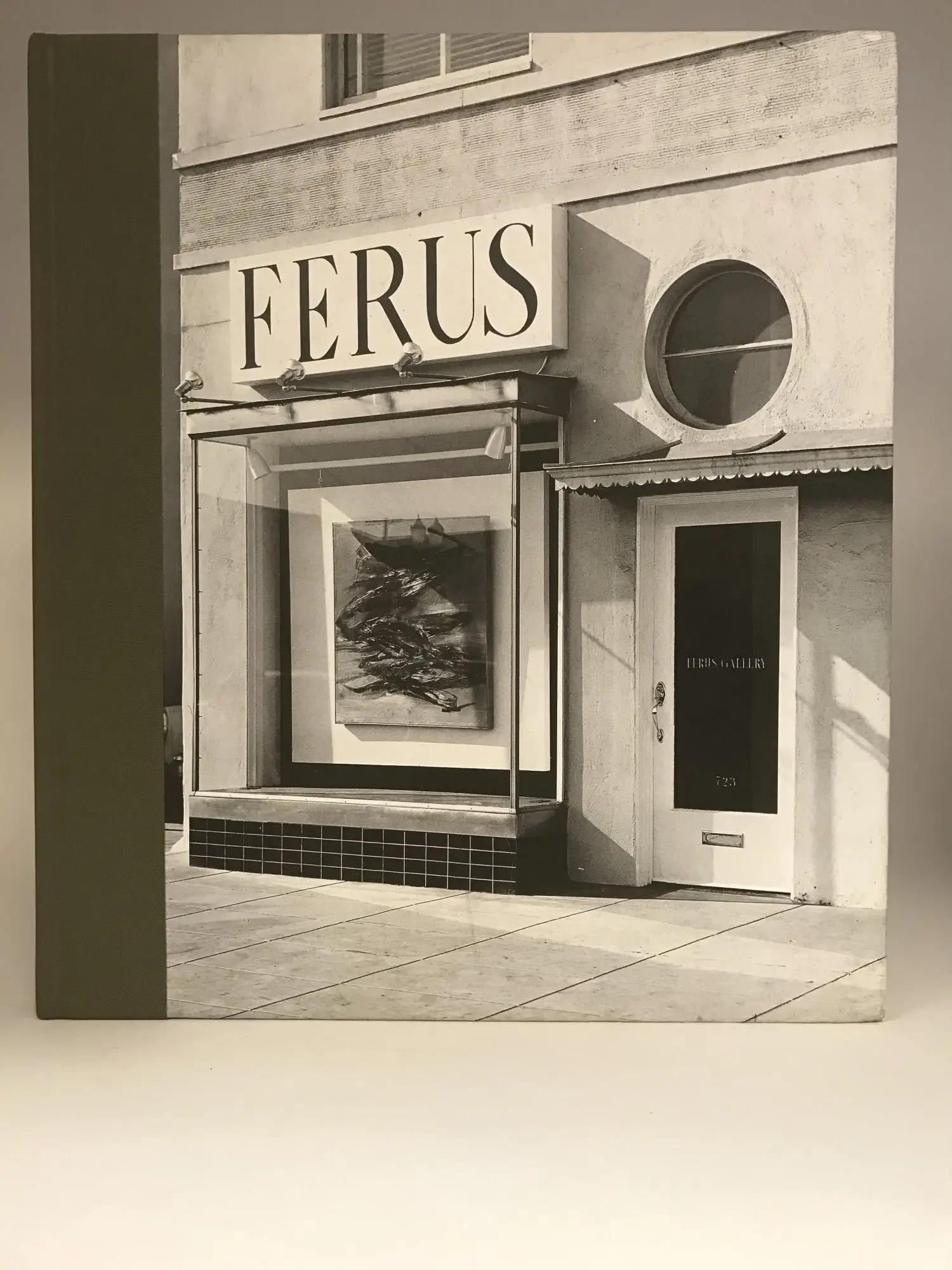
The historic Ferus Gallery storefront in Los Angeles, a pioneering space that helped shape the city’s postwar contemporary art movement.
huh
Pettibone’s route into this practice started in Los Angeles, not New York, and it started with a shock rather than a plan. Born in Alhambra, California in January 1938, he studied at the Otis Art Institute and earned his MFA there in 1962, the same year Andy Warhol showed his Campbell’s Soup Cans at the Ferus Gallery on La Cienega Boulevard, a show that scandalized as much of the LA art world as it electrified. Pettibone later called it the craziest show he had ever seen. Two years on, he made his first appropriations, shrinking Warhol’s soup cans down to under a foot across and even reproducing Warhol’s rubber stamped signature alongside his own.
By 1965 he had his first major exhibition, staged at that same Ferus Gallery where Warhol had shown. From there Pettibone kept working through the icons of the era, replicating paintings by Lichtenstein, Frank Stella, Jasper Johns, and Marcel Duchamp, whose Boîte en valise, a miniature portable museum of the artist’s own work, seems to have given Pettibone as much conceptual fuel as Warhol’s soup cans did. In 1969 the New York dealer Leo Castelli took him on, a relationship that would run for the rest of the artist’s life, more than five decades with a single gallery representing his work.
never
Appropriation art eventually became a recognized, even fashionable, category, associated later with figures like Sherrie Levine and Richard Prince, artists whose direct rephotographing of other people’s work was read as pointed critique, an argument about authorship and copyright pushed to a confrontational edge. Pettibone, who arrived at the practice earlier than most of them, got read differently. Critics and dealers alike have tended to describe his relationship to the source material as admiring rather than adversarial. He was not trying to embarrass Lichtenstein or diminish Picasso. He wanted, by his own account, to be a great painter, and reasoned that copying a great painting was as direct a route there as any.
That framing shows up consistently across how institutions have written about him. The Institute of Contemporary Art in Philadelphia organized his first full retrospective in 2005, built in collaboration with the Tang Teaching Museum at Skidmore College and the Laguna Art Museum in California, and when the New York Times reviewed it, critic Roberta Smith described Pettibone as a careful explorer of the simple love of art, someone whose work exposed the tangled mix of admiration and competition that drives artists to claim something as their own. That is a generous reading of a practice that, in less sympathetic hands, could easily be dismissed as mere reproduction.
Whether that generosity was fully earned is a fair question to leave open. Pettibone spent a career working other artists’ images without, as far as the record shows, facing the legal friction that appropriation art sometimes invites. Part of that is scale and material transformation, a seven inch hand fabricated object with its own miniature stretcher is not a photocopy. Part of it may simply be timing, arriving at the gesture before the market and the courts had fully worked out what appropriation art was going to mean.
industry
The secondary market has treated these small canvases with real seriousness. A Woman with Flowered Hat example moved through Phillips’ New York editions sale in October 2018, carrying a ten to fifteen thousand dollar estimate and closing at seventeen thousand five hundred. Three years later, another example in the same series went through Phillips again, this time estimated between twelve and eighteen thousand and selling for twenty thousand one hundred and sixty, a jump that tracks with the broader run up in appropriation art prices over that period. Bonhams has also brought examples to auction, and dealers including Guy Hepner and Surovek Gallery continue to list available examples from the edition on the primary and secondary market.
Pettibone’s institutional footprint runs well beyond the auction houses. His work sits in the permanent collections of the Museum of Modern Art, the Whitney Museum of American Art, the Museum of Contemporary Art Los Angeles, and the National Gallery in Washington, a spread that places a self described copyist inside the same institutional company as the artists he spent his career remaking.
away
Pettibone died on August 19, 2024, in Cobleskill, New York, at 86, following a fall. Castelli Gallery, which had represented him since 1969, confirmed the news. His last exhibition with the gallery, in 2022, presented fifteen new paintings reinterpreting Jasper Johns flag paintings through his familiar reduced scale treatment, an unwitting final statement from an artist still working the same central idea nearly six decades after he first tried it on Warhol’s soup cans.
He was survived by his daughter, bridal designer Claire Pettibone, and predeceased by his wife, the artist Shirley Pettibone, who had studied alongside him at Otis and died in 2011. The family had relocated from Brooklyn to upstate New York in 1970, the same year this particular Lichtenstein miniature was made, settling into a shh rural life that stood in some contrast to the West Coast gallery scene where his career had begun.
fin
What makes Woman with Flowered Hat, 1963, 1970 worth sitting with today is not simply the novelty of its scale or the neat symmetry of its title. It is a small, physical record of how images travel through artists, gaining and shedding meaning at every stop, Picasso’s grief stricken modernist portrait of Dora Maar becoming Lichtenstein’s cool, mechanical dot pattern, becoming Pettibone’s handmade miniature memorial to both of them. Each transformation kept faith with the last one’s surface while shh abandoning its stakes.
Pettibone never pretended the copies were anything other than copies, and that honesty is arguably the most radical thing about the work. In an art market that prizes originality as almost a moral category, he built a fifty year career on the opposite premise, that devotion, precision, and scale could themselves be a form of authorship. The tiny canvas does not ask to be mistaken for a Lichtenstein. It asks to be recognized as a Pettibone, made from the raw material of someone else’s masterpiece, which by 1970 was already made from the raw material of someone else’s.
n
From the DRIFT archive: The Art of the Can: Chaz Bojórquez’s Hand-Signed MTN Spray Paint Edition
Related Articles
Winter Ran Down A Plywood Panel In Gaeta
Cy Twombly, Untitled (Winter Picture), 2004. Acrylic on plywood in the artist’s frame. Gagosian, Madison […]