DRIFT AUDIO
Listen to this story
Choose a voice, then press play.
Alpha Industries shoots its Fall/Winter 2026 Ultra Violet collection across the Austrian Alps, anchoring a wider flight jacket lineup around the CWU-45.
Alpha Industries has released its Fall/Winter 2026 Ultra Violet collection, shot across the Austrian Alps. The brand’s own editorial notes describe the campaign as an exploration of elevation through space, light and perspective, a framing that shows up in the imagery itself: wide, sparse mountain landscapes standing in for any sense of movement or action, with the clothing photographed at a distance and the terrain given nearly as much attention as the garments. That same idea carries into the collection. Where past Ultra Violet drops have leaned on bold colourways and heavier branding, this one pulls back, favoring clean silhouettes and restrained tones that let texture and construction carry the visual weight instead.
Alpha frames Ultra Violet overall as the label’s premium, modern uniform line, inspired by military structure and rebuilt through higher end construction than its mainline archive pieces, describing the season as one visual system running across every silhouette rather than a set of unrelated releases. That description holds for FW26 specifically: every piece in the collection traces back to a real flight jacket or field jacket in Alpha’s own military history, but each has been reworked in a more considered material, whether that means aviation grade nylon, camouflage rendered in embroidery instead of print, quilting, or leather with a natural shearling collar.
It is also a departure in tone from how outerwear brands usually shoot a winter flight jacket collection. There is no snowboarding, no climbing, no obvious demonstration of the gear doing something active. The Alps function as scale and backdrop rather than a proving ground, putting the emphasis back on construction rather than on what the pieces can survive. That restraint extends to the palette too: where past Alpha collections have leaned on high contrast camouflage and bold branding, Ultra Violet FW26 stays largely tonal, working through silverblue, vintage green and a handful of neutrals instead.
Two individuals in puffy winter jackets standing on a snow-covered platform, framed against an industrial tower topped with bright orange spheres and a cloudy sky.
stir
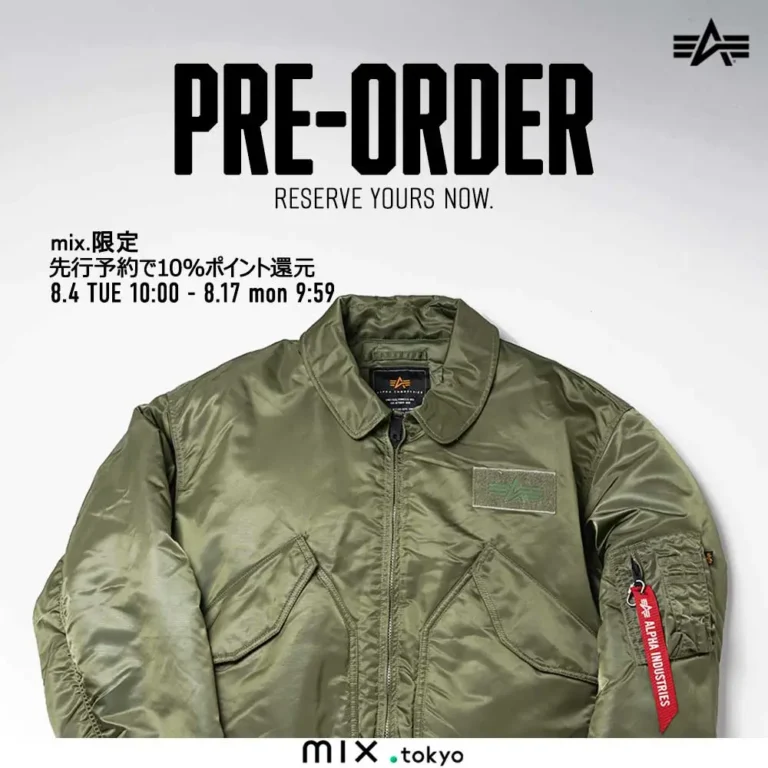
The CWU-45/P anchors the collection, and Alpha gives it three separate treatments for the season. The CWU-45/P Base UV Bomber Jacket sticks closest to the original, built in high end flight nylon and offered in a handful of tonal colourways including a silver blue and a vintage green, priced at 370 euros. The CWU-45/P Camo Embroidery UV Bomber Jacket takes the same shape and works camouflage into it through tonal embroidery rather than a printed pattern, so the camo pattern only fully reveals itself as the fabric catches light from different angles. That piece carries the collection’s highest price point, at 490 euros, reflecting the embroidery work involved. Rounding out the trio, the CWU-45/P Base Camo UV Bomber Jacket introduces a new camouflage colourway Alpha calls Snowdrift Woodland Camo, priced at 390 euros.
The CWU-45/P itself dates back to 1972, when the US military introduced it as a cold weather replacement for the MA-1 (the initials stand for Cold Weather Uniform), built to handle harsher conditions than its predecessor while remaining part of the standard issue flight uniform for Air Force and Navy pilots today. Alpha still produces military spec versions of the CWU-45/P in Nomex, a flame resistant fabric that also protects against chemicals and radiation, separate from the commercial versions it sells at retail. That history is part of why Alpha keeps returning to the silhouette as a testing ground for new materials and finishes each season, and Ultra Violet FW26 continues that pattern rather than introducing a new shape of its own. Style codes across the three FW26 versions stay close together, running 768005 for the Base, 768005C for the Base Camo, and 768009 for the Camo Embroidery, a naming convention Alpha uses consistently to group variants of the same silhouette across its Ultra Violet range.
View this post on Instagram
contour
Two further pieces extend the CWU family into new materials rather than new camouflage work. The CWU-36/P Leather distils the silhouette down into smooth black leather, stripping away the technical detailing of the nylon versions for a single, closer to minimal build. It was listed on Alpha’s own site as coming soon at the time of writing, without a confirmed price. The CWU-9/P Quilted Jacket takes the opposite approach, offering a lighter, more casual interpretation of the flight jacket shape in a quilted construction, available in Black, Silver Blue and Vintage Green according to Alpha’s own collection materials, though it had not yet appeared among the brand’s live product listings either.
The CWU-36/P has its own history worth noting alongside its CWU-45/P sibling. The two were developed together in the early 1970s as a matched pair, the CWU-45/P built for cold weather and the CWU-36/P designed as its warm weather counterpart, both eventually produced in flame resistant Nomex for military use alongside the standard commercial versions Alpha sells today. Seeing the CWU-36/P rendered in leather rather than its usual technical fabric is a more unusual move for the label, closer in spirit to what it has done with the CWU-45/P Camo Embroidery than to a straightforward reissue.
Between the two new pieces, they push the flight jacket idea toward opposite ends of the weight and construction spectrum rather than toward opposite ends of the color spectrum. The CWU-36/P Leather is heavier and more rigid by nature of its material, closer to a traditional leather jacket than to a technical shell. The CWU-9/P Quilted sits at the other extreme, favoring softness and light insulation over structure. Both stay inside Ultra Violet’s restrained tonal palette regardless, which keeps the range feeling like a single collection even as individual pieces reach for very different fabrications.
refine
Alongside the CWU family, the MA-1 Base Flight Jacket returns in classic flight nylon, priced from 210 euros depending on colourway. The MA-1 itself was standardized for Air Force and Navy pilots in the mid 1950s, built from a lighter nylon polyester blend that replaced the heavier leather jackets pilots had worn before it, and it remains the single most recognizable silhouette in Alpha’s catalogue. One detail from the MA-1’s own history stands out against Ultra Violet’s restrained approach to color: in 1960, the jacket’s lining was switched to a reversible Indian orange, so a downed pilot could turn the jacket inside out to signal for rescue against snow or water. Ultra Violet’s own MA-1 pieces stay tonal rather than referencing that high visibility detail directly, keeping the collection’s quieter palette intact even on its most historically loaded silhouette.
The N-2B Base reinforces the core outerwear offering alongside it, priced at 370 euros in colourways including vintage green, with a camouflage version in the new Snowdrift Woodland Camo running 390 euros. The N-2B traces back to the late 1950s, when it was developed to keep airmen warm at northern air bases in extreme cold, longer and heavier than the MA-1 by design. A further extended version, the N-3B, was built for aircrews facing even harsher conditions on troop transports and bombers, though that longer silhouette does not appear to be part of this particular Ultra Violet range.
The B-15 Leather goes further back than either of them. Finished with a natural shearling collar, it reinterprets one of Alpha’s earliest aviation icons: the original B-15 was first issued to Army and Air Force pilots in 1944, among the first nylon bomber jackets to replace the heavy leather flight gear that came before it, and it originally carried a fur collar before later revisions moved away from natural materials. The B-15 also sits at the root of several later Alpha silhouettes, having led directly to the L-2, L-2A and L-2B jackets that followed it, all of which kept its water repellent nylon shell and ribbed collar, hem and cuffs. Bringing shearling back onto a leather B-15 for Ultra Violet effectively reverses that old material logic, trading the jacket’s practical nylon legacy for the leather and fur construction it was designed to replace in the first place. As of this writing, the B-15 Leather had not yet appeared in Alpha’s own live product listings with a confirmed price or style code, though its presence in the FW26 Ultra Violet range checks out independently.
straddle
Beyond the jackets, Ultra Violet FW26 fills out with hoodies, T-shirts, vests, cargo pants, and a selection of bags, keeping the same restrained colour language as the outerwear rather than introducing a separate visual identity for the softer pieces. A vest version of the MA-1 Base sits inside that group as well, priced at 240 euros, giving the collection a sleeveless option built from the same base materials as the jackets around it. Alpha has not published extensive detail on the rest of this supporting range beyond confirming its presence in the collection, so specifics on individual hoodie or bag styles remain thin at the time of writing.
The bag category is the one place where the prior Ultra Violet season offers a useful point of comparison. Fall/Winter 2025’s edition of the line closed out with a Field Rucksack UV, Tote Bag UV, Weekend Bag UV and Travel Bag UV, spanning daily carry to travel pieces. Alpha has not confirmed whether FW26 repeats those exact names, but the pattern suggests this season’s bags likely cover similar ground.
View this post on Instagram
fin
The Ultra Violet Fall/Winter 2026 collection became available August 27, 2026, through alphaindustries.eu, Alpha’s own store in Frankfurt, and a set of retailers across Europe. Pricing across the confirmed pieces runs from 210 euros for the entry level MA-1 Base Flight Jacket up to 490 euros for the CWU-45/P Camo Embroidery, with most of the outerwear sitting between 370 and 390 euros. This is not Ultra Violet’s debut season either. Alpha introduced the line for Fall/Winter 2025 around the MA-1 ULCANS Flight Jacket, the MA-1 Base Flight Jacket and Vest, and the N-2B Base, and has since carried it through a Spring/Summer 2026 edition before arriving at this latest Fall/Winter chapter, which is why the brand describes the MA-1 Base Flight Jacket specifically as a piece that has shaped the Ultra Violet universe across recent seasons rather than a new addition to it.
That continuity sits on top of a company history that stretches back much further than Ultra Violet itself. Alpha Industries was founded by Samuel Gelber on October 17, 1959, in Knoxville, Tennessee, initially as a subcontractor producing outerwear for the US Department of Defense. The MA-1, CWU-45/P, N-2B and B-15 all began as genuine military issue designs before Alpha built its commercial business around them, and the company still identifies itself as an official US Defense Department contractor dating to that same 1959 founding.
Alpha kept manufacturing almost exclusively for the military through the 1960s before beginning commercial production in the 1970s, introducing its now familiar three bar logo specifically to separate consumer product from what it made for the Department of Defense. That commercial pivot proved decisive later on: as Cold War era defense budgets contracted and other military outfitters folded, Alpha’s early move into consumer retail let it keep operating while competitors shut down. The MA-1 in particular went on to a second life far from any airfield, adopted through the 1980s and 1990s by streetwear culture on both sides of the Pacific, including Japan’s Urahara scene and brands like Stussy, which built their own custom models on top of Alpha’s original nylon shape. Gelber led the company until his death, after which his son in law Alan Cirker took over and expanded its commercial business; today it is Michael Cirker, the third generation of the same family, who leads the company, which marked 50 years in business in 2009 and 60 in 2019 while keeping a small factory running in the same city where it started. Ultra Violet, in that context, reads less like a departure from Alpha’s military archive and more like the label applying nearly seven decades of that same archive to increasingly refined materials, one Austrian mountainside at a time.
Related Articles
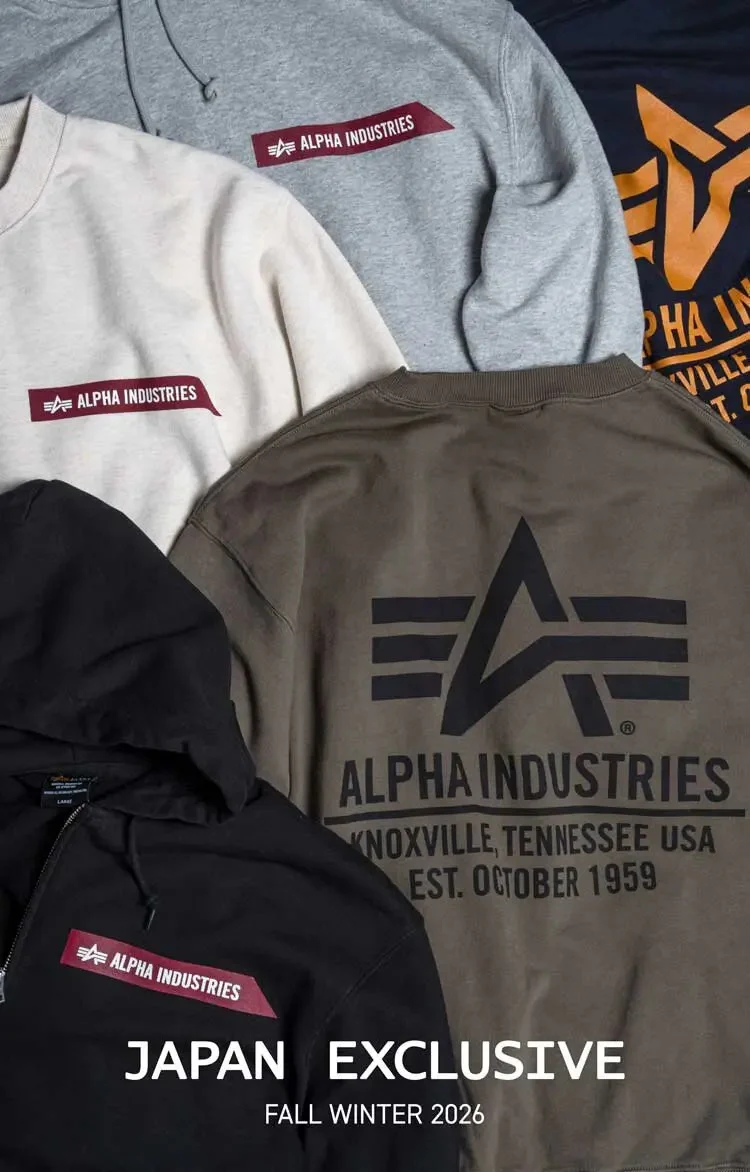
Alpha Industries Sorts Its Japan-Only Fall/Winter Line Into Four Fabric Stories
No flight jacket headlines it. Alpha Industries’ Japan-exclusive fall/winter release runs entirely on red ribbon, […]