DRIFT AUDIO
Listen to this story
Choose a voice, then press play.
In the vast and often chaotic landscape of contemporary art, few figures command attention quite like André Butzer. Born in Stuttgart, Germany, in 1973, Butzer has spent more than three decades forging a singular pictorial universe that bridges the raw emotional intensity of early European Expressionism with the bright, consumable imagery of American pop culture. His work oscillates between cartoonish exaggeration and profound existential inquiry, creating what he has termed “Science Fiction Expressionism.” This distinctive approach assembles the psychological depth of artists like Edvard Munch or Henri Matisse with the serial repetition and cultural immediacy of figures like Walt Disney and Andy Warhol.
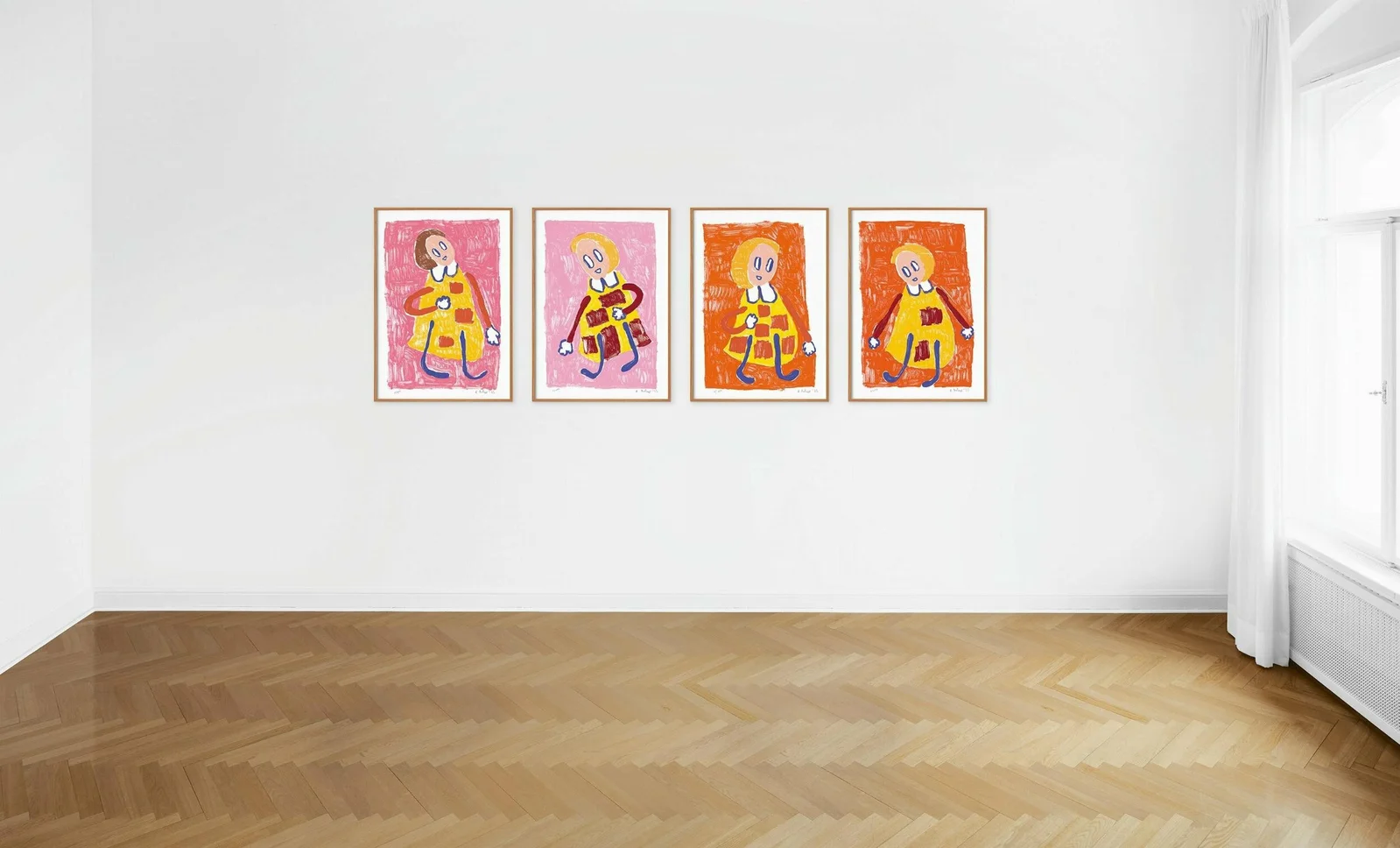
The Set of 4 Screen Prints Untitled I–IV (2022), published by TASCHEN in a strictly limited edition of 100 copies per print, stands as a luminous distillation of Butzer’s mature vision. Each print measures 100 x 70 cm and is executed as a six-color screen print on premium handmade Somerset cotton paper (300 g/m²). The entire process — from pigment mixing to hand-printing — was carried out with exceptional care, using CO₂-neutral and organic materials. Every impression is signed, numbered, and dated by the artist, underscoring the work’s status as both a high-quality print and a direct extension of his painterly practice.
oeuvre
At the center of this set lies Butzer’s iconic Woman figure, one of the most emotionally resonant motifs within his practice. Across his oeuvre, this figure functions as a guiding star — an embodiment of confident being, experienced living, and quiet benevolence. She reconciles vulnerability and strength, presence and absence, despair and hope. Within Untitled I–IV, she moves delicately through expansive fields of radiant color, appearing at once grounded and spectral.
Critics and the artist himself frequently describe her as existing “on the brink of this world and the beyond,” suspended between “vulnerable powerlessness and rigorous capability.” The figure carries echoes of archetypal femininity — maternal, spiritual, universal — while remaining unmistakably contemporary. In these screen prints, bold contours and luminous chromatic planes allow the Woman to emerge with remarkable clarity, as if the gesture of painting itself had only moments ago concluded.
The six-color process becomes essential to that sensation. Rather than flattening the imagery into graphic reproduction, the layered pigments generate depth and emotional atmosphere. Somerset paper contributes tactile warmth and subtle absorbency, softening the intensity of the pigments just enough to preserve a living quality. The result feels neither entirely printed nor entirely painted. Instead, the works occupy a charged space between reproduction and original gesture.
extent
Acknowledge these works also requires knowing Butzer’s broader conceptual terrain. His notion of “Science Fiction Expressionism” is not merely aesthetic branding. It is an attempt to reconcile radically different cultural inheritances: German philosophical idealism, postwar trauma, industrial modernity, American consumer optimism, and cartoon visual language.
Early in his career, Butzer gained recognition for grotesque, emotionally volatile figures that fused childlike forms with unsettling historical weight. Characters such as Friedens-Siemens embodied a world shaped simultaneously by industrial progress and catastrophic violence. His paintings referenced mass culture while interrogating the psychic residue left behind by the twentieth century.
This tension between innocence and devastation remains central to his work. Yet unlike many contemporary artists operating through irony or detachment, Butzer consistently pursues sincerity. His figures may appear exaggerated or absurd, but they are never emotionally vacant. Even at their most cartoonish, they carry traces of longing, grief, tenderness, and transcendence.
That emotional seriousness gives Untitled I–IV unusual gravity despite their apparent simplicity. The works radiate warmth and openness, yet beneath their luminous surfaces lies a persistent awareness of fragility. The Woman does not deny despair. She moves through it.
evolve
A crucial turning point in Butzer’s career arrived during his years living and working in California between 2018 and 2021. The environment dramatically altered his relationship to light, color, and spatial openness. After the dense darkness of his celebrated N-Paintings — near-monochromatic works that explored reduction to almost existential extremes — California introduced a renewed chromatic expansiveness.
The shift is palpable within Untitled I–IV. These prints feel sunlit without becoming naïve. Their color relationships evoke both West Coast brightness and the emotional directness of European modernism. Broad fields of yellow, pink, blue, and red seem to breathe rather than merely decorate. There is a looseness to the imagery that suggests outdoor painting, movement, and atmosphere.
At the same time, Butzer avoids purely decorative pleasure. The colors are psychologically charged. They function structurally and emotionally, creating tensions between stillness and motion, optimism and melancholy. Each print subtly alters the Woman’s posture, chromatic balance, and emotional register, generating a rhythm across the quartet that resembles visual music more than narrative illustration.
prag
Although Butzer is best known for monumental canvases, printmaking occupies an important role within his artistic philosophy. These screen prints demonstrate how editions can preserve intimacy and material integrity rather than dilute them.
Unlike mechanically detached reproductions, Untitled I–IV retains evidence of labor at every stage. Pigments were hand mixed. Screens were individually prepared. The works were printed manually onto handmade cotton paper. The process aligns directly with Butzer’s own resistance to overly rigid formalism. As he once remarked: “You shouldn’t make it crooked on purpose, but you shouldn’t make it straight on purpose, either.”
That statement encapsulates much of the emotional intelligence behind the edition. Perfection is not the goal. Presence is.
Printmaking also introduces a democratic dimension into Butzer’s practice. While his paintings command major institutional and market attention, editions create another mode of encounter — one rooted in repetition, circulation, and accessibility. Yet the limitation of only 100 sets preserves rarity and physical significance in an age increasingly dominated by infinite digital reproduction.
mat
One of the most compelling aspects of Untitled I–IV is how insistently material the works feel. In a contemporary environment saturated by screens, scrolling, and endlessly circulating imagery, these prints assert the value of physical encounter.
The texture of Somerset paper matters. The layering of pigment matters. The dimensions matter. Even the slight irregularities inherent in hand-pulled screen printing become part of the experience. The works demand duration rather than instant consumption.
This material emphasis positions the edition almost as a quiet act of resistance. While digital culture accelerates fragmentation and disposability, Butzer’s prints ask viewers to remain still. They reward repeated looking. Over time, small shifts in gesture, contour, and chromatic temperature reveal themselves gradually rather than immediately.
That slowness becomes deeply important within the emotional structure of the work. Hope, in Butzer’s universe, is never explosive or triumphant. It is persistent. Quiet. Repetitive. Maintained through attention.
show
The quartet format significantly shapes how the works function spatially. Displayed together, the prints create a cumulative environment in which repetition becomes transformation. Small formal changes between the images begin to generate emotional progression.
This serial logic connects Butzer not only to pop art traditions but also to spiritual and liturgical image systems. Repetition here is contemplative rather than commercial. Each image echoes the others while refusing exact duplication. The Woman becomes simultaneously singular and universal.
The scale — 100 x 70 cm — further intensifies that relationship. Large enough to command a room yet intimate enough for domestic viewing, the prints maintain a balance between monumentality and closeness. They can dominate contemporary interiors without losing emotional sensitivity.
Unframed presentation also allows collectors flexibility in shaping how the works interact with architectural space. Whether installed as a complete sequence or separated across rooms, the images maintain strong individual presence while gaining additional resonance collectively.
cont
Perhaps the most striking aspect of Butzer’s work today is its refusal of cynicism. In a cultural landscape often dominated by irony, emotional distancing, and conceptual coolness, his art insists on feeling. That insistence can appear almost radical.
The Woman figure within Untitled I–IV embodies that position completely. She is not merely symbolic. She becomes a carrier of human continuity itself — a figure capable of holding contradiction without collapsing beneath it.
Butzer’s art acknowledges catastrophe, alienation, industrialization, and cultural exhaustion. Yet it also maintains belief in painting’s ability to communicate tenderness, resilience, and transcendence. That balance between despair and affirmation gives the works unusual emotional durability.
Rather than retreating into nostalgia or abstraction, Butzer constructs a visual language where emotional directness and formal experimentation coexist. The prints therefore feel both historically grounded and strangely futuristic — suspended between twentieth-century memory and speculative possibility.
why
The enduring power of Untitled I–IV lies in its deceptive simplicity. At first glance, the works appear immediate and approachable. But sustained viewing reveals extraordinary complexity beneath the surface.
The prints synthesize major artistic traditions without becoming derivative. They reconcile expressionist emotion with pop clarity. They merge handmade intimacy with serial production. They move between humor and existential seriousness without collapsing into parody.
Most importantly, they maintain faith in art’s capacity to matter emotionally.
In an increasingly inhospitable world, Butzer’s Woman remains luminous. She walks through fields of color carrying both vulnerability and strength. Through six carefully layered pigments on handmade Somerset paper, Butzer reminds viewers that art can still function as both refuge and confrontation — a site where despair and hope coexist without cancellation.
That is what makes Untitled I–IV more than a collectible edition. It becomes an affirmation of painting itself: alive, unresolved, human, and necessary.
From the DRIFT archive: Andy Warhol’s Superman (1981): A Diamond-Dust Resurrection of the American Myth · The Art of the Can: Chaz Bojórquez’s Hand-Signed MTN Spray Paint Edition
Related Articles

Where the Face Should Be, Rafael Silveira Paints Open Sky
A pink shirt, shoulder-length hair, then no face at all: in “Surprise,” Rafael Silveira lets flowers and a clear blue sky stand in for the person.