DRIFT AUDIO
Listen to this story
Choose a voice, then press play.
Yves Klein remains one of the defining figures of postwar European art, not because of the length of his career, but because of the radical clarity of his view. Dead at only 34 years old, Klein transformed tincture, show, ritual, and even absence into artistic mediums. Few artists managed to compress so much conceptual force into such a brief period. His work continues to feel contemporary because it rejected static definitions of painting long before conceptual art became institutional language.
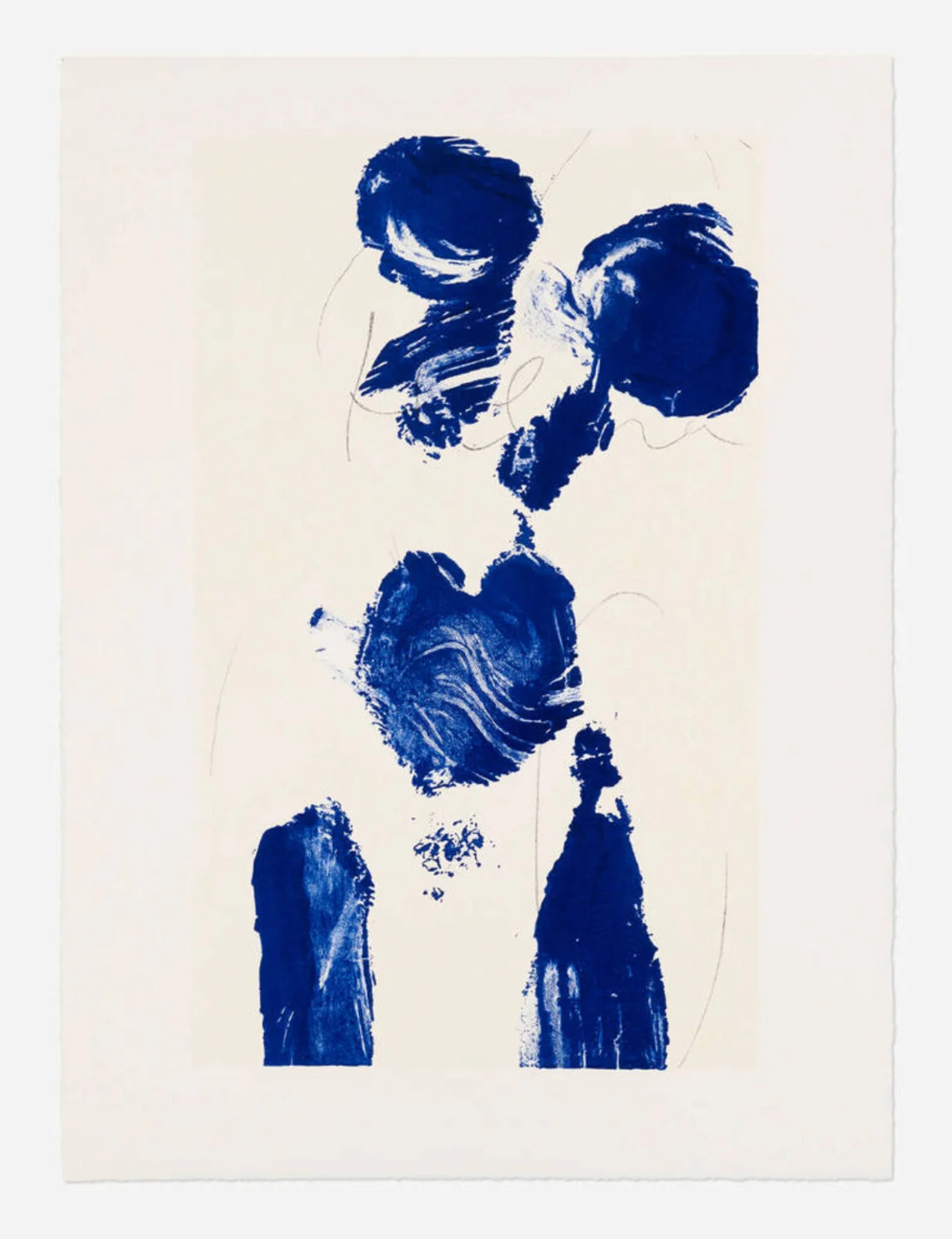
The 2004 lithograph Helena (ANT 61), derived from an original 1961 Anthropometry, represents one of the clearest condensations of Klein’s know. Measuring roughly 30 × 22 3/10 inches and issued in an edition of 150, the work reproduces one of Klein’s iconic body imprints in International Klein Blue, the patented ultramarine hue that became inseparable from his artistic identity.
More than a posthumous reproduction, Helena functions as an extension of Klein’s lifelong pursuit of immateriality. The image captures a female form pressed into blue pigment, leaving behind a trace that oscillates between figuration and abstraction. The body is present, yet absent. The gesture feels physical, but also ghostlike. In many ways, the work becomes less about anatomy than about energy, memory, and the residue of existence itself.
stir
Born in Nice in 1928 into a family of painters, Klein resisted conventional academic training. Instead, he gravitated toward philosophy, mysticism, and judo. His years in Japan, where he achieved a fourth-degree black belt, profoundly influenced the structure of his thought. Judo introduced Klein to concepts of emptiness, energy flow, and spatial balance, ideas that would later define his artistic experiments.
Unlike many painters of the era who remained committed to gesture and composition, Klein sought transcendence through reduction. His monochromes of the 1950s stripped away representation in favor of pure chromatic experience. Among all tinctures, ultramarine blue became his obsession. In 1960, he patented International Klein Blue (IKB), a matte, intensely saturated pigment designed to preserve luminosity rather than dulling under binder.
For Klein, blue symbolized infinity. It represented the sky, the sea, and the immeasurable beyond. He believed color could bypass rational interpretation and communicate directly with spiritual sensation. The viewer was not simply supposed to observe blue but immerse themselves within it.
This pursuit culminated in works like Le Vide (The Void), his 1958 exhibition at Galerie Iris Clert, where visitors entered an almost entirely empty gallery space. The gesture scandalized some audiences while astonishing others. Klein was effectively arguing that art did not need material density to exist. Presence itself could become artwork.
flow
The Anthropométries series, developed between roughly 1958 and 1961, remains Klein’s most iconic contribution to modern art. Rejecting brushes entirely, he transformed the human body into a living instrument. Nude female models, coated in IKB pigment, pressed themselves against canvases and paper under Klein’s direction. These performances often unfolded publicly, accompanied by his Monotone Symphony: a sustained single chord followed by prolonged silence.
The process fused painting, choreography, ritual, and theater. Klein described the models as “living brushes,” extensions of his artistic will. Yet the resulting works never feel entirely controlled. The pressure of skin, the movement of limbs, and the unpredictability of contact produce compositions that hover between intention and accident.
The imprints themselves occupy a fascinating view territory. They resemble prehistoric cave markings, religious relics, and modern abstractions simultaneously. Breasts, thighs, torsos, and gestures emerge through fields of electric blue, but the body is never fully stabilized into portraiture. Instead, it becomes evidence — a trace left behind by motion.
Helena belongs directly to this lineage. The composition appears elongated and fluid, suggesting a figure caught mid-motion. Arms and torso dissolve into saturated blue gradients while negative space surrounds the imprint like silence surrounding sound.
scope
One of the reasons Klein’s Anthropométries remain so compelling is that they resist singular interpretation. On one level, they are undeniably physical works. The body literally touched the surface. Yet they also feel spectral, as though the figure has already disappeared.
This paradox defines Helena. The work transforms corporeality into absence. The viewer sees not the woman herself, but the residue of her presence. Klein’s blue becomes a kind of metaphysical atmosphere around the body rather than mere pigment.
The image also anticipates later conceptual and performance practices. Artists such as Marina Abramović and Carolee Schneemann would later use the body as both medium and message, but Klein approached this territory earlier and through a distinctly spiritual framework.
At the same time, the Anthropométries remain controversial. Feminist critiques have long questioned the power dynamics embedded within the performances. Klein directed nude female models while positioning himself as orchestrator rather than participant. Critics argue this risks reducing women to instruments of male authorship.
Yet others contend the works transcend objectification through their abstraction. The bodies cease functioning as erotic spectacle and instead become carriers of energy, rhythm, and spatial consciousness. Helena, particularly, feels more contemplative than voyeuristic. Its softness and openness encourage meditation rather than consumption.
sig
No discussion of Helena can exist without acknowledging the overwhelming force of International Klein Blue itself. IKB is not merely color within Klein’s work; it is subject matter.
Unlike traditional ultramarine, Klein’s formula retained extraordinary saturation and matte depth. The pigment appears simultaneously flat and infinite, absorbing light while radiating intensity. In Helena, the blue silhouette seems to float against the white paper rather than sit upon it.
This chromatic strategy radically altered how viewers experience space. Instead of using perspective or illusionistic modeling, Klein used color as an immersive field. The body imprint becomes suspended within a cosmic atmosphere.
Blue, for Klein, was the closest view equivalent to immateriality. He associated it with the endlessness of the sky and the sea — spaces humans perceive as infinite precisely because they resist physical containment. Helena channels this know perfectly. The body is finite, but the blue surrounding it feels boundless.
qualify
Because Helena is a posthumous lithograph issued decades after Klein’s death, questions of authenticity naturally emerge. Can a work produced in 2004 still genuinely belong to Klein’s oeuvre?
Within the traditions of printmaking and conceptual art, the answer is largely yes. The edition was certified by the Yves Klein Archives and associated with Klein’s widow, Rotraut Klein-Moquay. More importantly, Klein himself consistently prioritized idea over handcrafted uniqueness. His practice already challenged conventional notions of authorship and material originality.
Lithography also proves especially appropriate for translating the Anthropométries. The medium preserves subtle tonal transitions, edges, and gradients, allowing the blue imprint to retain organic softness. Rather than flattening the image into mechanical reproduction, the print medium extends the tactile sensation of the original.
The posthumous edition therefore becomes conceptually aligned with Klein’s own thinking. If immateriality and reproducibility already existed within his philosophy, Helena functions less like a copy and more like a continuation.
straddle
Klein occupies a rare transitional position in art history. His monochromes anticipate minimalism, while his performances stages behind conceptual and body art. Helena encapsulates this intersection beautifully.
The work contains the purity associated with modernist abstraction, yet it also carries the performative residue central to later conceptual practices. The body imprint becomes documentation of an action, almost like a photographic trace.
Klein’s influence radiates across multiple generations. Artists concerned with light, voids, atmosphere, and perception — from James Turrell to Anish Kapoor — inherit aspects of his fascination with immaterial experience.
Yet Helena remains uniquely tied to its own historical moment as well. Created in the wake of World War II and amid the rapid modernization of Europe, Klein’s art reflects a culture hunger for transcendence beyond material devastation. His work sought spirituality without religion, ritual without institution, and infinity within modern life.
day
In the contemporary era, Helena acquires new meanings. We live within a world dominated by screens, viewed identities, and endless digital reproduction. The human body increasingly appears as image rather than physical presence.
Klein’s imprint feels strangely intimate in contrast. It records literal contact between skin and surface. The work insists upon embodiment while simultaneously transforming the body into abstraction.
That duality explains why Helena continues to resonate with collectors, curators, and younger audiences alike. The lithograph carries historical importance, but it also communicates emotionally. Its silence feels contemporary.
The work invites viewers to contemplate what remains after presence disappears. It turns the body into memory and tincture into atmosphere. Even decades after Klein’s death, the image still expands outward psychologically, filling the surrounding space with a sense of cosmic stillness.
impression
Helena (ANT 61) ultimately stands as more than a lithograph. It operates as a concentrated expression of Yves Klein’s entire worldview. Through a single blue imprint, the work addresses presence, absence, spirituality, show, and infinity all at once.
Klein believed art should transcend material limitations and “impregnate space” with sensibility. Helena achieves exactly that. The body dissolves into pure chromatic energy, leaving behind an image that feels suspended between flesh and void.
More than sixty years after the original Anthropometry, the work still refuses containment. Its blue continues to radiate beyond the paper itself, transforming silence into atmosphere and absence into something strangely alive.
From the DRIFT archive: Banksy’s Pulp Fiction (2004): Inside the Satire Behind an Iconic Screenprint · The Art of the Can: Chaz Bojórquez’s Hand-Signed MTN Spray Paint Edition
Related Articles

Where the Face Should Be, Rafael Silveira Paints Open Sky
A pink shirt, shoulder-length hair, then no face at all: in “Surprise,” Rafael Silveira lets flowers and a clear blue sky stand in for the person.