Andy Warhol’s Sixteen Jackies (1964): Repetition, Grief, and the Media Spectacle of Tragedy
DRIFT AUDIO
Listen to this story
Choose a voice, then press play.
serial
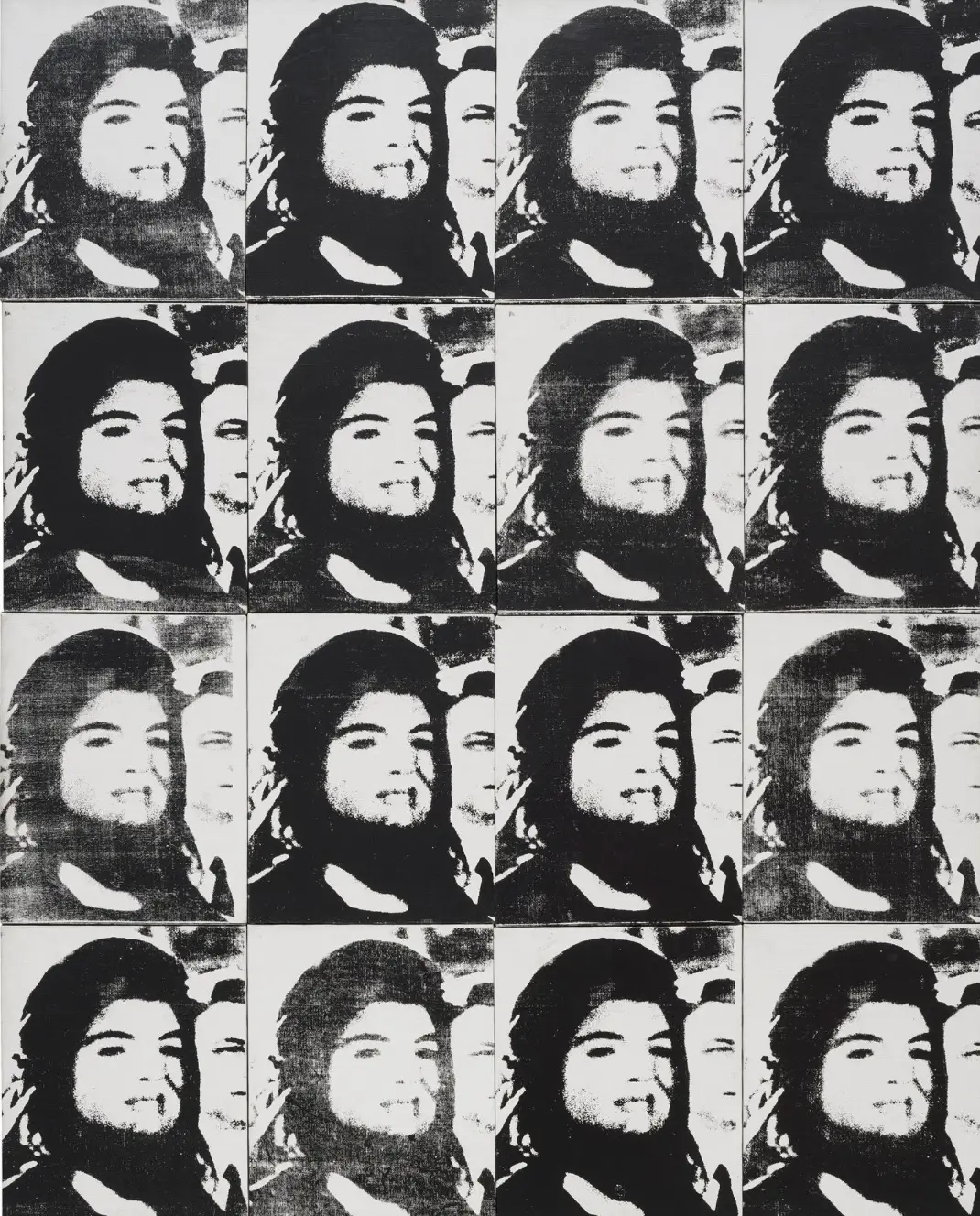
Andy Warhol’s Sixteen Jackies, created in 1964, stands as one of the most haunting and iconic works from his Death and Disaster series. Comprising sixteen joined canvases arranged in a 4×4 grid, each panel measuring approximately 20 x 16 inches (overall roughly 80 x 64 inches), the piece uses silkscreen ink on linen to repeat a single black-and-white image of Jacqueline Kennedy in mourning. The source photograph, taken by Henri Dauman during the funeral procession for President John F. Kennedy on November 25, 1963, captures Jackie veiled in dark organdy, her face stoic yet revealing profound private grief amid public spectacle.
This monumental work distills the national trauma of JFK’s assassination into a repetitive, almost mechanical visual mantra. By isolating and replicating the image of the grieving widow, Warhol transforms personal loss into a commentary on celebrity, media saturation, and collective desensitization. Unlike his tinctured celebrity portraits, such as the Marilyns or Lizes, Sixteen Jackies employs a stark monochromatic palette that echoes newspaper print, underscoring the raw, unvarnished dissemination of tragedy in mass media.
hx
To stay Sixteen Jackies, one must revisit November 22, 1963. President John F. Kennedy was assassinated in Dallas, Texas, an event broadcast live and replayed endlessly on television. The nation—and the world—watched as Jackie Kennedy, once the glamorous symbol of “Camelot,” stepped off Air Force One in a blood-stained pink Chanel suit, then appeared veiled and composed during the state funeral. Media coverage was unprecedented; networks suspended regular programming, and images of the veiled widow flooded newspapers and magazines.
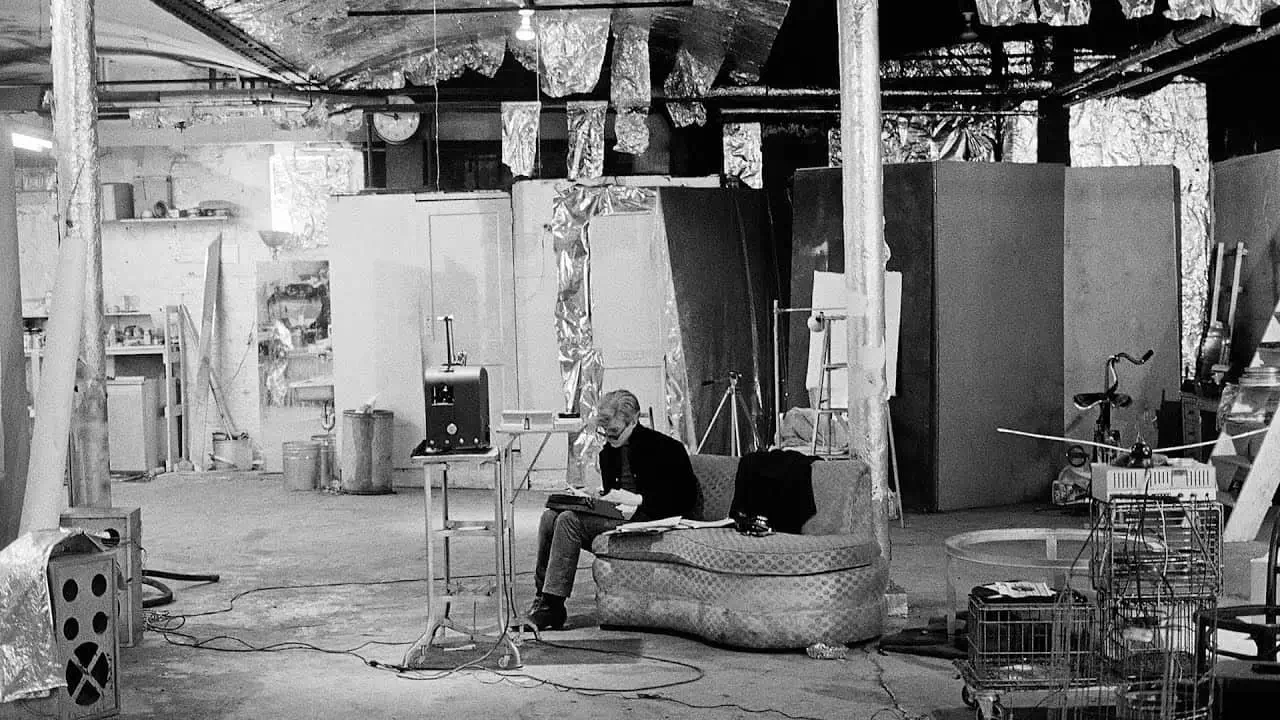
Andy Warhol, then emerging as a leading Pop artist, was deeply affected. According to studio assistant Gerard Malanga, upon hearing the news, Warhol’s immediate reaction was pragmatic: “Let’s go to work.” He and his circle, including poet John Giorno, watched the coverage intently. Warhol collected newspaper clippings and tabloid photos of Jackie, selecting eight key images for his broader Jackie series. These ranged from pre-assassination smiles to post-tragedy solemnity.
Warhol had transitioned from commercial illustration to fine art in the early 1960s. His early Pop works like Campbell’s Soup Cans (1962) celebrated consumer culture through repetition. By 1962–63, he adopted the silkscreen technique, allowing mechanical reproduction of photographic images onto canvas. This method introduced imperfections—smudges, misalignments, and fading—that mimicked the degradation of mass-printed media. Sixteen Jackies exemplifies this: the repeated image shows subtle variations in ink density, evoking the flickering of film frames or the wear of repeated newspaper exposure.
flow
The Death and Disaster series, which includes car crashes, electric chairs, and race riots, marked a darker turn in Warhol’s practice. Works like Orange Car Crash (1963) or Silver Liz confronted mortality head-on. Sixteen Jackies fits within this body of work but uniquely humanizes it through a recognizable celebrity figure. Jackie becomes both icon and everywoman, her grief commodified by the same media machine that Warhol simultaneously critiqued and embraced.
Visually, Sixteen Jackies is deceptively simple. The 4×4 grid creates a rhythmic pattern, inviting the eye to scan row by row, much like reading a contact sheet or watching a film strip. Each panel isolates Jackie’s face and veiled head from a procession photo. The black ink on a light ground creates sharp contrast, her features emerging almost ghost-like. The veil partially obscures her eyes, symbolizing the divide between public composure and private sorrow.
Warhol’s silkscreen process was collaborative and industrial, executed at his Factory studio. Assistants helped stretch canvases, mix inks, and pull squeegees. This democratized authorship, aligning with Warhol’s famous desire to “be a machine.” Yet despite the mechanical process, the work remains deeply expressive. Repetition here does not numb emotion—it amplifies it.
real
Art historian Hal Foster described Warhol’s repetitions as producing a form of “traumatic realism,” where images recur because they cannot be psychologically processed. Sixteen Jackies embodies that concept. The image returns again and again, as if replaying collective shock in real time.
Compared to other works in the Jackie sequence, Sixteen Jackies is singular in its monochromatic severity. Nine Jackies, for example, uses multiple source images and varied color backgrounds to convey emotional fluctuation. Sixteen Jackies, by contrast, remains locked into one image and one emotional register. Its repetition feels monolithic, meditative, and relentless.
The scale—over six feet tall—immerses the viewer physically. Standing before it means confronting not one Jackie but sixteen. The grid recalls Byzantine icons or Renaissance altarpieces, though secularized and mechanized through Pop Art. Warhol’s Catholic upbringing subtly echoes through this repetition, transforming Jackie into a contemporary saint of televised mourning.
show
Sixteen Jackies interrogates how mass media processes tragedy. In 1963, television brought the assassination into living rooms worldwide, creating one of the first truly shared media mourning rituals. Jackie herself orchestrated elements of the funeral procession—the riderless horse, the eternal flame, the solemn choreography—turning private grief into national theater.
Warhol captures that duality perfectly. Jackie’s image feels intimate because of the close crop, yet distant because of the veil and endless repetition. The work asks whether repeated exposure intensifies empathy or erodes it. Warhol’s answer remains intentionally ambiguous.
The piece also critiques celebrity culture. Jackie Kennedy, like Marilyn Monroe before her, became both a real woman and a constructed media image. Pre-assassination, she symbolized elegance, sophistication, and “Camelot” optimism. After Dallas, she became the image of dignified sorrow. Warhol collapses these distinctions, placing presidents, movie stars, widows, and consumer products within the same visual economy.
move
Feminist readings of Sixteen Jackies often emphasize the voyeuristic dimensions of public mourning. Jackie’s body, face, and emotional state became globally consumed imagery. The veil functions paradoxically: it protects her while simultaneously heightening fascination with her grief.
Warhol, who navigated identity and outsiderhood throughout his life, understood the tension between surface glamour and hidden pain. His portraits frequently reveal fragility beneath media polish. In Sixteen Jackies, vulnerability emerges not through expressive brushwork but through repetition itself.
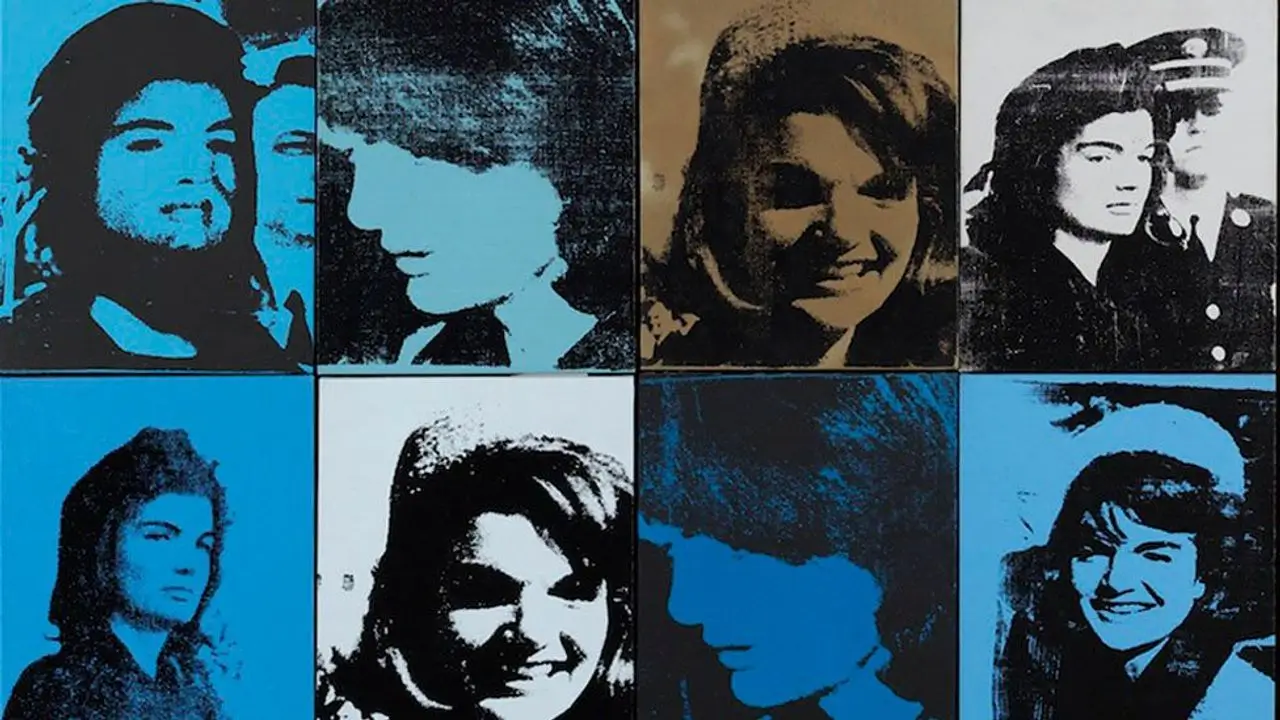
Jackie Kennedy: Andy Warhol’s pop saint
Each silkscreen variation carries tiny shifts in texture and density. Some faces appear darker, heavier, more obscured. Others feel faded and spectral. These imperfections humanize the mechanical process, creating emotional instability beneath the rigid structure.
leg
Upon its debut, the Jackie works helped cement Warhol’s reputation as more than a detached Pop provocateur. Critics recognized the emotional and cultural weight embedded within the repetition. Exhibitions like the 1965 ICA Philadelphia presentation elevated the series into a defining statement of postwar American art.
Auction history reflects its importance. Sixteen Jackies has sold for tens of millions of dollars, passing through prestigious collections and major institutions. Art historians frequently position it among the most significant works of Warhol’s career because it merges personal tragedy, celebrity culture, political history, and media critique into one unified visual language.
Its influence extends far beyond Pop Art. Later artists exploring mediated trauma, archival repetition, and photographic reproduction—from Gerhard Richter to contemporary digital collage artists—inherit Warhol’s strategies. The work also feels strikingly prophetic in the age of endless scrolling, viral catastrophe, and 24-hour news cycles.
endure
More than sixty years later, Sixteen Jackies remains painfully contemporary. Warhol understood that modern memory is shaped through repeated images. Tragedy becomes spectacle, spectacle becomes commodity, and commodity becomes mythology.
Yet despite its detachment, the work never entirely loses its humanity. Beneath the serial repetition lies a woman enduring unimaginable grief under relentless public observation. Warhol freezes that moment, then multiplies it until it becomes impossible to escape.
The result is not simply a Pop Art masterpiece, but a cultural mirror reflecting how societies consume sorrow, construct icons, and remember history through images.
From the DRIFT archive: Andy Warhol’s Cosmic Vision in ‘Moonwalk’
Related Articles

Where the Face Should Be, Rafael Silveira Paints Open Sky
A pink shirt, shoulder-length hair, then no face at all: in “Surprise,” Rafael Silveira lets flowers and a clear blue sky stand in for the person.