DRIFT AUDIO
Listen to this story
Choose a voice, then press play.
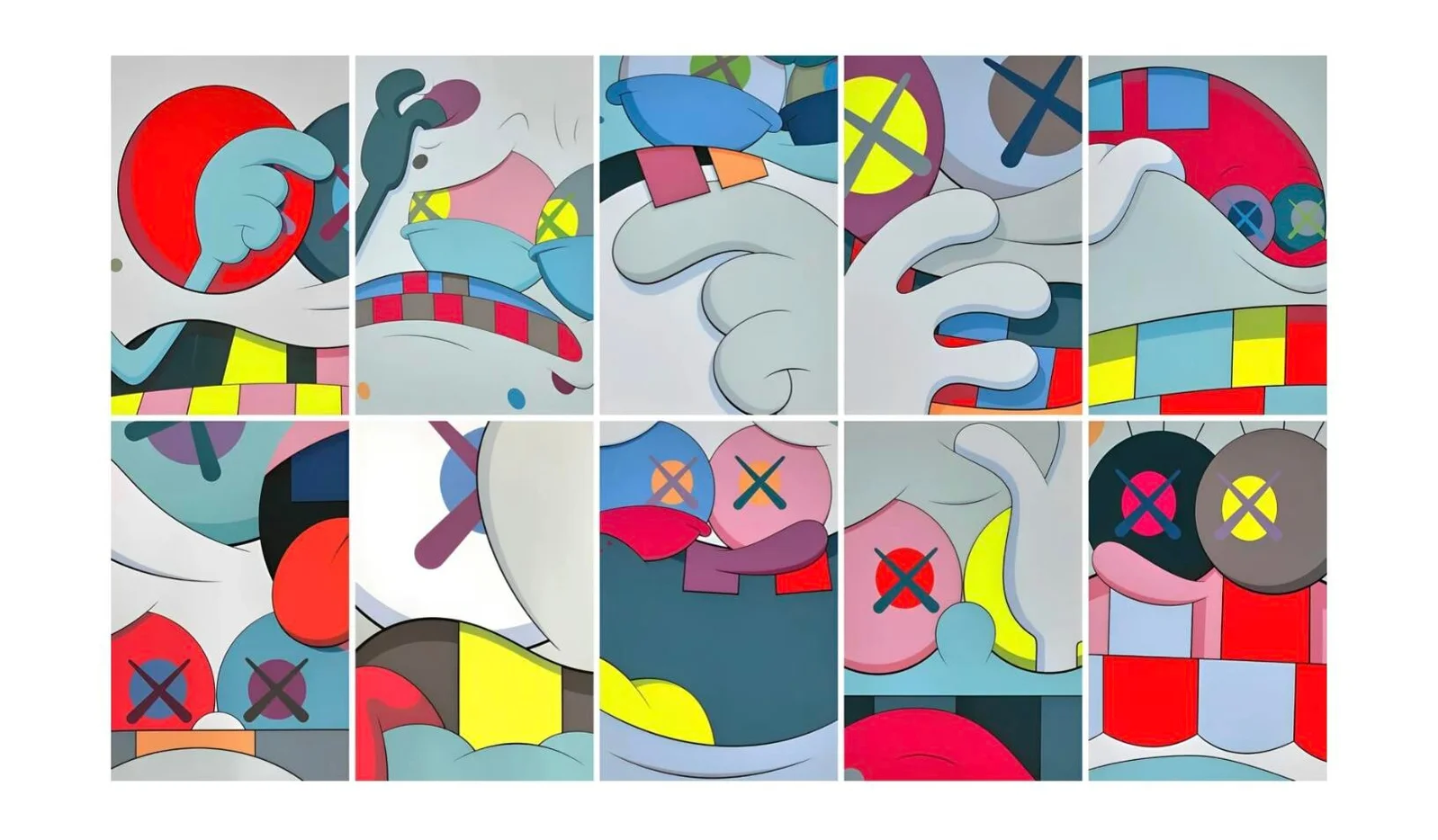
KAWS’s Blame Game (2014/2015) is a complete portfolio of 10 screenprints, issued in a limited edition of 100 alongside artist proofs and published by Pace Prints, New York. Each print measures approximately 35 × 23 inches (88.8 × 58.4 cm) on Saunders Waterford High White paper, with every work signed, dated, and numbered in pencil. The portfolio also includes a title page and cloth-covered presentation case, reinforcing its identity not merely as a print release, but as a unified collectible art object.
The series exemplifies the mature view lang of KAWS—born Brian Donnelly in 1974—through bold contour lines, flat color blocking, cartoon-derived abstraction, and the artist’s unmistakable “X”-ed-out eyes. Across the portfolio, viewers encounter tightly cropped facial fragments, hands, mouths, and emotional gestures extracted from unknown or imagined animated characters. Rather than presenting complete figures, Blame Game isolates emotional details, transforming familiar cartoon syntax into psychological portraiture.
stir
KAWS first emerged during the 1990s through street-level interventions that altered advertisements and billboards across New York, Paris, and Tokyo. By reworking commercial imagery directly within public space, he developed a view approach that fused graffiti culture, graphic design, animation, and consumer iconography into something immediately recognizable yet difficult to categorize.
Over time, that language transitioned seamlessly into galleries, museums, haute collisions, and auction houses without abandoning its accessibility. Blame Game sits within that trajectory: a body of work that feels rooted in pop culture while functioning fully within contemporary fine art discourse.
The influence of Pop Art is unmistakable. Andy Warhol’s experiments with repetition and screenprinting linger beneath the surface, while Keith Haring’s bold outlines and rhythmic motifs echo throughout the compositions. KAWS’s own background in animation—including freelance work connected to shows like Doug and Daria—also informs the clean graphic precision of the series. The works read instantly, but their emotional ambiguity complicates their apparent simplicity.
stance
What defines Blame Game most powerfully is fragmentation. Faces are incomplete. Eyes disappear into cropped edges. Hands obscure expressions. Mouths hover between cartoon exaggeration and emotional restraint. The viewer never receives a fully resolved identity.
That incompleteness becomes thematic.
The portfolio’s title suggests cycles of projection, emotional deflection, and fractured accountability. By presenting only portions of characters rather than full portraits, KAWS transforms cartoon familiarity into something uneasy and psychologically loaded. The figures appear shy, detached, vulnerable, or quietly melancholic despite the exaggerated graphic style.
This tension has always defined KAWS’s strongest work: the collision between coltish view lang and subtle emotional darkness. The “X”-eyes simultaneously flatten expression and intensify it. They function as symbols of anonymity, emotional exhaustion, mortality, or disconnection depending on the context.
Within Blame Game, those symbols feel less like branding devices and more like emotional punctuation.
tincture
The portfolio’s vibrant palette initially suggests optimism. Saturated blues, pinks, yellows, reds, and flesh tones create an approachable view field associated with cartoons, toys, and mass-media nostalgia. Yet the cropped compositions destabilize that comfort.
KAWS frequently uses color not merely decoratively, but psychologically. Bright hues lure the viewer inward before the fragmentation creates distance. The result is an emotional contradiction: approachable images that remain strangely inaccessible.
This dynamic mirrors broader contemporary life—hyper-view yet emotionally detached, endlessly expressive yet fragmented through screens, branding, and mediated identity. The characters feel simultaneously universal and unknowable.
Each individual print operates independently, but together the ten works accumulate into a modular emotional system. Installed as a complete portfolio, Blame Game becomes less about single images and more about repetition, rhythm, and emotional variation across similar forms.
evolve
As a complete edition of only 100, Blame Game occupies a particularly desirable position within KAWS’s print market. Individual works from the series regularly appear at auction, often achieving prices ranging from several thousand pounds to upwards of £12,000 depending on colorway, condition, and provenance. Complete portfolios command substantially stronger attention, with estimates and realized values often entering the £50,000–£70,000 range or beyond.
Collectors place significant emphasis on completeness. Original portfolio cases, title sheets, matching edition numbers, and strong condition reports dramatically affect valuation. Full portfolios become increasingly scarce over time as sets are broken apart and individual prints circulate independently.
The market strength surrounding KAWS extends beyond prints alone. Landmark sales—including The KAWS Album, which exceeded $14 million—solidified his transition from crossover phenomenon into fully institutionalized contemporary artist. Collaborations with brands such as Nike, Uniqlo, Dior, and Supreme further amplified visibility, creating a rare artist whose commercial convergences strengthened rather than diluted fine-art demand.
Museum recognition also reinforced this position, with exhibitions at institutions including MOCA Los Angeles and major international galleries confirming KAWS’s place within contemporary art history rather than merely collectible culture.
why
Collectors gravitate toward Blame Game for several interconnected reasons. Visually, the works possess immediate impact: large scale, bold color, and instantly identifiable imagery. Conceptually, the series captures KAWS at a mature phase where his vocabulary became increasingly distilled and emotionally precise.
The portfolio also represents the broader evolution of contemporary art itself. KAWS dissolves distinctions between street art and institutional art, between collectible object and emotional artifact, between mass culture and personal reflection.
What initially appears simple gradually reveals greater emotional complexity.
The cropped faces and disconnected gestures become metaphors for fragmented communication, mediated identity, and contemporary emotional distance. The portfolio rewards repeated viewing because its emotional tone constantly shifts—goofy one moment, melancholic the next, strangely intimate despite its flat graphic language.
fin
Blame Game ultimately succeeds because it compresses KAWS’s entire view know into a single cohesive body of work. It retains the accessibility of pop imagery while introducing vulnerability, ambiguity, and emotional fracture beneath the surface.
For collectors, the portfolio represents more than a desirable edition. It captures a defining period in KAWS’s practice: a moment where street-art origins, fine-art legitimacy, and global cultural saturation converged into one of the most recognizable visual languages in contemporary art.
What remains most compelling is how human the work feels despite its cartoon construction. Beneath the bright palettes and simplified forms, Blame Game quietly studies isolation, projection, emotion, and connection in the age of endless imagery.
From the DRIFT archive: The Art of the Can: Chaz Bojórquez’s Hand-Signed MTN Spray Paint Edition · Scott Listfield: The Astronaut in C.R.E.A.M. — Street Memory, Pop Iconography, and the Architecture of Nostalgia
Related Articles
Joël Andrianomearisoa Finds More Than One Black in a Square of Buttons
In La Guerre des Boutons I, a field of ordinary fasteners turns a modest textile […]