DRIFT AUDIO
Listen to this story
Choose a voice, then press play.
Banksy: The Enigmatic Artist
Before diving into “Trolleys (Colour),” it’s essential to understand the artist behind the work. Banksy emerged in the late1990s as a prominent figure in the street art scene. His identity remains shrouded in mystery, which adds to the allure and intrigue surrounding his works. Banksy’s art is characterized by its satirical nature, often critiquing societal norms, politics, and consumerism. His pieces are typically stenciled, allowing for quick execution and a distinctive visual style.
Context of “Trolleys (Colour)”
Created in2007, “Trolleys (Colour)” is a screenprint that reflects Banksy’s ongoing critique of modern society’s consumer culture. The mid-2000s were a period marked by rapid globalization, increased consumerism, and environmental concerns. These themes are central to Banksy’s work, and “Trolleys (Colour)” is no exception.
Visual Analysis
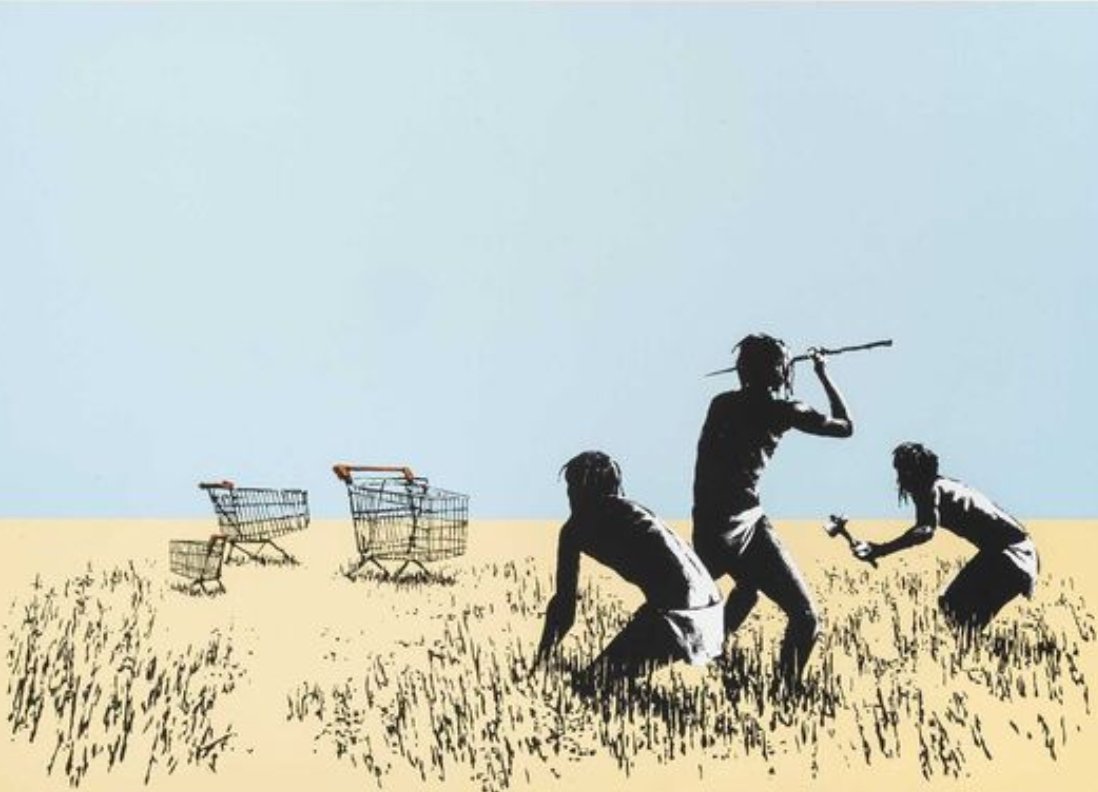
“Trolleys (Colour)” depicts a group of primitive hunter-gatherers, reminiscent of early humans, engaged in a futile attempt to hunt shopping carts with spears. The juxtaposition of these two elements—prehistoric figures and modern shopping trolleys—creates a striking visual and thematic contrast. The artwork is rendered in Banksy’s signature stencil style, with the addition of color to highlight the trolleys, drawing the viewer’s attention to the central theme of consumerism.
Consumerism and Materialism
At its core, “Trolleys (Colour)” is a critique of consumer culture. The shopping carts symbolize modern society’s obsession with consumption and material goods. By placing these symbols in the hands of hunter-gatherers, Banksy highlights the absurdity of equating survival with consumerism. The primitive figures, who historically relied on nature for sustenance, are now depicted as pursuing empty symbols of modern life, suggesting a loss of connection with the natural world.
Environmental Commentary
The artwork also comments on environmental degradation. The presence of shopping carts in a natural setting implies the encroachment of consumer culture on the environment. This encroachment leads to the depletion of natural resources and the prioritization of material goods over ecological balance. Banksy subtly critiques how consumerism contributes to environmental harm, urging viewers to reconsider their relationship with nature.
Irony and Satire
Banksy’s use of irony is evident in the depiction of hunter-gatherers, who traditionally hunted for survival, now hunting shopping carts. This absurd scenario satirizes the modern pursuit of material wealth, suggesting that society has replaced genuine needs with superficial desires. The humor in the piece serves to engage viewers, prompting them to reflect on their own consumption habits.
Historical Reflection
By referencing early human history, Banksy invites viewers to consider the evolution of human priorities. The artwork suggests that while technology and society have advanced, fundamental human behaviors remain unchanged. The pursuit of resources, once driven by necessity, is now driven by consumerism, raising questions about progress and its implications.
Impression and Reception
“Trolleys (Colour)” has been widely discussed and analyzed, contributing to Banksy’s reputation as a leading figure in contemporary art. The piece resonates with audiences due to its accessible imagery and thought-provoking themes. It has been exhibited in various galleries and continues to be a popular subject in discussions about art and consumerism.
Banksy’s work often sparks debate about the role of street art in society. “Trolleys (Colour)” exemplifies how street art can transcend traditional boundaries, engaging with social and political issues in a way that is both accessible and impactful. The artwork challenges viewers to question their own values and the societal structures that shape them.
Banksy’s Broader Influence
Banksy’s influence extends beyond individual artworks. He has played a significant role in legitimizing street art as a form of contemporary expression. His works often appear in unexpected locations, challenging the conventional art world’s norms and reaching a diverse audience. This democratization of art is a key aspect of Banksy’s legacy, encouraging other artists to explore social and political themes in their work.
Flow
Banksy’s “Trolleys (Colour)” is a powerful commentary on consumerism, environmental degradation, and the evolution of human priorities. Through the use of irony, satire, and striking visual contrasts, Banksy invites viewers to reflect on the absurdities of modern life. The artwork’s enduring relevance speaks to Banksy’s ability to capture the zeitgeist and provoke meaningful dialogue about the world we inhabit.
Read Drift’s related feature, Breaking Free: Banksy’s Barcode (2004) and Its Bold Critique of Consumerism.
Related Articles

Modigliani’s Limestone ‘Tête’
Carved from a single block of limestone in Montparnasse more than a century ago, one of Modigliani's rare stone heads goes to auction for the first time…