DRIFT AUDIO
Listen to this story
Choose a voice, then press play.
San Francisco’s honey bear artist is turning porch season into a scavenger hunt again, five years after he retired the pandemic-era original.
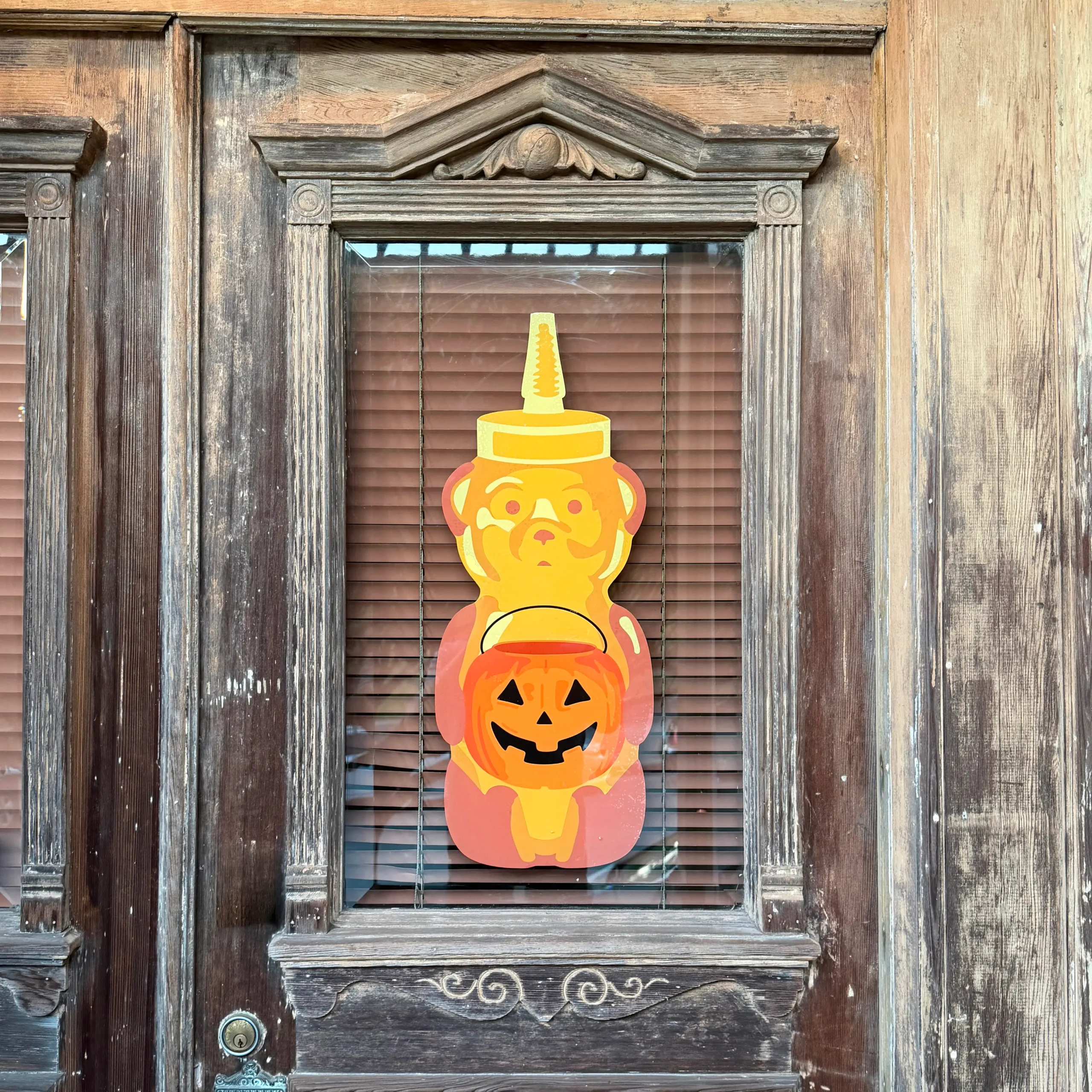
fnnch, the pseudonymous San Francisco street artist behind the city’s ubiquitous honey bear murals, has a new item in his shop, and it is built for exactly one week of the year. The Halloween Bear Window Cling is a $20 print of one of seven possible bear designs, produced as ink on premium white vinyl that sticks to glass without any adhesive at all. No tape, no static gel, no residue left behind when November arrives. Peel it off carefully and it can be stored flat for next year.
The selection process is part of the fun, and fnnch is upfront about it in his own listicle copy: buyers do not get to choose which of the seven bears they receive. Order more than one and every print in the order will be a different design, and an order of exactly seven bears comes with an eighth bonus print, a bear that was misprinted in the wrong size during production. The idea is less about owning a specific bear than about which ones show up in which windows up and down a block.
fnnch
The material is a genuine upgrade over the original run. fnnch’s own product listicle for earlier Hunt kits warned buyers outright that those prints would fade and were not built to last, since they were paper, disposable by design, and meant to be taken down carefully rather than kept up indefinitely. The new vinyl cling flips that instruction: fnnch now tells buyers the print can be removed without damage and stored safely for future Halloweens, which turns a one season decoration into something closer to an annual ornament.
That is the whole design brief: a decoration meant to be spotted by a neighbor on a walk, not a collectible to hide away. It is also, explicitly, a sequel. fnnch ran a Honey Bear Hunt once before, and this is his first attempt at bringing the format back since he shut it down in 2021.
stir
The original Honey Bear Hunt was a product of the earliest, strangest weeks of the pandemic. In April 2020, with much of San Francisco shuttered, fnnch began wheat pasting mask and soap themed honey bears onto boarded up businesses in the Castro, a response to a city that had suddenly gone quiet. Within the month the project had spread into other neighborhoods, and by May 2020 he had turned it into something buyers could take part in directly: a mail order kit containing a bear print to tape in a window, a sticker, and a small unsigned print as a thank you, priced at $18, which fnnch described at the time as close to his own cost.
The hunt part of the Honey Bear Hunt came from an opt-in map. Buyers who wanted to could have their general location added to a shared map, turning the whole city into a search for bears in strangers’ windows. It worked. By March 2021, fnnch had sold roughly 20,000 of the kits, and the project’s popularity helped push his charitable giving from around $12,000 in 2019 to more than $300,000 in 2020, funneled to local nonprofits including SF New Deal and a Bay Area COVID relief fund. Later variants followed the same format under different names, including a Vaccinated Bear tied to the vaccine rollout and a Ballet Bear that closed out the run.
flow
The map did not last. A note still attached to one of the old Hunt Kit listings on fnnch’s store reads plainly: after a year of maintaining it, he decided to stop. By his own account, he ended the original Honey Bear Hunt entirely in 2021, and has spent the years since looking for a way to bring the idea back that felt new rather than repeated.
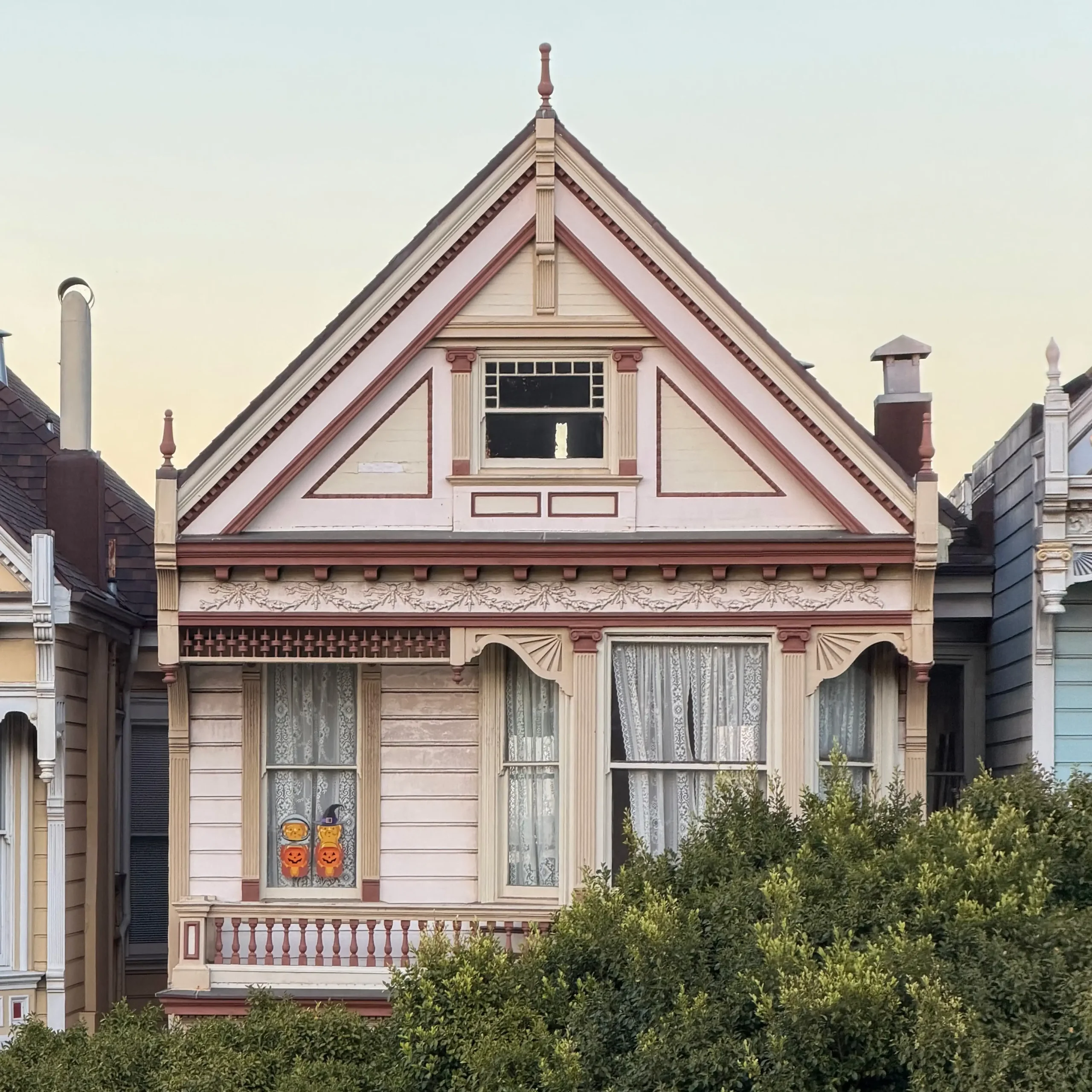
That stretch has not been quiet. fnnch’s honey bears have appeared at Burning Man for six consecutive years running, and in 2025 he opened the fnnch Museum, a year-long, free retrospective inside one of San Francisco’s Painted Ladies at Alamo Square, walking visitors through all 116 editions of the honey bear he had released since debuting the design in January 2015. He has kept releasing new bear variants steadily in the years since, from a Burner Bear built for the desert to seasonal, sports and pop culture themed editions sold through his own store. What he had not done again, until now, was bring back the specific mechanic that made the original Hunt work: a cheap, mass produced print meant to travel from his shop into other people’s windows.
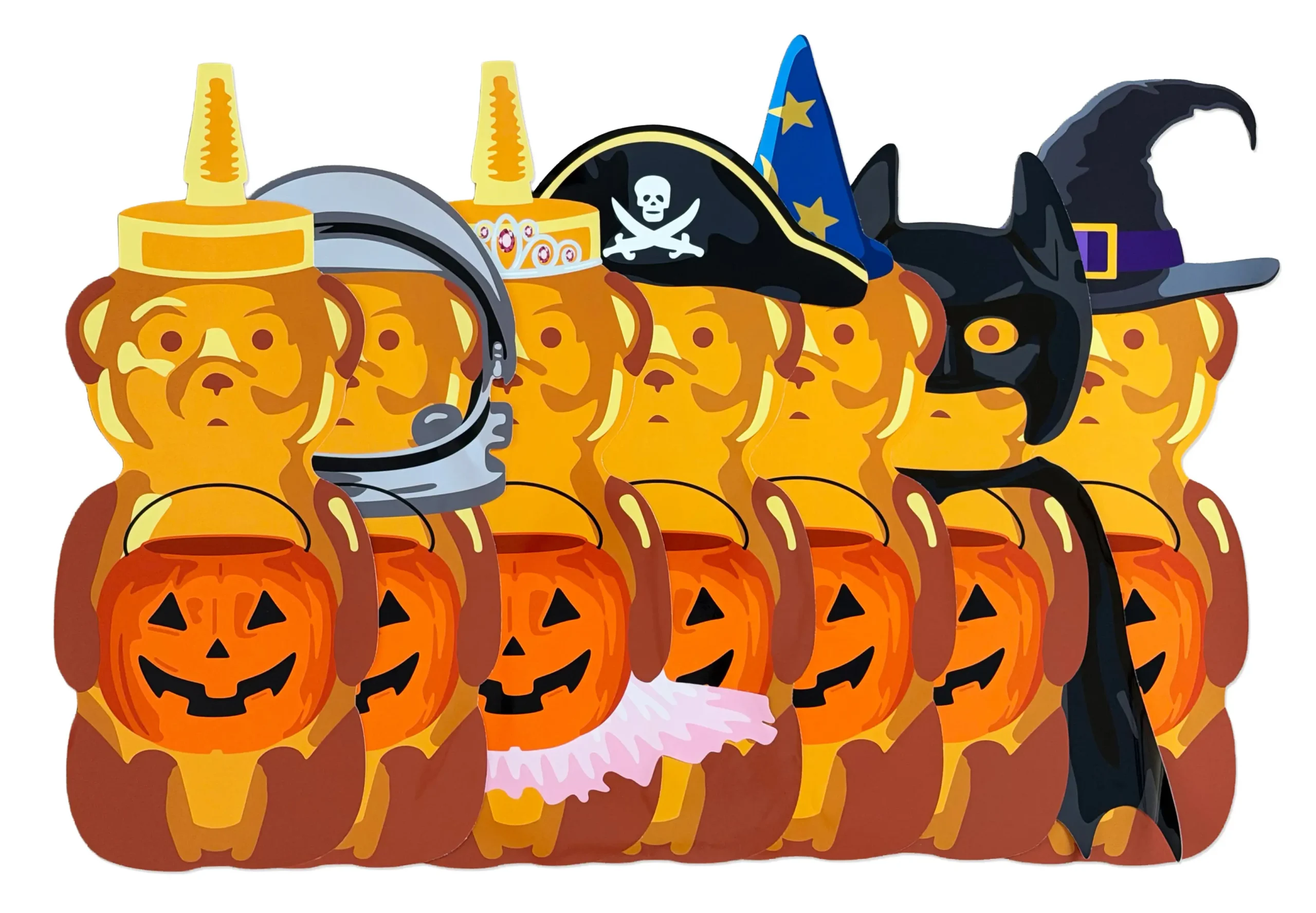
Halloween Honey Bear Costume Illustration
challenge
The honey bear’s popularity has never been unanimous, and a Halloween revival does not erase that history. By 2021, critics were describing the sheer volume of fnnch’s bears as oversaturating San Francisco’s streets. KQED’s arts desk ran a piece asking either the city had turned against the honey bears altogether, and a street artist quoted in that coverage argued the bear’s cute, homogeneous ubiquity had become a stand in for the same gentrification reshaping the city around it. A mural fnnch painted for the San Francisco LGBT Community Center, later reworked with a fellow artist after concerns that an earlier version’s imagery read as blackface, was ultimately painted over by the center that April as part of a routine mural rotation and in response to community complaints.
None of that dented the Honey Bear Hunt’s own reception, which tended to be judged on different terms: a low cost, opt-in project that gave isolated households something to do together, rather than another unsanctioned mural appearing on a wall that never asked for one. It is worth holding both readings at once heading into this relaunch. The same bear that some critics have called a symbol of a flattened, over marketed San Francisco is also the one credited with quietly organizing thousands of households into a shared neighborhood activity during the loneliest stretch of the pandemic.
nar
By his own telling, the push to revisit the Hunt came from home rather than from the shop. fnnch has said that although San Francisco famously goes all out for Halloween, he had never paid the tradition much attention himself until his toddler son became fixated on it last year, and the two of them spent mornings that October hunting for what the boy called scary decorations around their neighborhood. The new window cling series is, in his framing, an attempt to join that tradition rather than simply revive an old product line.
It is a fitting origin story for an artist whose whole body of work runs on the same instinct: take something small and domestic, in this case a plastic honey bottle shaped like a bear, and turn it into a shared, walkable experience. fnnch, who grew up in Kirkwood, Missouri and moved to the Bay Area in 2005 to attend Stanford University, graduating with degrees in economics and mathematics, settled in San Francisco in 2011 and began painting in public spaces under a pseudonym to shield his identity while working illegally on other people’s property. He has said he chose the honey bear specifically because it reads as universally positive: nostalgic, a little bit about childhood sugar cravings, and legible to basically anyone who passes it on a wall. That same legibility is presumably why it translates so easily to a Halloween decoration a five year old can spot from the sidewalk.
fnnch’s output has scaled well beyond honey bears alone since that first 2015 mailbox painting. His 2017 “9 Cans of LaCroix” series, nine canvases painted at the same dimensions Andy Warhol used for his Campbell’s soup cans, sold out its Mission District opening night and drew direct comparisons to Warhol in the San Francisco Chronicle and the Washington Post. By the end of 2020, the San Francisco Business Journal reported that fnnch’s company, Brambling LLC, had doubled its revenue over the previous year, itself a 50 percent increase over 2019, growth the outlet tied directly to the reach of the Honey Bear Hunt. He has described his own rationale for working in public rather than through galleries in blunt terms, pointing out that San Francisco’s biggest art museum draws a fraction of the visitors the city itself sees in a year, and that a wall reaches people a museum never will.
scope
fnnch’s pitch that San Francisco takes Halloween seriously is not an exaggeration, and it long predates his own window clings. Cole Valley’s Belvedere Street has closed itself to car traffic on Halloween night for decades, a tradition residents trace back to the 1970s, when neighbors asked police to shut the block down over speeding cars and simply kept doing it every year after. In Corona Heights, a house on Upper Terrace has built out an increasingly elaborate display of tombstones and figures for more than two decades, drawing crowds who treat it as a fixed stop on their route. Sea Cliff goes in a different direction entirely, with homeowners installing life sized recreations of Beetlejuice, Sally and Jack from The Nightmare Before Christmas, and other genre favorites across its blocks. Out in the Outer Richmond, Lake Street doubles as a designated Slow Street every October, giving families a car-free stretch to walk between houses stacked with spiders, pumpkins and ghosts, while a run of houses along Divisadero Street, including a longstanding display near Pacific Heights, has become its own regular stop on local best of Halloween lists.
View this post on Instagram
Notably, some of that decorating happens on fnnch’s own doorstep. Duboce Triangle, where he has lived since settling in the city, has its own Waller Street tradition, with houses along the stretch between Scott and Steiner strung with ghosts, spiders and stranger sights most Octobers. A honey bear cling in a Duboce Triangle window this year would not be an outlier so much as one more entry in a display the block already puts up on its own.
fin
The timing matters here. fnnch’s own account of the launch describes having several hundred window clings in hand and ready to ship within about a week, with a promise to run another batch through the same email list if the first sold out quickly. As of this writing, that first batch already has: the listing on his store now reads as a pre order for a second production run, with a stated goal of shipping in time for orders to arrive before October 15. It is a reasonable problem for a $20 seasonal print to have, and it suggests the appetite for a second Honey Bear Hunt has not diminished much since the last one.
Everything else about the drop is unchanged from fnnch’s original framing: seven designs in circulation, a randomized draw per order, a bonus eighth misprinted bear for anyone who buys a full set of seven, and no promise about which bear will land in which box. fnnch has said that if this batch also sells through quickly, he will plan a further run and announce it through his mailing list rather than his store alone. The bears are sold directly through store.fnnch.com, with no retail partner or wholesale distribution attached to this release.
Related Articles
Louise Bourgeois Turned a Handkerchief Into Her Own Confession
A cotton handkerchief stitched with one of Louise Bourgeois’ own lines has become one of […]